×
American Samoa🇦🇸 | 5 days itinerary

A Complete 5-Day Plan for American Samoa

By Johan Kruseman 🇳🇱 | Updated May 2, 2026
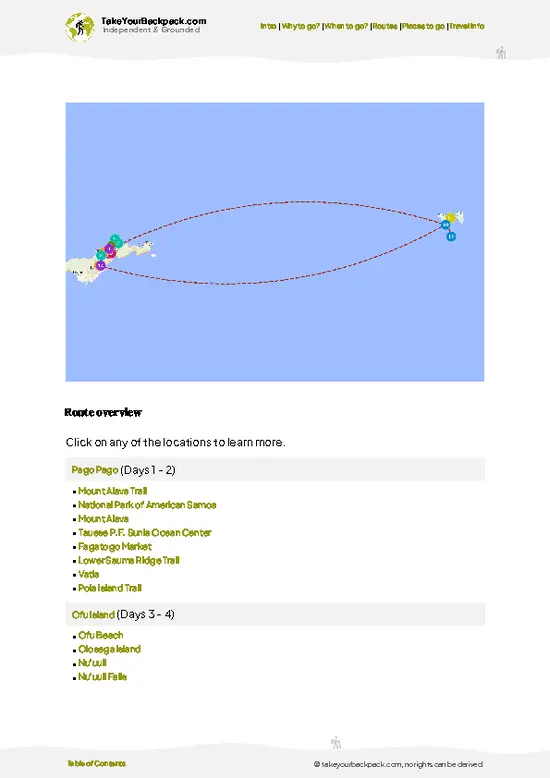
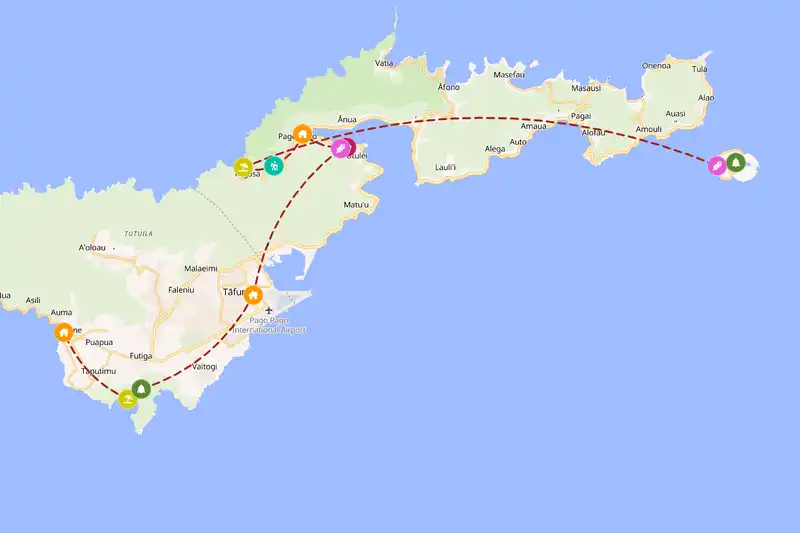
This 5-day itinerary is for travelers who want to go beyond the harbor and really feel American Samoa’s mix of high ridges, quiet villages, and outer islands, using taxis, local buses, and inter-island boats or small planes at an unhurried but adventure-forward pace. You’ll split time between Pago Pago on Tutuila and the Manu‘a Islands, trading city edges for reef-fringed beaches and high volcanic peaks.

Days 1-2: Pago Pago, Fagatogo & National Park ridges - Harbor base and big views

Use Pago Pago as your base for the first two nights, starting with a harbor walk and a visit to the Jean P. Haydon Museum to get your bearings on Samoan culture, colonial history, and the role of the US territory in the wider Pacific. Cross into Fagatogo to see the administrative core and dive into the Fagatogo Market, where you can snack your way through local produce and simple cooked dishes while watching the daily rhythm of commuters, schoolkids, and churchgoers. In the afternoon, step into the Tauese P.read more 👉
This 5-day itinerary is for travelers who want to go beyond the harbor and really feel American Samoa’s mix of high ridges, quiet villages, and outer islands, using taxis, local buses, and inter-island boats or small planes at an unhurried but adventure-forward pace. You’ll split time between Pago Pago on Tutuila and the Manu‘a Islands, trading city edges for reef-fringed beaches and high volcanic peaks.

Days 1-2: Pago Pago, Fagatogo & National Park ridges - Harbor base and big views

Use Pago Pago as your base for the first two nights, starting with a harbor walk and a visit to the Jean P. Haydon Museum to get your bearings on Samoan culture, colonial history, and the role of the US territory in the wider Pacific. Cross into Fagatogo to see the administrative core and dive into the Fagatogo Market, where you can snack your way through local produce and simple cooked dishes while watching the daily rhythm of commuters, schoolkids, and churchgoers. In the afternoon, step into the Tauese P.F. Sunia Ocean Center to understand the reefs and marine life that the National Park of American Samoa protects, then spend your evening along the waterfront before turning in early. On Day 2, head up into the park proper via the Mount Alava Trail, climbing through rainforest to the summit of Mount Alava for sweeping views over Pago Pago Harbor and the north coast, then continue along the ridge or descend toward the village of Vatia to feel how quickly you can move from harbor bustle to quiet bay. If you still have energy, add the short Lower Sauma Ridge Trail for another angle on the cliffs and sea stacks, then return to Pago Pago for a second night, tired in the best way.

Day 3: Leone, west Tutuila & Fagatele Bay - History and marine sanctuary

Shift your focus west on Day 3, driving out to the town of Leone, where churches, monuments, and village greens tell the story of missionaries, tsunamis, and the resilience of local communities. Continue along the coast toward the Le’ala Shoreline National Natural Landmark, where protected shoreline and wave-battered rock platforms show off the raw edge of Tutuila’s geology, then push on to the Fagatele Bay National Marine Sanctuary. Here, a steep access route leads down toward the protected waters of Fagatele Bay Beach, and you can spend your time hiking to viewpoints or, with proper arrangements and conditions, snorkeling in some of the healthiest coral in the territory. As the day winds down, loop back toward the central part of the island, stopping in Tafuna for a more suburban, everyday slice of life before returning to your accommodation for the night on Tutuila.

Days 4-5: Manu‘a Islands - Ofu, Olosega & Ta’u drama

On Day 4, trade Tutuila’s harbor for the outer islands by heading to the Manu‘a group, aiming first for Ofu Island, where life slows down and the road is more likely to be shared with pigs than cars. Spend your time along Ofu Beach, a long arc of pale sand and clear water backed by steep green ridges, where you can snorkel right off the shore and feel like you’ve stepped into a postcard that somehow never got mass tourism. If logistics allow, continue across the short bridge to Olosega Island for a walk and a different angle on the same reef system, then settle in for a quiet island night where the loudest sound is the surf. On Day 5, make a side trip to the village of Ta’u Island to feel the remoteness of the farthest-flung of the Manu‘a group, and, if you’re up for a serious adventure and have the right support, use your time to appreciate the looming presence of Lata Mountain, the highest point in American Samoa and a reminder of the islands’ volcanic origins. Wrap your final afternoon with a last swim or shoreline walk before making your way back toward Tutuila, carrying the contrast between harbor life and outer-island quiet with you as the real souvenir.

If you ever return with extra days and strong legs, seek out the rarely visited interior valleys of Olosega, where faint pig tracks and old plantation paths lead into a world that feels almost completely untouched by modern tourism.

Loading the map 🌍
film
0
0
0a
Pago Pago
Randolfo Santos
film
1
1
1a
Jean P. Haydon Museum
film
2
2
2a
Fagatogo Market
film
3
3
3a
of American Samoa
Sarah Gage-hunt
film
4
4
4a
Mount Alava Trail
Alexander Simo
film
5
5
5a
Lower Sauma Ridge Trail
Alexander Simo
film
6
6
6a
Le’ala Shoreline National Natural Landmark
film
7
7
7a
Fagatele Bay Beach
Dave Wiltzius
film
8
8
8a
Ofu Island
film
9
9
9a
Ofu Beach
Avichai Ben- Tzur
film
10
10
10a
Lata Mountain
Lim Joey (joey)

✈️ The backpacker research shortcutAmerican Samoa Travel Guide

An offline-friendly backpacking guide with optimized travel routes, ranked highlights, transport advice, and the best areas to stay.
example page 0 from our offline Travel Guide for American Samoaexample page 1 from our offline Travel Guide for American Samoaexample page 2 from our offline Travel Guide for American Samoaexample page 3 from our offline Travel Guide for American Samoaexample page 4 from our offline Travel Guide for American Samoaexample page 5 from our offline Travel Guide for American Samoa
The digital guide (143 pages) contains:
37 highlights, ranked by travel appeal
Optimized 2, 3 & 5-day travel routes
Best neighborhoods to stay
How to get around
Offline-friendly for travel without Wi-Fi
👉 See all 30+ guide features

📅 Plan smarter in minutes, not weeks
Month by month travel advice
Festivals & national holidays
Budget expectations

🗺️ Go to the right places, skip the overrated ones
Honest pros & cons of destinations
Top hikes, parks & viewpoints
Lesser-known places most travelers miss
Clear “worth it vs skip it” guidance

🛏️ Travel smoothly without rookie mistakes
Best areas to stay
Transport systems explained simply
Common scams & safety advice
SIM cards, money & practical tips

🌍 Understand the country, not just visit it
Culture & traditions
52 Essential phrases & customs
Festivals worth planning around
Traveler-friendly historical context
Insights that make places more meaningful

📱 Built for real travel conditions
Fully downloadable PDF
Works completely offline
Optimized for phone use
Useful in remote areas & buses
Everything in one place
Save weeks of stressful planning
Get instant access to the full guide directly. 30-day money-back guarantee.


Sent to your inbox immediately after payment • 100% Secure Checkout
Best Backpacking Travel Advisor 2025 tourism awardBest Backpacking
Travel Advisor
2025
What others say about Take Your Backpack Guides:
⭐⭐⭐⭐⭐
Fantastic, amazing amount of information!
⭐⭐⭐⭐⭐
My goodness this is amazing, it's what I've been looking for hats off too you!
⭐⭐⭐⭐⭐
I think this is absolutely BRILLIANT
⭐⭐⭐⭐
Very complete and informative. It's still missing places, but I gotta to commend you
⭐⭐⭐⭐⭐
This is truly amazing, thank you, can't wait to explore it with my kids!
⭐⭐⭐⭐⭐
Awesome resource, thank you!
⭐⭐⭐⭐⭐
This is amazing! Can't wait to explore the ones I haven't seen
⭐⭐⭐⭐
I love this! Well done, great idea.
⭐⭐⭐⭐⭐
Thanks for taking the time to make this gem!
⭐⭐⭐⭐⭐
This might be the best website I've ever seen.
⭐⭐⭐⭐⭐
Congratulations, and thank you so much for your work; it's incredibly valuable.
⭐⭐⭐⭐
In all seriousness I think you did a great job pointing out the important spots
⭐⭐⭐⭐⭐
10/10 very good
⭐⭐⭐⭐⭐
As someone who's only just starting to visit regularly this is awesome, thank you.
⭐⭐⭐⭐
Thank you very much! I'm going to visit my dad, it's going to be very useful!
⭐⭐⭐⭐⭐
This is really cool! We'll be travelling for the first time and this definitely come in handy.
⭐⭐⭐⭐⭐
You are now our minister of culture, congratulations 👨‍💼
⭐⭐⭐⭐⭐
Just wanted to tell you that this is a pearl! Going to follow your recommendations.
⭐⭐⭐⭐⭐
This is so cool. I'll definitely be using the resource for my travels soon.
⭐⭐⭐⭐⭐
This is very impressive! Good work.
⭐⭐⭐⭐⭐
This is an amazing and informative site. Very well done!

🧭 RouteAlternative Routes

Travel American Samoa your way — from a quick highlights trip to a slow-paced adventure.

🙋 FAQBackpacking FAQ

Short version: yes, you can backpack American Samoa independently, but it feels more like slow island living than classic hostel-hopping. There’s very little tourist infrastructure, which is exactly why it’s great if you like low-key, real-life travel and don’t mind figuring things out on the fly.

English is widely spoken, people are generally friendly and helpful, and crime against visitors is low if you use normal street sense. The main challenge is logistics: limited public transport hours, few budget accommodations, and almost no walkable “backpacker district.” You’ll be dealing with family-run guesthouses, homestays, and maybe basic hotels rather than dorms and party hostels.

For a budget traveler, the keys are: base yourself on Tutuila (near Pago Pago or Tafuna), use local buses during the day, and plan your hikes and village visits around bus schedules and daylight. Food is manageable on a budget if you eat where locals eat: small cafes, plate-lunch spots, and supermarket picnics instead of resort restaurants.

If you’re comfortable with island time, asking locals for help, and not having everything pre-booked online, independent backpacking here is very doable and very rewarding. If you need tight schedules, lots of options, and nightlife, it will feel frustrating and limited.
For most backpackers, 4–7 full days is the sweet spot for American Samoa.

If you’re on a tight Pacific itinerary and just want a taste, 3–4 days on Tutuila lets you: hike a couple of trails in the National Park, ride the buses along the coast, explore villages, and squeeze in a beach day. It’ll feel busy but not rushed.

If you want to actually slow down and get into the rhythm of the islands, aim for 7–10 days. That gives you time to:
- Spend several days hiking and swimming around Tutuila (Vatia, Pola Island viewpoints, Blunts Point, etc.).
- Take at least one side trip to Ofu/Olosega in the Manuʻa Islands if flights/boats line up and your budget allows.
- Have buffer days for weather, canceled transport, and just sitting by the water doing nothing.

Under 3 days is mostly a layover: you’ll see the harbor, maybe one hike, and that’s it. Over 10 days only makes sense if you’re really into slow travel, writing, or diving into local life, because there isn’t a huge list of “sights” – the value is in repetition and routine.
You can get around without a car on Tutuila, but you need to play by the rules of island time.

The backbone is the colorful aiga buses that run along the main coastal road between villages and the Tafuna/Pago Pago area. They’re cheap, fun, and very local. They don’t have fixed printed timetables, but they run most frequently during daylight on weekdays and less on Sundays and evenings. You pay in cash when you get off; keep small bills handy.

For a backpacker, this works well if you:
- Base yourself near the main road so you can flag buses easily.
- Plan hikes and beach visits that start and end near bus routes.
- Start early so you’re not stranded after dark when buses thin out.

Taxis exist but are pricey for a tight budget, so think of them as emergency backup or for airport runs. Hitchhiking is sometimes possible and often safe when done with normal caution, but you shouldn’t rely on it as your only plan.

On the outer Manuʻa islands, transport is much more limited. You’ll mostly walk around your village area, and any side trips usually require arranging a boat or ride through your guesthouse or local contacts. Without a car, you can still have a great trip, but you trade flexibility for savings and local immersion.
For a budget traveler, the must-visits are the places where you can trade money for time and sweat instead of big-ticket tours.

On Tutuila:
- National Park of American Samoa (Tutuila section): Hike the trails above Pago Pago and Vatia for big ocean views, rainforest, and coastal cliffs. The park is free; your only costs are transport and snacks.
- Vatia & Pola Island viewpoints: The village of Vatia and the lookouts toward Pola Island give you that wild, dramatic coastline feeling without needing a boat tour.
- Blunts Point / WWII gun placements: A short, sweaty hike with history and harbor views. Great value: no entry fee, just effort.
- The coastal bus ride: Simply riding the aiga buses along the main road is a must-do experience. It’s cheap, social, and gives you a rolling tour of daily life.

If your budget and timing allow a side trip:
- Ofu (Manuʻa Islands): This is the one place that genuinely deserves the global-level hype. The beach and lagoon here are world-class, with clear water and coral right off the sand. It’s not cheap to reach, but once you’re there, your days are basically free: swimming, snorkeling, walking, and staring at the water.

Beyond that, your “musts” are simple: at least one Sunday church service (for the music and community), a few local plate lunches, and unstructured time just sitting by the water watching the light change.
If you’re short on time or money, skip anything that eats a whole day without giving you a new angle on the islands.

You can skip:
- Chasing every viewpoint on Tutuila: Pick a couple of strong hikes (like one around Vatia and one near Pago Pago) instead of trying to tick off every lookout. The scenery has a theme; you don’t need all of it.
- Expensive resort-style meals: They’re fine, but they don’t add much to your understanding of the place. Stick to local cafes, bakeries, and supermarket picnics unless you really want one splurge night.
- Shopping and souvenir hunting: There isn’t a huge craft market scene compared to some Pacific islands, and most items are imported. If your time is tight, your hours are better spent outside.
- Over-ambitious multi-island hopping: If flights or boats to Manuʻa don’t line up easily with your dates and budget, don’t force it. A rushed 1–2 day dash to Ofu with stressful connections can feel like more hassle than reward. In that case, go deep on Tutuila instead of shallow on multiple islands.
- Trying to build a nightlife schedule: There are bars and kava spots, but this isn’t a big party destination. If you’re short on time, prioritize early mornings and daylight hikes over late nights.

Focus on a few strong experiences—one or two hikes, a village or two, time in the water, and a Sunday service—and let the rest go without guilt.

🇦🇸 American SamoaMore of American Samoa

Ready to build a truly unique trip? Predefined routes are perfect for first-time visitors, but there is so much more to discover. Whether you are chasing a city trip, pristine national parks, local food scenes, or quiet beaches, pick a category to design your own path.