×
Belgium🇧🇪 | 10 days itinerary

How to Spend 10 Days in Belgium

By Johan Kruseman 🇳🇱 | Updated May 8, 2026
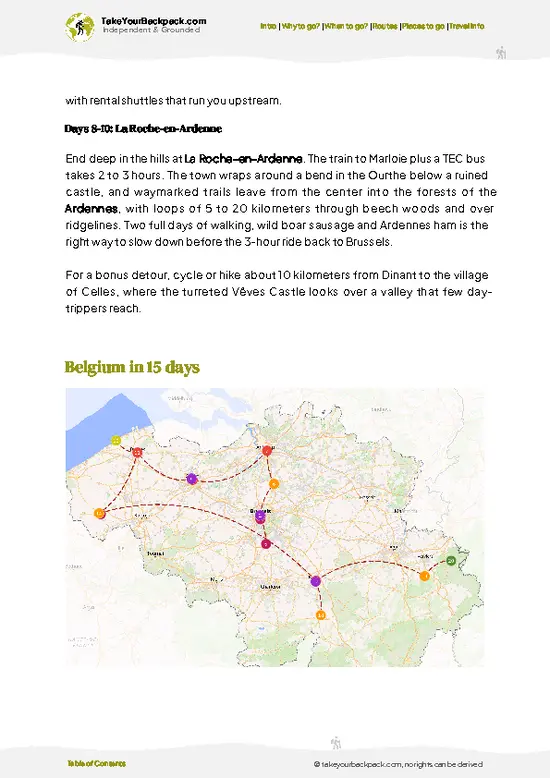
This 10-day itinerary is for travelers who want a balanced Belgium: big-city culture, medieval cores, and a meaningful dive into history, all by train with a moderate, not manic, pace. You’ll loop from Brussels through Flanders and the coast, then finish with a powerful World War I chapter before circling back.

Days 1-3: Brussels culture, art, and icons

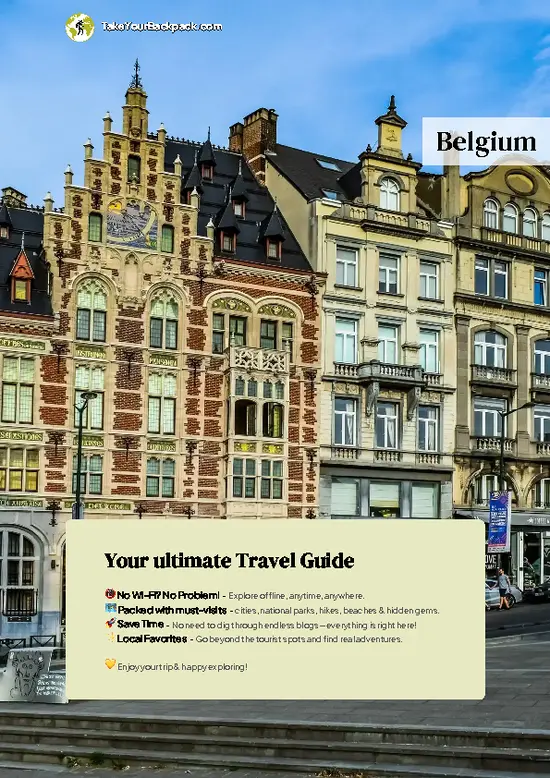
Start with three nights in Brussels so you’re not rushing between museums and monuments. Use your first afternoon to walk straight into Grand Place Brussels / La Grand-Place, Brussels, then wander the nearby streets and check off the quirky Manneken Pis as a light-hearted intro. Over the next two days, dig into the city’s brains: spend a half-day at the Royal Museums of Fine Arts of Belgium for old masters and modern works, then another at the Magritte Museum to get inside Belgium’s surrealist headspace. When you need air, ride the metro or tram out to the Atomium, where the retro-futurist spheres and elevated views remind you that Brussels … read more 👉
This 10-day itinerary is for travelers who want a balanced Belgium: big-city culture, medieval cores, and a meaningful dive into history, all by train with a moderate, not manic, pace. You’ll loop from Brussels through Flanders and the coast, then finish with a powerful World War I chapter before circling back.

Days 1-3: Brussels culture, art, and icons

Start with three nights in Brussels so you’re not rushing between museums and monuments. Use your first afternoon to walk straight into Grand Place Brussels / La Grand-Place, Brussels, then wander the nearby streets and check off the quirky Manneken Pis as a light-hearted intro. Over the next two days, dig into the city’s brains: spend a half-day at the Royal Museums of Fine Arts of Belgium for old masters and modern works, then another at the Magritte Museum to get inside Belgium’s surrealist headspace. When you need air, ride the metro or tram out to the Atomium, where the retro-futurist spheres and elevated views remind you that Brussels is more than just old stone and EU offices.

Days 4-5: Ghent’s castle and character

Next, take a short train to Ghent and give it two nights so you can feel the city beyond a day-trip blur. Anchor your first day around the Gravensteen Castle, exploring its chunky walls and city views before wandering into Ghent’s Patershol, a tight-knit quarter of narrow lanes and low houses that feels like a medieval village tucked inside a modern city. On your second day, slow down: walk the riverside quays, dip into cafés, and enjoy how Ghent’s student population keeps the place buzzing without turning it into a theme park.

Days 6-7: Bruges canals and coastal air

From Ghent, it’s a quick hop to Bruges, where two nights give you time to enjoy the city early and late, when it’s at its best. Climb the Belfry of Bruges early one morning, then spend the rest of the day drifting between canals, quiet side streets, and chocolate shops. On your second day, take advantage of the easy coastal access and ride out to Knokke-Heist, where the North Sea, long beach, and nearby Zwin Nature Park offer a breezy reset from city sightseeing before you return to Bruges for the evening.

Days 8-9: Ypres and the Flanders Fields

Shift gears with two nights in Ypres, a small town that carries a heavy World War I story. Dedicate a full day to the In Flanders Fields Museum, which does a powerful job of turning names and dates into human stories, then walk some of the nearby cemeteries and memorials to connect the dots on the landscape itself. In the evening, attend the Last Post ceremony at the Menin Gate (time it so you’re in town that night), letting the bugles and silence sink in after everything you’ve seen during the day.

Day 10: Coastal pause at Oostende and return to Brussels

On your final day, route yourself via the coast for one last change of scenery by stopping in Oostende. Spend a few lazy hours walking the promenade, grabbing seafood, or just sitting on the sand watching the North Sea before catching an afternoon or evening train back to Brussels for your departure. This gentle coastal finale keeps the trip from ending on a purely somber note and gives you a last, salty snapshot of Belgium beyond its city squares.

The moment that sticks with me from this route is stepping out of the In Flanders Fields Museum into the quiet streets of Ypres and realizing how much history you’ve just walked through in a single small town.
Loading the map 🌍
film
0
0
0a
Brussels
Anurag Mukherjee
film
1
1
1a
Grand Place Brussels
film
2
2
2a
La Grand-Place, Brussels
Photos Are Copyrighted By Their Owners
film
3
3
3a
Royal Museums of Fine Arts of Belgium
Pixabay
film
4
4
4a
Magritte Museum
film
5
5
5a
Atomium
film
6
6
6a
Ghent
Pixabay
film
7
7
7a
Gravensteen Castle
film
8
8
8a
Ghent’s Patershol
film
9
9
9a
Bruges
Pixabay
film
10
10
10a
Belfry of Bruges
film
11
11
11a
Knokke-Heist
film
12
12
12a
Zwin Nature Park
Zwin Natuur Park
film
13
13
13a
Ypres
film
14
14
14a
In Flanders Fields Museum
film
15
15
15a
Oostende
Fredo Jung

🛏️ Where to stay?The Route Breakdown

✈️ The backpacker research shortcutBelgium Travel Guide

An offline-friendly backpacking guide with optimized travel routes, ranked highlights, transport advice, and the best areas to stay.
example page 0 from our offline Travel Guide for Belgiumexample page 1 from our offline Travel Guide for Belgiumexample page 2 from our offline Travel Guide for Belgiumexample page 3 from our offline Travel Guide for Belgiumexample page 4 from our offline Travel Guide for Belgiumexample page 5 from our offline Travel Guide for Belgium
The digital guide (304 pages) contains:
90 highlights, ranked by travel appeal
Optimized 5, 10 & 15-day travel routes
Best neighborhoods to stay
How to get around
Offline-friendly for travel without Wi-Fi
👉 See all 30+ guide features

📅 Plan smarter in minutes, not weeks
Month by month travel advice
Festivals & national holidays
Budget expectations

🗺️ Go to the right places, skip the overrated ones
Honest pros & cons of destinations
Top hikes, parks & viewpoints
Lesser-known places most travelers miss
Clear “worth it vs skip it” guidance

🛏️ Travel smoothly without rookie mistakes
Best areas to stay
Transport systems explained simply
Common scams & safety advice
SIM cards, money & practical tips

🌍 Understand the country, not just visit it
Culture & traditions
52 Essential phrases & customs
Festivals worth planning around
Traveler-friendly historical context
Insights that make places more meaningful

📱 Built for real travel conditions
Fully downloadable PDF
Works completely offline
Optimized for phone use
Useful in remote areas & buses
Everything in one place
Save weeks of stressful planning
Get instant access to the full guide directly. 30-day money-back guarantee.


Sent to your inbox immediately after payment • 100% Secure Checkout
Best Backpacking Travel Advisor 2025 tourism awardBest Backpacking
Travel Advisor
2025
What others say about Take Your Backpack Guides:
⭐⭐⭐⭐⭐
Fantastic, amazing amount of information!
⭐⭐⭐⭐⭐
My goodness this is amazing, it's what I've been looking for hats off too you!
⭐⭐⭐⭐⭐
I think this is absolutely BRILLIANT
⭐⭐⭐⭐
Very complete and informative. It's still missing places, but I gotta to commend you
⭐⭐⭐⭐⭐
This is truly amazing, thank you, can't wait to explore it with my kids!
⭐⭐⭐⭐⭐
Awesome resource, thank you!
⭐⭐⭐⭐⭐
This is amazing! Can't wait to explore the ones I haven't seen
⭐⭐⭐⭐
I love this! Well done, great idea.
⭐⭐⭐⭐⭐
Thanks for taking the time to make this gem!
⭐⭐⭐⭐⭐
This might be the best website I've ever seen.
⭐⭐⭐⭐⭐
Congratulations, and thank you so much for your work; it's incredibly valuable.
⭐⭐⭐⭐
In all seriousness I think you did a great job pointing out the important spots
⭐⭐⭐⭐⭐
10/10 very good
⭐⭐⭐⭐⭐
As someone who's only just starting to visit regularly this is awesome, thank you.
⭐⭐⭐⭐
Thank you very much! I'm going to visit my dad, it's going to be very useful!
⭐⭐⭐⭐⭐
This is really cool! We'll be travelling for the first time and this definitely come in handy.
⭐⭐⭐⭐⭐
You are now our minister of culture, congratulations 👨‍💼
⭐⭐⭐⭐⭐
Just wanted to tell you that this is a pearl! Going to follow your recommendations.
⭐⭐⭐⭐⭐
This is so cool. I'll definitely be using the resource for my travels soon.
⭐⭐⭐⭐⭐
This is very impressive! Good work.
⭐⭐⭐⭐⭐
This is an amazing and informative site. Very well done!

🧭 RouteGot More or Less Time?

Travel Belgium your way — from a quick highlights trip to a slow-paced adventure.

🙋 FAQCommon Questions

Belgium is one of the easiest countries in Europe to backpack on your own. Distances are short, trains are frequent, and almost everyone in cities speaks at least some English, especially younger people and anyone in hospitality. You do not need a tour or a car to see the main sights. The country is compact, so you can base yourself in one city (often Brussels, Ghent, or Antwerp) and do cheap day trips by train. Hostels are common in the main cities and student towns, and they’re usually clean, social, and safe. Wild camping is technically not allowed in most places, but there are official campsites and a few designated bivouac zones if you want to sleep outside legally. The main challenge for backpackers is cost: Belgium is not ultra-cheap, but you can keep it reasonable by cooking in hostel kitchens, grabbing bakery lunches, using supermarket beer instead of bar rounds, and walking instead of taking trams for short distances. Overall, if you’ve handled any Western European country solo, Belgium will feel straightforward and low-stress.
For a first-time backpacking trip focused on cities and easy day trips, 5–7 days is a sweet spot. That gives you time for Brussels, Bruges, and Ghent plus one extra stop like Antwerp or Leuven without rushing. If you only have 3–4 days, focus on two bases: Brussels plus either Bruges or Ghent, and do one as a day trip from the other. With 7–10 days, you can slow down and add places with more local flavor: Antwerp for arts and nightlife, Leuven or Liège for student energy, and maybe a day in the Ardennes (Dinant, La Roche-en-Ardenne, or Bouillon) for hiking and river views. Anything beyond 10 days is great if you want to dig into beer culture, cycling routes, and smaller towns, but most backpackers will feel they’ve seen the main highlights in about a week. Because distances are short, it is better to spend more nights in fewer bases and day-trip out, instead of packing and unpacking every day.
You can easily travel all over Belgium without a car, and for backpackers it is usually cheaper and less stressful to rely on public transport. The national train network connects almost every city you are likely to visit: Brussels, Bruges, Ghent, Antwerp, Leuven, Liège, Mechelen, and many smaller towns. Trains are frequent on the main routes, tickets are simple to buy at machines or online, and there are usually discounts for youth, weekends, or multi-trip passes that can cut costs. Inside cities, you can walk most of the historic centers in 15–25 minutes, and supplement with trams, buses, or metro lines when you are tired or staying farther out. For the coast, there is a long coastal tram that runs along the North Sea towns, which is fun and practical. For the Ardennes and more rural areas, buses exist but are slower and less frequent, so you need to check schedules and avoid late-night arrivals. If you stick mostly to cities and popular towns, you will not miss having a car at all.
For a budget traveler, the must-visits are the places that give you the most character per euro and are easy to reach by train. Brussels is worth at least a day or two: the Grand Place at night, the comic murals, cheap frites stands, and a couple of classic bars for Belgian beer. It is not everyone’s favorite city, but it is the main hub and has good free or cheap sights if you know where to look. Bruges is the postcard medieval city: canals, cobbles, and old guild houses. It is touristy and can be crowded, but if you go early morning or evening, it feels much calmer and more atmospheric. Ghent is the backpacker favorite: similar medieval core to Bruges but with a big student population, more local life, and better value for food and nightlife. Antwerp is a strong add if you have time: fashion, street art, a big train station that feels like a cathedral, and a solid bar and café scene. If you want a nature day, the Ardennes region is the go-to: towns like Dinant or La Roche-en-Ardenne give you river views, castles, and hiking without needing a car if you plan your trains and buses. For beer lovers, visiting a traditional beer bar in Brussels, Ghent, or Antwerp is as essential as any museum.
If you are short on time, skip anything that eats hours of transport for a similar experience you can get closer to your base. Many small Flemish towns are charming but feel quite similar once you have seen Bruges and Ghent, so you can safely skip extra side trips to places like Kortrijk or Aalst unless you have a specific reason. The Atomium in Brussels looks cool from the outside, but going inside is not essential for most backpackers on a budget; you can see it from a distance or in photos and put that money toward food or a museum you actually care about. The European Union quarter is interesting if you love politics, but for most travelers it is just modern office buildings and security barriers, so do not prioritize it over the historic centers. The Belgian coast is fun in summer, but if you only have a few days and you are already visiting other European beaches on your trip, you can skip it and focus on the cities. Expensive organized day tours from Brussels to Bruges or Ghent are also skippable: the train is cheap and easy, and you can walk the centers on your own with a downloaded map or offline app.

🇧🇪 BelgiumWhere to Go Next

Ready to build a truly unique trip? Predefined routes are perfect for first-time visitors, but there is so much more to discover. Whether you are chasing a city trip, pristine national parks, local food scenes, or quiet beaches, pick a category to design your own path.