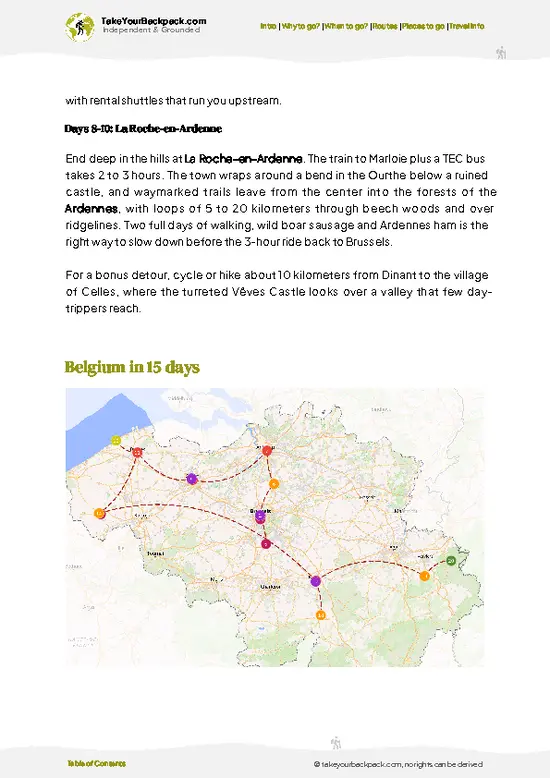
This 15-day loop suits travelers who want the full spread of Belgium at a steady, unhurried pace: the big art cities, the war history of the Westhoek, a slice of the coast and the green, hilly east. Most nights last two or more, so you unpack properly and spend more days walking than riding. Everything runs on public transport: intercity trains for almost every move, the Brussels metro and trams, the coast tram between Ostend and De Haan, and one TEC bus ride up to the High Fens.
Days 1-3: Brussels
Start in
Brussels because almost every flight and Eurostar lands here, and the city works best when you are fresh. Give the first evening to
La Grand-Place, when the gilded guildhall facades are floodlit and the day-trip crowds have gone. The next day goes on painting and architecture: the
Magritte Museum holds the largest collection of the surrealist’s work anywhere, and a tram south to Saint-Gilles brings you to the
Horta Museum, Victor Horta’s own Art Nouveau house, where every banister and …
read more 👉This 15-day loop suits travelers who want the full spread of Belgium at a steady, unhurried pace: the big art cities, the war history of the Westhoek, a slice of the coast and the green, hilly east. Most nights last two or more, so you unpack properly and spend more days walking than riding. Everything runs on public transport: intercity trains for almost every move, the Brussels metro and trams, the coast tram between Ostend and De Haan, and one TEC bus ride up to the High Fens.
Days 1-3: Brussels
Start in Brussels because almost every flight and Eurostar lands here, and the city works best when you are fresh. Give the first evening to La Grand-Place, when the gilded guildhall facades are floodlit and the day-trip crowds have gone. The next day goes on painting and architecture: the Magritte Museum holds the largest collection of the surrealist’s work anywhere, and a tram south to Saint-Gilles brings you to the Horta Museum, Victor Horta’s own Art Nouveau house, where every banister and door handle curls. Book a time slot and avoid Mondays, when it is closed. On day 3, ride out to the Waterloo Battlefield and Memorial, about 40 minutes by bus or by train plus bus. The underground museum explains 1815 clearly, then you climb the 226 steps of the Lion’s Mound and look over the farmland where it happened.Days 4-5: Mechelen and Antwerp
Break the short ride north with a stop in Mechelen, 20 minutes from Brussels. Climbing the 538 steps of St. Rumbold’s tower is the reason to come, and the town center is compact enough that a few hours is plenty. Continue to Antwerp for two nights. Antwerp is Belgium’s most fashion-conscious city, with a port-town edge, and it has the cheapest good food of the four Flemish art cities. Spend a full day between the Rubens House, the cathedral and the rooftop of the MAS museum over the old docks, and save time for the grand hall of Antwerp Central station.Days 6-7: Ghent
Ghent is under an hour west, and it is the city I would pick to live in: a big student population keeps prices sane and the canals busy after dark. Walk into the Castle of Gravensteen, the moated fortress of the Counts of Flanders, and keep the second evening for Ghent’s Patershol, a knot of narrow medieval lanes that now holds some of the city’s best small restaurants. The Van Eyck brothers’ Ghent Altarpiece in St. Bavo’s Cathedral is the other non-negotiable stop.Days 8-9: Bruges and De Haan
A 25-minute train drops you in Bruges. Stay in town so you see it early and late, when the canals are quiet. Climb the 366 steps of the Belfry of Bruges before the queue builds, then lose the afternoon on the back canals east of the Markt. On day 9, take the train to Ostend and the coast tram to De Haan, the one Belgian beach resort that escaped the wall of apartment towers. It has low Belle Époque villas, dunes and a wide, calm beach. It is the place to swim if the weather allows.Day 10: Ypres
Head inland to Ypres, about 1 hour 30 minutes via Kortrijk. One night is the right length. The In Flanders Fields Museum inside the rebuilt Cloth Hall tells the First World War story through individual lives, and at 8 pm the Last Post sounds under the Menin Gate, as it has every evening for decades. Stay over so you can be there for it without racing for a train.Days 11-12: Namur and Dinant
Day 11 is the long travel day, around 3 hours to Namur via Brussels, and the slower pace after it is deliberate. Namur marks the switch to French-speaking Wallonia. The Namur Citadel sits on the rock where the Sambre meets the Meuse, and a cable car lifts you up from the center. On day 12, take the 30-minute train south to Dinant: its onion-domed collegiate church sits under a sheer cliff, and the town celebrates Adolphe Sax, inventor of the saxophone, on almost every corner.Days 13-15: Spa and the High Fens
Finish in Spa, the town that gave its name to every spa in the world. Two nights lets you soak in the hilltop thermal baths and still have a full day outdoors. For the High Fens Nature Reserve, take the train to Verviers and a TEC bus up to Baraque Michel, then walk the wooden boardwalks across the peat bogs toward Signal de Botrange, at 694 meters the highest point in Belgium. Bring a waterproof, because the plateau gets its own colder, wetter weather. Day 15 is an easy ride back to Brussels Airport, about 2 hours, usually with changes in Pepinster and Brussels-North.
If a friend had a spare afternoon in Bruges, I’d send them 15 minutes up the line to Lissewege, a whitewashed polder village with a huge brick church tower, and tell them to pack a picnic because there are only a few places to eat.v2.webp)

 Best Backpacking

