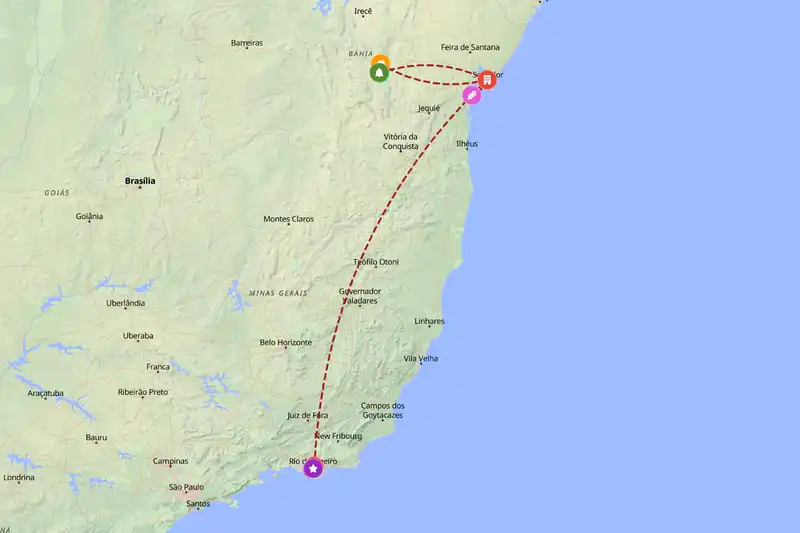
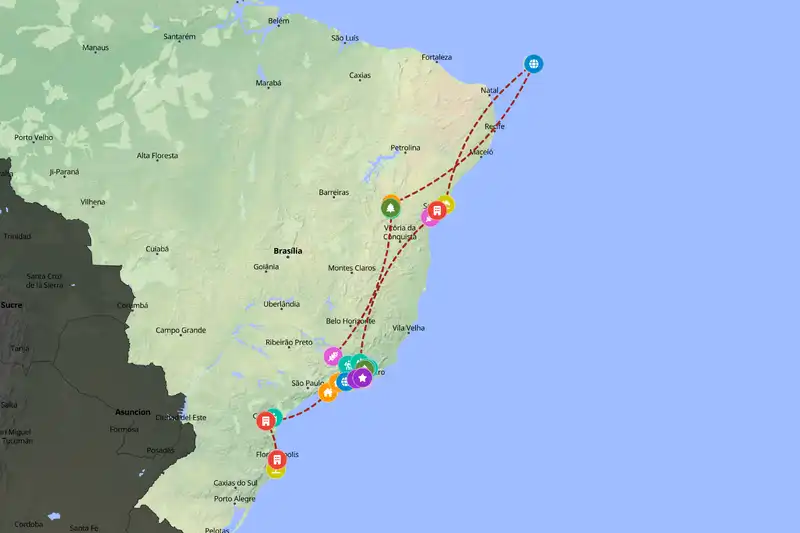
Yes, Brazil is very doable on your own: intercity buses, cheap domestic flights and hostels in every popular town cover the main backpacker circuits. The real hurdles are language, since English is thin outside hostels, and the sheer distances.
Load offline Portuguese into a translation app and learn a few bus-station phrases. Dorm beds run about R$60 to 120 (US$11 to 22) in
Rio de Janeiro,
Salvador and
Florianopolis. Rio to São Paulo is 6 hours by bus for R$100 to 200, while Rio to Salvador is over 24 hours on the road, so fly that leg for roughly R$300 to 700 booked a few weeks ahead. WhatsApp handles almost every booking, from pousadas to boat tours, and app cabs are the safer choice after dark in big cities.
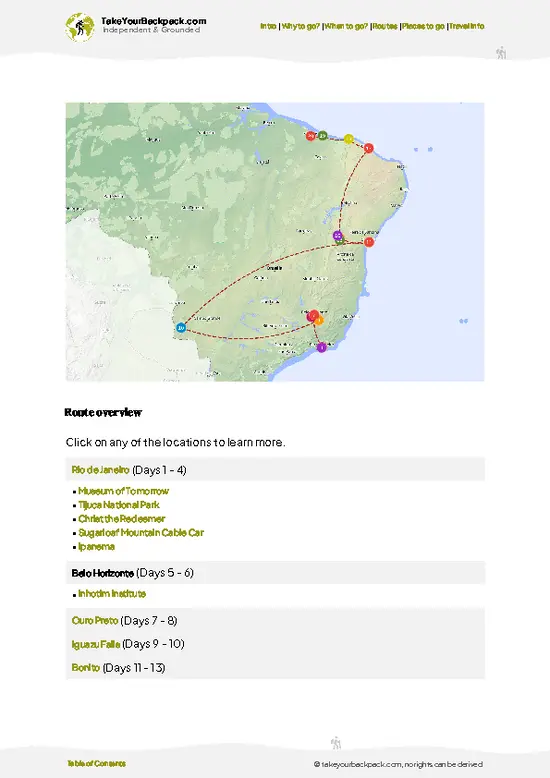
Plan at least two weeks for Brazil, and even that covers one region well; three to four weeks lets you link two or three regions with flights. The country is larger than the contiguous United States, so travel days eat time fast.
With 14 days, stick to
Rio de Janeiro (4 to 5 days),
Ilha Grande and
Paraty by bus and boat. With 21 days, add
Iguazu Falls (2 days) and Bahia, with
Salvador plus 5 to 6 days in
Chapada Diamantina. A month makes room for
Bonito (3 days) and the north coast run from
Jericoacoara to
Lençóis Maranhenses (6 to 7 days). Many domestic flights connect through São Paulo, so count half a day for each cross-country hop.
Yes, Brazil works well without a car: long-distance buses and domestic flights reach nearly every place backpackers go, and a car only helps in rural pockets such as Chapada Diamantina or the Minas Gerais backroads.
Typical bus legs: Rio to São Paulo 6 hours, São Paulo to Florianópolis 10 to 12 hours, Salvador to
Lençois 6 to 7 hours, usually R$100 to 250 depending on seat class. Flights with Gol, LATAM and Azul cover jumps like Rio to Salvador in 2 hours. Some places need special transport:
Jericoacoara is reached by 4x4 over the dunes,
Ilha Grande and
Morro de São Paulo are car-free and boat-only, and
Bonito tours include agency transfers. In Rio and São Paulo, metros and app cabs (R$15 to 40 across town) handle the rest.
The places in Brazil most worth your time are
Rio de Janeiro,
Iguazu Falls,
Salvador and at least one of the big natural areas:
Chapada Diamantina,
Lençóis Maranhenses or
Bonito.
Give Rio 4 to 5 days for Sugarloaf, Christ the Redeemer and Tijuca’s forest trails. Iguazu needs 2 days and is a 2 hour flight from Rio. Salvador’s Pelourinho deserves 3 days, and Chapada Diamantina another 4 to 6 from
Lençois, 6 to 7 hours away by bus. The Lençóis Maranhenses lagoons fill roughly June to September; pair them with
Jericoacoara over 6 to 7 days. For colonial history,
Ouro Preto is 2 hours by bus from Belo Horizonte, and
Paraty is 4.5 to 5 hours from Rio.
If you’re short on time in Brazil, skip Brasília, Fernando de Noronha and an Amazon add-on first; each costs more days or money than a two-week trip can spare.
Brasília is an architecture pilgrimage, but its spread-out layout needs a car and one day covers the Niemeyer buildings.
Fernando de Noronha requires a flight from Recife or Natal, an environmental fee of about R$100 per day and a park pass of roughly R$350 to 400 for foreigners, so
Ilha Grande or
Morro de São Paulo give island time for far less. A trip from
Manaus into the rainforest only makes sense with 4 to 5 days for a lodge stay.
Sao Paulo rewards food and museum lovers, but 1 to 2 days is enough on a beach-and-nature route.
Yes, our itinerary-planner does exactly that. Set your trip length in days, give your interests and travel style, optionally give start- and end location and/or some mandatory stops you would like to include and the itinerary planner creates your personalized routes for Brazil in seconds. Try it out!
Try the itinerary planner

 Best Backpacking