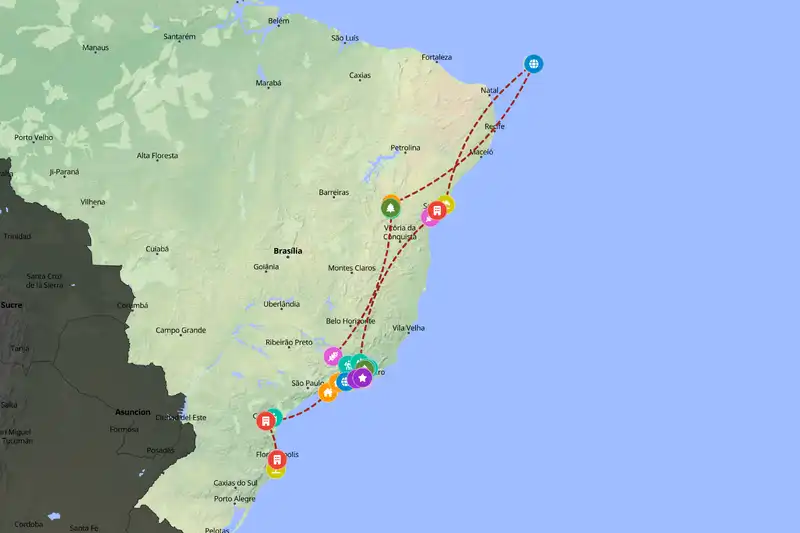
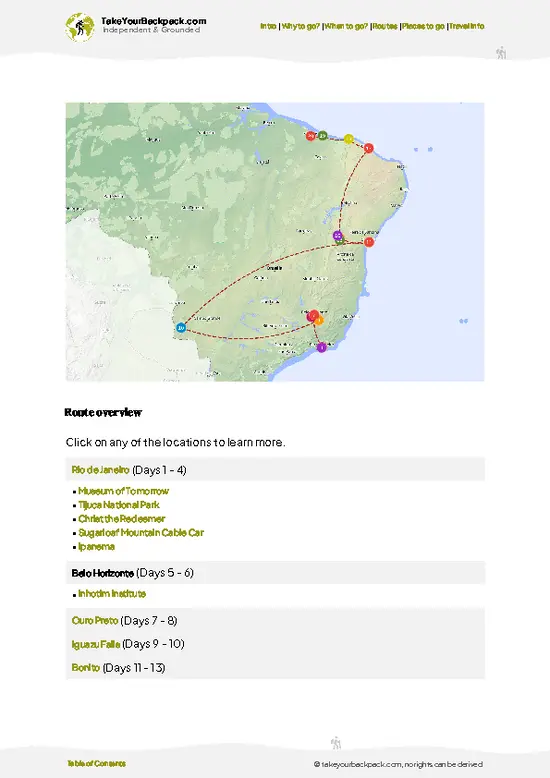
This month-long sweep through Brazil is for travelers who want the big icons and the places between them: baroque gold towns, the clearest rivers in the country, Bahia’s food and drumming, and the dune coast of Ceará and Maranhão. The pace is steady rather than rushed, with two to four nights per stop and rest days placed after every long transfer. You’ll use domestic flights for the four longest jumps, intercity buses for regional legs, 4x4 transfers on the sand roads of the north coast, and metro plus app cabs inside cities.
Days 1-5: Rio de Janeiro
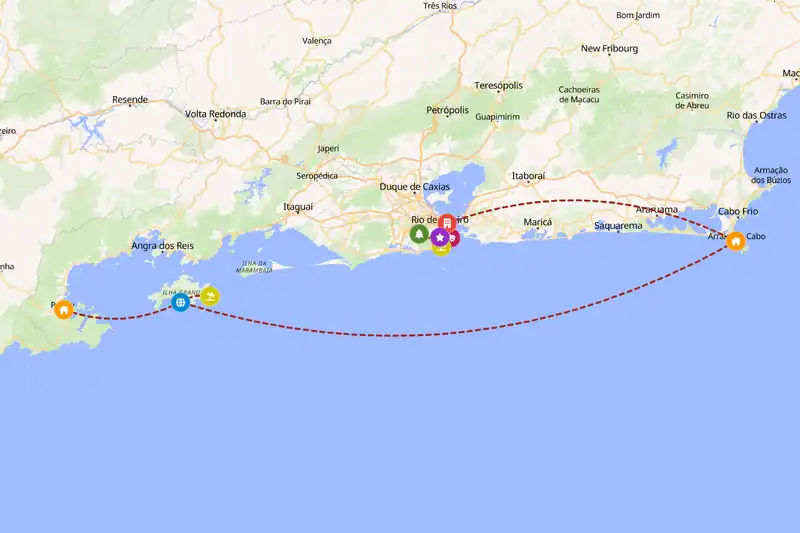
Rio de Janeiro is the logical opening because its international airport has the most long-haul connections, and four nights give jet lag time to fade. Spend one morning on the waterfront at the
Museum of Tomorrow, whose Santiago Calatrava structure juts into Guanabara Bay over the revamped Porto Maravilha district, then walk the Olympic Boulevard murals nearby. Give another day to
Tijuca National Park, the forest that climbs straight out of …
read more 👉This month-long sweep through Brazil is for travelers who want the big icons and the places between them: baroque gold towns, the clearest rivers in the country, Bahia’s food and drumming, and the dune coast of Ceará and Maranhão. The pace is steady rather than rushed, with two to four nights per stop and rest days placed after every long transfer. You’ll use domestic flights for the four longest jumps, intercity buses for regional legs, 4x4 transfers on the sand roads of the north coast, and metro plus app cabs inside cities.
Days 1-5: Rio de Janeiro
Rio de Janeiro is the logical opening because its international airport has the most long-haul connections, and four nights give jet lag time to fade. Spend one morning on the waterfront at the Museum of Tomorrow, whose Santiago Calatrava structure juts into Guanabara Bay over the revamped Porto Maravilha district, then walk the Olympic Boulevard murals nearby. Give another day to Tijuca National Park, the forest that climbs straight out of the city, and ride up to Christ the Redeemer Statue early, before the cruise-ship groups. Save the Sugarloaf Mountain Cable Car (around R$200, US$35 to 40) for late afternoon, and finish evenings on Ipanema, where the crowd claps the sun down at Arpoador rock.Days 5-9: Belo Horizonte, Inhotim and Ouro Preto
A 6 to 7 hour bus north takes you to Belo Horizonte, a city of corner bars and the Mercado Central rather than postcard sights, which is exactly why it makes a relaxed base. The reason to come is the Inhotim Institute in Brumadinho, about 60 km and 1.5 hours away: a botanical park with dozens of contemporary art pavilions spread across hills, needing a full day and comfortable shoes (entry roughly R$50 to 60). Then ride 2 hours to Ouro Preto, where steep cobbled lanes link baroque churches carved and decorated during the 18th-century gold rush. Two nights let you climb between churches without wrecking your calves.Days 9-11: Iguazu Falls
Fly from Belo Horizonte’s Confins airport to Foz do Iguaçu, usually connecting through São Paulo. The Brazilian side of Iguazu Falls gives the wide panorama, and the walkway toward the Devil’s Throat soaks you in spray within seconds. One full day covers the park; the second morning is buffer for weather.Days 11-14: Bonito
This is the longest travel day of the month, so plan nothing else: connect through Campinas to Bonito’s small airport, or fly into Campo Grande and take a 4 to 5 hour shuttle. Bonito runs on a quota system, meaning every river float, cave and waterfall is booked through local agencies with limited daily spots, so reserve your snorkel days before you arrive. Drifting face-down over fish in rivers so clear they look empty is the experience you came for.Days 14-17: Salvador
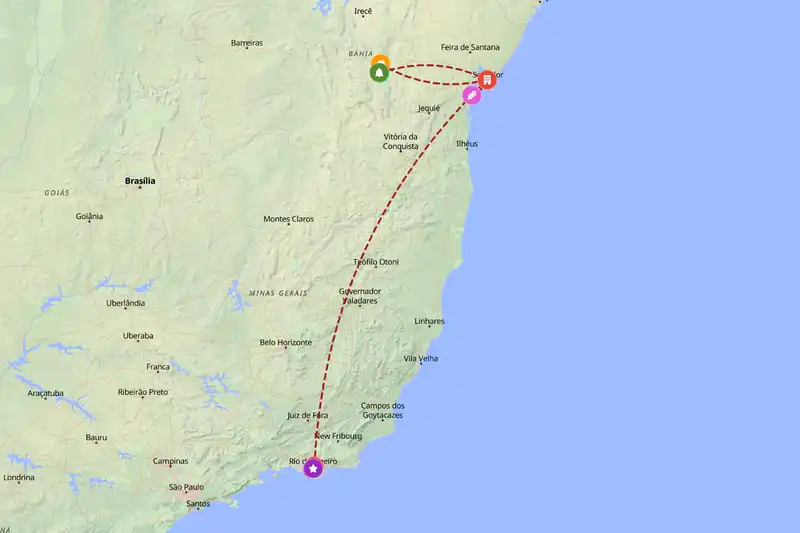
Another connecting flight brings you to Salvador, and three nights here are deliberately unhurried. Wander the pastel squares of the Pelourinho Historic Center Cultural Complex by day, eat acarajé from the Bahian women frying it in dendê oil in Rio Vermelho, and watch the sunset from the lighthouse fort at Farol da Barra, where locals swim off the rocks below.Days 17-21: Lençóis and Chapada Diamantina
A 6 to 7 hour bus west reaches Lençois, an old diamond-mining town turned trekking base for Chapada Diamantina National Park. Use four nights for day trips: the flat-topped Morro do Pai Inácio at dusk, the hike to the top of Cachoeira da Fumaça, and the Lapa doce cavern, a dry cave system of stalagmite halls about 70 km away, usually combined with blue-water caves on an agency tour.Days 21-26: Fortaleza and Jericoacoara
Bus back to Salvador on day 21 and catch an evening flight of about 2 hours to Fortaleza. Two nights here are recovery time, with the seafront Beira Mar crafts market in the evening. Then a 5 to 6 hour transfer, finished by 4x4 over the dunes, delivers you to Jericoacoara, a sand-street village where the whole town walks up the sunset dune each evening. Kitesurfers come from roughly July to December for the steady wind; everyone else rents a buggy to the hammocks of Lagoa do Paraíso.Days 26-30: Lençóis Maranhenses and São Luís
The Rota das Emoções 4x4 transfer from Jeri to Barreirinhas takes most of a day, ending at the gateway to Lençóis Maranhenses National Park. Three nights give you two 4x4 tours among white dunes and rainwater lagoons, which are fullest from roughly June to September. A 4 hour bus then reaches São Luís, whose colonial center is clad in Portuguese tiles and pulses with reggae, for a final night before flying out.
I’d send a friend past Barreirinhas to Atins, a sandy fishing village at the river mouth with kitesurfing and easy walks into the dunes, and I’d tell them to book two nights there and bring cash because ATMs are scarce.



 Best Backpacking