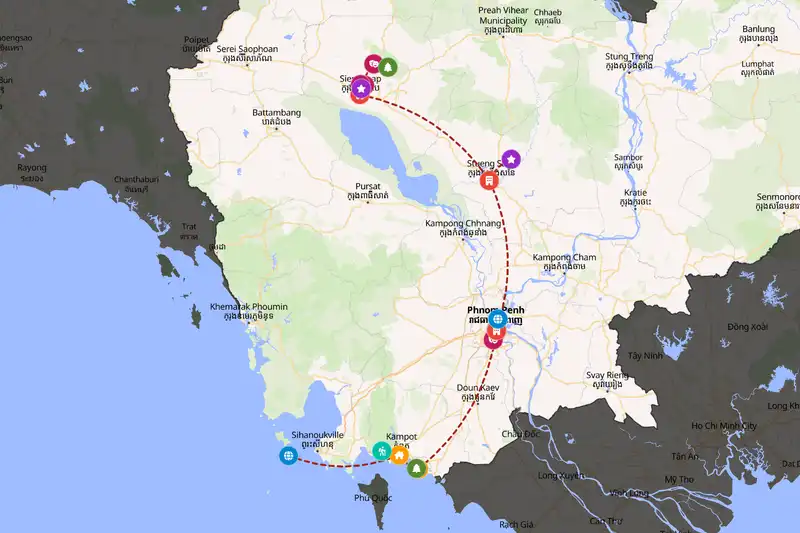
Yes, Cambodia is one of the easiest countries in Southeast Asia to backpack on your own, thanks to a dense network of tourist buses, US dollars accepted almost everywhere and hostels in every town on the main loop.
An e-visa or visa on arrival costs about US$30 to 36, and dorm beds run US$5 to 10 a night. The classic circuit of
Siem Reap,
Phnom Penh,
Kampot and the
Koh Rong islands needs no advance planning beyond booking buses a day ahead (US$10 to 18 for the 6-hour Phnom Penh to Siem Reap run). Ride-hailing apps such as PassApp and Grab fix tuk-tuk prices, and a daily budget of US$20 to 35 covers most backpackers.
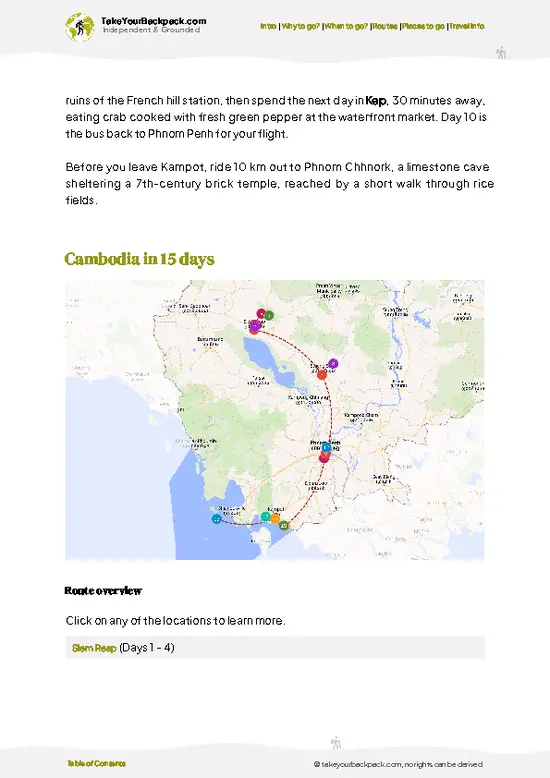
Two weeks is the ideal amount of time for Cambodia, enough to cover Angkor, the capital and the south coast without rushing.
With 5 days, stay in
Siem Reap and give Angkor three temple days plus
Kulen Mountain. Ten days adds
Battambang (2 nights),
Phnom Penh (2 nights) and
Kampot (2 to 3 nights). With 15 days, you can add the pre-Angkorian site of Sambor Prei Kuk,
Kep and three beach nights on
Koh Rong Sanloem. The remote northeast around
Banlung and
Sen Monorom needs an extra 5 to 7 days, since each is a 7- to 10-hour trip from the capital.
Yes, you can travel all of Cambodia without a car, using buses, minivans, ferries and tuk-tuks that link every major stop.
Typical legs:
Phnom Penh to
Siem Reap takes 6 hours (US$10 to 18), Siem Reap to
Battambang 3 to 4 hours, Phnom Penh to
Kampot 3 to 4 hours (US$8 to 12), and Kampot to
Kep 30 to 45 minutes. Speedboats from Sihanoukville reach
Koh Rong and Koh Rong Sanloem in 45 to 60 minutes. Locally, tuk-tuks cost US$2 to 5 per hop, a full Angkor day by tuk-tuk is US$15 to 25, and scooters rent for US$5 to 10 a day.
The must-visits in Cambodia are the Angkor temples around Siem Reap, the capital Phnom Penh, the river town of Kampot and the Koh Rong islands.
At Angkor, prioritize
Angkor Wat at sunrise,
Bayon Temple,
Ta Prohm Temple and
Banteay Srei Temple, which a 3-day pass (US$62) covers comfortably. In
Phnom Penh, give 2 to 3 days to the Royal Palace, the Tuol Sleng Genocide Museum and Choeung Ek. Spend 2 to 3 nights in
Kampot for Bokor Mountain and crab in nearby
Kep, then 3 nights on
Koh Rong or
Koh Rong Sanloem, 45 minutes by speedboat from Sihanoukville.
If you are short on time in Cambodia, skip Sihanoukville town, the remote northeast and the floating-village boat trips sold in Siem Reap.
Sihanoukville has become a casino and construction zone, so treat it as a ferry stop for
Koh Rong rather than a destination.
Ratanakiri and
Mondolkiri are beautiful but sit 7 to 10 hours from Phnom Penh each way, which eats 4 to 5 days of a short trip. Around Siem Reap, tours to Chong Kneas on the Tonle Sap often end with pressure to buy overpriced rice for schools.
Otres Beach and
Koh Tonsay (Rabbit Island) are also easy cuts when the island beaches are on your list.
Yes, our itinerary-planner does exactly that. Set your trip length in days, give your interests and travel style, optionally give start- and end location and/or some mandatory stops you would like to include and the itinerary planner creates your personalized routes for Cambodia in seconds. Try it out!
Try the itinerary plannerv2.webp)

 Best Backpacking