×
Canada🇨🇦 | 14 days itinerary

A Complete 14-Day Plan for Canada

By Johan Kruseman 🇳🇱 | Updated May 10, 2026
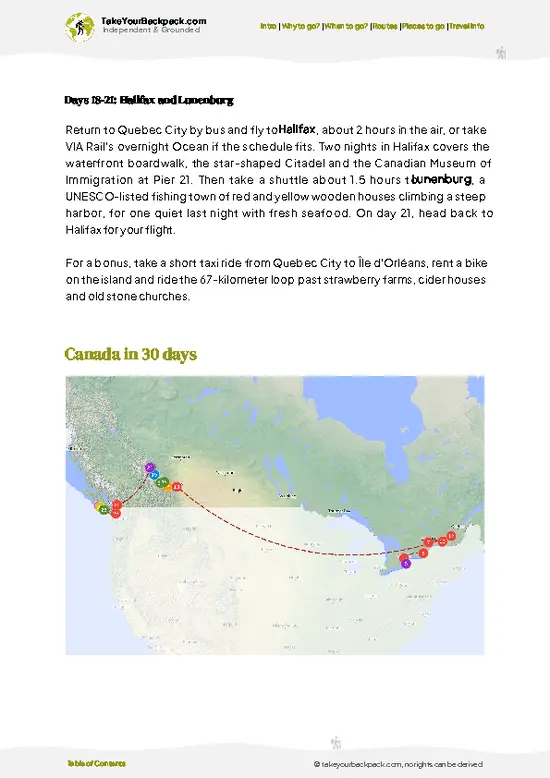
This 14-day route is for first-time visitors who want a deep dive into the Canadian Rockies without racing across the country, moving at a relaxed but adventure-forward pace using a mix of shuttle buses, regional buses, and the occasional taxi within towns. You’ll base yourself in a few key hubs, use park shuttles to reach trailheads and lakes, and balance big mountain days with hot springs, cafés, and slow evenings.

Days 1-4: Calgary to Banff & Banff National Park

Fly into Calgary and head straight to Banff by shuttle, giving yourself three full days to settle into mountain time. Use Banff town as your soft landing: stroll the main street, ride local buses into Banff National Park, and spend a half-day soaking at Banff Upper Hot Springs to shake off jet lag. Over these days, mix easy viewpoint walks with one solid hiking day on the Plain of Six Glaciers Trail, which gives you that classic turquoise-lake-plus-glacier combo without needing technical skills. Evenings are for slow dinners, … read more 👉
This 14-day route is for first-time visitors who want a deep dive into the Canadian Rockies without racing across the country, moving at a relaxed but adventure-forward pace using a mix of shuttle buses, regional buses, and the occasional taxi within towns. You’ll base yourself in a few key hubs, use park shuttles to reach trailheads and lakes, and balance big mountain days with hot springs, cafés, and slow evenings.

Days 1-4: Calgary to Banff & Banff National Park

Fly into Calgary and head straight to Banff by shuttle, giving yourself three full days to settle into mountain time. Use Banff town as your soft landing: stroll the main street, ride local buses into Banff National Park, and spend a half-day soaking at Banff Upper Hot Springs to shake off jet lag. Over these days, mix easy viewpoint walks with one solid hiking day on the Plain of Six Glaciers Trail, which gives you that classic turquoise-lake-plus-glacier combo without needing technical skills. Evenings are for slow dinners, riverside walks, and watching the light fade off the peaks instead of packing and unpacking every night.

Days 5-8: Icefields Parkway to Jasper & Jasper National Park

Travel the Icefields Parkway by bus or shuttle, one of the most scenic drives on the planet, and treat the journey as a full sightseeing day rather than just a transfer. Stop at roadside viewpoints and short walks along the way, then roll into the town of Jasper for a four-night stay that keeps the pace easy. Use Jasper as your base to explore Jasper National Park’s lakes and canyons, and if you like gentle thrills, take a half-day to ride the Jasper SkyTram for big alpine views without a brutal climb. With four nights, you can alternate between moderate hikes and lazier days by the lake, which keeps your legs fresh and your schedule flexible for weather.

Days 9-11: YohoKootenay via Canadian Rockies

Head back south along the spine of the Canadian Rockies, breaking up the return with time in quieter parks. Spend a day in Yoho for waterfalls, emerald lakes, and shorter hikes that still feel wild, then another day dipping into Kootenay for canyon walks and hot-spring vibes without the Banff crowds. Keeping these as day-focused stops rather than new bases means you see more variety without the fatigue of constant hotel changes. This middle stretch is where the Rockies really feel like a continuous mountain world instead of a single town with a famous name.

Days 12-14: Canmore & final Rockies hikes

Finish with two or three nights in Canmore, which has a more local, lived-in feel than Banff but still sits right under serious peaks. Use the town as a relaxed base for your final hikes or just café-hopping and river walks if your legs are done. Being closer to Calgary makes your departure day simpler, and ending in Canmore instead of backtracking to Banff keeps the route feeling like a loop rather than a rewind.

My favorite memory from this route is that first post-hike soak at Banff Upper Hot Springs when the evening air turned cold and the mountains went pink around the pool.
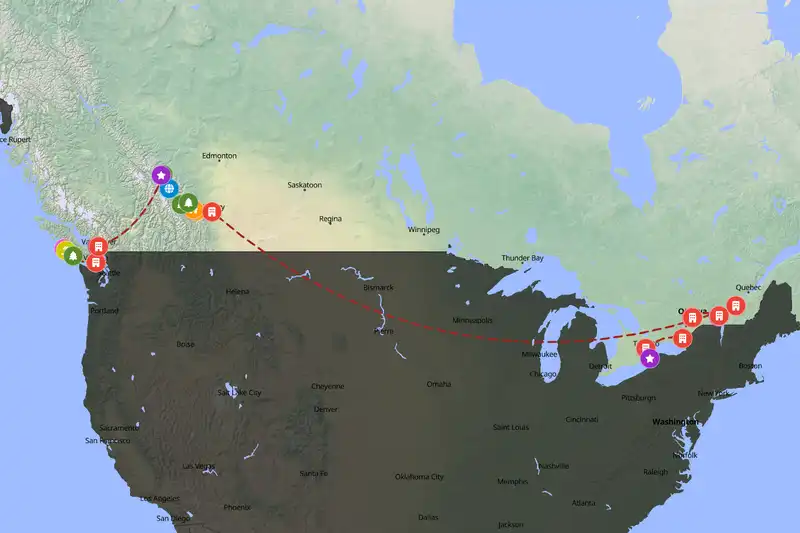
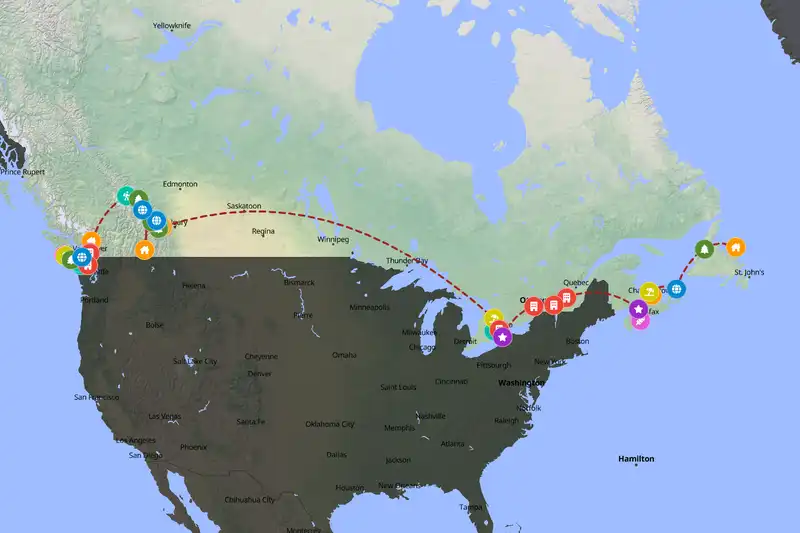
Loading the map 🌍
film
0
0
0a
Banff
Raffaele Imbroinise
film
1
1
1a
Banff
film
2
2
2a
Banff Upper Hot Springs
film
3
3
3a
Icefields Parkway
Shiun Lo
film
4
4
4a
Jasper
Pixabay
film
5
5
5a
Jasper SkyTram
James Gunn
film
6
6
6a
Canadian Rockies
film
7
7
7a
Yoho
Magno Cidade
film
8
8
8a
Kootenay
Kenny Burger
film
9
9
9a
Canmore

🛏️ Where to stay?Where You'll Go

✈️ The backpacker research shortcutCanada Travel Guide

An offline-friendly backpacking guide with optimized travel routes, ranked highlights, transport advice, and the best areas to stay.
example page 0 from our offline Travel Guide for Canadaexample page 1 from our offline Travel Guide for Canadaexample page 2 from our offline Travel Guide for Canadaexample page 3 from our offline Travel Guide for Canadaexample page 4 from our offline Travel Guide for Canadaexample page 5 from our offline Travel Guide for Canada
The digital guide (430 pages) contains:
131 highlights, ranked by travel appeal
Optimized 14, 21 & 30-day travel routes
Best neighborhoods to stay
How to get around
Offline-friendly for travel without Wi-Fi
👉 See all 30+ guide features

📅 Plan smarter in minutes, not weeks
Month by month travel advice
Festivals & national holidays
Budget expectations

🗺️ Go to the right places, skip the overrated ones
Honest pros & cons of destinations
Top hikes, parks & viewpoints
Lesser-known places most travelers miss
Clear “worth it vs skip it” guidance

🛏️ Travel smoothly without rookie mistakes
Best areas to stay
Transport systems explained simply
Common scams & safety advice
SIM cards, money & practical tips

🌍 Understand the country, not just visit it
Culture & traditions
Local customs
Festivals worth planning around
Traveler-friendly historical context
Insights that make places more meaningful

📱 Built for real travel conditions
Fully downloadable PDF
Works completely offline
Optimized for phone use
Useful in remote areas & buses
Everything in one place
Save weeks of stressful planning
Get instant access to the full guide directly. 30-day money-back guarantee.


Sent to your inbox immediately after payment • 100% Secure Checkout
Best Backpacking Travel Advisor 2025 tourism awardBest Backpacking
Travel Advisor
2025
What others say about Take Your Backpack Guides:
⭐⭐⭐⭐⭐
Fantastic, amazing amount of information!
⭐⭐⭐⭐⭐
My goodness this is amazing, it's what I've been looking for hats off too you!
⭐⭐⭐⭐⭐
I think this is absolutely BRILLIANT
⭐⭐⭐⭐
Very complete and informative. It's still missing places, but I gotta to commend you
⭐⭐⭐⭐⭐
This is truly amazing, thank you, can't wait to explore it with my kids!
⭐⭐⭐⭐⭐
Awesome resource, thank you!
⭐⭐⭐⭐⭐
This is amazing! Can't wait to explore the ones I haven't seen
⭐⭐⭐⭐
I love this! Well done, great idea.
⭐⭐⭐⭐⭐
Thanks for taking the time to make this gem!
⭐⭐⭐⭐⭐
This might be the best website I've ever seen.
⭐⭐⭐⭐⭐
Congratulations, and thank you so much for your work; it's incredibly valuable.
⭐⭐⭐⭐
In all seriousness I think you did a great job pointing out the important spots
⭐⭐⭐⭐⭐
10/10 very good
⭐⭐⭐⭐⭐
As someone who's only just starting to visit regularly this is awesome, thank you.
⭐⭐⭐⭐
Thank you very much! I'm going to visit my dad, it's going to be very useful!
⭐⭐⭐⭐⭐
This is really cool! We'll be travelling for the first time and this definitely come in handy.
⭐⭐⭐⭐⭐
You are now our minister of culture, congratulations 👨‍💼
⭐⭐⭐⭐⭐
Just wanted to tell you that this is a pearl! Going to follow your recommendations.
⭐⭐⭐⭐⭐
This is so cool. I'll definitely be using the resource for my travels soon.
⭐⭐⭐⭐⭐
This is very impressive! Good work.
⭐⭐⭐⭐⭐
This is an amazing and informative site. Very well done!

🧭 RouteAdjust Your Pace

Travel Canada your way — from a quick highlights trip to a slow-paced adventure.

🙋 FAQTraveler FAQ

Short answer: yes, but it’s not Southeast Asia-easy. Canada is very backpackable if you accept that distances are huge, transport is limited outside cities, and nature is the main event. Solo travel is safe by global standards; people are generally helpful, English is widely spoken (plus French in Québec), and infrastructure in cities is solid. The catch is cost and spacing: hostels exist but are concentrated in major cities and big national parks, so you need to plan more than you would in, say, Europe. Wild camping rules vary by province and land type, so you can’t just pitch a tent anywhere; you’ll rely on official campgrounds, backcountry permits, or stealthy but respectful car-camping if you have wheels. For pure backpackers using buses and trains, think in terms of hubs: base yourself in a city (Vancouver, Calgary, Montréal, Toronto) and do 2–5 day side trips. Hiking and backcountry trips are well-marked and regulated, but you must respect wildlife rules (bears, moose, weather swings) and carry proper gear; this is not a place to wing it with a fashion backpack and sneakers. If you’re comfortable with long distances, booking transport ahead, and a bit of logistical homework, Canada is very doable independently on a budget.
For a budget backpacker, the real question is: which slice of Canada do you want, not “all of Canada.” The country is too big to “do” in one go unless you have months. Use this as a rough guide: 1 week: Pick one region only. Examples: Vancouver + a quick taste of Vancouver Island, or Calgary + Banff/Canmore, or Montréal + Québec City. You’ll get a feel for Canada but not the full spread. 2 weeks: You can do one region properly or two small regions lightly. Good combos: Vancouver + Rockies (fly into Vancouver, bus/ride-share to Banff/Calgary), or Toronto + Montréal + Québec City by bus/train. This is the sweet spot for many first-timers. 3–4 weeks: You can cross one big chunk of the country in a slow, backpacker-friendly way. For example: West Coast (Vancouver, Vancouver Island) + Rockies (Jasper/Banff/Yoho) + a prairie stop (Saskatoon/Winnipeg) or East Coast (Montréal, Québec City, Ottawa, Toronto, maybe a quick hop to Nova Scotia). 2–3 months: Now you can think about a coast-to-coast journey, mixing cities, small towns, and multiple national parks, with time for workaways or volunteering to save money. For most budget travelers, 10–21 days focused on one or two regions gives the best value: less time and money wasted on long-haul transport, more time hiking, camping, and actually being in places instead of staring out a bus window.
You can get around parts of Canada without a car, but not the whole country in a smooth, cheap way. Think of it as a network of islands: cities and a few tourist corridors are easy; everything in between is patchy. Where it’s easy: Major cities (Vancouver, Toronto, Montréal, Québec City, Ottawa, Calgary, Edmonton) have decent public transit and walkable cores. Intercity buses and trains connect the main urban corridor in the east (Windsor–Toronto–Ottawa–Montréal–Québec City) reasonably well. Tourist hotspots like Banff, Jasper, and Whistler have shuttles and seasonal buses from nearby cities. Where it’s harder: Rural areas, small towns, and much of the north have limited or no public transport. Hitchhiking exists but comes with safety and weather risks, and you can wait a long time between cars. Domestic flights cover big distances but eat your budget fast. For a car-free backpacking plan, build your route around: 1) The eastern city corridor (Toronto–Ottawa–Montréal–Québec City) by bus/train; 2) Vancouver + Vancouver Island + Whistler using buses/ferries; 3) Calgary to Banff/Lake Louise/Jasper using shuttle buses and tour buses; 4) Occasional budget flights between regions if you’re short on time. Use ride-share boards and hostel noticeboards to split fuel costs with drivers when possible. You absolutely can travel Canada without driving, but you’ll need to accept slower travel, more planning, and focusing on well-connected routes instead of chasing every remote viewpoint you see on Instagram.
For budget travelers, the must-visits are places where nature is wild, access is realistic, and costs can be managed with hostels and camping. West: 1) The Canadian Rockies (Banff, Jasper, Yoho, Kootenay). This is the classic Canada postcard: turquoise lakes, glaciers, big wildlife, and endless hiking. Base in Banff, Lake Louise, or Jasper; use hostels or campgrounds; hike instead of paying for every gondola and tour. 2) Vancouver + Vancouver Island. Vancouver gives you mountains-meet-ocean city life with cheap(ish) Asian food and good transit. Vancouver Island (Victoria, Nanaimo, Tofino/Ucluelet, Strathcona Provincial Park) adds surf towns, coastal hikes, and mellow camping. 3) Whistler and the Sea-to-Sky corridor. Easy to reach from Vancouver, packed with trails and lakes; you can skip the pricey activities and just hike, swim, and camp. Central/East: 4) Montréal. Affordable by North American standards, full of cheap eats, festivals, and a strong backpacker scene. Great base for budget travelers who like culture as much as hiking. 5) Québec City and nearby Charlevoix/Laurentians. Old stone streets, French vibe, and access to good hiking and river scenery without needing a car if you plan well. 6) Toronto + Niagara region. Toronto is more expensive but a key hub; worth a few days for neighborhoods, food, and museums. Niagara Falls is touristy but still impressive once; do it as a day trip and don’t linger. 7) East Coast (Nova Scotia, New Brunswick, Prince Edward Island). If you have time, the Maritimes are fantastic for road trips, coastal hikes, and friendly small towns. Without a car, focus on Halifax and nearby day trips. If you’re short on time and money, prioritize: one big nature area (Rockies or Vancouver Island/Whistler) plus one cultural city (Montréal or Vancouver). That combo gives you the “Canada feeling” without trying to cross the entire country.
If you’re short on time or cash, skip anything that’s mostly about distance and bragging rights instead of actual experience. 1) Trying to cross the whole country in one trip. A rushed coast-to-coast bus or train ride sounds romantic but mostly gives you long, expensive days watching fields and trees. Focus on one or two regions instead. 2) Overpriced city attractions that duplicate what you can get for free. In Toronto, Vancouver, or Montréal, you don’t need every observation deck, aquarium, and paid viewpoint. Pick one or two that genuinely interest you and spend the rest of your time walking neighborhoods, parks, and waterfronts. 3) Expensive gondolas and skywalks if you’re a hiker. In the Rockies and coastal mountains, many paid viewpoints can be reached by hiking trails if you’re reasonably fit. Save those $50–$80 tickets for food, gear, or an extra night in a hostel. 4) Remote northern trips unless they’re your main goal. The Yukon, Northwest Territories, and Nunavut are incredible but brutally expensive to reach and explore. If you’re on a tight budget or schedule, keep them for a dedicated future trip. 5) Extra days in Niagara Falls or similar hyper-touristy zones. See the falls, walk around, maybe do one boat trip if it fits your budget, then move on. Staying multiple days there drains money you could spend on national parks or more interesting towns. 6) Generic malls and outlet shopping. Canada’s not a budget shopping paradise; unless you specifically need gear, your time is better spent outside. When in doubt, skip long detours for “just another city” and invest your limited days in one strong nature hub and one or two cities with character and good cheap food.

🇨🇦 CanadaSee More of Canada

Ready to build a truly unique trip? Predefined routes are perfect for first-time visitors, but there is so much more to discover. Whether you are chasing a city trip, pristine national parks, local food scenes, or quiet beaches, pick a category to design your own path.