×
Canada🇨🇦 | 30 days itinerary

How to Spend 30 Days in Canada

By Johan Kruseman 🇳🇱 | Updated May 10, 2026
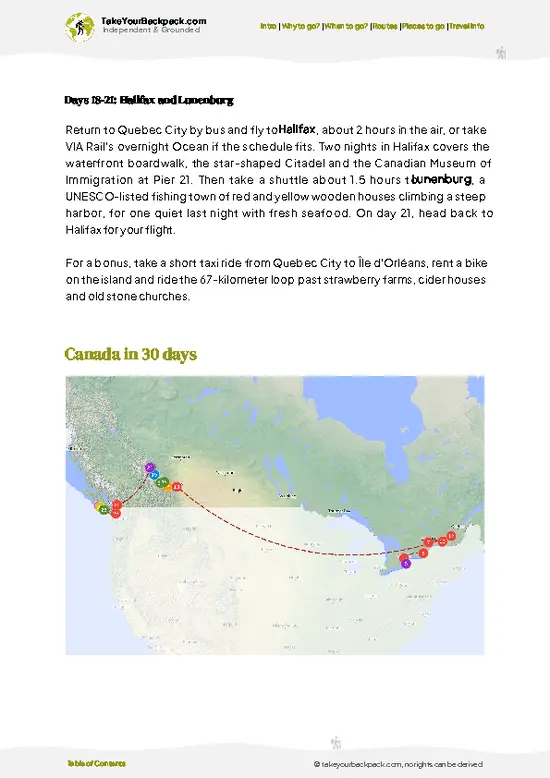
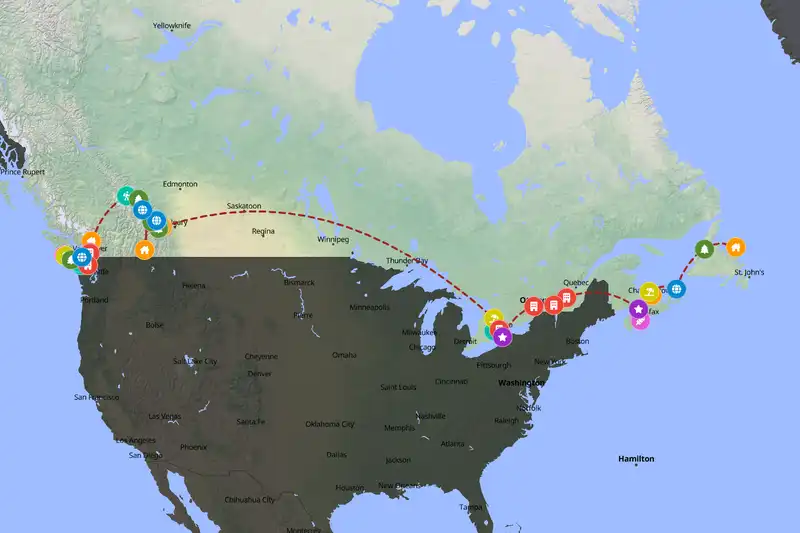
This 30-day route is for travelers who want to really live inside Canada for a month, mixing major cities, classic road-trip regions, and deeper cuts that most visitors never reach, all at a steady, immersive pace. You’ll use trains and buses in the east, a couple of domestic flights to bridge the huge distances, and a mix of shuttles and local transit in the Rockies and on the coasts, with no back-to-back brutal travel days.

Days 1-5: Toronto, CN Tower, Royal Ontario Museum, Casa Loma, Ripley’s Aquarium of Canada & Niagara Falls

Start with five nights in Toronto to give yourself time to adjust and actually enjoy the city instead of just passing through. Use one day for the Royal Ontario Museum and optionally the Bata Shoe Museum if you like quirky collections, another for the CN Tower and Ripley’s Aquarium of Canada right next door, and a half-day exploring Casa Loma for a different angle on the city’s history. Take a full-day trip to Niagara Falls, treating it as a slow wander along the … read more 👉
This 30-day route is for travelers who want to really live inside Canada for a month, mixing major cities, classic road-trip regions, and deeper cuts that most visitors never reach, all at a steady, immersive pace. You’ll use trains and buses in the east, a couple of domestic flights to bridge the huge distances, and a mix of shuttles and local transit in the Rockies and on the coasts, with no back-to-back brutal travel days.

Days 1-5: Toronto, CN Tower, Royal Ontario Museum, Casa Loma, Ripley’s Aquarium of Canada & Niagara Falls

Start with five nights in Toronto to give yourself time to adjust and actually enjoy the city instead of just passing through. Use one day for the Royal Ontario Museum and optionally the Bata Shoe Museum if you like quirky collections, another for the CN Tower and Ripley’s Aquarium of Canada right next door, and a half-day exploring Casa Loma for a different angle on the city’s history. Take a full-day trip to Niagara Falls, treating it as a slow wander along the river rather than a quick photo stop. The extra night here means you can also slip in a side trip to Wasaga Beach or Sandbanks Beach if you want a freshwater beach day without derailing the whole itinerary.

Days 6-9: Ottawa, Canadian Museum of History, Canadian War Museum & National Gallery of Canada

Ride the train to Ottawa and settle in for four nights to dig into Canada’s capital at a human pace. Spend one day at the Canadian Museum of History across the river, another at the Canadian War Museum if you’re interested in military history, and carve out time for the National Gallery of Canada to balance things with art and architecture. With four nights, you can mix museum days with canal walks and market lunches instead of sprinting from exhibit to exhibit. This phase gives you context for everything else you’ll see over the month.

Days 10-13: Montreal, Old Port of Montreal Observation Wheel & Montreal Museum of Fine Arts

Head to Montreal for four nights to lean into food, culture, and neighborhood wandering. Use one day to explore Old Montreal and ride the Old Port of Montreal Observation Wheel, another for the Montreal Museum of Fine Arts, and keep at least one day mostly unplanned for café-hopping and park time. The slower pace lets you feel the city’s rhythm instead of just its checklist sights. This is your last big urban block before the route turns more heavily toward nature.

Days 14-17: Quebec City, La Mauricie National Park, Canadian Maritimes, Rimouski & Gaspé

Travel to Quebec City for two nights to enjoy its historic core, then start curving along the St. Lawrence toward the Canadian Maritimes. Use a day trip from Quebec City or an en route stop to dip into La Mauricie National Park for lakes and forest trails, then continue to Rimouski for a night as a practical coastal waypoint. From there, head to Gaspé for two nights, giving yourself time for coastal walks and small-town life at the edge of the peninsula. This stretch feels like a slow-motion transition from big city to wild coast, with each stop adding more sea and fewer skyscrapers.

Days 18-21: Halifax, Cape Breton Island (Nova Scotia), Cabot Trail & Cape Breton Highlands National Park

Continue into the Maritimes and base yourself in Halifax for three nights, using the city as your hub for seafood, harbor walks, and day trips. Dedicate one long but rewarding day to Cape Breton Island (Nova Scotia), driving or joining a tour around the Cabot Trail and into Cape Breton Highlands National Park for cliffside viewpoints and short hikes. The extra night in Halifax gives you breathing room so this doesn’t feel like a punishing there-and-back. This phase is where the Atlantic side of Canada really clicks into place: rugged coast, big skies, and a slower pace of life.

Days 22-25: Vancouver, Vancouver Aquarium, Kitsilano Beach, English Bay Beach & Vancouver Island

Fly across the country to Vancouver and give yourself three nights to adjust to the Pacific side. Spend a day in Stanley Park with the Vancouver Aquarium, another day split between Kitsilano Beach and English Bay Beach, and keep one day flexible for neighborhoods or short hikes. Then take the ferry to Vancouver Island and overnight in Nanaimo as a practical and low-key first stop, breaking up the journey and letting you sample island life beyond the capital. This phase is about easing into the west rather than crash-landing into the Rockies.

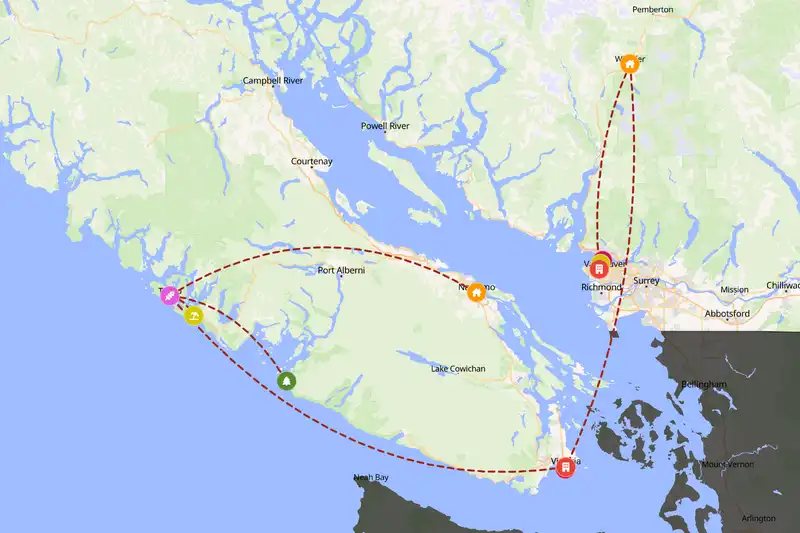
Days 26-30: Tofino, Pacific Rim, Long Beach, Port Alberni & Victoria

Head across the island via Port Alberni to the village of Tofino, your base for three nights on the wild Pacific edge. Spend your days exploring Pacific Rim National Park, walking the sand and surf of Long Beach, and wandering the rainforest trails between storms or sunsets depending on the season. On your way back, stop again through Port Alberni if needed, then finish with a night or two in Victoria to decompress with harbor walks and a final café crawl before departure. Ending here, after a month that started in Toronto’s towers and wound through capitals, coasts, and islands, gives the trip a satisfying arc from big-city energy to ocean-side calm.

The part of this route that lives rent-free in my head is walking the hard-packed sand of Long Beach at low tide, realizing I’d started this same trip weeks earlier staring down from the CN Tower.
Loading the map 🌍
film
0
0
0a
Toronto
Pixabay
film
1
1
1a
Royal Ontario Museum
Pixabay
film
2
2
2a
Ripley’s Aquarium of Canada
film
3
3
3a
Casa Loma
film
4
4
4a
Niagara Falls
Pixabay
film
5
5
5a
Sandbanks Beach
Lokyao Pon
film
6
6
6a
Ottawa
Cheng Betty
film
7
7
7a
National Gallery of Canada
film
8
8
8a
Montreal
Pixabay
film
9
9
9a
Quebec City
Marcelo Fernandez Mena
film
10
10
10a
Canadian Maritimes
Chase M
film
11
11
11a
Halifax
Bill Conklin
film
12
12
12a
Cape Breton Island (Nova Scotia)
Jon Eastman
film
13
13
13a
Cape Breton Highlands
Mike Corrigan
film
14
14
14a
Vancouver
Pixabay
film
15
15
15a
Vancouver Aquarium
Pixabay
film
16
16
16a
Kitsilano Beach
Inchang Hwang
film
17
17
17a
English Bay Beach
Amer Zaman
film
18
18
18a
Tofino
Daniel Vogel
film
19
19
19a
Pacific Rim
Jose Domínguez
film
20
20
20a
Long Beach
Vivy Raj
film
21
21
21a
Victoria
John Chu

✈️ The backpacker research shortcutCanada Travel Guide

An offline-friendly backpacking guide with optimized travel routes, ranked highlights, transport advice, and the best areas to stay.
example page 0 from our offline Travel Guide for Canadaexample page 1 from our offline Travel Guide for Canadaexample page 2 from our offline Travel Guide for Canadaexample page 3 from our offline Travel Guide for Canadaexample page 4 from our offline Travel Guide for Canadaexample page 5 from our offline Travel Guide for Canada
The digital guide (430 pages) contains:
131 highlights, ranked by travel appeal
Optimized 14, 21 & 30-day travel routes
Best neighborhoods to stay
How to get around
Offline-friendly for travel without Wi-Fi
👉 See all 30+ guide features

📅 Plan smarter in minutes, not weeks
Month by month travel advice
Festivals & national holidays
Budget expectations

🗺️ Go to the right places, skip the overrated ones
Honest pros & cons of destinations
Top hikes, parks & viewpoints
Lesser-known places most travelers miss
Clear “worth it vs skip it” guidance

🛏️ Travel smoothly without rookie mistakes
Best areas to stay
Transport systems explained simply
Common scams & safety advice
SIM cards, money & practical tips

🌍 Understand the country, not just visit it
Culture & traditions
Local customs
Festivals worth planning around
Traveler-friendly historical context
Insights that make places more meaningful

📱 Built for real travel conditions
Fully downloadable PDF
Works completely offline
Optimized for phone use
Useful in remote areas & buses
Everything in one place
Save weeks of stressful planning
Get instant access to the full guide directly. 30-day money-back guarantee.


Sent to your inbox immediately after payment • 100% Secure Checkout
Best Backpacking Travel Advisor 2025 tourism awardBest Backpacking
Travel Advisor
2025
What others say about Take Your Backpack Guides:
⭐⭐⭐⭐⭐
Fantastic, amazing amount of information!
⭐⭐⭐⭐⭐
My goodness this is amazing, it's what I've been looking for hats off too you!
⭐⭐⭐⭐⭐
I think this is absolutely BRILLIANT
⭐⭐⭐⭐
Very complete and informative. It's still missing places, but I gotta to commend you
⭐⭐⭐⭐⭐
This is truly amazing, thank you, can't wait to explore it with my kids!
⭐⭐⭐⭐⭐
Awesome resource, thank you!
⭐⭐⭐⭐⭐
This is amazing! Can't wait to explore the ones I haven't seen
⭐⭐⭐⭐
I love this! Well done, great idea.
⭐⭐⭐⭐⭐
Thanks for taking the time to make this gem!
⭐⭐⭐⭐⭐
This might be the best website I've ever seen.
⭐⭐⭐⭐⭐
Congratulations, and thank you so much for your work; it's incredibly valuable.
⭐⭐⭐⭐
In all seriousness I think you did a great job pointing out the important spots
⭐⭐⭐⭐⭐
10/10 very good
⭐⭐⭐⭐⭐
As someone who's only just starting to visit regularly this is awesome, thank you.
⭐⭐⭐⭐
Thank you very much! I'm going to visit my dad, it's going to be very useful!
⭐⭐⭐⭐⭐
This is really cool! We'll be travelling for the first time and this definitely come in handy.
⭐⭐⭐⭐⭐
You are now our minister of culture, congratulations 👨‍💼
⭐⭐⭐⭐⭐
Just wanted to tell you that this is a pearl! Going to follow your recommendations.
⭐⭐⭐⭐⭐
This is so cool. I'll definitely be using the resource for my travels soon.
⭐⭐⭐⭐⭐
This is very impressive! Good work.
⭐⭐⭐⭐⭐
This is an amazing and informative site. Very well done!

🧭 RouteOther Route Options

Travel Canada your way — from a quick highlights trip to a slow-paced adventure.

🙋 FAQFAQ: Backpacking Canada

Short answer: yes, but it’s not Southeast Asia-easy. Canada is very backpackable if you accept that distances are huge, transport is limited outside cities, and nature is the main event. Solo travel is safe by global standards; people are generally helpful, English is widely spoken (plus French in Québec), and infrastructure in cities is solid. The catch is cost and spacing: hostels exist but are concentrated in major cities and big national parks, so you need to plan more than you would in, say, Europe. Wild camping rules vary by province and land type, so you can’t just pitch a tent anywhere; you’ll rely on official campgrounds, backcountry permits, or stealthy but respectful car-camping if you have wheels. For pure backpackers using buses and trains, think in terms of hubs: base yourself in a city (Vancouver, Calgary, Montréal, Toronto) and do 2–5 day side trips. Hiking and backcountry trips are well-marked and regulated, but you must respect wildlife rules (bears, moose, weather swings) and carry proper gear; this is not a place to wing it with a fashion backpack and sneakers. If you’re comfortable with long distances, booking transport ahead, and a bit of logistical homework, Canada is very doable independently on a budget.
For a budget backpacker, the real question is: which slice of Canada do you want, not “all of Canada.” The country is too big to “do” in one go unless you have months. Use this as a rough guide: 1 week: Pick one region only. Examples: Vancouver + a quick taste of Vancouver Island, or Calgary + Banff/Canmore, or Montréal + Québec City. You’ll get a feel for Canada but not the full spread. 2 weeks: You can do one region properly or two small regions lightly. Good combos: Vancouver + Rockies (fly into Vancouver, bus/ride-share to Banff/Calgary), or Toronto + Montréal + Québec City by bus/train. This is the sweet spot for many first-timers. 3–4 weeks: You can cross one big chunk of the country in a slow, backpacker-friendly way. For example: West Coast (Vancouver, Vancouver Island) + Rockies (Jasper/Banff/Yoho) + a prairie stop (Saskatoon/Winnipeg) or East Coast (Montréal, Québec City, Ottawa, Toronto, maybe a quick hop to Nova Scotia). 2–3 months: Now you can think about a coast-to-coast journey, mixing cities, small towns, and multiple national parks, with time for workaways or volunteering to save money. For most budget travelers, 10–21 days focused on one or two regions gives the best value: less time and money wasted on long-haul transport, more time hiking, camping, and actually being in places instead of staring out a bus window.
You can get around parts of Canada without a car, but not the whole country in a smooth, cheap way. Think of it as a network of islands: cities and a few tourist corridors are easy; everything in between is patchy. Where it’s easy: Major cities (Vancouver, Toronto, Montréal, Québec City, Ottawa, Calgary, Edmonton) have decent public transit and walkable cores. Intercity buses and trains connect the main urban corridor in the east (Windsor–Toronto–Ottawa–Montréal–Québec City) reasonably well. Tourist hotspots like Banff, Jasper, and Whistler have shuttles and seasonal buses from nearby cities. Where it’s harder: Rural areas, small towns, and much of the north have limited or no public transport. Hitchhiking exists but comes with safety and weather risks, and you can wait a long time between cars. Domestic flights cover big distances but eat your budget fast. For a car-free backpacking plan, build your route around: 1) The eastern city corridor (Toronto–Ottawa–Montréal–Québec City) by bus/train; 2) Vancouver + Vancouver Island + Whistler using buses/ferries; 3) Calgary to Banff/Lake Louise/Jasper using shuttle buses and tour buses; 4) Occasional budget flights between regions if you’re short on time. Use ride-share boards and hostel noticeboards to split fuel costs with drivers when possible. You absolutely can travel Canada without driving, but you’ll need to accept slower travel, more planning, and focusing on well-connected routes instead of chasing every remote viewpoint you see on Instagram.
For budget travelers, the must-visits are places where nature is wild, access is realistic, and costs can be managed with hostels and camping. West: 1) The Canadian Rockies (Banff, Jasper, Yoho, Kootenay). This is the classic Canada postcard: turquoise lakes, glaciers, big wildlife, and endless hiking. Base in Banff, Lake Louise, or Jasper; use hostels or campgrounds; hike instead of paying for every gondola and tour. 2) Vancouver + Vancouver Island. Vancouver gives you mountains-meet-ocean city life with cheap(ish) Asian food and good transit. Vancouver Island (Victoria, Nanaimo, Tofino/Ucluelet, Strathcona Provincial Park) adds surf towns, coastal hikes, and mellow camping. 3) Whistler and the Sea-to-Sky corridor. Easy to reach from Vancouver, packed with trails and lakes; you can skip the pricey activities and just hike, swim, and camp. Central/East: 4) Montréal. Affordable by North American standards, full of cheap eats, festivals, and a strong backpacker scene. Great base for budget travelers who like culture as much as hiking. 5) Québec City and nearby Charlevoix/Laurentians. Old stone streets, French vibe, and access to good hiking and river scenery without needing a car if you plan well. 6) Toronto + Niagara region. Toronto is more expensive but a key hub; worth a few days for neighborhoods, food, and museums. Niagara Falls is touristy but still impressive once; do it as a day trip and don’t linger. 7) East Coast (Nova Scotia, New Brunswick, Prince Edward Island). If you have time, the Maritimes are fantastic for road trips, coastal hikes, and friendly small towns. Without a car, focus on Halifax and nearby day trips. If you’re short on time and money, prioritize: one big nature area (Rockies or Vancouver Island/Whistler) plus one cultural city (Montréal or Vancouver). That combo gives you the “Canada feeling” without trying to cross the entire country.
If you’re short on time or cash, skip anything that’s mostly about distance and bragging rights instead of actual experience. 1) Trying to cross the whole country in one trip. A rushed coast-to-coast bus or train ride sounds romantic but mostly gives you long, expensive days watching fields and trees. Focus on one or two regions instead. 2) Overpriced city attractions that duplicate what you can get for free. In Toronto, Vancouver, or Montréal, you don’t need every observation deck, aquarium, and paid viewpoint. Pick one or two that genuinely interest you and spend the rest of your time walking neighborhoods, parks, and waterfronts. 3) Expensive gondolas and skywalks if you’re a hiker. In the Rockies and coastal mountains, many paid viewpoints can be reached by hiking trails if you’re reasonably fit. Save those $50–$80 tickets for food, gear, or an extra night in a hostel. 4) Remote northern trips unless they’re your main goal. The Yukon, Northwest Territories, and Nunavut are incredible but brutally expensive to reach and explore. If you’re on a tight budget or schedule, keep them for a dedicated future trip. 5) Extra days in Niagara Falls or similar hyper-touristy zones. See the falls, walk around, maybe do one boat trip if it fits your budget, then move on. Staying multiple days there drains money you could spend on national parks or more interesting towns. 6) Generic malls and outlet shopping. Canada’s not a budget shopping paradise; unless you specifically need gear, your time is better spent outside. When in doubt, skip long detours for “just another city” and invest your limited days in one strong nature hub and one or two cities with character and good cheap food.

🇨🇦 CanadaExpand Your Journey

Ready to build a truly unique trip? Predefined routes are perfect for first-time visitors, but there is so much more to discover. Whether you are chasing a city trip, pristine national parks, local food scenes, or quiet beaches, pick a category to design your own path.