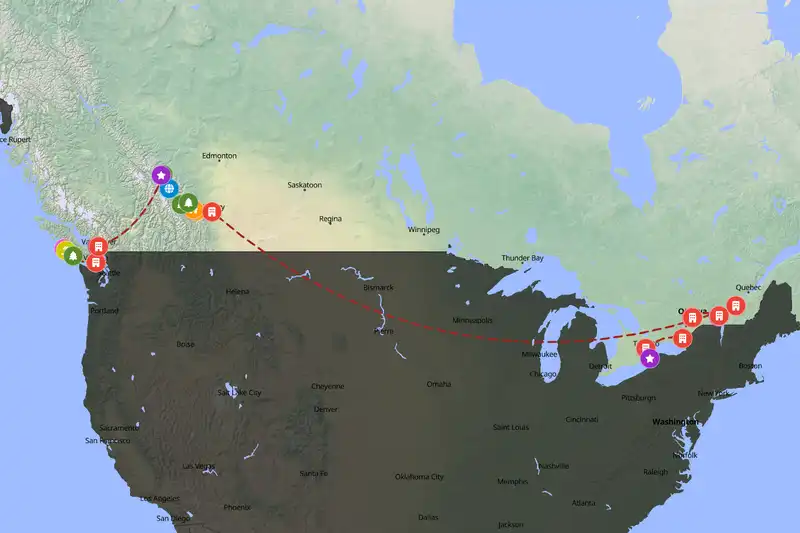
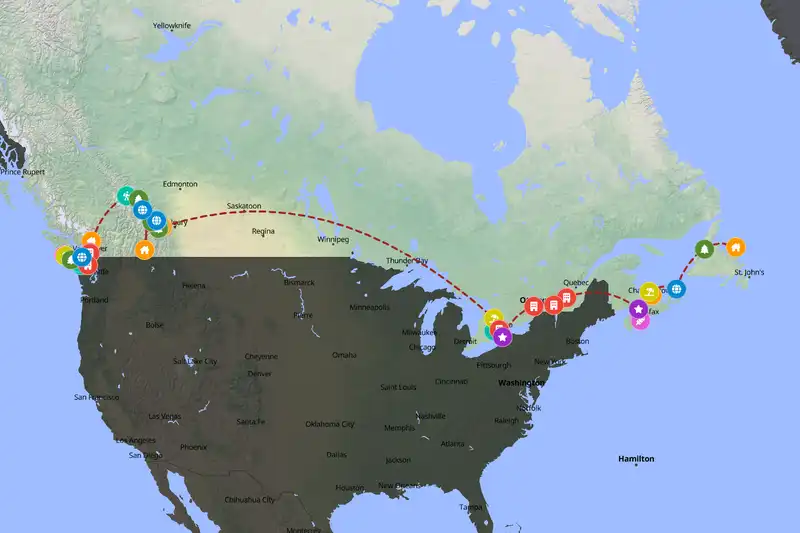
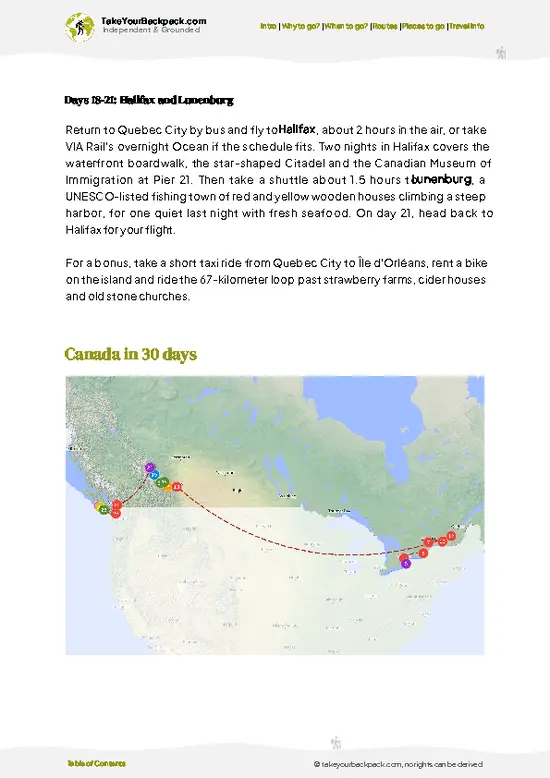
This 21-day route is for travelers drawn to the cities and history of eastern Canada, with a stretch of French-speaking Quebec countryside and a finish on the Atlantic. It suits people who like museums, food and walkable old towns as much as whale watching. The pace is comfortable, with three or four nights in each city. You’ll ride VIA Rail trains between Toronto, Ottawa, Montreal and Quebec City, regional Intercar buses into Charlevoix and Tadoussac, a short flight or VIA Rail’s overnight Ocean to Halifax, and a shuttle to Lunenburg.
Days 1-4: Toronto and Niagara Falls
Fly into
Toronto and give it four nights, since the city’s neighborhoods each deserve their own time. The ferry to the Toronto Islands costs little and gives you the best skyline view. Then compare it with the view from the top of the
CN Tower, 553 meters tall. Spend a rainy morning at the
Royal Ontario Museum, where the Chinese architecture galleries and the dinosaur halls are the standouts, and an afternoon at the
Art …
read more 👉This 21-day route is for travelers drawn to the cities and history of eastern Canada, with a stretch of French-speaking Quebec countryside and a finish on the Atlantic. It suits people who like museums, food and walkable old towns as much as whale watching. The pace is comfortable, with three or four nights in each city. You’ll ride VIA Rail trains between Toronto, Ottawa, Montreal and Quebec City, regional Intercar buses into Charlevoix and Tadoussac, a short flight or VIA Rail’s overnight Ocean to Halifax, and a shuttle to Lunenburg.
Days 1-4: Toronto and Niagara Falls
Fly into Toronto and give it four nights, since the city’s neighborhoods each deserve their own time. The ferry to the Toronto Islands costs little and gives you the best skyline view. Then compare it with the view from the top of the CN Tower, 553 meters tall. Spend a rainy morning at the Royal Ontario Museum, where the Chinese architecture galleries and the dinosaur halls are the standouts, and an afternoon at the Art Gallery of Ontario, with its room of Group of Seven landscapes that show the northern wilderness Canadians picture when they think of home. Kensington Market and the food stalls of Chinatown handle dinner.
Make Niagara Falls a day trip, about 2 hours each way by GO Train or bus. Stand at the railing beside Horseshoe Falls, take the boat into the spray, and return to Toronto for the night.Days 5-7: Ottawa
The train to Ottawa takes about 4 to 4.5 hours. The capital is compact and calm after Toronto, and three nights let you take it slowly. The National Gallery of Canada sits in a glass building facing Parliament, with a giant bronze spider sculpture outside and a strong collection of Indigenous and Canadian art inside. Cross the bridge to Gatineau for the Canadian Museum of History, where the curved Grand Hall holds West Coast totem poles under a wall of windows. In summer, walk the Rideau Canal towpath; in winter, people skate on it.Days 8-11: Montreal
Montreal is 2 hours east by train, and four nights is not too many. Walk up Mount Royal, hop between the outdoor spiral staircases of the Plateau and order bagels hot from the oven in Mile End. The Jean-Talon market is the place for picnic supplies, and in summer the city fills with free outdoor festival stages downtown. French is the working language here, though staff switch to English easily.Days 12-14: Quebec City
The train continues about 3 to 3.5 hours to Quebec City, the only walled city north of Mexico. Three nights gives you time for the ramparts, the Château Frontenac terrace, the funicular down to the Lower Town and a long walk across the Plains of Abraham. It is the most European-feeling stop on the route, and the cafés stay open late.Days 15-17: Baie-Saint-Paul and Tadoussac
An Intercar bus takes about 1.5 hours to Baie-Saint-Paul, an artists’ town in the Charlevoix hills with galleries lining the main street and local cheese shops. Stay one night, then continue to Tadoussac, crossing the mouth of the Saguenay Fjord on the free ferry at the end of the ride.
Tadoussac is the whale-watching hub of the St. Lawrence. From late spring to fall, Zodiac and boat tours head out for minke, fin and sometimes blue whales, and white belugas live here all year. Two nights gives you a backup day if the wind cancels a trip.Days 18-21: Halifax and Lunenburg
Return to Quebec City by bus and fly to Halifax, about 2 hours in the air, or take VIA Rail’s overnight Ocean if the schedule fits. Two nights in Halifax covers the waterfront boardwalk, the star-shaped Citadel and the Canadian Museum of Immigration at Pier 21. Then take a shuttle about 1.5 hours to Lunenburg, a UNESCO-listed fishing town of red and yellow wooden houses climbing a steep harbor, for one quiet last night with fresh seafood. On day 21, head back to Halifax for your flight.
For a bonus, take a short taxi ride from Quebec City to Île d’Orléans, rent a bike on the island and ride the 67-kilometer loop past strawberry farms, cider houses and old stone churches.v2.webp)

 Best Backpacking