×

Denmark🇩🇰 | best townsDiscover the 10 Best towns Across Denmark

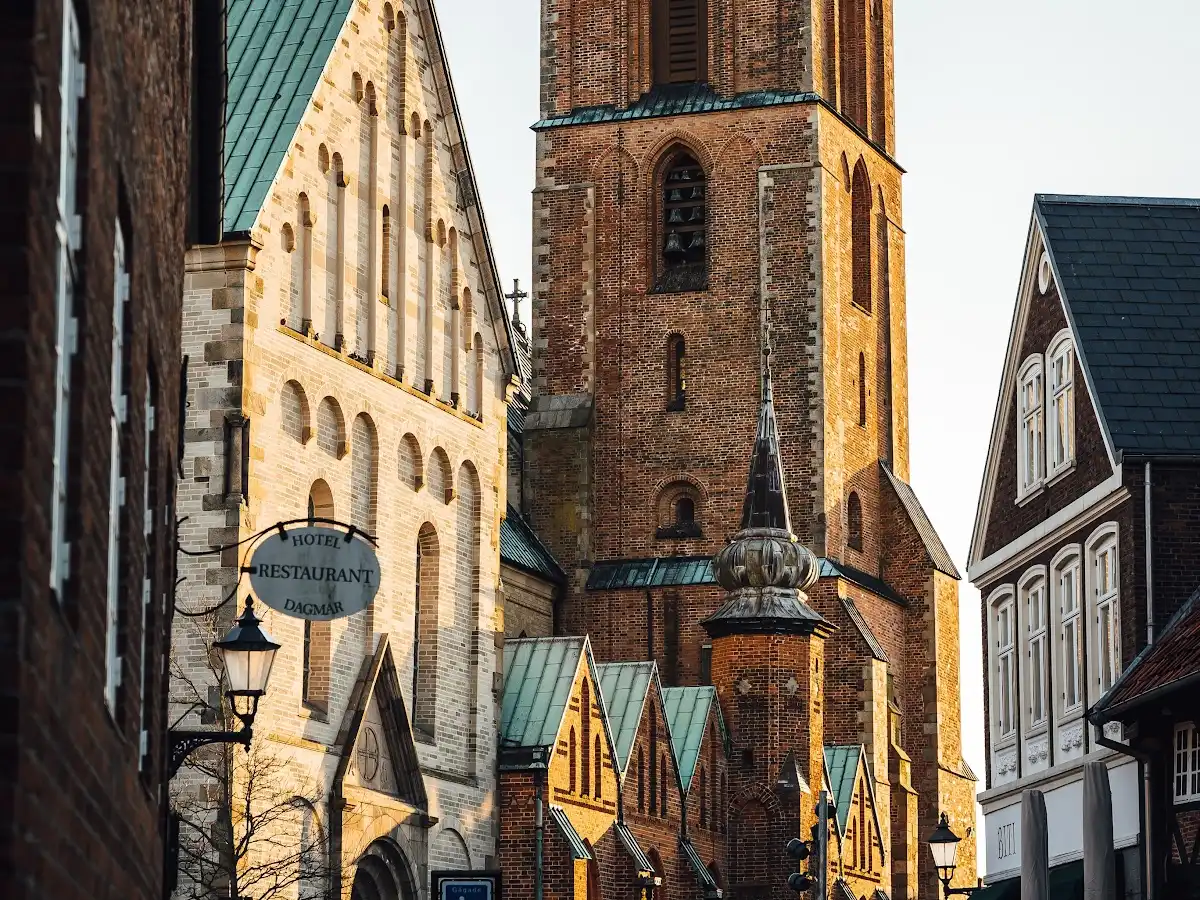
Towns in Denmark are small, orderly and walkable, usually built around a harbor, a market square or a half-timbered main street. The differences are regional. Funen and the south have the oldest, best-preserved centers and gentle prices. Jutland is larger and more varied, with North Sea fishing ports, windy dunes and fewer visitors outside July. Zealand and the Copenhagen orbit are the easiest to reach by train but cost the most. Bornholm and the other islands add ferry time and summer crowds. For backpacking or independent travel, the trains and bike lanes make nearly everything simple, while expensive food and lodging shape the choices.

By Johan Kruseman 🇳🇱 | Updated October 18, 2026
Explore the best villages in Denmark

Why go?Why These town Stand Out

Denmark suits town travel because of its scale and geography. The country is a peninsula plus more than 400 islands, no point is far from the sea, and most towns grew up as harbors and market centers within a short distance of each other. Medieval street plans survive in many places, and the half-timbered building tradition left compact cores that still work as living centers rather than museum sets.

The infrastructure helps. A dense rail and bus network, ferries between the islands and extensive cycle routes make independent movement straightforward, and English is spoken almost universally. Public spaces are clean, quiet and orderly, with a strong culture of trust and informality.

Travelers should know the limits. Denmark is expensive, especially for meals, alcohol and beds, and there … read more 👉
Denmark suits town travel because of its scale and geography. The country is a peninsula plus more than 400 islands, no point is far from the sea, and most towns grew up as harbors and market centers within a short distance of each other. Medieval street plans survive in many places, and the half-timbered building tradition left compact cores that still work as living centers rather than museum sets.

The infrastructure helps. A dense rail and bus network, ferries between the islands and extensive cycle routes make independent movement straightforward, and English is spoken almost universally. Public spaces are clean, quiet and orderly, with a strong culture of trust and informality.

Travelers should know the limits. Denmark is expensive, especially for meals, alcohol and beds, and there is little in the way of dramatic scenery. The landscape is flat, the climate is maritime and changeable, and many smaller towns are quiet in the evening, with shops closing early and on Sundays. The appeal is in detail and atmosphere: harbors, bakeries, small museums, churches and bike rides between them. Those expecting mountains, nightlife or cheap eating will be disappointed. Those who value calm, design and ease of movement tend to find the country rewarding.
Behind the Scenes of Selection
The list of best towns in Denmark is created based on charm, local culture, atmosphere, hidden gems, and visitor appeal. If you feel a town is missing in this list, please let us know.

When to go?Optimal Periods for Travel

Best months: The best months for towns in Denmark are May to September, when daytime highs run about 15 to 22°C, daylight lasts up to 17 hours in midsummer, and outdoor seating, ferries and museums all operate on full schedules. June and early September give the best balance of mild weather and manageable crowds.

Peak and shoulder seasons: July and the first half of August are the peak. Danish school holidays fill coastal towns and islands such as Bornholm, Funen’s south coast and the west Jutland beaches, and beds can cost 20 to 40 percent more than in spring. Book ahead for those areas. April and October are shoulder months with highs of 8 to 13°C, lower prices and shorter opening hours, and some seasonal attractions open only from May or close after September.

Winter and rain: From November … read more 👉
Best months: The best months for towns in Denmark are May to September, when daytime highs run about 15 to 22°C, daylight lasts up to 17 hours in midsummer, and outdoor seating, ferries and museums all operate on full schedules. June and early September give the best balance of mild weather and manageable crowds.

Peak and shoulder seasons: July and the first half of August are the peak. Danish school holidays fill coastal towns and islands such as Bornholm, Funen’s south coast and the west Jutland beaches, and beds can cost 20 to 40 percent more than in spring. Book ahead for those areas. April and October are shoulder months with highs of 8 to 13°C, lower prices and shorter opening hours, and some seasonal attractions open only from May or close after September.

Winter and rain: From November to March temperatures hover between -1 and 5°C, days are short (about 7 hours of light in December), and the weather is damp and windy. Many seaside towns go very quiet and some guesthouses and campsites close. Christmas markets in December give inland and city-edge towns a good reason to visit. Rain falls year-round, roughly 600 to 800 mm annually, with late summer and autumn the wettest. The west coast of Jutland is windier and cooler than the sheltered east and the islands, so pack a windproof layer even in July.

town hoppingOptimizing Your Multi-Stop Itinerary

How long to allow: A trip combining several towns in Denmark needs 7 to 12 days, which allows four to six stops without constant packing. Denmark is compact, so the limiting factor is not distance but the habit of trying to see too much.

Grouping and direction: The regions that cluster well are Zealand with Copenhagen as the rail hub, Funen and the south islands, and east Jutland. Travel in one direction. A west-bound sweep works naturally: start in Copenhagen, cross to Funen by train (about 2 hours to Odense, over the Great Belt bridge), then continue into Jutland (Odense to Aarhus about 1.5 hours, to Ribe about 2 to 2.5 hours with a change). Bornholm is a separate branch and needs a ferry of 2.5 to 3 hours from Køge or a short flight from Copenhagen, plus at least three days to be worth … read more 👉
How long to allow: A trip combining several towns in Denmark needs 7 to 12 days, which allows four to six stops without constant packing. Denmark is compact, so the limiting factor is not distance but the habit of trying to see too much.

Grouping and direction: The regions that cluster well are Zealand with Copenhagen as the rail hub, Funen and the south islands, and east Jutland. Travel in one direction. A west-bound sweep works naturally: start in Copenhagen, cross to Funen by train (about 2 hours to Odense, over the Great Belt bridge), then continue into Jutland (Odense to Aarhus about 1.5 hours, to Ribe about 2 to 2.5 hours with a change). Bornholm is a separate branch and needs a ferry of 2.5 to 3 hours from Køge or a short flight from Copenhagen, plus at least three days to be worth the trouble. The far north of Jutland is 3 to 4 hours from Aarhus by train and bus.

Pacing and mistakes: Allow one night per small town, two where there is a lot to walk, cycle or visit. Typical mistakes are fitting the islands and the north into a short trip, ignoring that rural buses thin out sharply on weekends, and arriving late in towns where restaurants stop serving around 20:00 or 21:00. Instead, cut a region, check weekend timetables on Rejseplanen, and keep arrivals before late afternoon.

The ListMust-Visit towns in Denmark

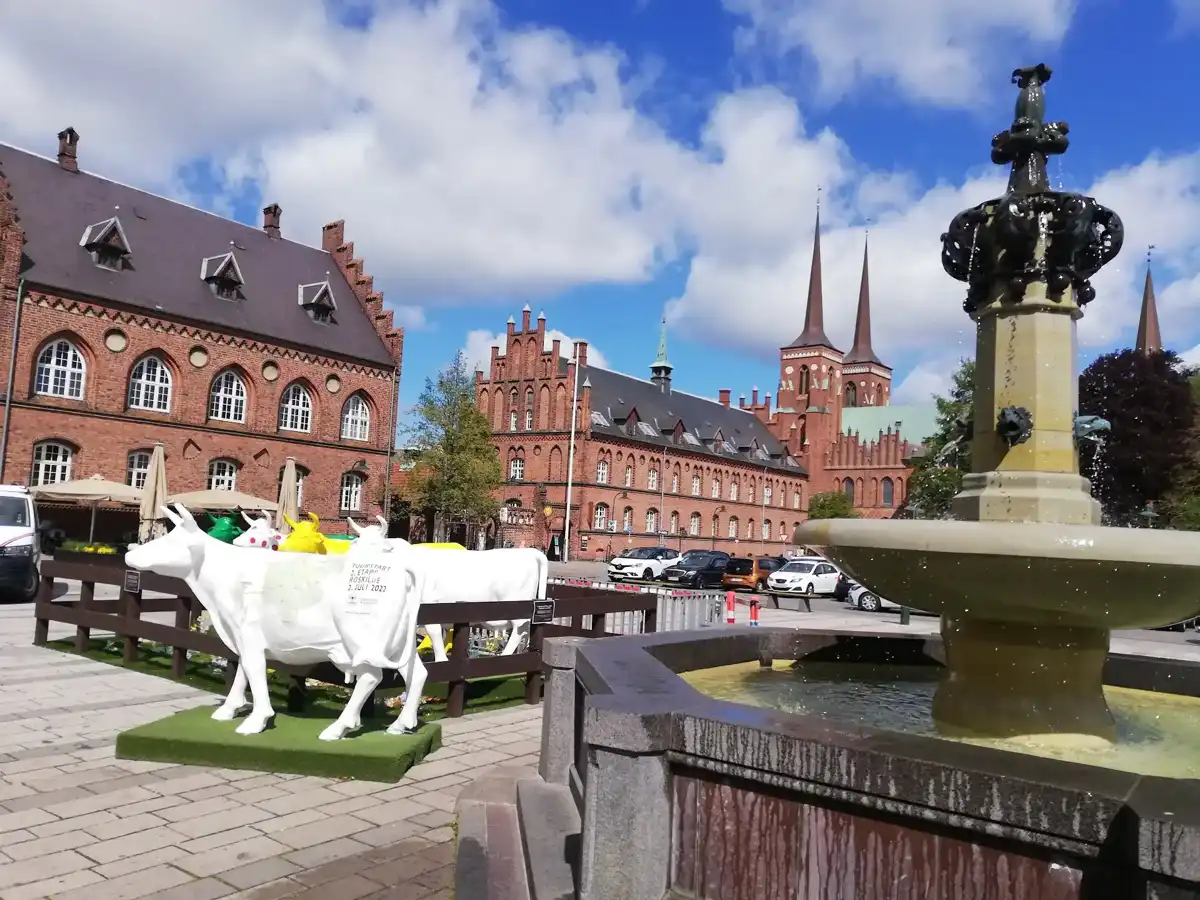
1 Roskilde

Viking ship museum, cathedral, music festival site

See reconstructed longships, visit royal tombs, and walk fields that host one of Europe’s largest music festivals.

denmark-city-roskilde
© Google | Alexander Herrmann

2 Helsingør

Kronborg Castle, Øresund views, maritime museum

Stand at the edge of Denmark, gaze across to Sweden, and explore a fortress that inspired Shakespeare’s Hamlet.

3 Ribe

medieval streets, Viking history, cathedral square

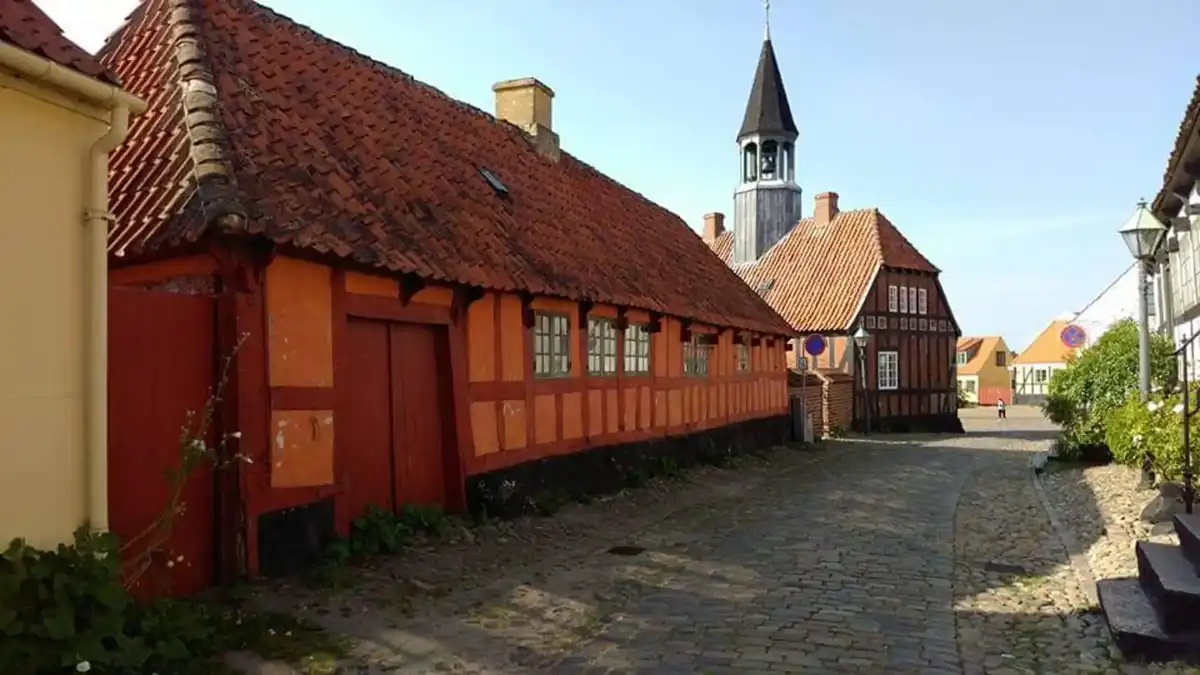
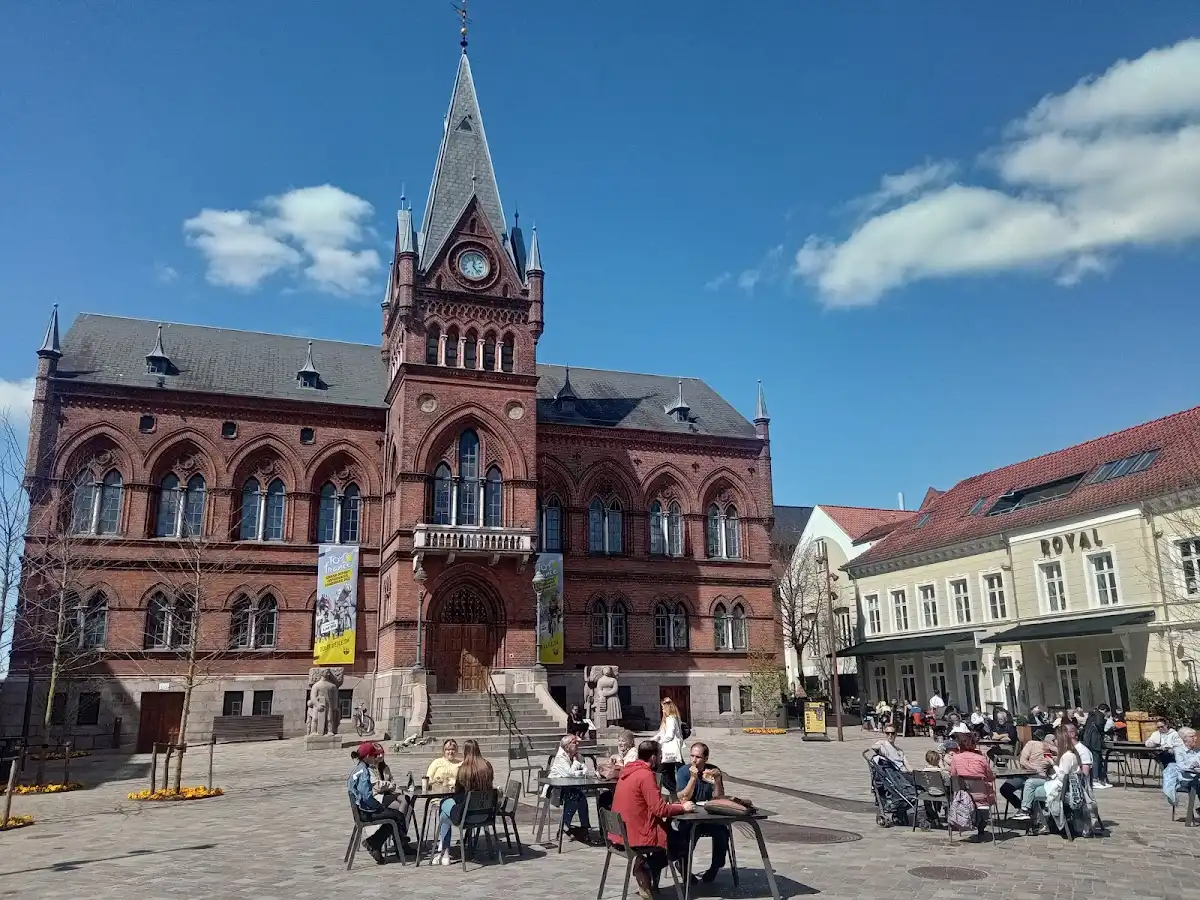
Wander cobbled lanes lined with timbered houses, then trace centuries of Danish life from Viking settlements to the present day.

denmark-city-ribe
© Google |

4 Ebeltoft

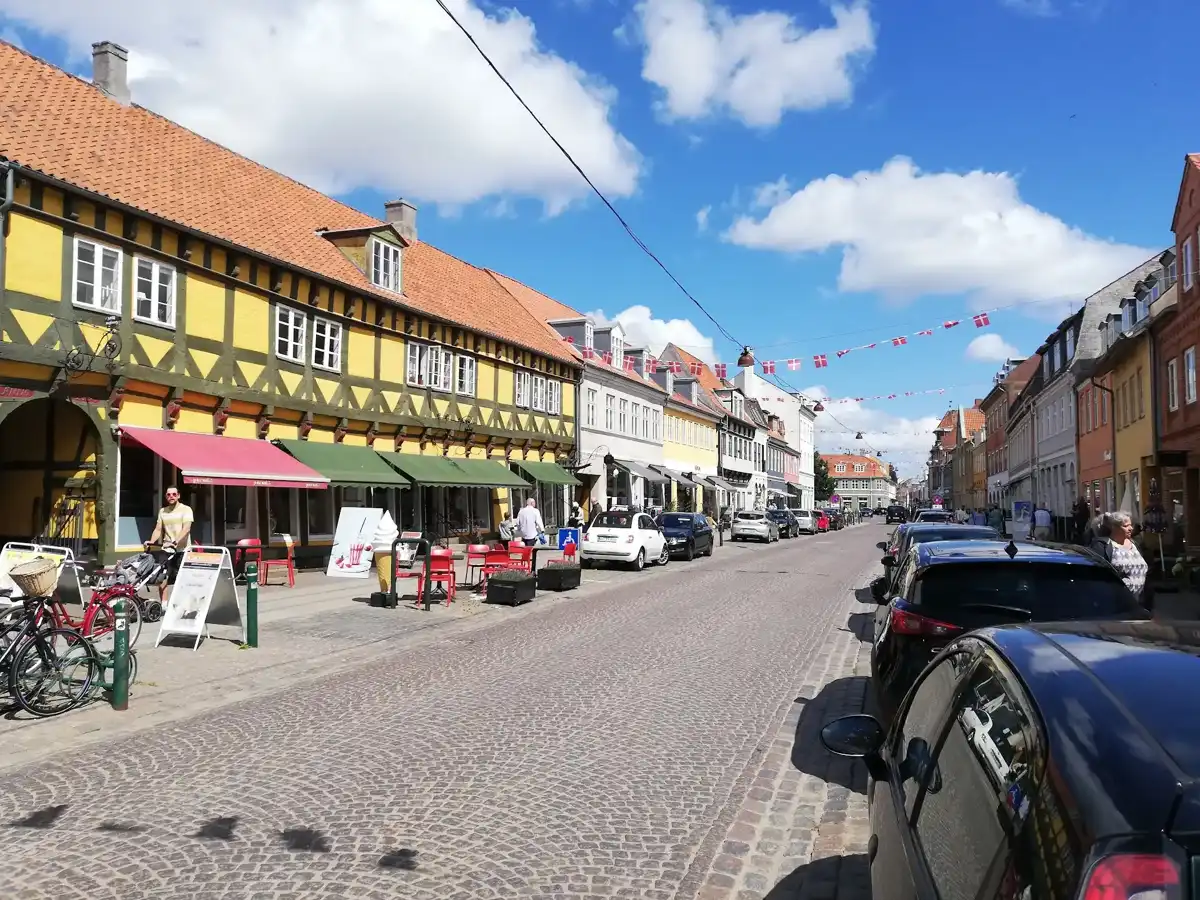
timbered houses, glass museum, cobbled main street

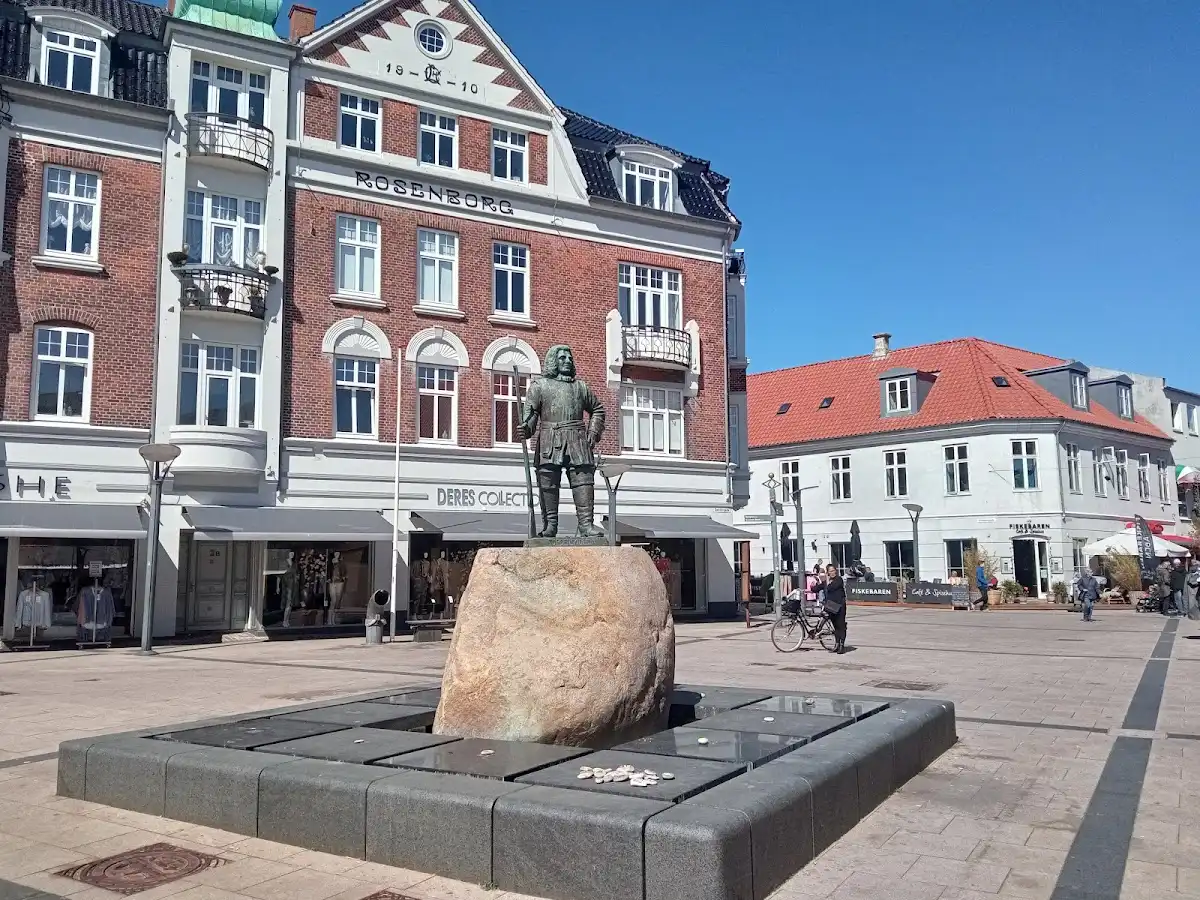
Admire centuries-old buildings, visit contemporary glass art, and walk a main street lined with small shops and cafés.

denmark-city-ebeltoft
© Google | Simon

5 Billund

LEGO origins, family attractions, airport hub

Experience a town built around creative play, international connections, and accessible activities designed for all ages.

6 Silkeborg

lake district, forest trails, art museum

Paddle through interconnected lakes, hike wooded ridges, and discover Danish landscape art in a town surrounded by natural quiet.

denmark-city-silkeborg
© Google |

7 Rønne

granite houses, Baltic ferry, cobbled alleys

Arrive by sea, wander through stone-built streets, and use the town as a base for exploring Bornholm’s varied landscapes.

denmark-city-ronne
© Google |

8 Hillerød

Frederiksborg Castle, baroque gardens, lake island

Tour a lakeside palace filled with Danish history, stroll formal gardens, and enjoy the calm of a town set among woods.

denmark-city-hillerod
© Google |

9 Sønderborg

harborfront, Dybbøl Mill, borderland culture

Walk along the water’s edge, visit sites recalling Denmark’s shifting borders, and experience a blend of Danish and German influences.

10 Esbjerg

North Sea port, modern sculpture, offshore industry

Watch ships come and go, visit striking public art on the waterfront, and see how the sea shapes daily life and work.

11 Frederikshavn

ferry port, palm beach, WWII bunkers

Relax on a sandy beach lined with palm trees, explore coastal defenses, and catch ferries to Norway or Sweden.

denmark-city-frederikshavn
© Google |

12 Vejle

fjord views, modern architecture, rolling hills

Climb forested slopes for panoramic views, admire innovative buildings, and explore a town shaped by its landscape.

denmark-city-vejle
© Google |

13 Faaborg

South Funen archipelago, harbor, pastel houses

Board island ferries, stroll narrow lanes with colorful facades, and enjoy the slow pace of a coastal market town.

14 Nyborg

Great Belt Bridge, medieval castle, coastal ramparts

Cross from island to island, explore a fortress once central to Danish kings, and walk along the old town’s defenses.

15 Ringkøbing

windblown fjord, red brick houses, cobbled square

Feel the North Sea breeze, explore a compact town center, and watch windsurfers skim across the shallow fjord.

16 Nexø

east coast harbor, smokehouses, art ceramics

Sample smoked fish, browse local pottery, and watch the rhythm of daily life in Bornholm’s second-largest town.

17 Køge

half-timbered square, sandy beach, Viking ship

Relax on the coast, explore Denmark’s oldest town square, and see a reconstructed Viking vessel in the harbor.

denmark-city-koge
© Google | Alexander Herrmann

18 Haderslev

cathedral, lakeside park, canal

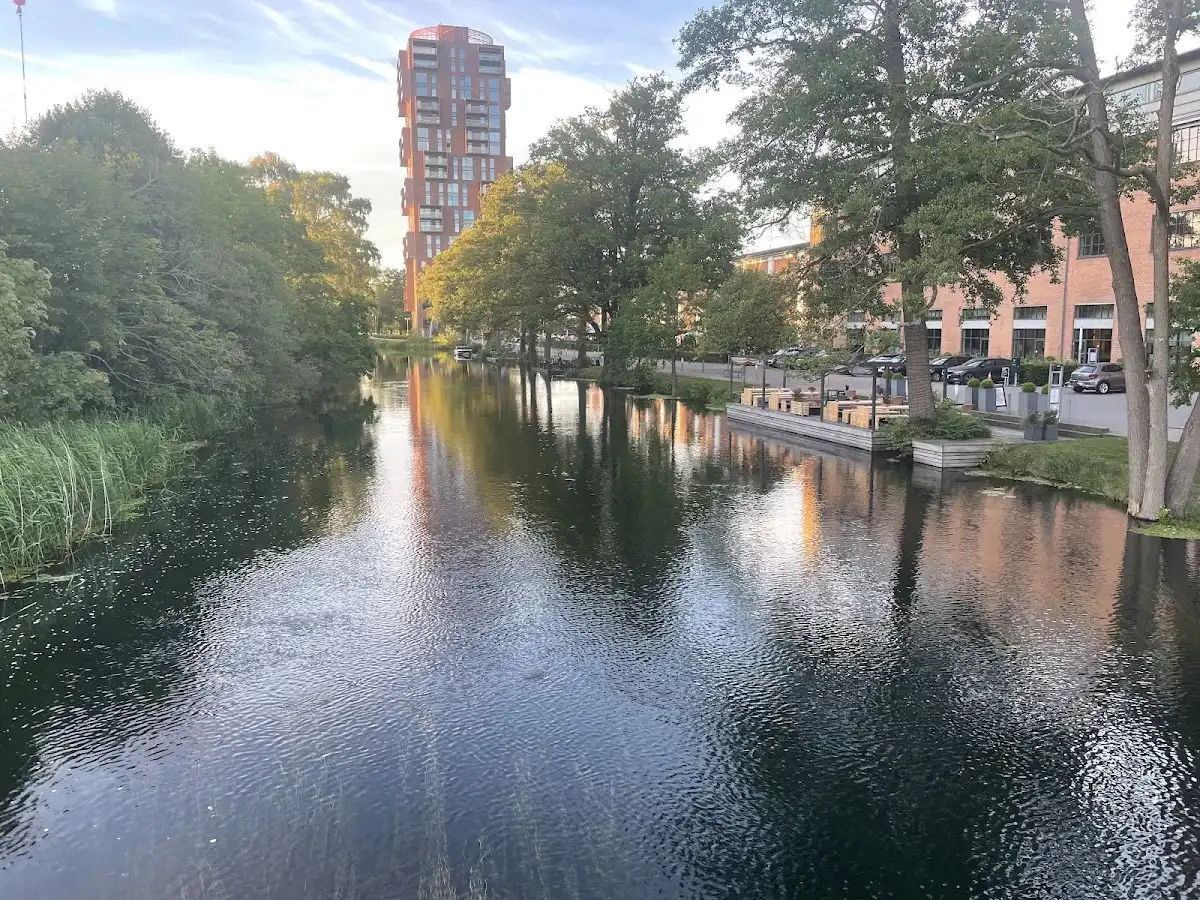
Cycle along tree-lined lakes, visit a towering church, and follow the canal through a town shaped by water.

19 Thisted

Limfjord shore, craft brewery, heathland

Sample local beer, walk along quiet fjord beaches, and explore open landscapes dotted with small villages.

20 Hirtshals

fishing harbor, lighthouse, ferry terminal

Watch trawlers unload the day’s catch, climb to windswept views, and feel the pulse of a town linked to the North Sea.

21 Kalundborg

five-towered church, industrial harbor, medieval quarter

See unique church architecture, wander through narrow medieval streets, and observe the mix of old town and working port.

22 Holbæk

fjord marina, art galleries, market square

Sail or kayak on calm waters, browse local art, and experience a lively town center with regular outdoor events.

23 Skive

fjordside promenade, sculpture trail, local museum

Walk along the waterfront, discover outdoor art installations, and learn about the region’s rural traditions.

24 Lemvig

harbor basin, coastal cliffs, planet path

Follow a scale model of the solar system along the fjord, watch fishing boats, and hike dramatic coastal hills.

Think you know Denmark?

Prove you’re a true local — uncover 14 lesser-known towns in Denmark that locals tend to keep to themselves.
Loading the map 🌍

Expert viewTips and Advice from Travelers

How many towns: Plan on four to six towns in a typical 8 to 12 day trip. Fewer than four wastes the efficient rail network. More than six turns the trip into luggage handling, since each move costs half a day once you add checkout, the ride and finding the hostel. One night per stop is acceptable for small harbors, two for larger centers with several things to do.

Which kind to prioritize: For a first trip, favor historic centers on Funen and in the south and east of Jutland. They give the most for the least cost and effort, with walkable cores, free churches and streets, and frequent trains. Choose coastal and island towns if you want beaches, cycling and quiet, but accept higher summer prices, ferry fares (roughly DKK 150 to 400, about US$22 to 58, one way) and sparse buses. University … read more 👉
How many towns: Plan on four to six towns in a typical 8 to 12 day trip. Fewer than four wastes the efficient rail network. More than six turns the trip into luggage handling, since each move costs half a day once you add checkout, the ride and finding the hostel. One night per stop is acceptable for small harbors, two for larger centers with several things to do.

Which kind to prioritize: For a first trip, favor historic centers on Funen and in the south and east of Jutland. They give the most for the least cost and effort, with walkable cores, free churches and streets, and frequent trains. Choose coastal and island towns if you want beaches, cycling and quiet, but accept higher summer prices, ferry fares (roughly DKK 150 to 400, about US$22 to 58, one way) and sparse buses. University and design-minded towns suit people who like cafés, galleries and evenings out, and they have the best hostel supply. The west coast and the far north give wind and space but need more time and a bike or rental car, so they suit repeat visitors more than first-timers.

What it costs: A frugal backpacker should budget DKK 650 to 950 a day (about US$95 to 140). Hostel dorms run DKK 230 to 400, camping DKK 90 to 150 per person, and supermarket food (Netto, Rema 1000, Lidl) about DKK 100 to 150 a day. A bakery lunch costs DKK 40 to 70, and a restaurant main DKK 150 to 250. Local trains and buses run about DKK 20 to 40 for short hops and DKK 150 to 300 for cross-regional rides, and a Rejsekort or the DOT app lowers fares. Museum entry is DKK 90 to 160, castles and cathedrals often DKK 80 to 140, while walking streets, harbors and many churches are free. Rental bikes cost DKK 100 to 200 a day. Most towns need no guide, since signage is clear and audio apps or tourist offices cover the rest.

Safety and etiquette: Towns are very safe. Violent crime is rare, but bicycle theft is common, so lock your bike with a frame lock. Cycle lanes are taken seriously, and stepping into one is the most likely way a visitor gets into trouble. Danes tend to be reserved and punctual, queue properly and keep quiet on trains. Cards and phones are accepted nearly everywhere, and many places do not take cash. Tap water is excellent, so skip bottled water. Check opening hours, since many small museums close on Mondays and shops shut early on Sundays. Wild camping is mostly illegal, but designated shelters (shelter huts) and primitive campsites are free or cheap and widely available.

✈️ The backpacker research shortcutDenmark Travel Guide

An offline-friendly backpacking guide with optimized travel routes, ranked highlights, transport advice, and the best areas to stay.
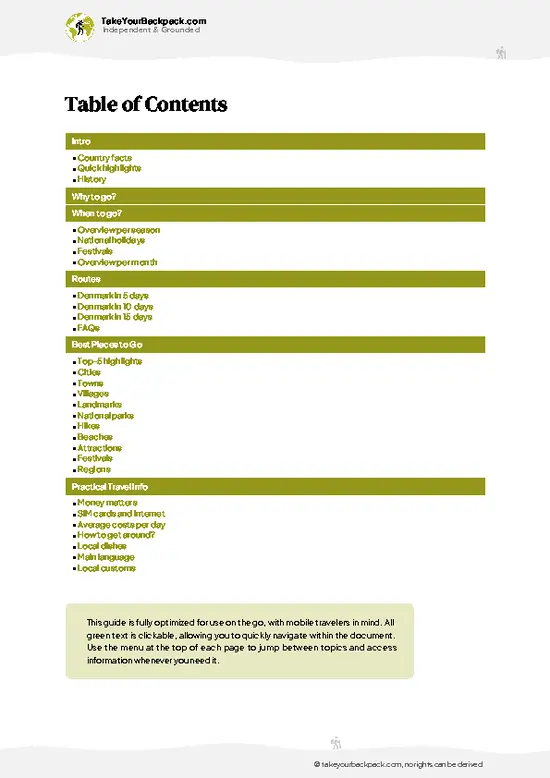
example page 0 from our offline Travel Guide for Denmark
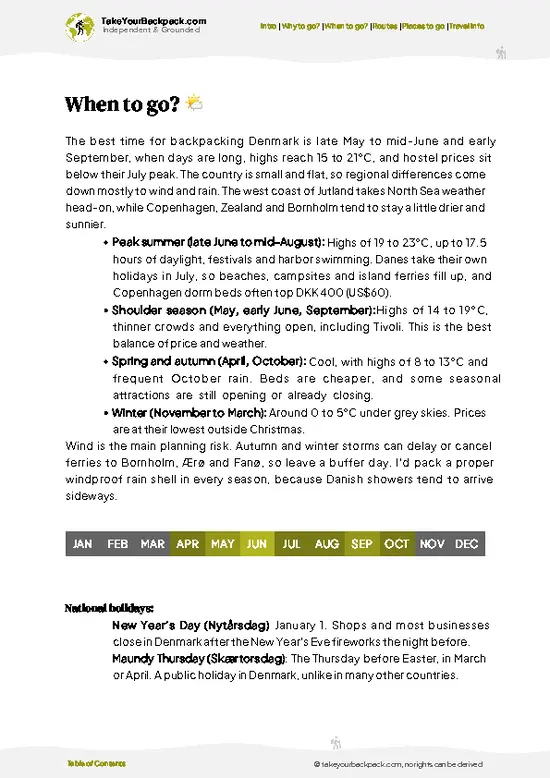
example page 1 from our offline Travel Guide for Denmark
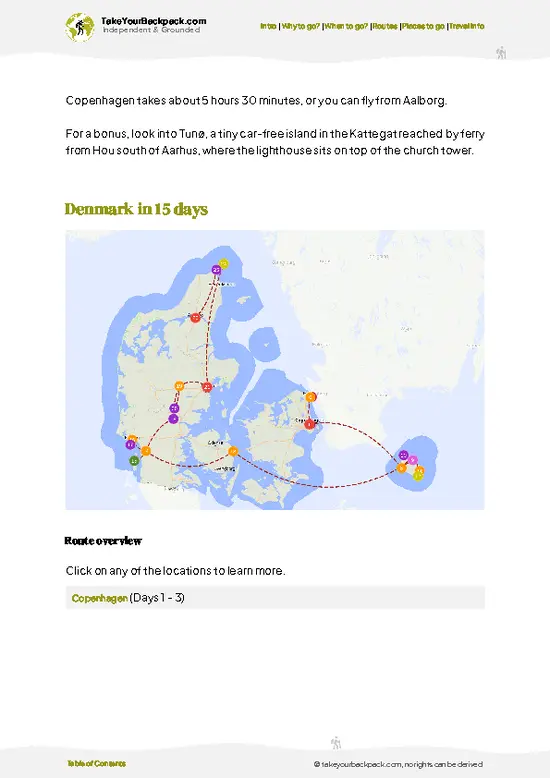
example page 2 from our offline Travel Guide for Denmark
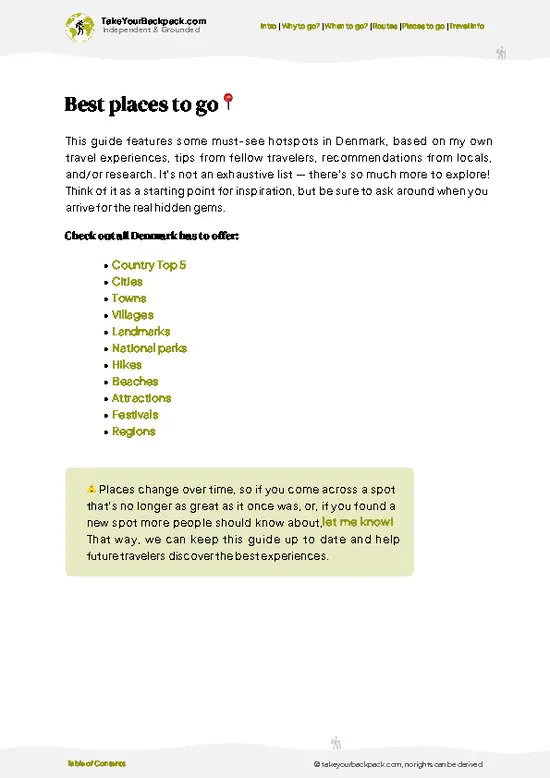
example page 3 from our offline Travel Guide for Denmark
example page 4 from our offline Travel Guide for Denmark
example page 5 from our offline Travel Guide for Denmark
example page 6 from our offline Travel Guide for Denmark
example page 7 from our offline Travel Guide for Denmark
The digital guide (359 pages) contains:
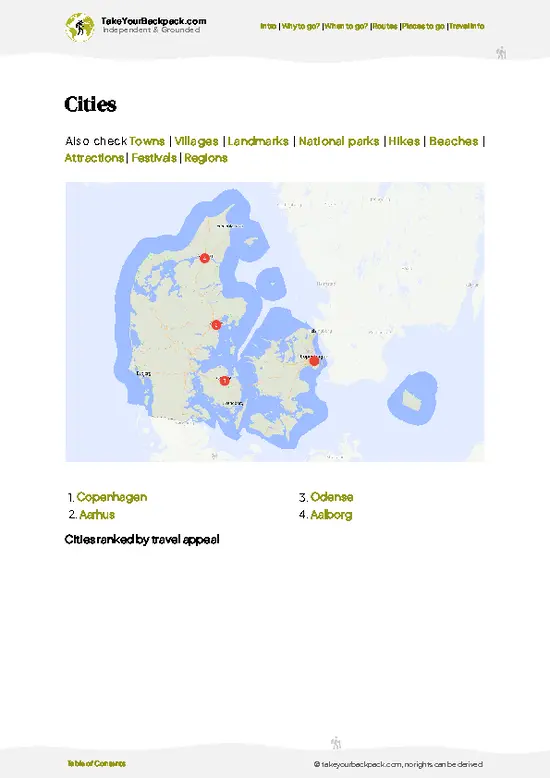
✅ 97 highlights, ranked by travel appeal
✅ Optimized 5, 10 & 15-day travel routes
✅ Cities, national parks, landmarks, beaches
✅ How to get around
✅ Offline-friendly for travel without Wi-Fi
👉 Click to see all 30+ guide features

📅 Plan smarter in minutes, not weeks
✅ Month by month travel advice
✅ Festivals & national holidays
✅ Budget expectations

🗺️ Go to the right places, skip the overrated ones
✅ Honest pros & cons of destinations
✅ Top hikes, parks & viewpoints
✅ Lesser-known places most travelers miss
✅ Clear “worth it vs skip it” guidance

🛏️ Travel smoothly without rookie mistakes
✅ Best areas to stay
✅ Transport systems explained simply
✅ Common scams & safety advice
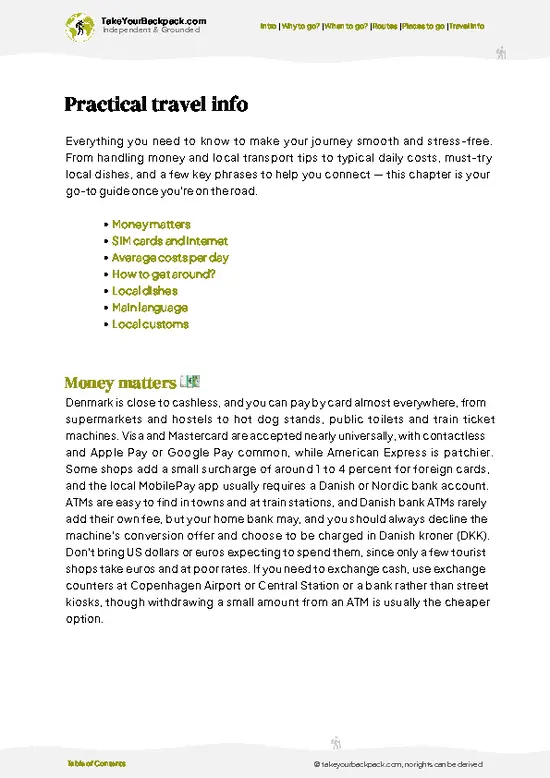
✅ SIM cards, money & practical tips

🌍 Understand the country, not just visit it
✅ Culture & traditions
✅ 52 Essential phrases & customs
✅ Festivals worth planning around
✅ Traveler-friendly historical context
✅ Insights that make places more meaningful

📱 Built for real travel conditions
✅ Fully downloadable PDF
✅ Works completely offline
✅ Optimized for phone use
✅ Useful in remote areas & buses
✅ Everything in one place
Stop searching, start planning
Get instant access to your full guide. 30‑day money-back guarantee.
+ Add another guide for just

By proceeding you agree to our terms.
Sent to your inbox immediately after payment • 100% Secure Checkout
Best Backpacking Travel Advisor 2025 tourism awardBest Backpacking
Travel Advisor
2025
What others say about Take Your Backpack Guides:
⭐⭐⭐⭐⭐
Fantastic, amazing amount of information!
⭐⭐⭐⭐⭐
My goodness this is amazing, it's what I've been looking for hats off too you!
⭐⭐⭐⭐⭐
I think this is absolutely BRILLIANT
⭐⭐⭐⭐
Very complete and informative. It's still missing places, but I gotta to commend you
⭐⭐⭐⭐⭐
This is truly amazing, thank you, can't wait to explore it with my kids!
⭐⭐⭐⭐⭐
Awesome resource, thank you!
⭐⭐⭐⭐⭐
This is amazing! Can't wait to explore the ones I haven't seen
⭐⭐⭐⭐
I love this! Well done, great idea.
⭐⭐⭐⭐⭐
Thanks for taking the time to make this gem!
⭐⭐⭐⭐⭐
This might be the best website I've ever seen.
⭐⭐⭐⭐⭐
Congratulations, and thank you so much for your work; it's incredibly valuable.
⭐⭐⭐⭐
In all seriousness I think you did a great job pointing out the important spots
⭐⭐⭐⭐⭐
10/10 very good
⭐⭐⭐⭐⭐
As someone who's only just starting to visit regularly this is awesome, thank you.
⭐⭐⭐⭐
Thank you very much! I'm going to visit my dad, it's going to be very useful!
⭐⭐⭐⭐⭐
This is really cool! We'll be travelling for the first time and this definitely come in handy.
⭐⭐⭐⭐⭐
You are now our minister of culture, congratulations 👨‍💼
⭐⭐⭐⭐⭐
Just wanted to tell you that this is a pearl! Going to follow your recommendations.
⭐⭐⭐⭐⭐
This is so cool. I'll definitely be using the resource for my travels soon.
⭐⭐⭐⭐⭐
This is very impressive! Good work.
⭐⭐⭐⭐⭐
This is an amazing and informative site. Very well done!

🛏️ Where to stay?Top Places to Consider Staying

Denmark has plenty of hostels, with dorm beds usually running DKK 200 to 400 (about US$30 to 60) a night and the widest choice in Copenhagen, plus smaller clusters in Aarhus and Odense. In Copenhagen, Vesterbro next to the Central Station has the most beds and the Meatpacking District’s late bars, though stretches of Istedgade feel scruffy after dark, while Indre By puts you within walking distance of Nyhavn and Strøget at higher prices, and Nørrebro trades a 15 to 20 minute bike ride from the center for cheaper food and lively bars along Jægersborggade and Blågårdsgade. In Aarhus, the Latin Quarter keeps you close to cafés and the old town, but rooms book out fast around university terms and … read more 👉
Denmark has plenty of hostels, with dorm beds usually running DKK 200 to 400 (about US$30 to 60) a night and the widest choice in Copenhagen, plus smaller clusters in Aarhus and Odense. In Copenhagen, Vesterbro next to the Central Station has the most beds and the Meatpacking District’s late bars, though stretches of Istedgade feel scruffy after dark, while Indre By puts you within walking distance of Nyhavn and Strøget at higher prices, and Nørrebro trades a 15 to 20 minute bike ride from the center for cheaper food and lively bars along Jægersborggade and Blågårdsgade. In Aarhus, the Latin Quarter keeps you close to cafés and the old town, but rooms book out fast around university terms and festival weeks.

If you enjoy meeting fellow travelers, consider choosing hostels with high ratings for atmosphere. On the other hand, if you prefer having your own space, a hotel might be a better option.

DenmarkMore Places Across Denmark

👋 Meet the founderWho’s Behind Take Your Backpack?

Johan, backpacker and founder of TakeYourBackpackHi, I’m Johan (Netherlands 🇳🇱), the creator of TakeYourBackpack. Over the past 3 decades, I’ve backpacked through 90+ countries across six continents, gaining extensive experience with independent travel, long-term trips, and overland routes.

This site is built on a combination of firsthand travel experience and carefully curated insights from other backpackers. Many guides are based on places I’ve personally visited, while others bring together tips, observations, and practical advice shared by trusted travelers I’ve met along the way.

The goal is to provide realistic, experience-driven guidance — not generic itineraries — so you can explore destinations with better context, clearer expectations, and more confidence.