×

Equatorial Guinea🇬🇶 | best townsTop-Rated 10 towns in Equatorial Guinea

Equatorial Guinea’s towns offer a unique blend of local culture, walkability, and regional differences that shape every backpacking experience. From the bustling streets of Malabo to the quieter charm of Bata, each town presents distinct vibes influenced by geography and seasonal patterns. Choosing the right town impacts your budget, safety, and ease of travel, making it essential for independent travelers to consider how these factors enhance cultural immersion and overall enjoyment.

By Johan Kruseman 🇳🇱 | Updated June 11, 2026
Explore the best villages in Equatorial Guinea

Why go?Key Factors That Shape the Experience

Towns in Equatorial Guinea stand out for their local charm and cultural richness, offering a pace of life that contrasts sharply with more commercialized destinations. The culinary scene is vibrant, showcasing unique dishes that reflect the country’s diverse influences, from Spanish to indigenous flavors.

Geographically, the country’s infrastructure can be challenging, with limited transport options that may affect travel time. This necessitates careful itinerary planning; clustering towns can enhance depth of exploration but may sacrifice accessibility.

Equatorial Guinea’s climate varies significantly, impacting the best times to visit different regions. Travelers should weigh the trade-offs between immersive experiences in less accessible areas and the convenience of more developed towns. … read more 👉
Towns in Equatorial Guinea stand out for their local charm and cultural richness, offering a pace of life that contrasts sharply with more commercialized destinations. The culinary scene is vibrant, showcasing unique dishes that reflect the country’s diverse influences, from Spanish to indigenous flavors.

Geographically, the country’s infrastructure can be challenging, with limited transport options that may affect travel time. This necessitates careful itinerary planning; clustering towns can enhance depth of exploration but may sacrifice accessibility.

Equatorial Guinea’s climate varies significantly, impacting the best times to visit different regions. Travelers should weigh the trade-offs between immersive experiences in less accessible areas and the convenience of more developed towns. Understanding these dynamics is crucial for a rewarding journey through this often-overlooked destination.
Behind the Scenes of Selection
The list of best towns in Equatorial Guinea is created based on charm, local culture, atmosphere, hidden gems, and visitor appeal. If you feel a town is missing in this list, please let us know.

When to go?Seasonal Guide to Visiting

Seasonality significantly influences the towns of Equatorial Guinea. The country experiences a tropical climate, characterized by two main seasons: the dry season and the rainy season. The dry season, typically from November to March, offers more comfortable temperatures and lower humidity, making it ideal for exploring local life and cultural events.

Optimal months for visits are generally December through February, when rainfall is minimal and outdoor activities are more enjoyable.

Shoulder seasons occur in April and October, presenting a balance between fewer crowds and moderate weather. However, travelers may encounter occasional rain and humidity.

Peak periods coincide with local festivals, which can lead to increased accommodation costs and crowded conditions. Understanding these … read more 👉
Seasonality significantly influences the towns of Equatorial Guinea. The country experiences a tropical climate, characterized by two main seasons: the dry season and the rainy season. The dry season, typically from November to March, offers more comfortable temperatures and lower humidity, making it ideal for exploring local life and cultural events.

Optimal months for visits are generally December through February, when rainfall is minimal and outdoor activities are more enjoyable.

Shoulder seasons occur in April and October, presenting a balance between fewer crowds and moderate weather. However, travelers may encounter occasional rain and humidity.

Peak periods coincide with local festivals, which can lead to increased accommodation costs and crowded conditions. Understanding these patterns helps in planning trips that align with personal preferences for weather and local experiences.

town hoppingHow to Combine towns Into One Trip

Routing Logic

Focus on regional clusters to minimize travel fatigue. Start in Malabo, the capital, then head to Bata, which is a natural next stop. From there, consider visiting smaller towns like Luba or Mbini, which offer unique local experiences.

Time Management

Allocate at least half a day for each town. This allows for exploration without feeling rushed. If visiting multiple towns in one day, expect longer travel times due to road conditions.

Common Mistakes

Avoid cramming too many stops into a short timeframe. This leads to exhaustion and missed experiences. Prioritize quality over quantity.

Trade-offs

Consider the balance between speed and depth. Quick visits may save time but can sacrifice meaningful interactions. Budget constraints may limit comfort, so weigh accommodations … read more 👉

Routing Logic

Focus on regional clusters to minimize travel fatigue. Start in Malabo, the capital, then head to Bata, which is a natural next stop. From there, consider visiting smaller towns like Luba or Mbini, which offer unique local experiences.

Time Management

Allocate at least half a day for each town. This allows for exploration without feeling rushed. If visiting multiple towns in one day, expect longer travel times due to road conditions.

Common Mistakes

Avoid cramming too many stops into a short timeframe. This leads to exhaustion and missed experiences. Prioritize quality over quantity.

Trade-offs

Consider the balance between speed and depth. Quick visits may save time but can sacrifice meaningful interactions. Budget constraints may limit comfort, so weigh accommodations against experiences. Flexibility in planning allows for spontaneous discoveries, enhancing the journey.

The ListHighly Recommended towns of Equatorial Guinea

1 Pueblo de Luba

volcanic hills, colonial relics, black sand beaches

Relax in a coastal settlement framed by volcanic slopes and relics of colonial architecture, with quiet beaches just beyond the town.

equatorial-guinea-city-pueblo-de-luba v1
© Google |

2 Moca

crater lakes, cool climate, highland farming

Explore a highland village known for its cool air, crater lakes, and agricultural terraces carved into the slopes above the clouds.

equatorial-guinea-city-moca
© Google |

3 Ebebiyin

border crossroads, tri-national junction, busy transport hub

Cross into a town defined by its position at the meeting point of three countries, with constant movement and cross-border exchange.

4 Mongomo

presidential palace, grand cathedral, ceremonial avenues

Visit a place where national identity is on display, with monumental buildings and wide streets reflecting political significance.

5 Evinayong

hilltop setting, administrative center, panoramic views

Climb to a town perched above the rainforest, where government buildings and open vistas define the landscape and daily rhythm.

6 Mbini

river mouth, mangrove swamps, fishing boats

Watch fishermen at work where the river meets the sea, surrounded by mangroves and the constant sound of water and wildlife.

7 Cogo

island access, estuary location, stilt houses

Travel to a riverside town with wooden homes on stilts, offering access to islands and a unique estuarine environment.

8 Baney

road junction, local commerce, Bioko highlands

Pause in a small town at a crossroads in Bioko’s highlands, where local trade and transport routes intersect in a compact center.

9 Añisoc

savanna edge, regional market, crossroads town

Experience a market town at the transition between forest and savanna, where regional trade and rural life converge.

10 Niefang

river crossing, gateway town, mixed cultures

Cross the river into a town that serves as a gateway between regions, marked by cultural diversity and a steady flow of travelers.

11 Aconibe

forest edge, local markets, river crossing

Experience a town where daily life unfolds along the riverbank, with markets and forested surroundings shaping the pace and priorities.

12 Rebola

mountain slopes, Bioko Island villages, traditional homesteads

Hike through a hillside community on Bioko, where rural life and mountain scenery create a sense of isolation and authenticity.

13 Micomeseng

agricultural zone, cocoa farms, rural landscape

Travel through a farming region where cocoa plantations and small villages stretch across the landscape, shaping the local economy.

Think you know Equatorial Guinea?

Prove you’re a true local — uncover 3 lesser-known towns in Equatorial Guinea that locals tend to keep to themselves.
Loading the map 🌍

Expert viewInsights from Locals and Experts

Regional Clustering
Equatorial Guinea is compact, making it feasible to explore multiple towns in a single trip. Aim for three to five towns to capture the essence of the country. Each area offers distinct cultural flavors and landscapes. The coastal towns contrast sharply with the inland regions, where traditional lifestyles persist. Prioritize your route based on interests—be it coastal relaxation or cultural immersion.

Travel Rhythm
Expect a slower pace. Infrastructure can be inconsistent, so plan for delays. Roads may be unpaved, and public transport options are limited. Allocate ample time for travel between towns. A week is a reasonable timeframe to experience a few towns without feeling rushed. This allows for spontaneous encounters and deeper engagement with local life.

Local Charmread more 👉
Regional Clustering
Equatorial Guinea is compact, making it feasible to explore multiple towns in a single trip. Aim for three to five towns to capture the essence of the country. Each area offers distinct cultural flavors and landscapes. The coastal towns contrast sharply with the inland regions, where traditional lifestyles persist. Prioritize your route based on interests—be it coastal relaxation or cultural immersion.

Travel Rhythm
Expect a slower pace. Infrastructure can be inconsistent, so plan for delays. Roads may be unpaved, and public transport options are limited. Allocate ample time for travel between towns. A week is a reasonable timeframe to experience a few towns without feeling rushed. This allows for spontaneous encounters and deeper engagement with local life.

Local Charm
Each town has its unique character. Coastal areas often showcase vibrant fishing communities, while inland towns reflect rich traditions and customs. Engage with locals; their stories and hospitality can enhance your experience. Markets are lively hubs where you can taste local cuisine and buy handmade crafts. However, be prepared for language barriers; not everyone speaks English, so a few phrases in Spanish can go a long way.

Logistical Considerations
Accommodations vary widely, from basic guesthouses to more comfortable lodgings. Budget accordingly; while some places are affordable, others may require a splurge for better amenities. Always check for availability in advance, especially in smaller towns where options can be limited.

Safety & Cultural Considerations
While Equatorial Guinea is generally safe for travelers, remain vigilant. Avoid isolated areas after dark and respect local customs. Dress modestly, particularly in rural areas, to show respect for cultural norms. Understanding local etiquette can enhance your interactions and help you navigate social dynamics smoothly.

Trade-offs
The trade-off for a richer experience is the potential for logistical challenges. Embrace the unpredictability; it often leads to the most memorable moments. Balancing your itinerary with flexibility will allow you to adapt and make the most of your journey.

✈️ The backpacker research shortcutEquatorial Guinea Travel Guide

An offline-friendly backpacking guide with optimized travel routes, ranked highlights, transport advice, and the best areas to stay.
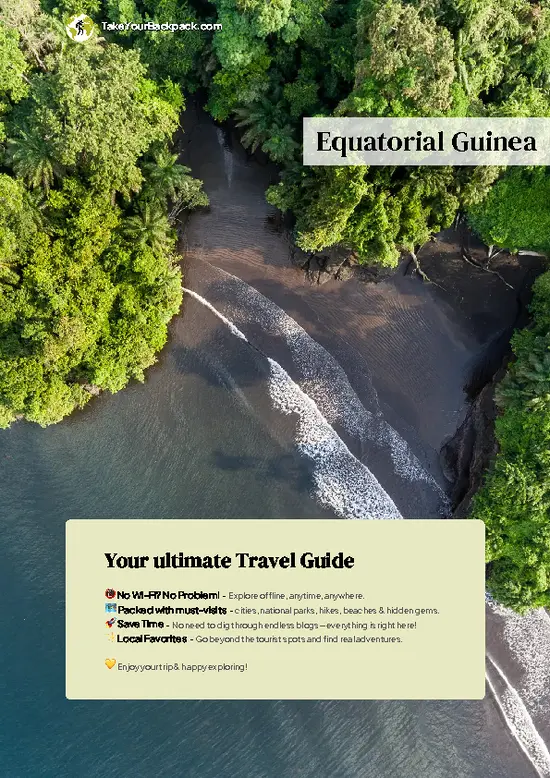
example page 0 from our offline Travel Guide for Equatorial Guinea
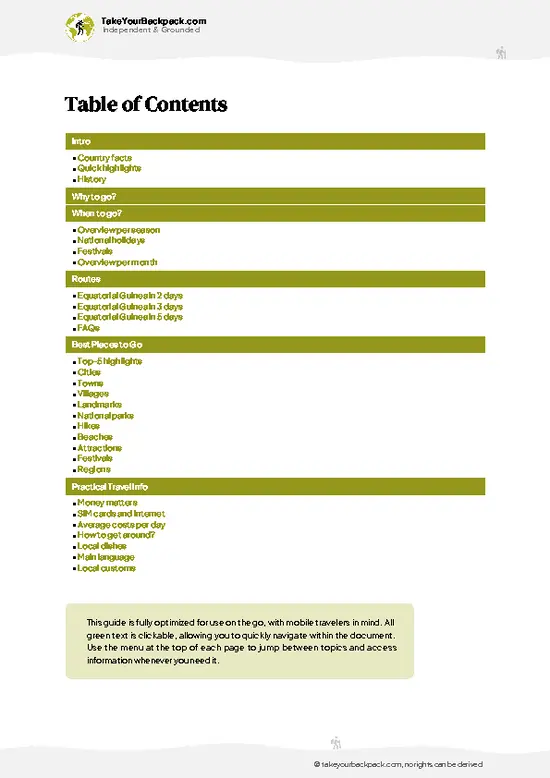
example page 1 from our offline Travel Guide for Equatorial Guinea
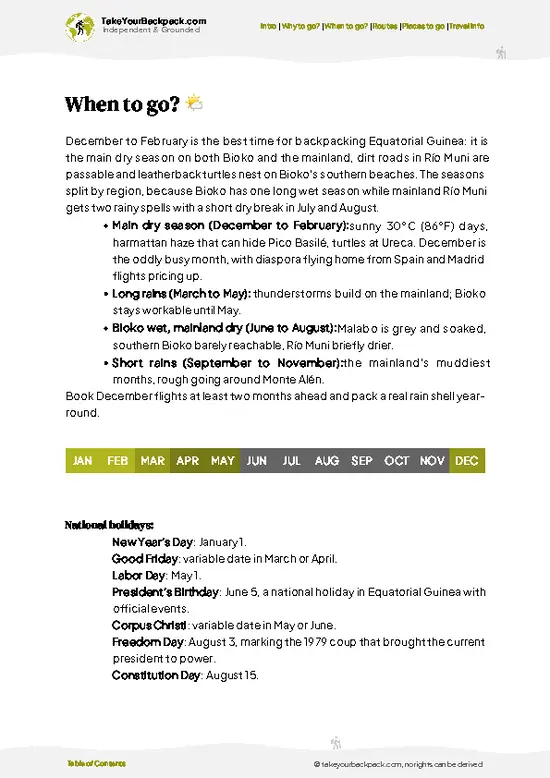
example page 2 from our offline Travel Guide for Equatorial Guinea
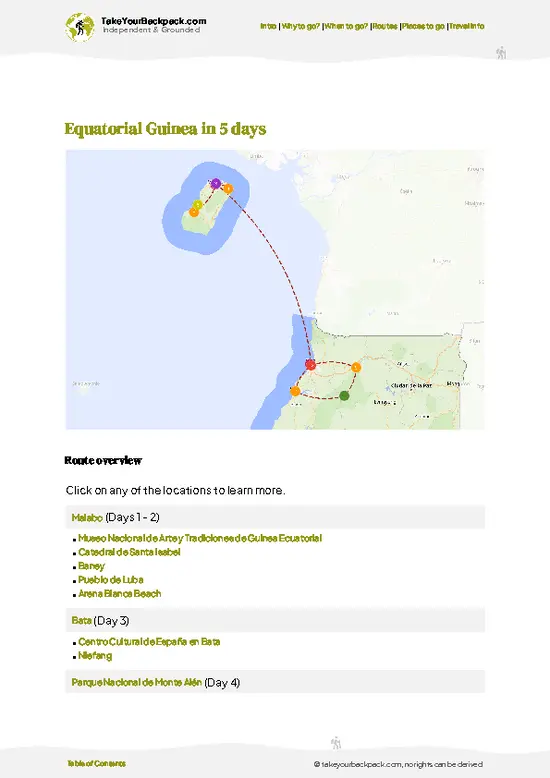
example page 3 from our offline Travel Guide for Equatorial Guinea
example page 4 from our offline Travel Guide for Equatorial Guinea
example page 5 from our offline Travel Guide for Equatorial Guinea
example page 6 from our offline Travel Guide for Equatorial Guinea
example page 7 from our offline Travel Guide for Equatorial Guinea
The digital guide (216 pages) contains:
52 highlights, ranked by travel appeal
Optimized 2, 3 & 5-day travel routes
Cities, national parks, landmarks, beaches
How to get around
Offline-friendly for travel without Wi-Fi
👉 Click to see all 30+ guide features

📅 Plan smarter in minutes, not weeks
Month by month travel advice
Festivals & national holidays
Budget expectations

🗺️ Go to the right places, skip the overrated ones
Honest pros & cons of destinations
Top hikes, parks & viewpoints
Lesser-known places most travelers miss
Clear “worth it vs skip it” guidance

🛏️ Travel smoothly without rookie mistakes
Best areas to stay
Transport systems explained simply
Common scams & safety advice
SIM cards, money & practical tips

🌍 Understand the country, not just visit it
Culture & traditions
52 Essential phrases & customs
Festivals worth planning around
Traveler-friendly historical context
Insights that make places more meaningful

📱 Built for real travel conditions
Fully downloadable PDF
Works completely offline
Optimized for phone use
Useful in remote areas & buses
Everything in one place
Save weeks of stressful planning
Get instant access to your full guide. 30‑day money-back guarantee.


By proceeding you agree to our terms.
Sent to your inbox immediately after payment • 100% Secure Checkout
Best Backpacking Travel Advisor 2025 tourism awardBest Backpacking
Travel Advisor
2025
What others say about Take Your Backpack Guides:
⭐⭐⭐⭐⭐
Fantastic, amazing amount of information!
⭐⭐⭐⭐⭐
My goodness this is amazing, it's what I've been looking for hats off too you!
⭐⭐⭐⭐⭐
I think this is absolutely BRILLIANT
⭐⭐⭐⭐
Very complete and informative. It's still missing places, but I gotta to commend you
⭐⭐⭐⭐⭐
This is truly amazing, thank you, can't wait to explore it with my kids!
⭐⭐⭐⭐⭐
Awesome resource, thank you!
⭐⭐⭐⭐⭐
This is amazing! Can't wait to explore the ones I haven't seen
⭐⭐⭐⭐
I love this! Well done, great idea.
⭐⭐⭐⭐⭐
Thanks for taking the time to make this gem!
⭐⭐⭐⭐⭐
This might be the best website I've ever seen.
⭐⭐⭐⭐⭐
Congratulations, and thank you so much for your work; it's incredibly valuable.
⭐⭐⭐⭐
In all seriousness I think you did a great job pointing out the important spots
⭐⭐⭐⭐⭐
10/10 very good
⭐⭐⭐⭐⭐
As someone who's only just starting to visit regularly this is awesome, thank you.
⭐⭐⭐⭐
Thank you very much! I'm going to visit my dad, it's going to be very useful!
⭐⭐⭐⭐⭐
This is really cool! We'll be travelling for the first time and this definitely come in handy.
⭐⭐⭐⭐⭐
You are now our minister of culture, congratulations 👨‍💼
⭐⭐⭐⭐⭐
Just wanted to tell you that this is a pearl! Going to follow your recommendations.
⭐⭐⭐⭐⭐
This is so cool. I'll definitely be using the resource for my travels soon.
⭐⭐⭐⭐⭐
This is very impressive! Good work.
⭐⭐⭐⭐⭐
This is an amazing and informative site. Very well done!

🛏️ Where to stay?Accommodation Highlights

There are very few true hostels in Equatorial Guinea; budget travelers should expect basic guesthouses and low‑cost hotels concentrated in the main cities rather than a broad hostel scene.
Most budget accommodation is in Malabo (city centre and waterfront) and Bata (city centre and port), with a smaller cluster in Luba on Bioko Island.
Malabo city centre puts you closest to markets, ferries and government offices with modest nightlife and generally safer daytime streets but occasional petty crime and frequent power/water outages; Bata offers more transport links and livelier evenings but can be noisy and less secure after dark; Luba is quiet and nearest beaches/hiking yet has far fewer services, … read more 👉
There are very few true hostels in Equatorial Guinea; budget travelers should expect basic guesthouses and low‑cost hotels concentrated in the main cities rather than a broad hostel scene.
Most budget accommodation is in Malabo (city centre and waterfront) and Bata (city centre and port), with a smaller cluster in Luba on Bioko Island.
Malabo city centre puts you closest to markets, ferries and government offices with modest nightlife and generally safer daytime streets but occasional petty crime and frequent power/water outages; Bata offers more transport links and livelier evenings but can be noisy and less secure after dark; Luba is quiet and nearest beaches/hiking yet has far fewer services, higher transport costs and limited accommodation standards.

If you enjoy meeting fellow travelers, consider choosing hostels with high ratings for atmosphere. On the other hand, if you prefer having your own space, a hotel might be a better option.

Equatorial GuineaSee More of Equatorial Guinea

👋 Meet the founderWho’s Behind Take Your Backpack?

Johan, backpacker and founder of TakeYourBackpackHi, I’m Johan (Netherlands 🇳🇱), the creator of TakeYourBackpack. Over the past decade, I’ve backpacked through 80+ countries across six continents, gaining extensive experience with independent travel, long-term trips, and overland routes.

This site is built on a combination of firsthand travel experience and carefully curated insights from other backpackers. Many guides are based on places I’ve personally visited, while others bring together tips, observations, and practical advice shared by trusted travelers I’ve met along the way.

The goal is to provide realistic, experience-driven guidance — not generic itineraries — so you can explore destinations with better context, clearer expectations, and more confidence.

Get full country guide •
Instant download • 52 highlights • Full Offline guide