Short version: Gabon is not an easy first-time backpacking country, but it’s absolutely doable if you’re patient, flexible, and okay with rough edges. It’s more like Congo or Angola than Ghana or Morocco in terms of ease.
Independent travel challenges:
-
Costs: Accommodation and park fees are high compared with West Africa. True budget options exist but are limited outside Libreville and a few towns.
-
Infrastructure: Distances are big, roads can be bad in the rainy season, and schedules are loose. You trade comfort for adventure.
-
Language: French is essential. With basic French and a smile, doors open; without it, logistics get frustrating fast.
-
Info gap: On-the-ground info is often word-of-mouth. You ask at the station, the bar, the corner shop. It’s old-school backpacking.
Why it’s still worth doing independently:
-
Wildlife on your own terms: You can reach places like Loango, Lopé, and Pongara without a tour group if you’re willing to piece together transport and negotiate locally.
-
Low tourist numbers: You’re not following a backpacker conveyor belt. Encounters feel personal, and locals are often curious and welcoming.
-
Safety: Outside normal big-city petty crime precautions, Gabon is generally calm. Night buses and isolated roads are more about breakdowns than bandits.
Who Gabon suits as an independent trip:
- Great if you’ve already backpacked in at least one or two tougher regions (Central/West Africa, parts of South America, or rural Southeast Asia).
- Still possible as a first big trip if you’re stubborn, organized, and okay with plans changing daily.
Bottom line: Independent backpacking in Gabon is logistically messy but rewarding. If you need clear timetables and hostels on every corner, it will stress you out. If you like figuring things out on the fly and don’t mind paying a bit more for the wild factor, it’s a fantastic challenge.
For a budget-conscious backpacker, the sweet spot is
10–21 days, depending on how many national parks you want to hit and how slowly you travel.
Rough breakdowns:
-
1 week (too rushed, only if you must): - Libreville + Pointe-Denis or Pongara (beach and turtles in season)
- Quick hop to Lopé National Park by train (1–2 nights)
- You’ll spend a lot of time in transit for limited park time.
-
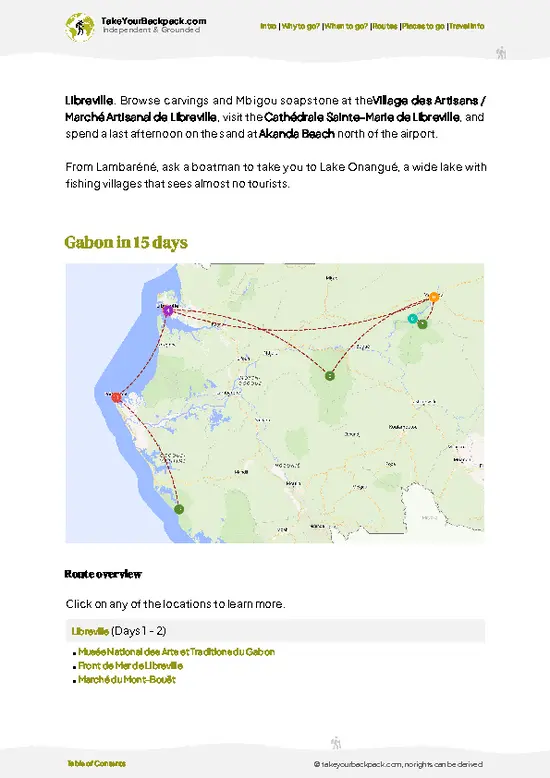
10–14 days (solid intro, realistic for most): - 1–2 days Libreville (markets, seafront, regroup after arrival)
- 3–4 days Lopé (forest, savanna, mandrills in season, river trips)
- 3–4 days Loango or Pongara (coast, wildlife, beaches)
- 1–2 buffer days for delays and backtracking
- This lets you see both forest and coast without sprinting.
-
3 weeks (ideal backpacker pace): - Everything above, plus:
- Extra days in Loango for better wildlife odds
- A stop in Lambaréné (Albert Schweitzer hospital, river vibe)
- Maybe a side trip to Franceville or another lesser-visited town
- You can ride more local transport instead of paying for private transfers.
Time budgeting tips for budget travelers:
-
Factor in slow transport: A single move between towns can eat a whole day.
-
Build in 2–3 flex days: For weather, broken vehicles, or full trains.
-
Spend more days in fewer parks: Park fees and transfers are expensive; it’s better value to stay longer in one place than to hop between three parks for one night each.
If you’re short on time and money, aim for
10–12 days and focus on
Libreville + Lopé + one coastal area. That gives you a real feel for Gabon without draining your savings.
You can get around Gabon without your own car, but you need patience and a flexible plan. Think shared taxis, bush taxis, and the train, not a neat bus network.
Main options without a car:
-
Train (Trans-Gabon Railway): - Connects Libreville (Owendo) with Lopé and Franceville.
- Good for reaching Lopé National Park on a budget.
- Schedules can change, and delays happen, so always keep a buffer day.
-
Shared taxis and bush taxis: - Operate between cities and towns; you pay per seat.
- They leave when full, not on a strict timetable.
- Cheap compared with private cars, but slower and less comfortable.
-
City taxis: - In Libreville and larger towns, you’ll use shared or private taxis constantly.
- Negotiate prices before getting in; ask locals what’s fair.
-
Boats: - Pirogues and small boats connect some coastal and river areas.
- Useful for places like Pointe-Denis or parts of Loango access.
-
Hitching / informal lifts: - Common on some routes; you contribute to fuel.
- Only do this in daylight and use normal safety judgment.
Where you may still need arranged transport:
-
National parks: Reaching park lodges or trailheads often requires a 4x4 transfer arranged through the lodge, park office, or a local driver. This is usually the biggest cost.
-
Remote villages: Services can be rare; sometimes the only realistic option is to pay for a private car or boat.
Budget strategy:
- Use
train + bush taxis for long distances.
- Accept that for at least one park (often Loango), you’ll probably pay for a
4x4 transfer as part of your park stay.
Conclusion: Yes, you can travel Gabon without a car, but you trade money savings for time and unpredictability. If you’re okay with that, it works.
For a budget backpacker, the must-visits are the places that give you maximum wildlife and sense of place for each hard-earned franc. These are the top priorities:
1. Lopé National Park- Best value forest–savanna combo that’s reasonably reachable by train.
- Good chances (season-dependent) for mandrills, forest elephants, and plenty of birdlife.
- Landscapes shift from open savanna hills to dense forest, so you feel like you’re in two countries at once.
- You can base yourself near the park and arrange guided walks and drives locally.
2. Loango National Park (if you can stretch the budget)- This is the big-ticket park: beaches, forest, lagoons, and wildlife in one place.
- In the right season, you can see elephants and other animals near the beach, plus hippos, crocs, and loads of birds.
- It’s expensive, but if you’re going to splurge on one place in Gabon, this is the one that actually earns it.
3. Libreville (1–2 days, not a destination but a useful stop)- You’ll likely pass through anyway; use it to get your bearings.
- Worth a short wander for street food, markets, and the seafront.
- Good place to organize cash, SIM cards, and onward transport.
4. Pongara National Park or Pointe-Denis (coast near Libreville)- Easier and cheaper coastal escape than Loango if you’re short on time or money.
- Boat ride from Libreville gives you quick access to beaches and, in season, turtle nesting.
- Works well as a 1–3 day add-on without heavy logistics.
5. Lambaréné- River town with a laid-back feel and historical interest (Albert Schweitzer hospital).
- Good for breaking up journeys and getting a sense of river life.
- Not as dramatic as the big parks, but more affordable and human-scale.
If you have limited time and money, the core must-visit combo is:
-
Libreville (1–2 days) + Lopé (3–4 days) + either Loango or Pongara/Pointe-Denis (3–4 days).
That mix gives you forest, savanna, coast, and real Gabonese daily life without trying to see everything.
If you’re short on time or traveling on a tight budget, skip anything that eats days and cash without giving you a clearly different experience from what you already have in your plan.
1. Multiple expensive parks with similar feel- Visiting
three or four national parks in one trip sounds great, but the costs stack up fast.
- If you’re already doing
Lopé + Loango, you can usually skip a third big park unless you have a specific goal (like hardcore birding).
- Focus on
more days in fewer parks for better wildlife sightings and better value.
2. Very remote interior towns just for the sake of it- Long, uncomfortable journeys to small towns with limited sights can burn 2–3 days each way.
- Unless you have a clear reason (visiting friends, research, volunteering), skip deep interior detours and invest that time in parks or the coast.
3. Overlong stays in Libreville- Libreville is useful for logistics and a short look around, but it’s not where Gabon really shines for backpackers.
- Keep it to
1–2 days on arrival or before departure. Extra days here are usually better spent in Lopé or by the ocean.
4. High-end resort experiences that duplicate cheaper options- If you’re already paying for a park lodge or a coastal stay, you don’t need a separate luxury beach resort on top.
- The scenery is similar; the price tag is not. Stick to one splurge and keep the rest simple.
5. Rushed cross-country loops- Trying to do a big loop (Libreville – Franceville – multiple parks – back) in under two weeks means you’ll mostly see bus stations and taxi ranks.
- If you’re short on time, skip the idea of “seeing the whole country” and commit to
one region + one or two parks done properly.
In practice, if you’re tight on time or money, you can safely skip:
- A third or fourth national park
- Deep interior detours with no clear purpose
- Extra days in Libreville beyond logistics
and you’ll still get a strong, memorable Gabon experience.