Yes, Germany is one of the easiest countries in Europe to backpack on your own, with trains or buses reaching almost every town, clear signage and widespread English in cities and hostels.
Dorm beds run about €25 to 45 a night in
Berlin,
Munich and
Hamburg, a bit less in
Leipzig or
Dresden. The Deutschlandticket, around €60 a month, covers every regional train, S-Bahn, tram and bus nationwide. Long-distance ICE fares from Berlin to Munich range from roughly €20 to over €100, depending on how early you book. Keep some cash for bakeries and small taverns, and note that most shops close on Sundays.
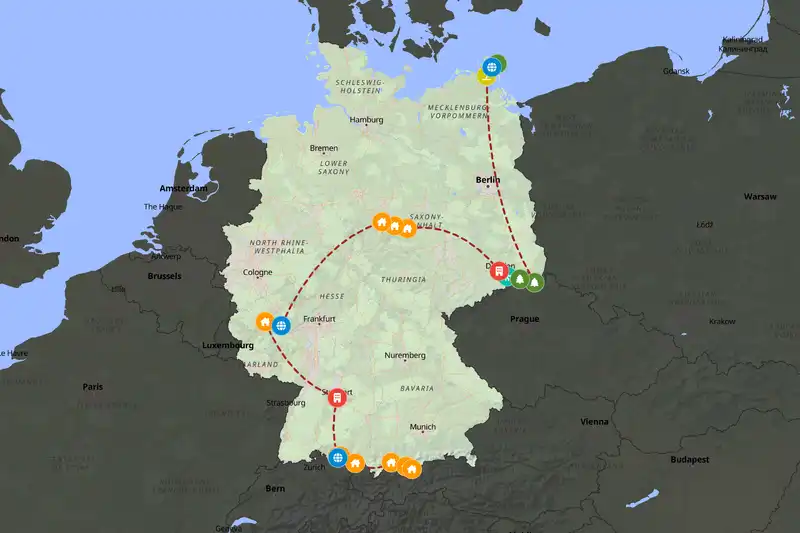
Two weeks covers Germany well for most first visits, while one week suits a single region and three weeks lets you travel from the North Sea ports down to the Alps.
With 7 days, stick to Bavaria:
Munich,
Neuschwanstein and
Garmisch-Partenkirchen, all within two hours of each other. With 14 days, add
Berlin,
Dresden, Saxon Switzerland and Franconian towns like
Bamberg. With 21 days, you can link
Hamburg,
Cologne, the Rhine and Moselle,
Heidelberg, the Black Forest and Lake Constance. Allow realistic transfer times: Berlin to Munich takes 4 to 4.5 hours by ICE, and Hamburg to Cologne about 4 hours.
Yes, you can travel all of Germany without a car, since fast trains link the major cities and regional trains and buses reach most towns, lakes and trailheads.
Berlin to Hamburg takes under 2 hours, Frankfurt to Cologne about 1 hour, and Munich to Füssen 2 hours by regional train. The Deutschlandticket (around €60 a month) covers all local and regional transport, and FlixBus fares between cities often run €10 to 30. Rural areas are slower but workable. In the
Black Forest, the KONUS guest card from participating guesthouses gives free regional buses and trains, and Alpine valleys like
Garmisch-Partenkirchen are served by hourly regional buses.
The essential stops in Germany are
Berlin,
Munich,
Cologne Cathedral,
Heidelberg,
Neuschwanstein Castle and the
Rhine Gorge, with Saxon Switzerland as the top nature pick.
Give Berlin 3 to 4 days for the Wall sites and Museum Island, and Munich 2 to 3 days. Cologne and Heidelberg each need 1 to 2 days; climbing the cathedral tower’s 533 steps takes about an hour. Pair the Rhine Gorge with
Cochem on the Moselle for 2 days of castles and vineyards. Neuschwanstein is best from an overnight in
Füssen, and the
Bastei in Saxon Switzerland is 45 minutes from Dresden by S-Bahn.
If you are short on time in Germany, skip
Frankfurt,
Düsseldorf and
Stuttgart as overnight stops, because each works better as a train hub or a half-day visit than a destination.
Frankfurt’s skyline and Römer square fill 3 to 4 hours between connections. Stuttgart is worth a stop mainly for car-museum fans.
Europa-Park costs around €60 to 70 for a day ticket and suits only coaster lovers. On a cloudy day, the
Zugspitze is a poor use of roughly €70 to 80, since you’ll see fog at the summit. Instead, put the saved days into
Bamberg, the Moselle or Saxon Switzerland.
Yes, our itinerary-planner does exactly that. Set your trip length in days, give your interests and travel style, optionally give start- and end location and/or some mandatory stops you would like to include and the itinerary planner creates your personalized routes for Germany in seconds. Try it out!
Try the itinerary planner
 Best Backpacking