×
Germany🇩🇪 | 14 days itinerary

A Complete 14-Day Plan for Germany

By Johan Kruseman 🇳🇱 | Updated May 8, 2026
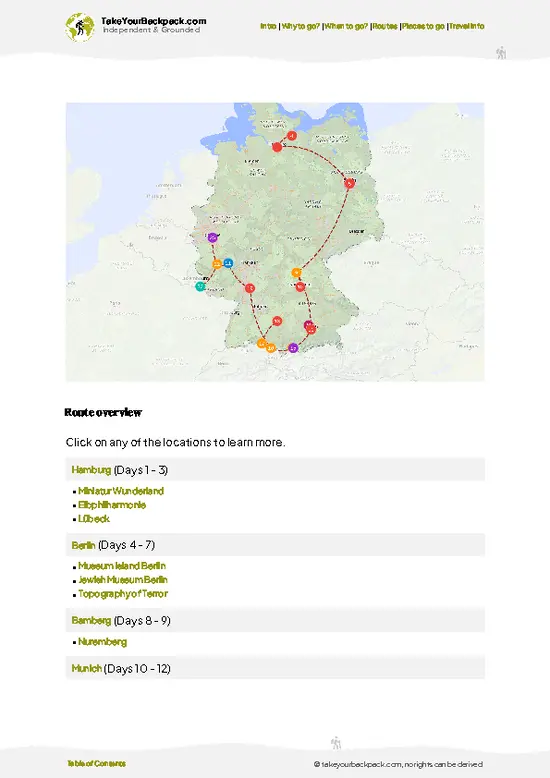
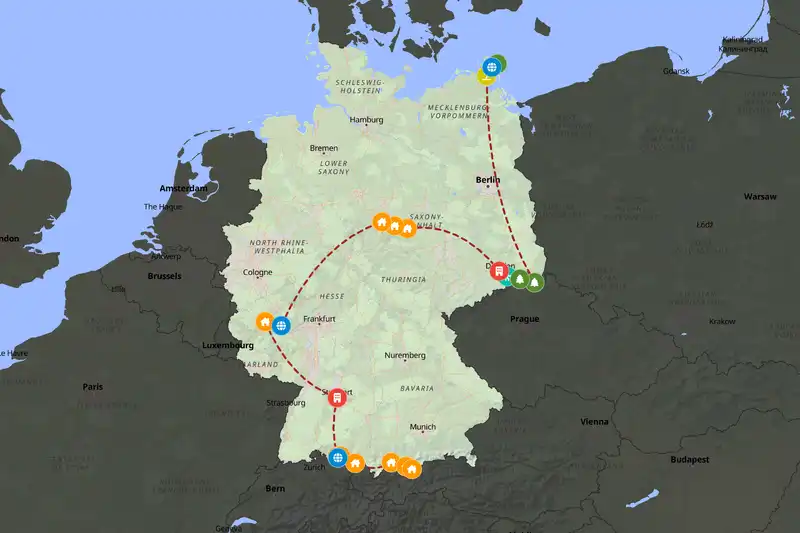
This 14-day route is for travelers who want a balanced first or second trip to Germany: big cities, river valleys, and a taste of the Alps, moving at a medium pace with a mix of ICE high-speed trains and regional lines. You’ll connect Berlin’s history, Saxon sandstone cliffs, and the Rhine-Moselle wine country with just enough time in each place to feel like you actually lived there for a minute.

Days 1-4: Berlin - museums, memory, and modern city life

Start in Berlin, using the city’s excellent U-Bahn and S-Bahn to hop between neighborhoods while keeping your base in one district for four nights. Spend a full day on Museum Island Berlin, diving into its cluster of collections and giving the Pergamon Museum the time it deserves for its monumental antiquities. Balance that with a day focused on 20th-century history: the Topography of Terror Documentation Center lays out the machinery of the Nazi regime in a way that’s stark and grounded, while the Jewish Museum Berlin hits harder on architecture … read more 👉
This 14-day route is for travelers who want a balanced first or second trip to Germany: big cities, river valleys, and a taste of the Alps, moving at a medium pace with a mix of ICE high-speed trains and regional lines. You’ll connect Berlin’s history, Saxon sandstone cliffs, and the Rhine-Moselle wine country with just enough time in each place to feel like you actually lived there for a minute.

Days 1-4: Berlin - museums, memory, and modern city life

Start in Berlin, using the city’s excellent U-Bahn and S-Bahn to hop between neighborhoods while keeping your base in one district for four nights. Spend a full day on Museum Island Berlin, diving into its cluster of collections and giving the Pergamon Museum the time it deserves for its monumental antiquities. Balance that with a day focused on 20th-century history: the Topography of Terror Documentation Center lays out the machinery of the Nazi regime in a way that’s stark and grounded, while the Jewish Museum Berlin hits harder on architecture and personal stories. A fourth day lets you wander, hit a café-heavy neighborhood, or slot in one more museum without turning the city into a checklist.

Days 5-7: Dresden and Saxon Switzerland - baroque city and cliff trails

Take a direct train to Dresden and give yourself two nights to explore its rebuilt baroque core and riverside walks, which feel very different from Berlin’s sprawl. From here, use a regional train to reach Saxon Switzerland for a full hiking day, where the sandstone towers and river views make it one of Germany’s most dramatic landscapes. If you’re up for a bigger trail experience, sample a section of the Malerweg, even if you’re not doing the full multi-day route, to get that mix of forest paths, cliff-edge viewpoints, and quiet villages. Returning to Dresden for your second night keeps logistics simple while still giving you a real taste of the Elbe valley’s outdoor side.

Days 8-10: Rhine Valley and Cochem - castles and river curves

Ride the train west to the Rhine Valley, switching gears from Saxon sandstone to steep vineyard slopes and castle silhouettes. Base yourself in or near the Rhine Gorge, using boats or local trains to hop between riverside towns and hilltop viewpoints without hauling your luggage every night. Then continue to Cochem in the Moselle Valley, where a compact old town, riverside promenades, and nearby vineyards make it easy to slow down for two nights. This phase is all about shorter travel legs, long walks along the water, and evenings that revolve around local wine rather than museum closing times.

Days 11-14: Cologne and Heidelberg - cathedral, student life, and castle views

Head north to Cologne and give yourself two nights to soak up big-city energy anchored by the Cologne Cathedral, whose sheer scale hits you the second you step out of the station. Climb the Cologne Cathedral Treasury and Tower for a vertical workout and a skyline view that ties together the river, bridges, and old town in one sweep. Then continue by train to Heidelberg, where two nights let you enjoy the student-town atmosphere and riverside walks without rushing. Spend a full day at Heidelberg Castle, taking time for both the ruins and the terraces that look down over the Neckar, then wrap your trip with a last evening in the old town before heading out via nearby rail connections.
The moment that sticks with me on this route is standing on a Rhine Gorge hillside at golden hour, watching trains, boats, and castle lights all move at their own pace while you finally feel like you’ve matched Germany’s rhythm.
Loading the map 🌍
film
0
0
0a
Berlin
Pixabay
film
1
1
1a
Pergamon Museum
Pixabay
film
2
2
2a
Dresden
Johann G
film
3
3
3a
Saxon Switzerland
Pixabay
film
4
4
4a
Malerweg
film
5
5
5a
Rhine Valley
Norbert Rettenmaier
film
6
6
6a
Rhine Gorge
Norbert Rettenmaier
film
7
7
7a
Moselle Valley
Arkadiusz Gowik
film
8
8
8a
Cologne
Jassim Anwar
film
9
9
9a
Cologne Cathedral
Hans Berger
film
10
10
10a
Cologne Cathedral Treasury and Tower
film
11
11
11a
Heidelberg Castle

🛏️ Where to stay?Your Route at a Glance

✈️ The backpacker research shortcutGermany Travel Guide

An offline-friendly backpacking guide with optimized travel routes, ranked highlights, transport advice, and the best areas to stay.
example page 0 from our offline Travel Guide for Germanyexample page 1 from our offline Travel Guide for Germanyexample page 2 from our offline Travel Guide for Germanyexample page 3 from our offline Travel Guide for Germanyexample page 4 from our offline Travel Guide for Germanyexample page 5 from our offline Travel Guide for Germany
The digital guide (452 pages) contains:
142 highlights, ranked by travel appeal
Optimized 7, 14 & 21-day travel routes
Best neighborhoods to stay
How to get around
Offline-friendly for travel without Wi-Fi
👉 See all 30+ guide features

📅 Plan smarter in minutes, not weeks
Month by month travel advice
Festivals & national holidays
Budget expectations

🗺️ Go to the right places, skip the overrated ones
Honest pros & cons of destinations
Top hikes, parks & viewpoints
Lesser-known places most travelers miss
Clear “worth it vs skip it” guidance

🛏️ Travel smoothly without rookie mistakes
Best areas to stay
Transport systems explained simply
Common scams & safety advice
SIM cards, money & practical tips

🌍 Understand the country, not just visit it
Culture & traditions
52 Essential phrases & customs
Festivals worth planning around
Traveler-friendly historical context
Insights that make places more meaningful

📱 Built for real travel conditions
Fully downloadable PDF
Works completely offline
Optimized for phone use
Useful in remote areas & buses
Everything in one place
Save weeks of stressful planning
Get instant access to the full guide directly. 30-day money-back guarantee.


Sent to your inbox immediately after payment • 100% Secure Checkout
Best Backpacking Travel Advisor 2025 tourism awardBest Backpacking
Travel Advisor
2025
What others say about Take Your Backpack Guides:
⭐⭐⭐⭐⭐
Fantastic, amazing amount of information!
⭐⭐⭐⭐⭐
My goodness this is amazing, it's what I've been looking for hats off too you!
⭐⭐⭐⭐⭐
I think this is absolutely BRILLIANT
⭐⭐⭐⭐
Very complete and informative. It's still missing places, but I gotta to commend you
⭐⭐⭐⭐⭐
This is truly amazing, thank you, can't wait to explore it with my kids!
⭐⭐⭐⭐⭐
Awesome resource, thank you!
⭐⭐⭐⭐⭐
This is amazing! Can't wait to explore the ones I haven't seen
⭐⭐⭐⭐
I love this! Well done, great idea.
⭐⭐⭐⭐⭐
Thanks for taking the time to make this gem!
⭐⭐⭐⭐⭐
This might be the best website I've ever seen.
⭐⭐⭐⭐⭐
Congratulations, and thank you so much for your work; it's incredibly valuable.
⭐⭐⭐⭐
In all seriousness I think you did a great job pointing out the important spots
⭐⭐⭐⭐⭐
10/10 very good
⭐⭐⭐⭐⭐
As someone who's only just starting to visit regularly this is awesome, thank you.
⭐⭐⭐⭐
Thank you very much! I'm going to visit my dad, it's going to be very useful!
⭐⭐⭐⭐⭐
This is really cool! We'll be travelling for the first time and this definitely come in handy.
⭐⭐⭐⭐⭐
You are now our minister of culture, congratulations 👨‍💼
⭐⭐⭐⭐⭐
Just wanted to tell you that this is a pearl! Going to follow your recommendations.
⭐⭐⭐⭐⭐
This is so cool. I'll definitely be using the resource for my travels soon.
⭐⭐⭐⭐⭐
This is very impressive! Good work.
⭐⭐⭐⭐⭐
This is an amazing and informative site. Very well done!

🧭 RouteAlternative Routes

Travel Germany your way — from a quick highlights trip to a slow-paced adventure.

🙋 FAQBackpacking FAQ

Yes, Germany is one of the easiest countries in Europe to backpack on your own. Trains and buses are frequent, safe, and well-signed, and English is widely spoken in cities and tourist areas, especially by younger people and service staff. You can show up in most places outside peak festivals and still find a hostel bed the same day, though you should always book ahead for Munich during Oktoberfest, big trade fairs, and school holidays. Supermarkets like Lidl, Aldi, and Rewe make it simple to self-cater, and tap water is drinkable almost everywhere, so you save a lot on food and drinks. Hiking trails are clearly marked, city centers are walkable, and there is a strong culture of rules actually being followed, which makes things predictable for solo travelers. The main challenges are that Germany is not ultra-cheap by Eastern European standards and that some smaller-town businesses close early or on Sundays, so you need to plan grocery runs and travel days with that in mind. Overall, if you can handle basic logistics and reading timetables, Germany is very beginner-friendly for independent backpacking.
For a first backpacking trip focused on value, 7–10 days is enough for a tight intro loop, 2 weeks is a comfortable sweet spot, and 3 weeks lets you slow down and add smaller towns and nature. With 7–10 days, focus on 2–3 bases: for example, Berlin (4 days) for history and nightlife, Dresden or Leipzig (2–3 days) for cheaper, creative city vibes, and Munich or Nuremberg (2–3 days) for Bavaria and day trips. With about 2 weeks, you can add the Rhine or Mosel valley for castles and cheap wine, or the Black Forest for hiking and small towns, without feeling rushed. With 3 weeks, you can mix in Hamburg and the north coast, or spend more time in the Alps region around Garmisch-Partenkirchen or Berchtesgaden for serious hiking. Anything under 5 days forces you to pick one region and stick to it, which is fine if you just want Berlin plus maybe one quick side trip. The key for budget travelers is to limit long train jumps, cluster cities by region, and give each base at least 2–3 nights so you are not burning money and time on constant transport.
You can absolutely get around Germany without a car, and for backpackers it is usually cheaper and less stressful to rely on public transport. The rail network is dense, and even smaller towns are often reachable by regional trains or buses. For long distances, use slower regional trains instead of high-speed ICE trains when you can; they take longer but are much cheaper, especially if you use regional day tickets like the Länder-Tickets or the Deutschland-Ticket style passes when available. These often allow unlimited regional travel in a state or nationwide for a day, which is perfect for budget-friendly city-to-city hops and day trips. Long-distance buses like FlixBus can be even cheaper than trains if you book in advance and do not mind slower journeys and occasional delays. Inside cities, you can rely on U-Bahn, S-Bahn, trams, and buses, plus walking and bike rentals; you rarely need taxis. The only times a car is truly useful are for very remote hiking trailheads, scattered villages in the Alps, or if you are traveling as a group and splitting fuel and rental costs. For most backpackers, a mix of regional trains, buses, and your own feet will cover almost everything you want to see.
For a first-time backpacker on a budget, a few places in Germany give you the best payoff for your time and money. Berlin is non-negotiable: it is relatively affordable for a capital, packed with history from the Cold War and World War II, and has a deep hostel scene, street food, and nightlife that runs late and does not require you to be rich. Munich is worth it if you want beer halls, Bavarian culture, and easy access to the Alps; it is pricier, but you can soften the blow by staying in hostels, using supermarkets, and doing free walking tours. The Rhine or Mosel valleys are fantastic value: you get castles, river views, and small towns like Bacharach, Cochem, or Koblenz, and you can explore by cheap regional trains, ferries, or even bike. Dresden and Leipzig are strong picks for budget travelers because they are cheaper than Munich or Hamburg but still full of culture, nightlife, and history, with good hostel options. If you like mountains and hiking, the Bavarian Alps around Garmisch-Partenkirchen or Berchtesgaden are worth the extra train ride, especially in summer when you can fill days with low-cost hikes instead of paid attractions. For a more low-key nature focus, the Black Forest or the Harz Mountains offer good trails, half-timbered towns, and a slower pace without destroying your budget.
If you are short on time, skip anything that eats hours of transit for a similar experience you can get closer to your main route. You can skip smaller, spread-out regions like the North Sea islands and much of the Baltic coast on a first trip; they are pleasant but require extra connections and are better if you already know Germany. You can also skip trying to see too many big cities in one go; for example, doing Berlin, Hamburg, Cologne, Frankfurt, Munich, and Stuttgart in a 10-day trip will just drain your budget on trains and leave you with surface-level impressions of each. Frankfurt is a common fly-in hub but not essential as a sightseeing stop for backpackers; if you are tight on time, treat it as an airport city and move on. Many heavily commercialized tourist streets full of chain shops, like some parts of central shopping districts in big cities, are easy to walk through once and then ignore; your time is better spent in neighborhoods, parks, and free museums or viewpoints. If you are not a hardcore theme park fan, you can skip big-ticket parks like Europa-Park on a budget trip, since the entry price plus transport can equal several days of hostel beds and groceries. In general, skip anything that requires a long detour for a single attraction and focus on clusters where you can see a lot by walking or using cheap regional transport from one base.

🇩🇪 GermanyMore of Germany

Ready to build a truly unique trip? Predefined routes are perfect for first-time visitors, but there is so much more to discover. Whether you are chasing a city trip, pristine national parks, local food scenes, or quiet beaches, pick a category to design your own path.