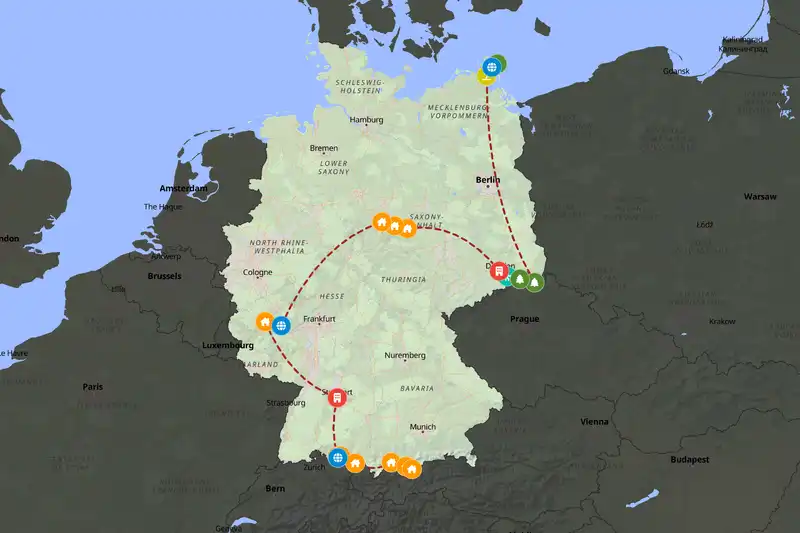
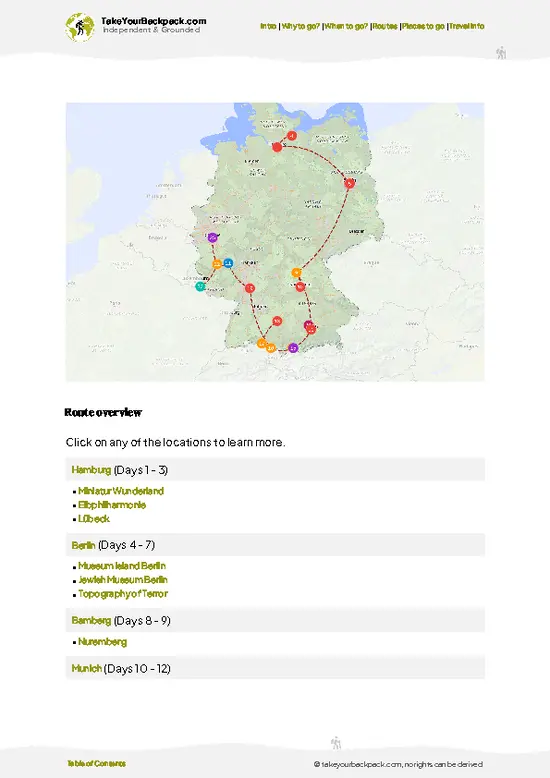
This three-week loop through Germany is for travelers who want the big names and the slower places between them: two port cities, the capital, Franconian beer towns, the Alps, a lake, a wine valley and the Rhine. The pace is relaxed, with two to four nights at most stops and only one truly long rail day. You can do all of it by train (ICE, IC and regional lines), plus one lake boat on the Bodensee and a regional bus or two around Füssen.
Days 1-3: Hamburg and Lübeck
Start in
Hamburg because it sets the tone for a different Germany: brick warehouses, ship horns on the Elbe and a city that feels closer to Copenhagen than to Munich. Spend one day between the Speicherstadt canals and
Miniatur Wunderland, where the model airport alone justifies the timed ticket (book online, roughly €20 to 25). Ride the long escalator up to the
Hamburg Elbphilharmonie Plaza and Concert Hall viewing deck, free with a timed ticket and best at sunset over the cranes.
On day three, take the regional train 45 minutes …
read more 👉This three-week loop through Germany is for travelers who want the big names and the slower places between them: two port cities, the capital, Franconian beer towns, the Alps, a lake, a wine valley and the Rhine. The pace is relaxed, with two to four nights at most stops and only one truly long rail day. You can do all of it by train (ICE, IC and regional lines), plus one lake boat on the Bodensee and a regional bus or two around Füssen.
Days 1-3: Hamburg and Lübeck
Start in Hamburg because it sets the tone for a different Germany: brick warehouses, ship horns on the Elbe and a city that feels closer to Copenhagen than to Munich. Spend one day between the Speicherstadt canals and Miniatur Wunderland, where the model airport alone justifies the timed ticket (book online, roughly €20 to 25). Ride the long escalator up to the Hamburg Elbphilharmonie Plaza and Concert Hall viewing deck, free with a timed ticket and best at sunset over the cranes.
On day three, take the regional train 45 minutes to Lübeck. The Holstentor gate and the steep-roofed merchant houses of the old Hanseatic island are worth a full day, and Niederegger marzipan is the local souvenir that actually tastes good.Days 4-7: Berlin, the layered capital
An ICE gets you to Berlin in about 2 hours. Four nights is the right amount here, because the city’s history needs breathing room between sites. Give one morning to Museum Island Berlin (the Neues Museum and the bust of Nefertiti are the pick), then cross to Kreuzberg for the Jewish Museum Berlin, whose zigzag Libeskind building is part of the exhibit. The Topography of Terror Documentation Center, built on the site of the former Gestapo headquarters, is free and sits beside a surviving stretch of the Wall. Leave evenings for Neukölln bars and late kebab runs.Days 8-9: Bamberg and Nürnberg
A direct ICE runs south to Bamberg in under 3 hours. Its old town is a UNESCO site that escaped heavy bombing, and the Altes Rathaus perched on a bridge over the Regnitz is the postcard shot. Order a Rauchbier at Schlenkerla; the smoked malt tastes like bacon, and you will either love it or finish it out of pride. On day nine, ride 45 minutes to Nürnberg for the Kaiserburg castle walls and the Nazi Party Rally Grounds documentation center, then come back to Bamberg for dinner.Days 10-12: Munich and its heavier side
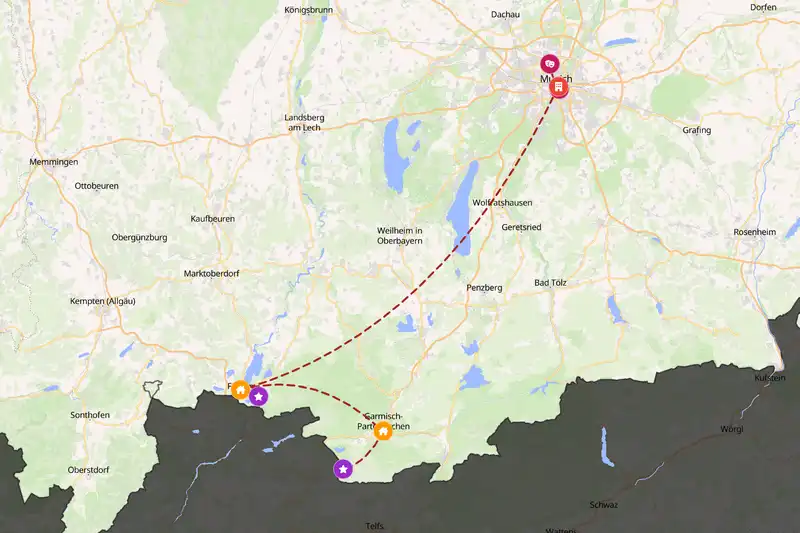
About 2 hours on to Munich. Beer gardens under chestnut trees are mandatory, but balance them. Spend a rainy afternoon in the Pinakothek Museums (Alte Pinakothek), where Dürer and Rubens hang without the crowds of Paris or Florence, and on Sundays most of the collection costs €1. Dedicate a quieter day to the Dachau Concentration Camp Memorial Site, reached by S-Bahn to Dachau and a short bus ride; entry is free, and the audio guide is worth renting.Day 13: Füssen and Neuschwanstein
The regional train to Füssen takes about 2 hours. Sleep there so you can reach Neuschwanstein Castle early, before tour buses arrive from Munich. Book the timed interior ticket in advance, and walk up to Marienbrücke for the classic view over the gorge.Days 14-15: Lindau and the Bodensee
Train connections via Kempten bring you to Lindau in 2.5 to 3 hours. The old town sits on an island linked by a causeway, with a stone lion and a lighthouse guarding the harbor and the Swiss and Austrian Alps across the water. Use day fifteen for a slow boat trip across the lake to Meersburg, whose medieval castle and terraced vineyards drop straight to the shore.Days 16-17: Ulm and Heidelberg
Day sixteen is the long one: around 5 hours of rail. Break it in Ulm, where the Minster has the tallest church spire in the world at 161.5 meters; climbing the 768 steps is a good way to stretch your legs between trains. Continue via Stuttgart to Heidelberg. Next morning, take the funicular to Heidelberg Castle, a red sandstone ruin above the Neckar, then cross the river to the Philosophers’ Walk for the view back.Days 18-19: Rhine Gorge and the Moselle at Cochem
Head north through the Rhine Gorge on the regional line between Mainz and Koblenz, sitting on the left side of the train for the castles and the Lorelei rock. Hop off in Bacharach for lunch, then continue to Cochem, where the Reichsburg rises above a river bend lined with Riesling vineyards. Spend the second day on the Moselsteig Trail, walking a stretch above the slopes and returning by local train or river boat.Days 20-21: Cologne finale
Two hours by train lands you at Cologne, and the station exit drops you directly beneath Cologne Cathedral. Climb the 533 steps of the south tower, then end the trip in a brewhouse drinking Kölsch from small 0.2-liter glasses that the waiters replace until you cover yours with a coaster.
I’d send a friend to Beilstein, a tiny village a short boat ride upriver from Cochem; go in the late afternoon once the day-trippers leave and order a glass of steep-slope Riesling on the riverside terrace.v2.webp)
 Best Backpacking