×
Guatemala🇬🇹 | 10 days itinerary

Your 10-Day Guatemala Itinerary

By Johan Kruseman 🇳🇱 | Updated May 4, 2026
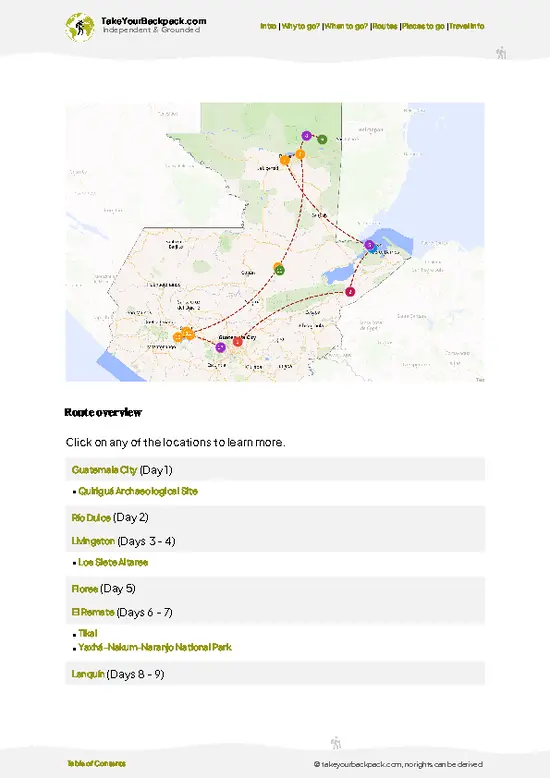
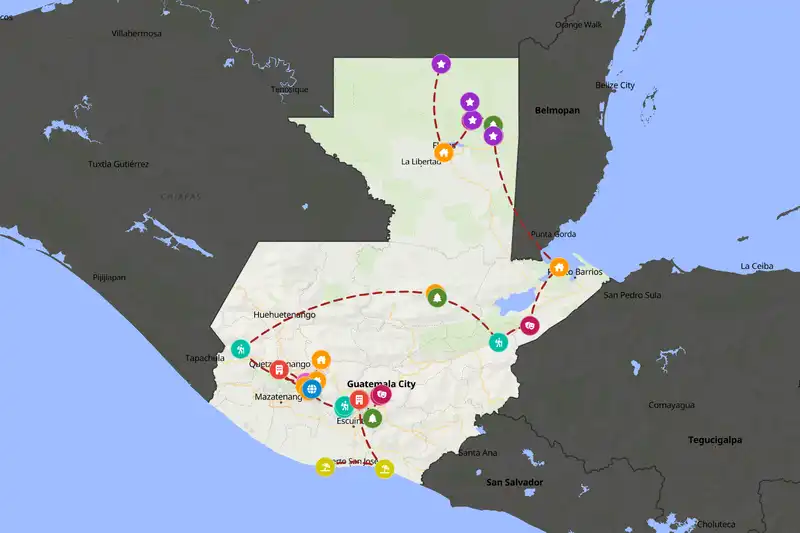
This 10-day route is for travelers who want a balanced mix of colonial cities, highland culture, and jungle ruins, moving at a medium pace with a couple of longer shuttle or bus days plus one domestic-style overnight bus or shuttle to reach the Petén region. You’ll use shuttles between major hubs, boats on lakes and rivers, and plenty of walking inside towns and archaeological sites, with enough downtime to actually enjoy where you are instead of just ticking boxes.

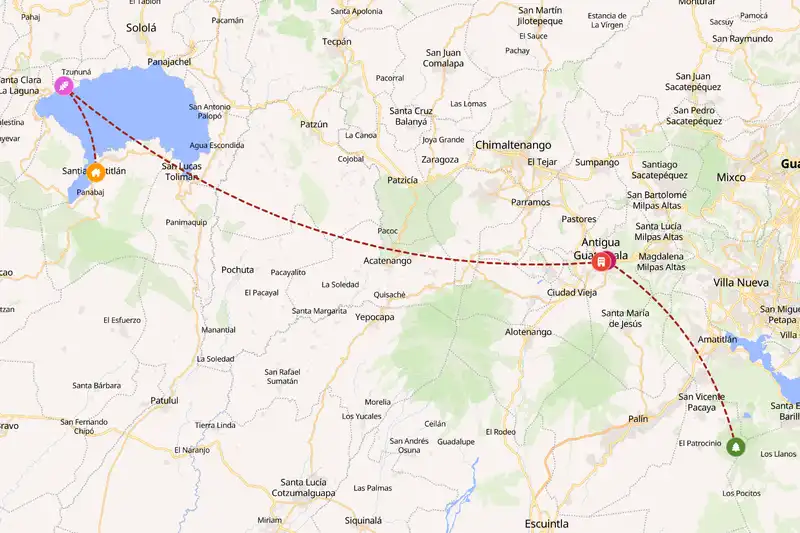
Days 1-3: Antigua, Cerro de la Cruz & Volcán Pacaya National Park

Start with three nights in Antigua so you can settle in, explore slowly, and fit in a volcano day without rushing. Use your first full day to wander the cobblestones and dive into Casa Santo Domingo Museums & Ruins, where cloisters, small galleries, and archaeological displays give you a crash course in Guatemala’s layered history while you’re still jet-lagged enough to appreciate the calm. Walk up to Cerro de la Cruz for a wide-angle view of the city and the surrounding … read more 👉
This 10-day route is for travelers who want a balanced mix of colonial cities, highland culture, and jungle ruins, moving at a medium pace with a couple of longer shuttle or bus days plus one domestic-style overnight bus or shuttle to reach the Petén region. You’ll use shuttles between major hubs, boats on lakes and rivers, and plenty of walking inside towns and archaeological sites, with enough downtime to actually enjoy where you are instead of just ticking boxes.

Days 1-3: Antigua, Cerro de la Cruz & Volcán Pacaya National Park

Start with three nights in Antigua so you can settle in, explore slowly, and fit in a volcano day without rushing. Use your first full day to wander the cobblestones and dive into Casa Santo Domingo Museums & Ruins, where cloisters, small galleries, and archaeological displays give you a crash course in Guatemala’s layered history while you’re still jet-lagged enough to appreciate the calm. Walk up to Cerro de la Cruz for a wide-angle view of the city and the surrounding volcanoes; it’s the best way to understand how compact Antigua really is and why it makes such a good base. Dedicate another day to Volcán Pacaya National Park, an accessible volcano outing where you hike through pine forest and old lava fields with views back toward the highlands, giving you a taste of Guatemala’s volcanic backbone without committing to a brutal overnight trek this early in the trip.

Days 4-5: Atitlán Lake, Panajachel & San Pedro La Laguna

Transfer by shuttle to Panajachel, the easiest jumping-off point for exploring Atitlán Lake, and give yourself two nights here or split them with San Pedro La Laguna if you want more nightlife and café culture. Spend your first lake day on the water, using public lanchas to hop between Panajachel and San Pedro, soaking up the contrast between Pana’s busy main street and San Pedro’s backpacker lanes and lakeside bars. On your second day, slow it down with a visit to San Juan La Laguna or Santa Cruz La Laguna, where you can see community-run textile workshops, murals, and quieter shorelines that show a more local rhythm than the main hubs, all without needing to change your base again.

Days 6-7: Quetzaltenango & Tajumulco Volcano

From the lake, head to Quetzaltenango (Xela) by shuttle or bus, trading water views for a more lived-in highland city that’s a hub for language schools and mountain hikes. Use your first afternoon to walk the central square and feel how different Xela’s energy is from Antigua’s polished colonial core; this is where you start to feel the everyday Guatemala that most short trips skip. If you’re up for a challenge and the weather cooperates, dedicate a long day or an overnight to Tajumulco Volcano, the highest peak in Central America, where the reward is a sense of scale over the whole region rather than just another summit selfie, and where the journey through rural communities on the way to the trailhead is half the experience. If Tajumulco feels too ambitious, you can still use Xela as a base for shorter local hikes or hot springs while keeping the itinerary’s mountain flavor intact.

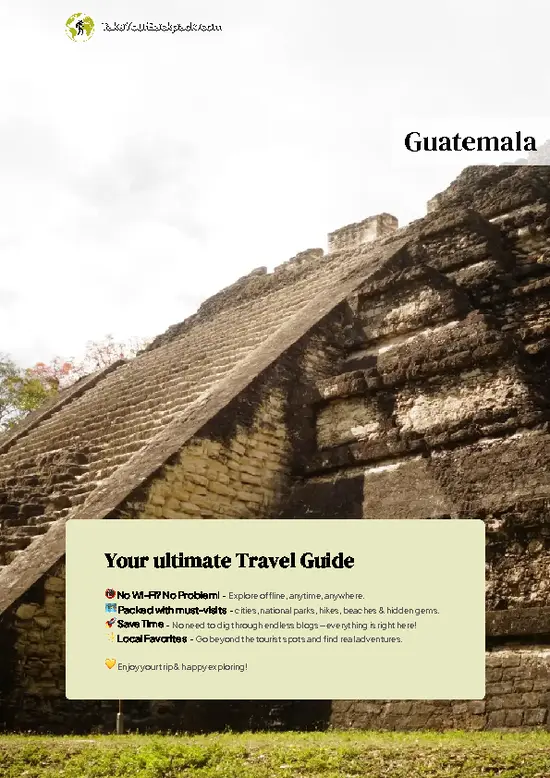
Days 8-10: Flores, Tikal & Tikal Archaeological Site

Next, make the jump to the Petén region by overnight bus or long shuttle day to Flores, a compact island town that works perfectly as a base for ruins and jungle without sacrificing creature comforts. Spend your first afternoon just walking the lakeside streets and catching sunset over the water so you’re not hitting the ruins exhausted. Then give a full day to Tikal and the Tikal Archaeological Site, where towering temples rise out of dense forest and howler monkeys provide the soundtrack; going with a guide or at least a good map turns it from “big ruins” into a story of shifting power and abandoned cities. Use your final day as a buffer: either return for a quieter half-day at Tikal, add a side trip to nearby viewpoints, or simply enjoy Flores’ cafés and lake swims before your onward journey, so the trip ends with space to process everything you’ve seen instead of a mad dash to the airport.

The moment that sticks with me most on this route is standing on a high temple at Tikal after a week in the highlands, realizing how completely different yet deeply connected Guatemala’s mountains and jungles feel.
Loading the map 🌍
film
0
0
0a
Antigua
Nelson Gonzalez
film
1
1
1a
Cerro de la Cruz
安川マサシ
film
2
2
2a
Panajachel
Milagro Campos
film
3
3
3a
San Juan La Laguna
Milagro Campos
film
4
4
4a
Quetzaltenango
Luis Rodríguez
film
5
5
5a
Flores
Gerardo Garcia
film
6
6
6a
Tikal
Unsplash
film
7
7
7a
Tikal Archaeological Site

🛏️ Where to stay?The Route Breakdown

✈️ The backpacker research shortcutGuatemala Travel Guide

An offline-friendly backpacking guide with optimized travel routes, ranked highlights, transport advice, and the best areas to stay.
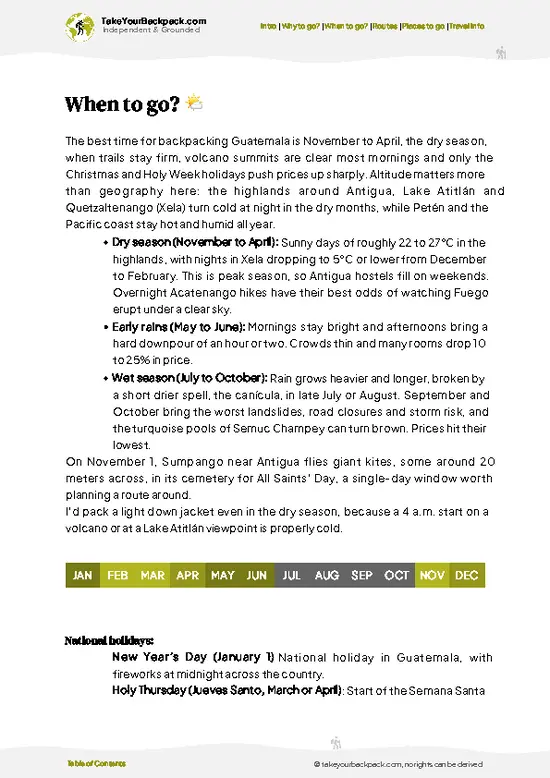
example page 0 from our offline Travel Guide for Guatemalaexample page 1 from our offline Travel Guide for Guatemalaexample page 2 from our offline Travel Guide for Guatemalaexample page 3 from our offline Travel Guide for Guatemalaexample page 4 from our offline Travel Guide for Guatemalaexample page 5 from our offline Travel Guide for Guatemala
The digital guide (341 pages) contains:
100 highlights, ranked by travel appeal
Optimized 5, 10 & 15-day travel routes
Best neighborhoods to stay
How to get around
Offline-friendly for travel without Wi-Fi
👉 See all 30+ guide features

📅 Plan smarter in minutes, not weeks
Month by month travel advice
Festivals & national holidays
Budget expectations

🗺️ Go to the right places, skip the overrated ones
Honest pros & cons of destinations
Top hikes, parks & viewpoints
Lesser-known places most travelers miss
Clear “worth it vs skip it” guidance

🛏️ Travel smoothly without rookie mistakes
Best areas to stay
Transport systems explained simply
Common scams & safety advice
SIM cards, money & practical tips

🌍 Understand the country, not just visit it
Culture & traditions
52 Essential phrases & customs
Festivals worth planning around
Traveler-friendly historical context
Insights that make places more meaningful

📱 Built for real travel conditions
Fully downloadable PDF
Works completely offline
Optimized for phone use
Useful in remote areas & buses
Everything in one place
Save weeks of stressful planning
Get instant access to the full guide directly. 30-day money-back guarantee.


Sent to your inbox immediately after payment • 100% Secure Checkout
Best Backpacking Travel Advisor 2025 tourism awardBest Backpacking
Travel Advisor
2025
What others say about Take Your Backpack Guides:
⭐⭐⭐⭐⭐
Fantastic, amazing amount of information!
⭐⭐⭐⭐⭐
My goodness this is amazing, it's what I've been looking for hats off too you!
⭐⭐⭐⭐⭐
I think this is absolutely BRILLIANT
⭐⭐⭐⭐
Very complete and informative. It's still missing places, but I gotta to commend you
⭐⭐⭐⭐⭐
This is truly amazing, thank you, can't wait to explore it with my kids!
⭐⭐⭐⭐⭐
Awesome resource, thank you!
⭐⭐⭐⭐⭐
This is amazing! Can't wait to explore the ones I haven't seen
⭐⭐⭐⭐
I love this! Well done, great idea.
⭐⭐⭐⭐⭐
Thanks for taking the time to make this gem!
⭐⭐⭐⭐⭐
This might be the best website I've ever seen.
⭐⭐⭐⭐⭐
Congratulations, and thank you so much for your work; it's incredibly valuable.
⭐⭐⭐⭐
In all seriousness I think you did a great job pointing out the important spots
⭐⭐⭐⭐⭐
10/10 very good
⭐⭐⭐⭐⭐
As someone who's only just starting to visit regularly this is awesome, thank you.
⭐⭐⭐⭐
Thank you very much! I'm going to visit my dad, it's going to be very useful!
⭐⭐⭐⭐⭐
This is really cool! We'll be travelling for the first time and this definitely come in handy.
⭐⭐⭐⭐⭐
You are now our minister of culture, congratulations 👨‍💼
⭐⭐⭐⭐⭐
Just wanted to tell you that this is a pearl! Going to follow your recommendations.
⭐⭐⭐⭐⭐
This is so cool. I'll definitely be using the resource for my travels soon.
⭐⭐⭐⭐⭐
This is very impressive! Good work.
⭐⭐⭐⭐⭐
This is an amazing and informative site. Very well done!

🧭 RouteGot More or Less Time?

Travel Guatemala your way — from a quick highlights trip to a slow-paced adventure.

🙋 FAQCommon Questions

Short answer: yes, Guatemala is very doable to backpack independently, even on a tight budget, as long as you respect a few safety basics and plan routes with daylight in mind. The classic backpacker circuit (Antigua – Lake Atitlán – Semuc Champey – Flores/Tikal – maybe Xela) is well-trodden, with hostels, shuttles, and tour desks everywhere, so you are rarely the first foreigner figuring something out.

English is common in tourist hubs, but you get more out of the country if you learn basic Spanish phrases; it helps with prices, directions, and building trust. In rural Maya areas, people may speak a local language first and Spanish second, so patience and smiles go a long way.

Safety-wise, the big rules are: avoid walking alone at night, especially in Guatemala City and isolated areas; use ATMs in secure places (inside malls or supermarkets); keep valuables out of sight on buses; and listen to local advice about which neighborhoods or trails are safe that week. Most backpackers move around without serious issues by sticking to daylight travel and not flashing gear.

Costs are friendly for budget travelers: dorm beds are common, street food and market comedores are cheap, and public transport is very affordable. You can travel on a low daily budget if you mix local buses and simple guesthouses, and splurge occasionally on a nicer meal or activity.

If you are used to ultra-ordered countries, Guatemala can feel chaotic at first: loose schedules, crowded buses, and last-minute changes. Treat that as part of the experience, build buffer time into your days, and you will find it surprisingly straightforward to handle on your own.
For a solid first trip, 2 weeks is the sweet spot for Guatemala: enough to see the main highlights without sprinting, but still compact for people with limited vacation time.

With about 7 days, you can do a focused mini-route:
- 1–2 nights in Antigua for colonial streets, food, and a volcano day hike.
- 3–4 nights at Lake Atitlán (base in San Pedro, San Marcos, or Panajachel) for boat-hopping between villages, short hikes, and chilling.
- Optional overnight Acatenango volcano trek if you prioritize it and are okay with a fast pace.

With 10–14 days, you can add more variety:
- Antigua (2–3 nights) including Acatenango.
- Lake Atitlán (3–4 nights).
- Semuc Champey (2–3 nights) for caves, river, and pools.
- Flores (2–3 nights) as a base for Tikal and maybe another ruin or lagoon.

With 3–4 weeks, you can slow down and go deeper:
- Add Xela (Quetzaltenango) for Spanish classes and multi-day hikes.
- Explore less-visited towns in the Western Highlands.
- Spend extra days at the lake or in Antigua to just live a bit instead of only sightseeing.

Travel days in Guatemala eat time because of winding roads and indirect routes, so it is smarter to see fewer places well than to try to hit every dot on the map. A good rule: assume most long moves between hubs will take a full day door to door.
You can absolutely get around Guatemala without a car; in fact, most backpackers do exactly that, and renting a car is usually more stress than it is worth.

Your main options:
- Tourist shuttles: Minibuses that run common backpacker routes (Antigua – Atitlán – Lanquín – Flores – Guatemala City). They cost more than local buses but are still reasonable, save time, and pick you up at your hostel. Great for long hops or if you are nervous about logistics.
- Chicken buses: Colorful, crowded former school buses that go almost everywhere. They are cheap and an experience in themselves. They can be tiring, and you need to watch your stuff, but they are the backbone of budget travel if you want to keep costs very low and see local life.
- Local minibuses and pickups: Short-distance rides between villages and towns, especially around Lake Atitlán and in the highlands. They are cheap and frequent but can be cramped.
- Boats: Around Lake Atitlán, public lanchas are the main way to move between villages. They run all day, are inexpensive, and are easy to use: you just show up at the dock and say your destination.
- Taxis and tuk-tuks: In towns like Antigua, Panajachel, and Flores, tuk-tuks and taxis are everywhere and cheap for short hops, especially at night when you do not want to walk.
- Domestic flights: There are flights between Guatemala City and Flores. They are not ultra-budget, but they save a full day of bus travel if you are short on time and want to see Tikal.

Without a car you gain flexibility: you can change plans easily, avoid worrying about parking or police stops, and drink that post-hike beer without thinking about driving. The trade-off is less control over exact timing, so you build in buffer time and aim to travel early in the day.
For a first-time backpacker trip focused on value and character, these are the places that earn their spot on almost any itinerary:

Antigua
- Why it is worth it: Cobblestone streets, ruined churches, great food, and a huge backpacker scene make it the easiest landing pad in the country. It is also the launch point for most volcano hikes.
- Do not miss: A volcano hike (Pacaya for easy, Acatenango for the big overnight challenge), wandering the ruins, and sampling street snacks and local coffee.

Lake Atitlán
- Why it is worth it: A ring of Maya villages around a deep blue lake, each with its own personality. It is the place to slow down, meet other travelers, and actually feel like you are living somewhere for a few days.
- Do not miss: Boat-hopping between villages, sunrise or sunset viewpoints, short hikes like Santa Cruz to Jaibalito, and local markets.

Tikal (via Flores)
- Why it is worth it: One of the most impressive Maya sites anywhere, set in dense jungle with howler monkeys roaring in the background. It is a rare place that lives up to the hype.
- Do not miss: Sunrise or early-morning visit to avoid heat and crowds, climbing the viewpoints that are open, and at least one night in Flores to enjoy the island-town vibe.

Semuc Champey (via Lanquín)
- Why it is worth it: Terraced turquoise pools in the middle of the jungle plus caves, river tubing, and a viewpoint. It is a long journey, but for many backpackers it is a highlight.
- Do not miss: The main pools and the mirador hike; decide for yourself if you want the full cave tour, as it is adventurous and not for everyone.

Optional but strong contenders if you have more time:
- Xela (Quetzaltenango): For Spanish classes, multi-day treks, and a more local city feel.
- Chichicastenango market (on market days): For textiles and a look at traditional Maya religious practices, if you are already nearby.

If your time is tight, prioritize Antigua, Lake Atitlán, and Tikal; add Semuc Champey if you are okay with one long travel slog for a big nature payoff.
If you are short on time, you skip things that cost a lot of transit hours for a relatively narrow payoff or that duplicate experiences you are already getting elsewhere.

Common candidates to skip:
- Guatemala City: Use it mainly as a transit hub. Unless you are very into big Latin American cities, your limited days are usually better spent in Antigua or the highlands. If you do stay, keep it short and focused on specific neighborhoods and museums.
- Long detours to random Pacific beaches: Guatemala has surf spots, but if your trip is short and you are not a dedicated surfer, the beaches are often less special than what you might find in neighboring countries, and they eat up time with hot, flat bus rides.
- Extra small towns that feel similar to places you are already visiting: If you are doing both Antigua and Lake Atitlán, you are already getting colonial architecture and highland village life. Adding multiple similar towns can blur together instead of adding depth.
- Over-stacking markets: One or two good markets (like Chichicastenango or a solid local market near where you are staying) are enough. After that, they start to feel repetitive unless you are seriously shopping for textiles.
- Trying to do both Semuc Champey and every far-flung corner in one short trip: Semuc is amazing but remote. If you only have a week, it can turn your itinerary into a bus marathon. In that case, it is reasonable to skip Semuc this time and focus on Antigua, Lake Atitlán, and Tikal, which give you a strong mix of culture, nature, and ruins with less backtracking.

The guiding rule: protect your energy and your daylight hours. It is better to have three places you remember clearly than six places you barely saw from a bus window.

🇬🇹 GuatemalaWhere to Go Next

Ready to build a truly unique trip? Predefined routes are perfect for first-time visitors, but there is so much more to discover. Whether you are chasing a city trip, pristine national parks, local food scenes, or quiet beaches, pick a category to design your own path.