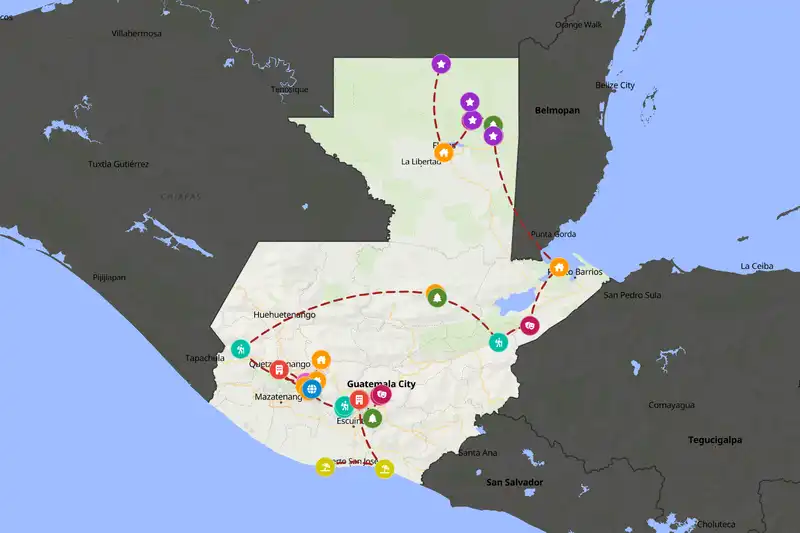
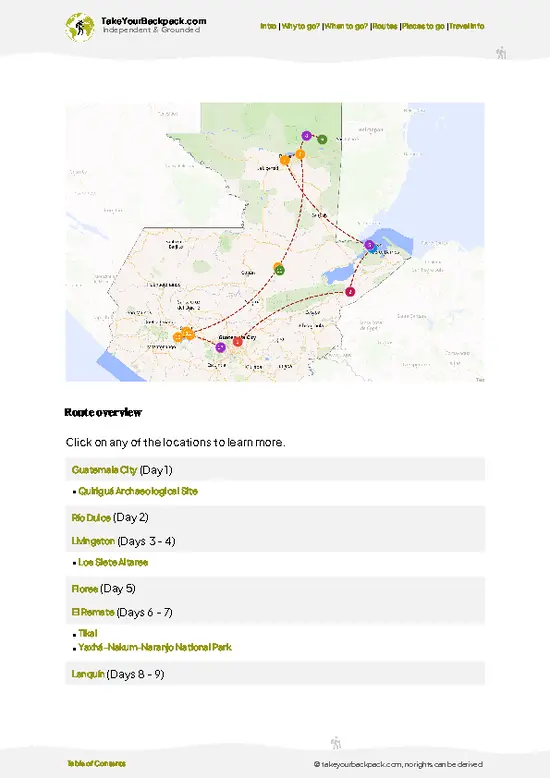
This 15-day Guatemala loop is for travelers with two full weeks who want the whole spread: a Garífuna town on the Caribbean, the big Maya cities of the Petén jungle, the river pools of Semuc Champey and the highland lake, finishing in Antigua an hour from the airport. The pace is steady, with two long shuttle days that are never back-to-back and enough two- and three-night stays to recover between them. You’ll use a first-class Litegua bus, river boats, tourist shuttles, colectivo minibuses, pickup trucks around Lanquín and the public lanchas on Lake Atitlán.
Days 1-2: Guatemala City, Quiriguá and Rio Dulce
Sleep your first night in
Guatemala City near the airport or in Zona 10. The reason to start here is the Litegua terminal: the first-class buses toward the Caribbean leave from the capital, and doing this leg first means you finish the trip in Antigua instead of on a six-hour bus to catch a flight.
On day two, ride about 3.5 to 4 hours east and get off at the Quiriguá turnoff, where tuk-tuks …
read more 👉This 15-day Guatemala loop is for travelers with two full weeks who want the whole spread: a Garífuna town on the Caribbean, the big Maya cities of the Petén jungle, the river pools of Semuc Champey and the highland lake, finishing in Antigua an hour from the airport. The pace is steady, with two long shuttle days that are never back-to-back and enough two- and three-night stays to recover between them. You’ll use a first-class Litegua bus, river boats, tourist shuttles, colectivo minibuses, pickup trucks around Lanquín and the public lanchas on Lake Atitlán.
Days 1-2: Guatemala City, Quiriguá and Rio Dulce
Sleep your first night in Guatemala City near the airport or in Zona 10. The reason to start here is the Litegua terminal: the first-class buses toward the Caribbean leave from the capital, and doing this leg first means you finish the trip in Antigua instead of on a six-hour bus to catch a flight.
On day two, ride about 3.5 to 4 hours east and get off at the Quiriguá turnoff, where tuk-tuks run you and your pack the 4 kilometers to the Quiriguá Archaeological Site. It’s small and quiet, set among banana plantations, and it holds the tallest carved stelae in the Maya world. Stela E stands roughly 8 meters above the ground, and the zoomorphic boulders covered in glyphs are carved with more detail than anything you’ll see at Tikal. Two hours is plenty. Flag the next bus on to Rio Dulce (about 1.5 hours) and spend the night by the water in one of the dock-side lodges.Days 3-4: Livingston
The boat from Rio Dulce to Livingston takes about 2 hours and runs through a limestone gorge with jungle on both walls, egrets on the banks and a stop at a hot spring. Tickets run around Q150 to 200 (US$19 to 26) one way. Livingston has no road connection to the rest of Guatemala, and it shows: the town is Garífuna, with punta music, coconut bread and tapado, a seafood soup cooked in coconut milk with plantain, which you should order at least once.
Use your full day for Los Siete Altares, a chain of freshwater pools and small cascades about an hour’s walk along the beach north of town. Go in a group or with a local guide, swim in the upper pools and walk back before late afternoon.Days 5-7: Flores, El Remate and the Petén ruins
Take the morning boat back to Rio Dulce and a shuttle north to Flores, about 4 to 5 hours. The island town sits on Lake Petén Itzá, joined to the mainland by a causeway, and its pastel streets take twenty minutes to circle. One night is enough before moving to El Remate, a village on the lake’s east shore about 30 kilometers closer to Tikal, with cheaper lakeside rooms and a dock to swim from.
Day six is for the Tikal Archaeological Site. Catch the earliest shuttle, pay the Q150 (about US$19) entry and walk the causeways between the temples while howler monkeys roar overhead. Climb the wooden stairs of Temple IV, around 65 meters tall, where the roof combs of the other temples poke through the canopy. On day seven, take a shuttle to the Yaxha-Nakum-Naranjo National Park, about an hour from El Remate, for the ruins of Yaxhá on a lagoon of the same name. Climb Temple 216 for sunset over the water, an experience with a fraction of Tikal’s crowds.Days 8-9: Lanquín and Semuc Champey
Day eight is the first long haul: take a colectivo back to Santa Elena early and a shuttle south to Lanquín, roughly 7 to 9 hours on roads that turn rough near the end. The town sits in a steep green valley of the Alta Verapaz, and the hostels along the river are built for exactly this kind of arrival, with family dinners and a hammock.
Ride a pickup truck 10 kilometers (about 45 minutes, Q25 to 30 each way) to Semuc Champey National Park. The Cahabón River disappears under a limestone shelf here, and on top of it sit stepped turquoise pools you can swim between. Entry is around Q50 (US$6.50). Climb to the El Mirador viewpoint first, about 30 to 45 minutes of steep stairs, then swim. Most hostels add the K’an Ba cave tour, where you wade and swim through the cave holding a candle.Days 10-12: San Juan La Laguna
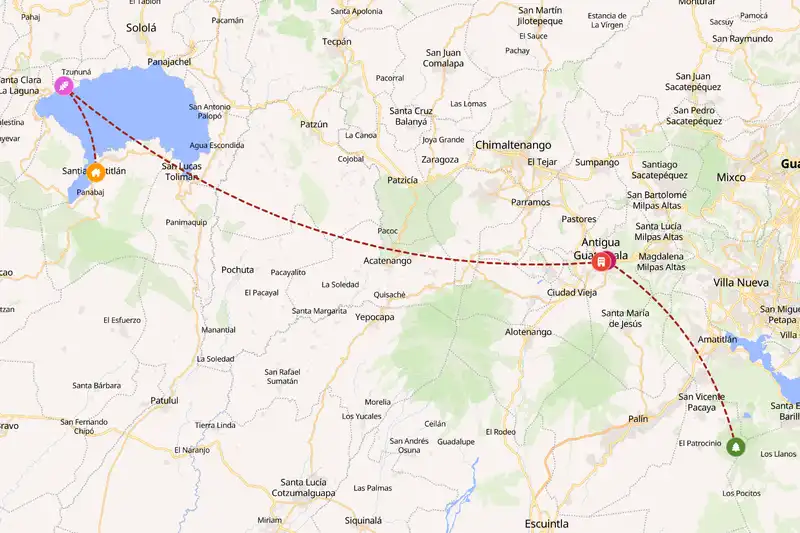
Day ten is the second long day, 9 to 10 hours by shuttle to Panajachel, then a lancha across Lake Atitlán to San Juan La Laguna. You’ve earned three nights. San Juan is a Tz’utujil town with weaving cooperatives that dye cotton with plants like indigo and achiote, small chocolate and coffee workshops, and murals covering most walls. It’s calmer than its party neighbor San Pedro, a ten-minute walk away.
Spend one day crossing the lake to Santa Catarina Palopó, where a community project has painted the houses in blue and green patterns drawn from the local huipil. If your dates fall on a Tuesday or Friday, stop at Sololá, 15 minutes uphill from Panajachel, for a market that runs on Kaqchikel and serves locals, with men of the cofradías still wearing traditional dress.Days 13-15: Antigua
A shuttle takes about 3 hours to Antigua, and finishing here means a one-hour ride to the airport on your last day. Walk up to Cerro de la Cruz in the morning for the view of the city grid with Volcán de Agua behind it, going with the tourist police escort or in a group. On the Parque Central, the Museo de Santiago / Museo del Libro Antiguo shares the old city hall: colonial weapons and furniture on one side, and on the other a replica of the first printing press in Central America with books printed in the 1600s. Leave the final afternoon for cafes, a market run for textiles and an early night before your flight.
If a friend were doing this route, I’d send them on a detour from Rio Dulce to Finca El Paraíso on Lake Izabal’s north shore, where a hot waterfall drops into a cold river, and I’d tell them to go on a weekday and bring water shoes.v2.webp)
 Best Backpacking