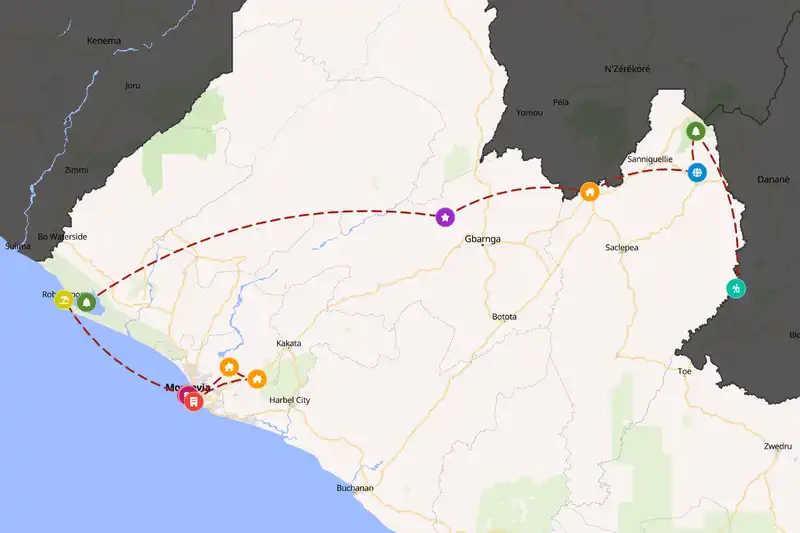
This 15-day loop is for travelers with some West Africa experience, or confident first-timers, who want to see Liberia from the surf coast to the high Nimba ridges and deep into the southeastern rainforest. The pace is steady with real rest days, but it includes two long road days on rough laterite. You will rely on shared taxis and minibuses between towns, motorbike taxis for the last stretch to falls and park gates, and kekehs (tricycles) and cabs inside Monrovia. Run it in the dry season, roughly November to April, because the southeastern roads can become impassable in the rains.
Days 1-2: Monrovia
Start with the story the rest of the country hangs on.
Providence Island, under the bridge by the Mesurado River, is where the first freed American settlers came ashore, and walking it first makes everything later, from Americo-Liberian town names to the hilltop mansions, make sense. From there it is a short walk to the
Liberia National Museum on Broad Street, a small collection whose masks …
read more 👉This 15-day loop is for travelers with some West Africa experience, or confident first-timers, who want to see Liberia from the surf coast to the high Nimba ridges and deep into the southeastern rainforest. The pace is steady with real rest days, but it includes two long road days on rough laterite. You will rely on shared taxis and minibuses between towns, motorbike taxis for the last stretch to falls and park gates, and kekehs (tricycles) and cabs inside Monrovia. Run it in the dry season, roughly November to April, because the southeastern roads can become impassable in the rains.
Days 1-2: Monrovia
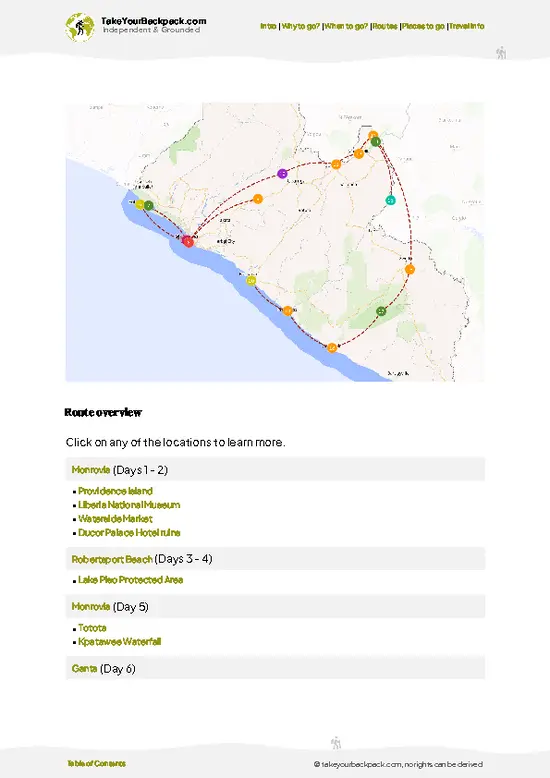
Start with the story the rest of the country hangs on. Providence Island, under the bridge by the Mesurado River, is where the first freed American settlers came ashore, and walking it first makes everything later, from Americo-Liberian town names to the hilltop mansions, make sense. From there it is a short walk to the Liberia National Museum on Broad Street, a small collection whose masks and civil war material deserve a slow hour. Push into Waterside Market next: fabric bolts, dried fish, phone credit sellers and wheelbarrow traffic, all squeezed between the river and downtown. End at the Ducor Palace Hotel ruins on Mamba Point at sunset; the hollow concrete shell looks straight down on West Point and the river mouth, and the guards may expect a small tip to let you up.Days 3-5: Robertsport Beach and Lake Piso
A 2.5 to 3.5 hour shared taxi ride northwest brings you to Robertsport Beach, where long left-hand point breaks roll in beside a quiet fishing town. Two nights here is the right dose after the capital: surf or take a lesson, eat grilled fish, and spend one morning on the Lake Piso Protected Area, the broad lagoon behind town, by dugout canoe with local fishermen. On day 5, head back to Monrovia for a single night to reset, change money and stock up before the interior.Days 6-9: Kpatawee, Ganta and Yekepa
The highway north is paved, which makes this the easiest long leg of the trip. Break it at Totota, the roadside town near President Tubman’s old country estate, then detour by motorbike to Kpatawee Waterfall, a wide cascade over granite boulders in Bong County where you can swim when the water is calm. Sleep in Ganta, a busy trading town on the Guinea border with the best market in Nimba County. The next morning, pass through Sanniquellie, the county capital, on the way to Yekepa, the old mining company town at the foot of the mountains. Three nights here give you one day to arrange permits and guides, and two for the East Nimba Nature Reserve and the Nimba Mountains, where steep forest trails climb to grassy ridges with views over three countries on a clear day.Days 10-13: Tchien, Sapo National Park and Greenville
Day 10 is the hardest move: 7 to 9 hours south via Tappita to Tchien, the town most Liberians now call Zwedru, where you sleep before the forest. Next day, continue to Sapo National Park, the largest stretch of primary rainforest in the country, and arrange the visit in advance with the Forestry Development Authority in Monrovia. Two nights at the park let you walk with trackers for chimpanzee signs, river crossings and, with luck, a glimpse of forest wildlife few visitors ever see. Roll down to Greenville, a sleepy port on the Sinoe River lagoon, for a night with a proper shower and fried plantains.Days 14-15: River Cess and Buchanan Beach
The coast road back is long and rough, 8 to 10 hours in good conditions, so start early. You pass through River Cess, a small riverside county seat that makes a good lunch stop, before reaching Buchanan Beach, where the iron ore railway from Yekepa ends at the port. Spend the last evening on the sand with cold beer and fresh fish, then on day 15 it is roughly 1.5 hours to Roberts International Airport.
If you have one spare day, head to Harper and walk out to the old lighthouse on Cape Palmas, where the Liberian coast turns toward Côte d’Ivoire.
 Best Backpacking