×

Liberia🇱🇷 | best townsBest 10 towns in Liberia

Towns in Liberia are working places first and sights second. Red laterite roads throw dust onto tin roofs, motorbike taxis whine past market tables stacked with cassava leaf, palm oil and smoked fish, and generators hum after dark. Monrovia’s coast is loud, humid and the most expensive. The interior (Nimba, Lofa, Bong) is cooler, hillier and slower, with fewer foreigners than almost anywhere in West Africa. The southeast is remote, with long, rough road stretches. Independent travelers and backpackers get real welcomes and few crowds, but should expect basic guesthouses, cash-only days and plenty of waiting.

By Johan Kruseman 🇳🇱 | Updated October 23, 2026
Explore the best landmarks in Liberia

Why go?Key Factors That Shape the Experience

Liberia suits towns that are lived in rather than staged. Founded partly by freed African Americans in the 19th century, the country carries an unusual mix: Americo-Liberian architecture and English as the common language sit beside Kpelle, Bassa, Kru, Mano and Gio communities, each with its own food, masks and rhythms. Add the scars of the civil wars that ended in 2003, and towns here feel rebuilt rather than preserved. You hear this in radio talk shows, in church singing on Sundays and in how quickly strangers start a conversation.

Geography shapes everything. Rainforest, rubber plantations and swampy lowlands meet the Nimba and Wologizi highlands, so towns sit in very different air: sticky and salty on the coast, cooler and misty up north. Infrastructure is the hard part. Paved roads are … read more 👉
Liberia suits towns that are lived in rather than staged. Founded partly by freed African Americans in the 19th century, the country carries an unusual mix: Americo-Liberian architecture and English as the common language sit beside Kpelle, Bassa, Kru, Mano and Gio communities, each with its own food, masks and rhythms. Add the scars of the civil wars that ended in 2003, and towns here feel rebuilt rather than preserved. You hear this in radio talk shows, in church singing on Sundays and in how quickly strangers start a conversation.

Geography shapes everything. Rainforest, rubber plantations and swampy lowlands meet the Nimba and Wologizi highlands, so towns sit in very different air: sticky and salty on the coast, cooler and misty up north. Infrastructure is the hard part. Paved roads are limited, many routes turn to red mud in the rains, electricity is patchy outside the capital, and ATMs are scarce away from Monrovia. Prices run higher than the region’s average because most goods are imported. Travelers should bring US dollars in clean notes, accept that Liberian dollars circulate alongside them, and plan on slow transport. Choose Liberia for raw, friendly, uncrowded contact with everyday West African life, not for polish.
How the List Was Created
The list of best towns in Liberia is created based on charm, local culture, atmosphere, hidden gems, and visitor appeal. If you feel a town is missing in this list, please let us know.

When to go?Seasonal Guide to Visiting

Best months: The best months for towns in Liberia are December to March, when the dry season brings clear skies, firmer roads and daytime temperatures of roughly 28 to 33°C. Harmattan haze can dull the light in the north and interior from December to February, and dust settles on everything, but mornings are crisp and nights in the highlands cool enough for a thin blanket.
Shoulder and wet seasons: November and April to May are workable shoulder months. Showers arrive in the afternoons, the air turns heavy, and the laterite starts to slick. From June to October Liberia sits among the wettest countries in Africa. The coast, including Monrovia, can receive over 4,000 mm a year, most of it falling in this window, often in July and August, with storms that drum on zinc roofs so loudly conversation … read more 👉
Best months: The best months for towns in Liberia are December to March, when the dry season brings clear skies, firmer roads and daytime temperatures of roughly 28 to 33°C. Harmattan haze can dull the light in the north and interior from December to February, and dust settles on everything, but mornings are crisp and nights in the highlands cool enough for a thin blanket.
Shoulder and wet seasons: November and April to May are workable shoulder months. Showers arrive in the afternoons, the air turns heavy, and the laterite starts to slick. From June to October Liberia sits among the wettest countries in Africa. The coast, including Monrovia, can receive over 4,000 mm a year, most of it falling in this window, often in July and August, with storms that drum on zinc roofs so loudly conversation stops. Interior tracks turn to soup, bridges flood and minibuses stall for hours.
Regional differences and prices: The southeast and the forest belt are the hardest to reach in the wet months, while the northern highlands stay a bit cooler and drier at the edges of the season. Crowds are never an issue, though flights and rooms in Monrovia tighten around Christmas and the holidays. Expect room rates to rise slightly then, roughly 10 to 25 percent, and transport fares to jump when roads are bad.

town hoppingHow to Combine towns Into One Trip

How long to allow: A trip linking several towns in Liberia needs 10 to 14 days, and 7 days is the minimum if you stick to one region. Distances look small on a map, yet a 150 km stretch can eat 5 to 8 hours on laterite roads, shared taxis leave only when full, and you will spend whole mornings waiting at motor parks.
Grouping and direction: Think in three clusters. The coast and Monrovia form the logistics hub. The north-central interior (Bong, Nimba and the Lofa direction) works as a loop out of the capital, with 4 to 7 hours between regions. The southeast sits far from everything, usually 8 to 12 hours or more by road from Monrovia in the dry season. Travel dry-season months and go outward from Monrovia toward the interior first, then return to the coast, saving the long southeast leg for … read more 👉
How long to allow: A trip linking several towns in Liberia needs 10 to 14 days, and 7 days is the minimum if you stick to one region. Distances look small on a map, yet a 150 km stretch can eat 5 to 8 hours on laterite roads, shared taxis leave only when full, and you will spend whole mornings waiting at motor parks.
Grouping and direction: Think in three clusters. The coast and Monrovia form the logistics hub. The north-central interior (Bong, Nimba and the Lofa direction) works as a loop out of the capital, with 4 to 7 hours between regions. The southeast sits far from everything, usually 8 to 12 hours or more by road from Monrovia in the dry season. Travel dry-season months and go outward from Monrovia toward the interior first, then return to the coast, saving the long southeast leg for the end if time allows. Allow 1 to 3 nights per stop; one night feels rushed after a long bumpy ride.
Planning mistakes: The usual error is cramming too many stops into a week and arriving after dark, when roads are hard to read and checkpoints and potholes multiply. Start at dawn, when the air is cool and shared taxis fill fastest. Another mistake is assuming cash is available. Withdraw in Monrovia, carry small bills, and build one buffer day for delays.

The ListMust-Visit towns in Liberia

1 Ganta

Nimba crossroads, dawn market, motor park, mission compound

Time a night here around the early market, the jostling motor park, and a Sunday service at the old Methodist mission.

2 Greenville

Sinoe capital, surf beach, settler streets, river-mouth landing

Catch the morning haul sorted on the sand, wander weathered settler buildings, and stroll a pale Atlantic shore with strong surf.

3 Voinjama

Lofa capital, central mosque, Lorma and Mandingo quarters, Guinea-border cloth

Browse a market stocked from across the Guinea border, join the neighborhood at late prayers, and climb a rise for highland views.

4 Yekepa

Mount Nimba gateway, former LAMCO town, ore railway remains, foothill guides

Walk the faded company grid in cool morning light, then arrange a guide for forest trails climbing the Nimba slopes.

5 Sanniquellie

Nimba foothills, 1959 declaration site, cool upland air, roadside grills

Stay a night to hike guided foothill trails, find the marker of a historic summit, and eat grilled meat after dark.

6 Tubmanburg

Bomi capital, iron ore ruins, ridge viewpoints, cookshop benches

Hike with a guide through rusting mine equipment and scarred hills, then look over zinc roofs from the ridges at day's end.

7 Barclayville

Grand Kru capital, empty Atlantic beaches, fishing landings, laterite road

Ride out to long empty beaches at low tide, then return for canoes unloading catch and Sunday choirs in the county capital.

8 Pleebo

Grebo market, Maryland junction, tarps and palm oil, Sunday drums

Sit at the crossroads with a cold drink as trucks and taxis head for Harper, then browse the tightly packed market rows.

9 Bensonville

Saint Paul riverbanks, Montserrado county seat, market stalls, day trip from Monrovia

Walk the main road past county offices and market stalls, then settle on the brown river's rocks where laundry and canoes share the edge.

10 Careysburg

Settler-era houses, hilltop churches, rubber lanes, river overlooks

Trace weathered 1800s houses along the ridge roads, hear Sunday hymns carry downhill, then follow footpaths through palms toward Saint Paul River views.

11 Fish Town

Cavalla landing, dugout canoes, River Gee, smoked fish

Watch pirogues unload at dawn, hire a paddler for a morning on the Cavalla, and walk the bank path past mended nets.

12 Bopolu

Gola and Kpelle roots, Gbarpolu seat, chiefs' compounds, stream walks

Arrange a courtesy visit to elders' compounds, browse the morning market, and follow short paths to stream crossings where children swim.

13 Foya

Border market, Guinea and Sierra Leone crossings, motorbike park, cookshops

Watch traders and porters stream toward two borders, haggle for kola and cloth, and finish with cassava leaf at a roadside kitchen.

14 Salala

Rubber rows, latex tapping, highway stalls, Bong County

Rise early to watch tappers work spiral-cut trees, then eat and restock at the roadside market where vehicles slow to buy.

15 Totota

Highway market, palm butter pots, back lanes, Bong roadside

Step off the bush taxi into stalls of cassava and peppers, eat from big midday pots, then wander the quiet lanes behind.

16 River Cess

Cestos River, mangrove canoe trips, empty surf beach, village footpaths

Paddle the slow brown Cestos at first light, then walk an empty Atlantic beach or farm paths with a local guide.

17 Kolahun

Lofa River edge, mosques and churches, forest-edge villages, border-zone market

Walk to the river for canoe traffic and laundry, then follow guided footpaths through farms to villages at the forest's edge.

18 Zwedru

Grand Gedeh capital, farmers' market, red-dust streets, motorbike taxis

Arrive early to see farmers fill the central market with cassava, peppers and palm oil, in a southeastern town with few visitors.

Think you know Liberia?

Prove you’re a true local — uncover 8 lesser-known towns in Liberia that locals tend to keep to themselves.
Loading the map 🌍

Expert viewWhat You Should Know

How many towns: I advise three to five towns on a two-week trip. Roads, not sights, set the pace: a day of travel on red dirt, with the windows open and dust in your teeth, often leaves you only one slow afternoon of wandering. Fewer stops mean you can sit through a market morning, accept an invitation to a meal of rice and palm butter, and still reach your bed before dark.
Which kind to prioritize: Coastal towns suit first-timers and anyone short on days: salt wind, fish smoke, beach bars and easier guesthouses. Interior towns suit travelers who want cooler air, forest edges, hill views and conversations in local markets. Southeast towns suit confident, experienced backpackers with spare days, patience and a tolerance for rough rooms. If you only choose one kind, choose the interior; you get … read more 👉
How many towns: I advise three to five towns on a two-week trip. Roads, not sights, set the pace: a day of travel on red dirt, with the windows open and dust in your teeth, often leaves you only one slow afternoon of wandering. Fewer stops mean you can sit through a market morning, accept an invitation to a meal of rice and palm butter, and still reach your bed before dark.
Which kind to prioritize: Coastal towns suit first-timers and anyone short on days: salt wind, fish smoke, beach bars and easier guesthouses. Interior towns suit travelers who want cooler air, forest edges, hill views and conversations in local markets. Southeast towns suit confident, experienced backpackers with spare days, patience and a tolerance for rough rooms. If you only choose one kind, choose the interior; you get the most character per day without the heaviest logistics.
Budget: Liberia costs more than neighboring countries. Plan US$40 to 70 a day on a shoestring basis: guesthouse rooms US$15 to 35, a plate of rice and sauce US$2 to 5, and shared taxis or motorbike rides US$1 to 10 for short hops and US$10 to 25 for long routes. Per visit, budget a few dollars for community or park fees, US$10 to 30 for a local guide on forest walks, and extra for a chartered ride on a bad road. Midrange comfort with air conditioning and reliable power runs US$60 to 100 or more.
Safety and culture: Daytime town life is generally relaxed, and people greet you with a handshake that ends in a finger snap, a ritual worth returning. Keep phones out of sight in crowded markets, avoid walking after dark, and use registered taxis at night. Expect police and immigration checkpoints; carry a passport copy and stay polite and patient. Dress modestly, ask before photographing people, and treat sacred forest societies with respect; some ceremonies and places are off limits to outsiders. Malaria is a real risk year-round, so bring prophylaxis and a net, and carry cash because cards rarely work.

✈️ The backpacker research shortcutLiberia Travel Guide

An offline-friendly backpacking guide with optimized travel routes, ranked highlights, transport advice, and the best areas to stay.
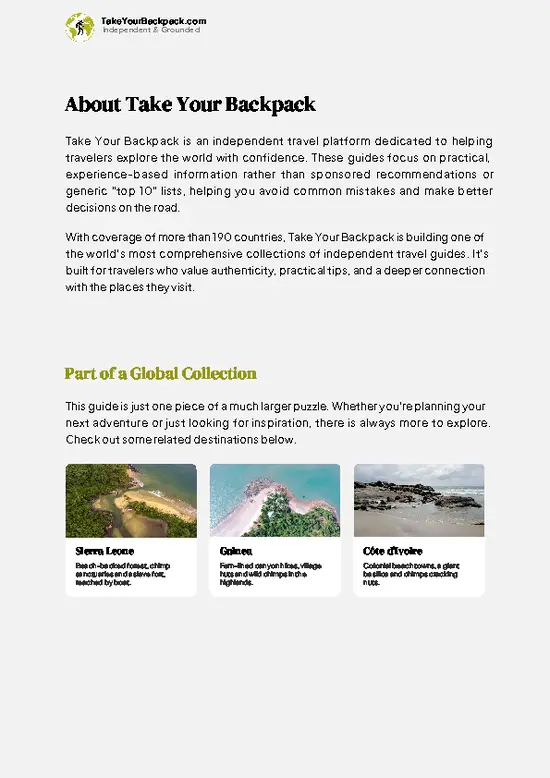
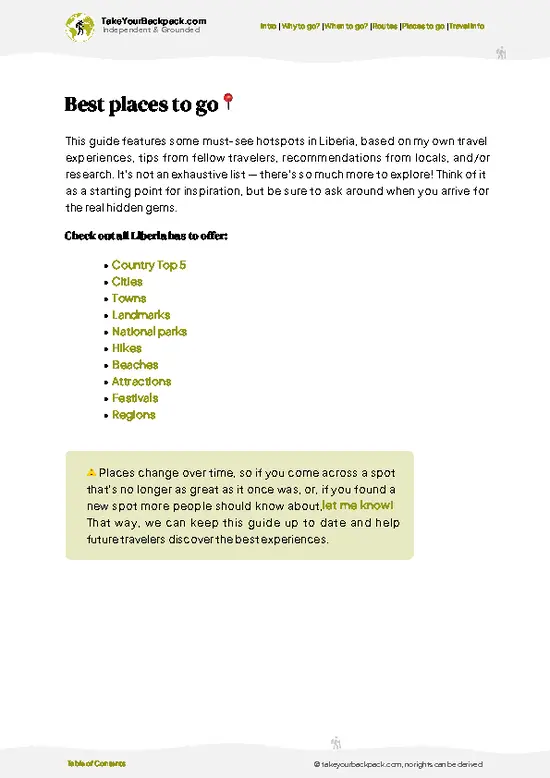
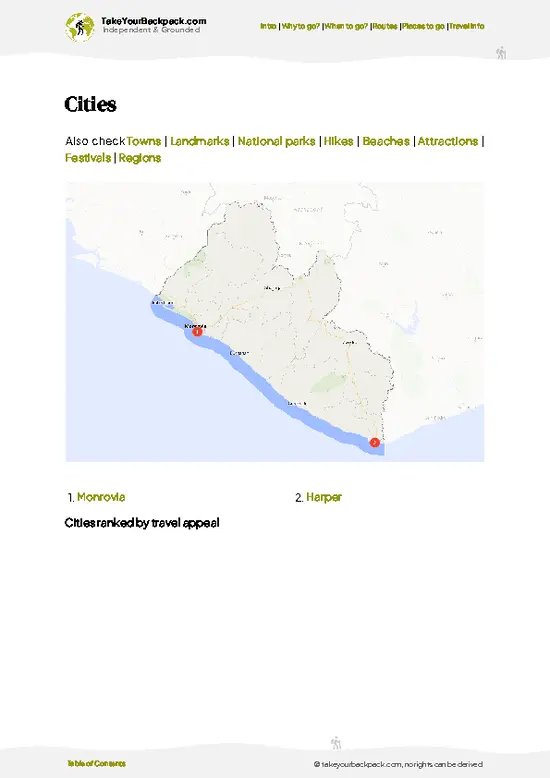
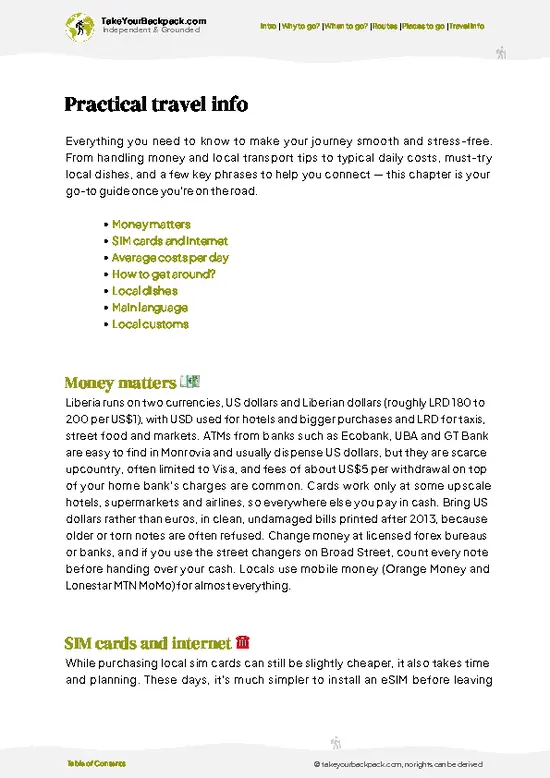
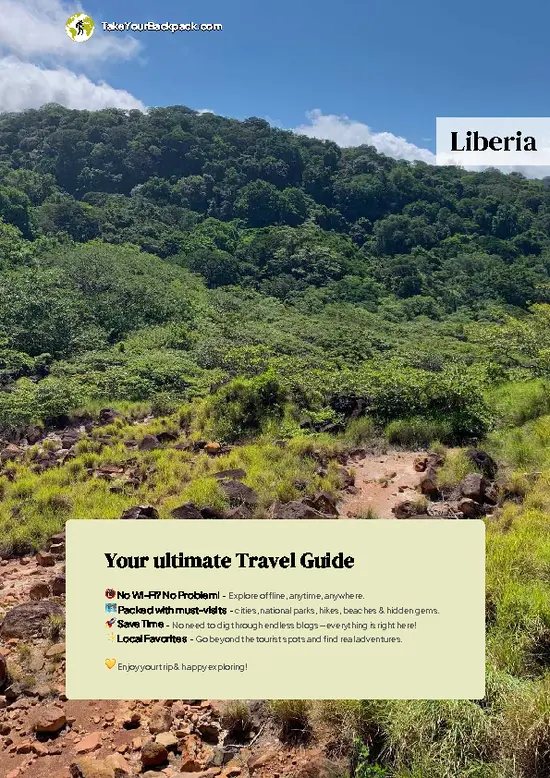
example page 0 from our offline Travel Guide for Liberia
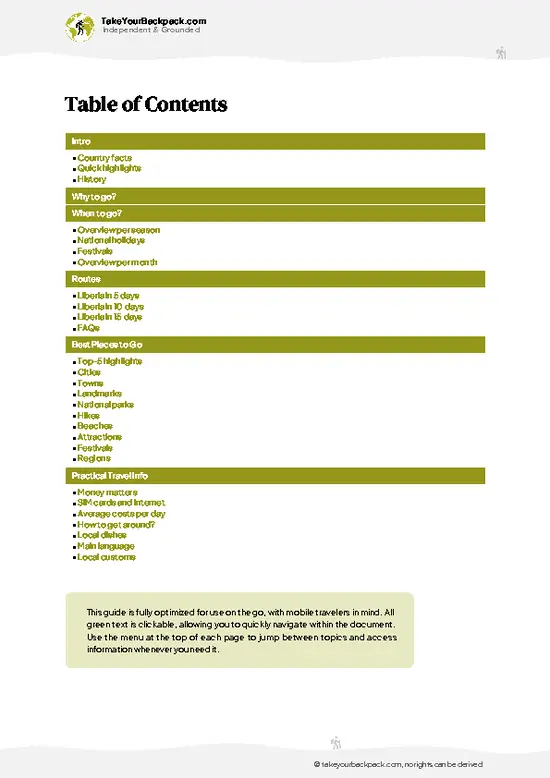
example page 1 from our offline Travel Guide for Liberia
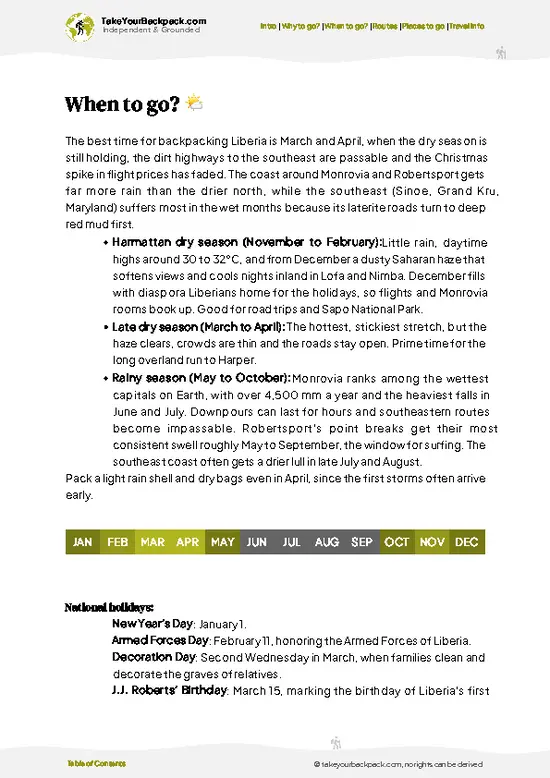
example page 2 from our offline Travel Guide for Liberia
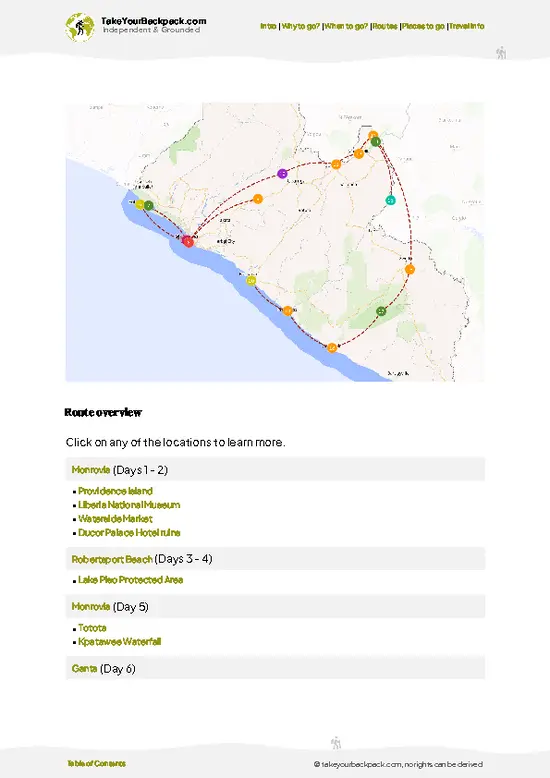
example page 3 from our offline Travel Guide for Liberia
example page 4 from our offline Travel Guide for Liberia
example page 5 from our offline Travel Guide for Liberia
example page 6 from our offline Travel Guide for Liberia
example page 7 from our offline Travel Guide for Liberia
The digital guide (211 pages) contains:
✅ 49 highlights, ranked by travel appeal
✅ Optimized 5, 10 & 15-day travel routes
✅ Cities, national parks, landmarks, beaches
✅ How to get around
✅ Offline-friendly for travel without Wi-Fi
👉 Click to see all 30+ guide features

📅 Plan smarter in minutes, not weeks
✅ Month by month travel advice
✅ Festivals & national holidays
✅ Budget expectations

🗺️ Go to the right places, skip the overrated ones
✅ Honest pros & cons of destinations
✅ Top hikes, parks & viewpoints
✅ Lesser-known places most travelers miss
✅ Clear “worth it vs skip it” guidance

🛏️ Travel smoothly without rookie mistakes
✅ Best areas to stay
✅ Transport systems explained simply
✅ Common scams & safety advice
✅ SIM cards, money & practical tips

🌍 Understand the country, not just visit it
✅ Culture & traditions
✅ Local customs
✅ Festivals worth planning around
✅ Traveler-friendly historical context
✅ Insights that make places more meaningful

📱 Built for real travel conditions
✅ Fully downloadable PDF
✅ Works completely offline
✅ Optimized for phone use
✅ Useful in remote areas & buses
✅ Everything in one place
Stop searching, start planning
Get instant access to your full guide. 30‑day money-back guarantee.
+ Add another guide for just

By proceeding you agree to our terms.
Sent to your inbox immediately after payment • 100% Secure Checkout
Best Backpacking Travel Advisor 2025 tourism awardBest Backpacking
Travel Advisor
2025
What others say about Take Your Backpack Guides:
⭐⭐⭐⭐⭐
Fantastic, amazing amount of information!
⭐⭐⭐⭐⭐
My goodness this is amazing, it's what I've been looking for hats off too you!
⭐⭐⭐⭐⭐
I think this is absolutely BRILLIANT
⭐⭐⭐⭐
Very complete and informative. It's still missing places, but I gotta to commend you
⭐⭐⭐⭐⭐
This is truly amazing, thank you, can't wait to explore it with my kids!
⭐⭐⭐⭐⭐
Awesome resource, thank you!
⭐⭐⭐⭐⭐
This is amazing! Can't wait to explore the ones I haven't seen
⭐⭐⭐⭐
I love this! Well done, great idea.
⭐⭐⭐⭐⭐
Thanks for taking the time to make this gem!
⭐⭐⭐⭐⭐
This might be the best website I've ever seen.
⭐⭐⭐⭐⭐
Congratulations, and thank you so much for your work; it's incredibly valuable.
⭐⭐⭐⭐
In all seriousness I think you did a great job pointing out the important spots
⭐⭐⭐⭐⭐
10/10 very good
⭐⭐⭐⭐⭐
As someone who's only just starting to visit regularly this is awesome, thank you.
⭐⭐⭐⭐
Thank you very much! I'm going to visit my dad, it's going to be very useful!
⭐⭐⭐⭐⭐
This is really cool! We'll be travelling for the first time and this definitely come in handy.
⭐⭐⭐⭐⭐
You are now our minister of culture, congratulations 👨‍💼
⭐⭐⭐⭐⭐
Just wanted to tell you that this is a pearl! Going to follow your recommendations.
⭐⭐⭐⭐⭐
This is so cool. I'll definitely be using the resource for my travels soon.
⭐⭐⭐⭐⭐
This is very impressive! Good work.
⭐⭐⭐⭐⭐
This is an amazing and informative site. Very well done!

🛏️ Where to stay?Top Places to Consider Staying

Liberia has almost no true backpacker hostels, so budget travel here means simple guesthouses and small hotels, usually around US$25 to 50 a night for a private room with a fan or air conditioning and a generator for power cuts. In Monrovia, Sinkor has the widest spread of mid-priced rooms close to beach bars and restaurants along Tubman Boulevard, while Mamba Point is the safest and best-connected area thanks to the embassies, but rooms there cost noticeably more. Downtown around Broad Street is cheaper and handy for markets and shared taxis but loud and sketchier after dark, and Paynesville is cheaper still but far from everything, while on the coast Robertsport has basic surf camps and beach … read more 👉
Liberia has almost no true backpacker hostels, so budget travel here means simple guesthouses and small hotels, usually around US$25 to 50 a night for a private room with a fan or air conditioning and a generator for power cuts. In Monrovia, Sinkor has the widest spread of mid-priced rooms close to beach bars and restaurants along Tubman Boulevard, while Mamba Point is the safest and best-connected area thanks to the embassies, but rooms there cost noticeably more. Downtown around Broad Street is cheaper and handy for markets and shared taxis but loud and sketchier after dark, and Paynesville is cheaper still but far from everything, while on the coast Robertsport has basic surf camps and beach huts that suit tighter budgets.

If you enjoy meeting fellow travelers, consider choosing hostels with high ratings for atmosphere. On the other hand, if you prefer having your own space, a hotel might be a better option.

LiberiaMore Places Across Liberia

👋 Meet the founderWho’s Behind Take Your Backpack?

Johan, backpacker and founder of TakeYourBackpackHi, I’m Johan (Netherlands 🇳🇱), the creator of TakeYourBackpack. Over the past 3 decades, I’ve backpacked through 90+ countries across six continents, gaining extensive experience with independent travel, long-term trips, and overland routes.

This site is built on a combination of firsthand travel experience and carefully curated insights from other backpackers. Many guides are based on places I’ve personally visited, while others bring together tips, observations, and practical advice shared by trusted travelers I’ve met along the way.

The goal is to provide realistic, experience-driven guidance — not generic itineraries — so you can explore destinations with better context, clearer expectations, and more confidence.