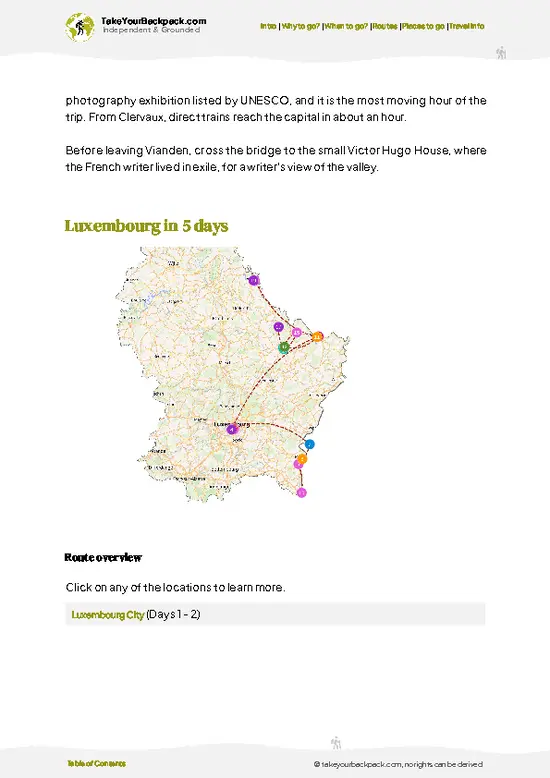
This five-day loop suits first-timers who want the whole of Luxembourg in one go without living out of a backpack every night: the capital’s fortress layers, a wine day on the Moselle, sandstone gorges in the east and a castle town in the north. The pace is relaxed, with three bases and no day spent mostly in transit. You need city buses, regional buses and the national trains, all free in second class, so your only transport cost is getting into the country.
Days 1-2: Luxembourg City and the Moselle Valley
Base yourself for two nights in
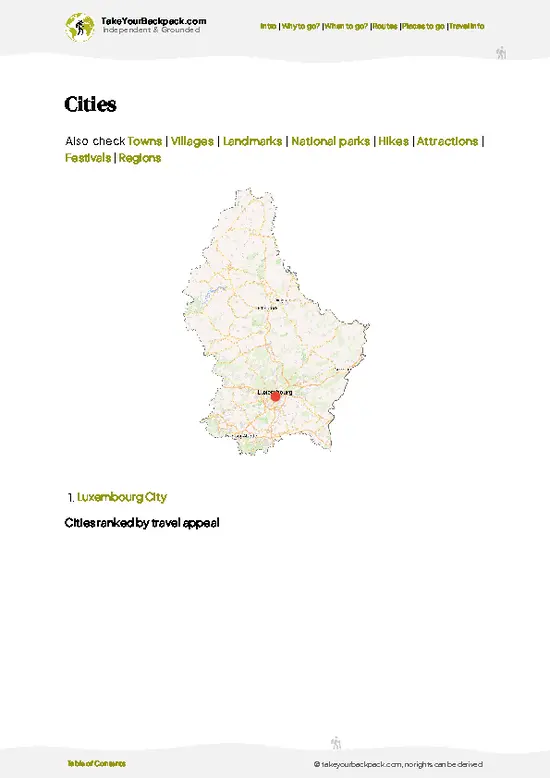
Luxembourg City, because the capital is where Luxembourg’s transport lines meet and the Moselle is an easy out-and-back from here. Start low rather than high: take the public elevator from the Plateau du Saint-Esprit down to
Grund, the old riverside quarter on the Alzette, where stone houses, a former abbey and a few pubs sit at the bottom of a cliff. Walk up the Corniche to the
Bock Casemates, the tunnels cut into the rock under the old fortress, then …
read more 👉This five-day loop suits first-timers who want the whole of Luxembourg in one go without living out of a backpack every night: the capital’s fortress layers, a wine day on the Moselle, sandstone gorges in the east and a castle town in the north. The pace is relaxed, with three bases and no day spent mostly in transit. You need city buses, regional buses and the national trains, all free in second class, so your only transport cost is getting into the country.
Days 1-2: Luxembourg City and the Moselle Valley
Base yourself for two nights in
Luxembourg City, because the capital is where Luxembourg’s transport lines meet and the Moselle is an easy out-and-back from here. Start low rather than high: take the public elevator from the Plateau du Saint-Esprit down to
Grund, the old riverside quarter on the Alzette, where stone houses, a former abbey and a few pubs sit at the bottom of a cliff. Walk up the Corniche to the
Bock Casemates, the tunnels cut into the rock under the old fortress, then cross into the upper town for the
Gëlle Fra, the gilded war memorial on Place de la Constitution, and the
Grand Ducal Palace, whose interior opens only for guided tours in summer. On a rainy afternoon, the
National Museum of History and Art on the Fish Market covers everything from Roman mosaics to modern painting.
Day 2 heads southeast to the
Moselle Valley, roughly 45 minutes by bus. Begin in
Remich, where a riverside promenade faces Germany across the water and wine cellars offer tastings of crémant and Riesling. Continue to
Kleinmacher for the A Possen folk and wine museum in an old winemaker’s house, then finish in
Schengen, the small village where the agreement that opened Europe’s borders was signed on a boat on the river. The European Museum here is free and takes about an hour. Buses link all three villages along the riverside road, so you can drift south and return to the city by evening.
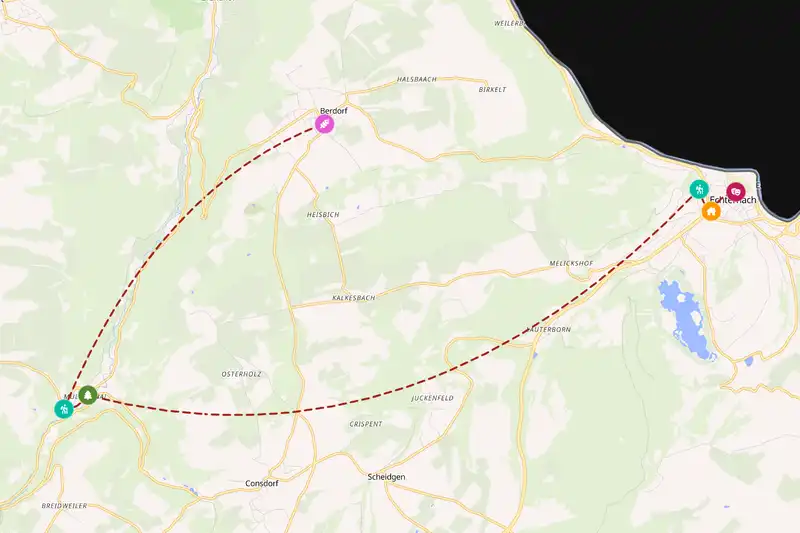
Days 3-4: Echternach and the Mëllerdall
On day 3, take the bus northeast to
Echternach, about an hour from the capital, and settle in for two nights. The town is the gateway to
Mëllerdall, the sandstone region nicknamed “Little Switzerland”, and staying here means you can hike from your door. Spend the afternoon in the
Abbey of Echternach, founded by Saint Willibrord, whose crypt still holds his tomb and draws the town’s dancing procession every Whit Tuesday.
Day 4 belongs to the
Mullerthal Trail. Walk the stretch from Echternach to
Berdorf (around 3 to 4 hours), threading through mossy rock corridors and narrow clefts where the temperature drops noticeably. From Berdorf, continue on foot or by bus toward Müllerthal village for the
Schiessentumpel Cascade Trail, a short loop to the three-pronged waterfall under a little stone bridge. If your legs still work, hop a bus to
Beaufort Castle, where a medieval ruin sits beside a later Renaissance manor and the gift shop sells the local blackcurrant liqueur. Buses take you back to Echternach for the night.
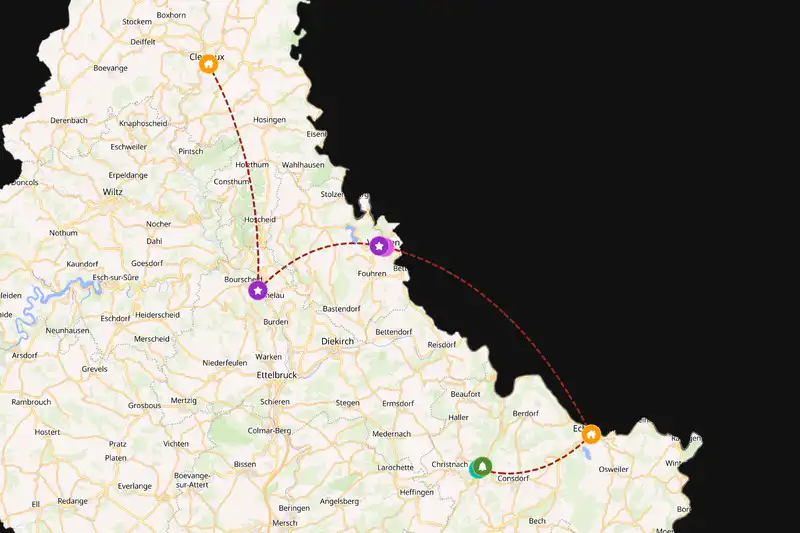
Day 5: Vianden
The final move goes north to
Vianden, roughly an hour by bus via Diekirch, and it saves Luxembourg’s most photogenic sight for last.
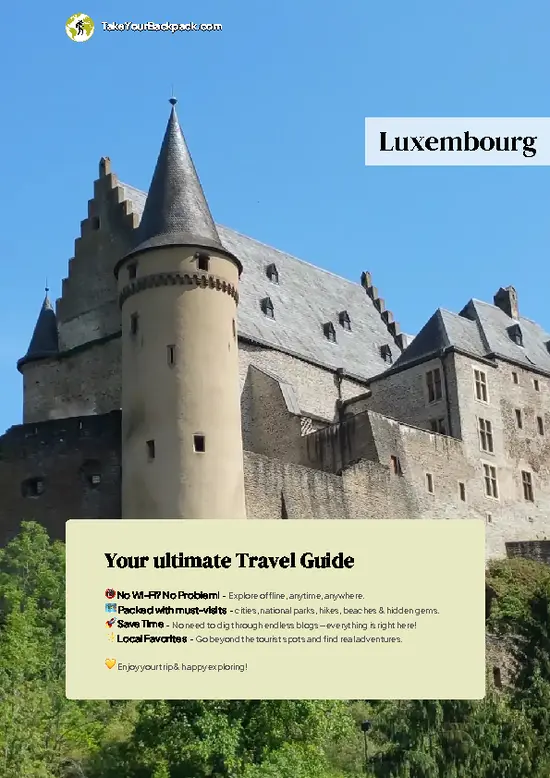
Vianden Castle towers over the Our river, restored room by room after centuries as a ruin; give it two hours, then walk the steep main street down to the bridge. Stay the night, because the castle lit up after dark is worth seeing, and next morning the bus to Ettelbruck and the train south get you back to the capital in about 75 minutes.
If a friend had one spare morning in Echternach, I would send them up the 20-minute path to the Wolfsschlucht, the Wolf’s Gorge, a slot between sandstone walls with a lookout over town at the top; go early and bring proper shoes, since the rock stays slick.

 Best Backpacking