×
Mali🇲🇱 | 10 days itinerary

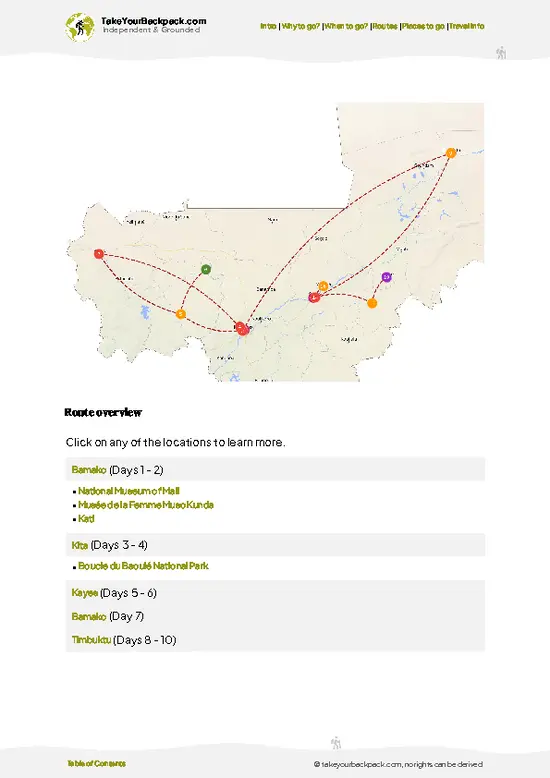
The Perfect 10-Day Route for Mali

By Johan Kruseman 🇳🇱 | Updated May 10, 2026
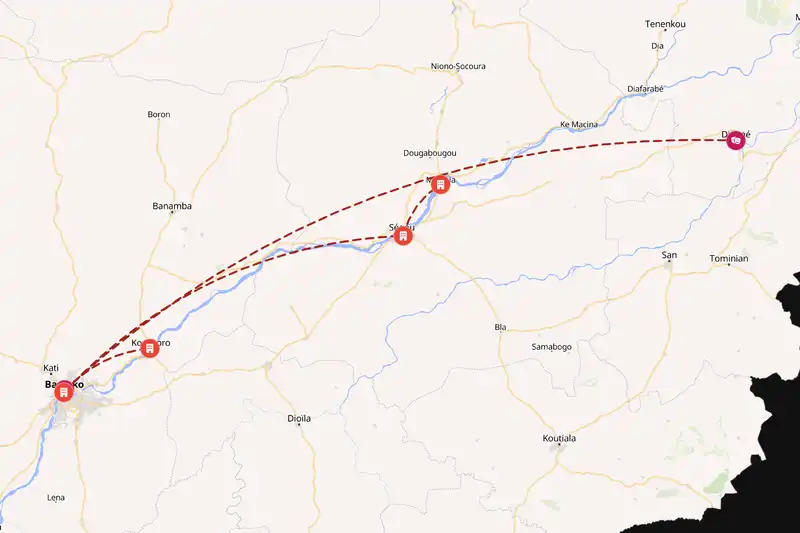
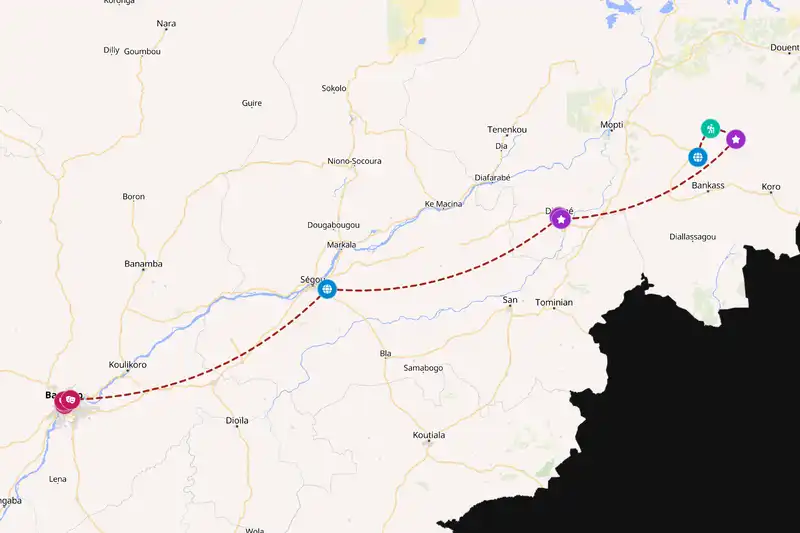
This 10-day route is for travelers who want a strong mix of river life, historic mud-brick cities, and Dogon trekking without sprinting across every corner of Mali; you’ll move mostly by road between Bamako, Ségou, Mopti, and Djenné, with a short river outing and a couple of days on foot in Dogon Country. The pace is steady but not punishing, with two- and three-night stops that let you unpack your bag and actually get to know each place.

Days 1-2: Bamako foundations & museum time

Start in Bamako, where the capital’s chaos is balanced by a surprisingly rich cultural core. Spend time at the National Museum of Mali, which gives you a crash course in Dogon masks, ancient terracottas, and Sahelian textiles so that the rest of your trip has context instead of just pretty photos. Swing by the Bamako Grand Mosque for a sense of contemporary religious life, and, if you have energy, dip into the city’s street food and music scene to feel how modern Mali hums after dark.

Days 3-4: Ségou Region & Niger-side

read more 👉
This 10-day route is for travelers who want a strong mix of river life, historic mud-brick cities, and Dogon trekking without sprinting across every corner of Mali; you’ll move mostly by road between Bamako, Ségou, Mopti, and Djenné, with a short river outing and a couple of days on foot in Dogon Country. The pace is steady but not punishing, with two- and three-night stops that let you unpack your bag and actually get to know each place.

Days 1-2: Bamako foundations & museum time

Start in Bamako, where the capital’s chaos is balanced by a surprisingly rich cultural core. Spend time at the National Museum of Mali, which gives you a crash course in Dogon masks, ancient terracottas, and Sahelian textiles so that the rest of your trip has context instead of just pretty photos. Swing by the Bamako Grand Mosque for a sense of contemporary religious life, and, if you have energy, dip into the city’s street food and music scene to feel how modern Mali hums after dark.

Days 3-4: Ségou Region & Niger-side calm

Head by road to Segou, trading capital noise for river breezes and sun-faded colonial-era facades. Use these days to walk the riverfront, explore the Ségou Region villages nearby, and take a relaxed boat ride on the Niger River to see fishermen, irrigated fields, and small riverside communities at work. The slower pace here is deliberate: it’s where you catch your breath, sip tea under mango trees, and watch the light change on the mud-brick houses before pushing deeper into the interior.

Days 5-6: Mopti & Djenné Grand Mosque

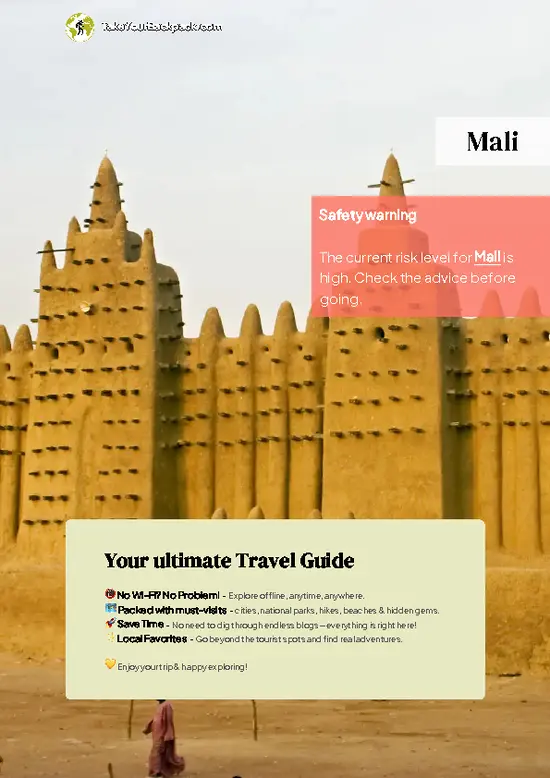
Continue by road to Mopti, your base for exploring the inland delta and one of Mali’s most iconic religious sites. From Mopti, make a day trip to Djenne to see the Djenné Grand Mosque, whose sculpted mud minarets and wooden toron beams make it one of the most distinctive religious buildings on the continent; wander the old streets and market before returning to Mopti for the night. Back in Mopti, use your remaining time for a short Niger River outing or a slow walk through the port area, where boats, traders, and herders all collide in a very photogenic kind of chaos.

Days 7-9: Bandiagara, Dogon Country & the Bandiagara Escarpment

Travel by road to Bandiagara and then into Dogon Country along the Bandiagara Escarpment for a two-night, three-day immersion in cliffside villages. You hike between settlements at a measured pace, stopping often for shade, stories, and millet beer, while your guide explains how the old Tellem cliff dwellings, current Dogon architecture, and ritual spaces all layer on top of each other. Evenings are for simple meals, star-watching, and quietly absorbing how different life feels when the nearest paved road is a long walk away.

Day 10: Return to Bamako

On your final day you make the long but straightforward road journey back toward Bamako, arriving with just enough time for a last plate of grilled brochettes or a quick revisit to the museum if your schedule allows. Ending where you started ties the whole loop together, letting you see how the art and artifacts in Bamako’s displays connect to the living cultures you’ve just walked through.

As a bonus, if you ever stretch this route, consider a side trip to the quiet village of Dioro, where early-morning pirogue rides through flooded fields feel like drifting through a watercolor painting.

Loading the map 🌍

🛏️ Where to stay?Where You'll Go

✈️ The backpacker research shortcutMali Travel Guide

An offline-friendly backpacking guide with optimized travel routes, ranked highlights, transport advice, and the best areas to stay.
example page 0 from our offline Travel Guide for Maliexample page 1 from our offline Travel Guide for Maliexample page 2 from our offline Travel Guide for Maliexample page 3 from our offline Travel Guide for Maliexample page 4 from our offline Travel Guide for Maliexample page 5 from our offline Travel Guide for Mali
The digital guide (276 pages) contains:
76 highlights, ranked by travel appeal
Optimized 5, 10 & 15-day travel routes
Best neighborhoods to stay
How to get around
Offline-friendly for travel without Wi-Fi
👉 See all 30+ guide features

📅 Plan smarter in minutes, not weeks
Month by month travel advice
Festivals & national holidays
Budget expectations

🗺️ Go to the right places, skip the overrated ones
Honest pros & cons of destinations
Top hikes, parks & viewpoints
Lesser-known places most travelers miss
Clear “worth it vs skip it” guidance

🛏️ Travel smoothly without rookie mistakes
Best areas to stay
Transport systems explained simply
Common scams & safety advice
SIM cards, money & practical tips

🌍 Understand the country, not just visit it
Culture & traditions
52 Essential phrases & customs
Festivals worth planning around
Traveler-friendly historical context
Insights that make places more meaningful

📱 Built for real travel conditions
Fully downloadable PDF
Works completely offline
Optimized for phone use
Useful in remote areas & buses
Everything in one place
Save weeks of stressful planning
Get instant access to the full guide directly. 30-day money-back guarantee.


Sent to your inbox immediately after payment • 100% Secure Checkout
Best Backpacking Travel Advisor 2025 tourism awardBest Backpacking
Travel Advisor
2025
What others say about Take Your Backpack Guides:
⭐⭐⭐⭐⭐
Fantastic, amazing amount of information!
⭐⭐⭐⭐⭐
My goodness this is amazing, it's what I've been looking for hats off too you!
⭐⭐⭐⭐⭐
I think this is absolutely BRILLIANT
⭐⭐⭐⭐
Very complete and informative. It's still missing places, but I gotta to commend you
⭐⭐⭐⭐⭐
This is truly amazing, thank you, can't wait to explore it with my kids!
⭐⭐⭐⭐⭐
Awesome resource, thank you!
⭐⭐⭐⭐⭐
This is amazing! Can't wait to explore the ones I haven't seen
⭐⭐⭐⭐
I love this! Well done, great idea.
⭐⭐⭐⭐⭐
Thanks for taking the time to make this gem!
⭐⭐⭐⭐⭐
This might be the best website I've ever seen.
⭐⭐⭐⭐⭐
Congratulations, and thank you so much for your work; it's incredibly valuable.
⭐⭐⭐⭐
In all seriousness I think you did a great job pointing out the important spots
⭐⭐⭐⭐⭐
10/10 very good
⭐⭐⭐⭐⭐
As someone who's only just starting to visit regularly this is awesome, thank you.
⭐⭐⭐⭐
Thank you very much! I'm going to visit my dad, it's going to be very useful!
⭐⭐⭐⭐⭐
This is really cool! We'll be travelling for the first time and this definitely come in handy.
⭐⭐⭐⭐⭐
You are now our minister of culture, congratulations 👨‍💼
⭐⭐⭐⭐⭐
Just wanted to tell you that this is a pearl! Going to follow your recommendations.
⭐⭐⭐⭐⭐
This is so cool. I'll definitely be using the resource for my travels soon.
⭐⭐⭐⭐⭐
This is very impressive! Good work.
⭐⭐⭐⭐⭐
This is an amazing and informative site. Very well done!

🧭 RouteAdjust Your Pace

Travel Mali your way — from a quick highlights trip to a slow-paced adventure.

🙋 FAQTraveler FAQ

Short answer: Mali is not an “easy” independent backpacking destination, but it can be deeply rewarding if you’re experienced and cautious. It’s more like expedition travel than casual backpacking.

Safety and security: Conditions have changed a lot over the last decade. Large parts of the north and center (including much of Dogon Country and areas around Timbuktu, Gao, Kidal) have had serious security issues. Independent travel there can be risky and sometimes impossible. You need to build your trip around the safer corridors and be ready to change plans fast.

Where independent backpacking works best: You’ll have the most realistic shot at independent travel in and around Bamako, Segou, Sikasso, and sometimes Mopti/Djenné when the situation allows. These areas have more infrastructure, more transport options, and more up-to-date local info.

Language: French is extremely useful. Outside Bamako, English is rare. If you don’t speak French, you’ll rely heavily on gestures, patience, and maybe a local fixer or guide. A few phrases in Bambara go a long way for goodwill.

Costs and style: Mali can be very affordable day to day (simple rooms, street food, local buses), but you may need to pay for private drivers, guides, or secure guesthouses in certain areas, which raises costs. Think low daily spend but with occasional big line items for safety and logistics.

Paperwork and admin: You must keep your passport, visa, and any required permits in order and easily accessible. Police and military checkpoints are common; staying calm, respectful, and organized makes these routine.

Who Mali is best for: Independent Mali is better suited to travelers who already have experience in West or Central Africa, are comfortable with uncertainty, and are willing to say “nope, that’s not safe today” and walk away from a plan. If this is your first time outside Europe/North America/SE Asia, Mali is a steep learning curve.

Bottom line: You can backpack Mali independently, but you should treat it as serious adventure travel: research security conditions before you go, stay flexible, lean on local advice, and don’t chase every famous name on the map if the risk feels off.
If you’re going to make the effort to reach Mali, anything under 10 days feels rushed. Two to three weeks is a sweet spot for budget travelers.

1 week (bare minimum, very compressed):
- Focus on Bamako and one additional hub like Segou or Sikasso.
- Enough time to get a feel for the music scene, markets, river life, and a bit of countryside.
- You’ll spend a big chunk of this just adjusting to heat, pace, and transport.

10–14 days (good backpacker window):
- Bamako: 3–4 days for markets, live music, street food, and day trips along the Niger.
- Segou: 2–3 days for riverfront life, colonial-era streets, and relaxed guesthouses.
- Sikasso region: 3–4 days for greener landscapes, waterfalls in season, and village visits.
- Optional Mopti/Djenné: 2–3 days if security and logistics allow, mainly for the Great Mosque of Djenné and river atmosphere.
- This length lets you move at local speed, recover from long bus rides, and not feel like you’re just collecting bus tickets.

3 weeks or more (for slower, deeper travel):
- You can build in rest days, repeat favorite spots, and wait out transport delays without stress.
- More time to connect with local musicians, artisans, and families rather than just sightseeing.
- If conditions ever improve in regions like Dogon Country or around Timbuktu, this is the kind of time frame you’d want to include them safely.

Season matters:
- Hot season makes everything slower and more tiring; build in extra rest days.
- Rainy season can disrupt roads and river schedules; you’ll need buffer days for delays.

For most backpackers, 12–18 days hits the balance between cost, effort, and depth without burning out.
You can get around parts of Mali without your own car, but it’s not as simple as hopping on a train in Europe. Think: patchwork of buses, minibuses, shared taxis, and boats, plus occasional private hires when you need control or safety.

What you can use as a backpacker:
- Intercity buses: Connect major towns like Bamako, Segou, Sikasso, and sometimes Mopti. They’re cheap but can be slow, crowded, and subject to breakdowns and checkpoints.
- Bush taxis and minibuses: Fill-up-and-go vehicles that leave when full. They reach smaller towns and villages but can be cramped and rough. Good for budget, not great for comfort.
- Shared taxis: In and around cities, you can share taxis along common routes. Cheap and frequent, but you need basic French and patience.
- Motorbike taxis (where available): Handy for short hops or reaching nearby villages. Always negotiate price first and wear a helmet if you can get one.
- Boats (when operating): On the Niger River, boats can sometimes connect towns like Mopti and smaller communities. They’re slow but atmospheric; schedules can be loose.

When you might want a private car or driver:
- If you’re heading into more remote areas with limited public transport.
- If you want to control departure times and stops, especially when daylight travel is safer.
- If you’re traveling in a small group and can split costs.

Practical tips:
- Travel by day whenever possible; it’s safer and less stressful.
- Build in buffer time; a “5-hour” ride can easily become 8–10 hours.
- Keep small bills handy for snacks, toilets, and short rides.
- Ask guesthouse staff which companies or routes are currently considered safest; local knowledge is worth more than any old guidebook.

Conclusion: Yes, you can get around without a car, but you trade comfort and predictability for cost savings and local immersion. For many backpackers, a hybrid approach (mostly public transport plus occasional private hires) works best.
Given current realities and a backpacker budget, the “must-visits” are the places that combine culture, relative accessibility, and a reasonable safety profile. Focus on depth over chasing legendary names that might be off-limits.

Bamako:
- The capital is your entry point and a destination in its own right.
- Street-level life is intense: markets piled with everything from dried fish to bright wax-print fabrics, roadside tea stands, and constant music.
- The live music scene is the soul of the city. Catch a show if you can; Malian musicians are world-class, and seeing them on home turf is special.
- Good base for practical errands: cash, SIM cards, onward tickets, and regrouping between legs.

Segou:
- Laid-back river town with character and history.
- Walkable streets, mud-brick architecture, and a calmer pace than Bamako.
- Great place to sit by the Niger with tea, watch pirogues glide past, and just let Mali sink in.
- Often has affordable guesthouses that cater to travelers, making logistics easier.

Djenné (when accessible and safe):
- Famous for the Great Mosque, one of the most iconic examples of Sudano-Sahelian mud architecture.
- The weekly market (traditionally on Monday) is a sensory overload of colors, smells, and noise.
- Even if you’re not an architecture nerd, the town’s mud-brick skyline at sunset is powerful.

Mopti and the Niger River (if conditions allow):
- Mopti is a busy river port with a strong Sahel feel: boats, traders, and dust swirling together.
- River trips from here, even short ones, give you a different angle on life along the Niger.

Sikasso region:
- Greener and slightly cooler than much of the country, especially in the right season.
- Known for agriculture, hills, and waterfalls; a nice contrast to the drier central areas.
- Good for low-key village visits and walks rather than big-ticket sights.

The real “must” in Mali is less a single site and more the combination of music, river life, and everyday street scenes. If you can experience those in a few different towns, you’re doing Mali right as a backpacker.
If you’re short on time, skip anything that eats days of travel for a single postcard shot, or that currently carries higher risk than reward.

Timbuktu (in most current scenarios):
- The name is legendary, but reaching it has often been complicated, expensive, and potentially unsafe.
- Even in better times, the journey could swallow several days and a lot of money that budget travelers could spend more meaningfully elsewhere.

Deep Dogon Country treks (under current security concerns):
- Classic multi-day treks through Dogon villages used to be a highlight, but security in the region has been fragile.
- If conditions are not clearly safe and well-organized with reputable guides, don’t force it just because it’s famous.

Over-ambitious cross-country loops:
- Trying to cram Bamako, Segou, Sikasso, Mopti, Djenné, and fringe regions into a 7–10 day trip turns your journey into a bus marathon.
- Skip the farthest or most logistically painful stop and spend that time actually being in Mali instead of just moving through it.

Multiple similar river towns:
- Once you’ve spent quality time in a couple of Niger-side towns (for example, Bamako’s riverfront and Segou), you don’t need to chase every small river settlement unless you have a specific reason.

High-end tourist experiences that don’t match your budget style:
- If a particular lodge, cruise, or packaged excursion costs several days of your normal budget, skip it unless it clearly adds something unique to your trip.

In practice, for a short trip, prioritize: Bamako + Segou + either Sikasso or (if safe and feasible) Djenné/Mopti. Skip ultra-remote destinations, risky regions, and any plan that requires you to travel long distances at night or rush through checkpoints just to tick a box.

🇲🇱 MaliSee More of Mali

Ready to build a truly unique trip? Predefined routes are perfect for first-time visitors, but there is so much more to discover. Whether you are chasing a city trip, pristine national parks, local food scenes, or quiet beaches, pick a category to design your own path.