×
Mauritania🇲🇷 | 15 days itinerary

How to Spend 15 Days in Mauritania

By Johan Kruseman 🇳🇱 | Updated September 4, 2026
This 15-day itinerary is for travelers who want to really live inside Mauritania for a while: a slow but wide-ranging loop that mixes caravan towns, desert hikes, oases, Atlantic coast, and the Senegal River valley. You’ll move mostly by 4x4 and long-distance road transfers, with enough two-night stops to keep it from feeling like a constant road trip and room to add optional side hikes and niche towns along the way.

Days 1-3: Nouakchott and Banc d’Arguin - From City to Wild Coast

Start with two nights in Nouakchott to get your bearings. Visit the Port de Pêche at sunset to watch the pirogues land, wander the Nouakchott Camel Market for a crash course in Saharan trade, and spend time in the National Museum of Mauritania to understand the caravan routes and Islamic scholarship that shaped the interior. If you enjoy urban texture, dip into the Nouakchott Central Market before walking Nouakchott Beach in the late afternoon. Then head north along the coast to Banc d’Arguin National Park, where … read more 👉
This 15-day itinerary is for travelers who want to really live inside Mauritania for a while: a slow but wide-ranging loop that mixes caravan towns, desert hikes, oases, Atlantic coast, and the Senegal River valley. You’ll move mostly by 4x4 and long-distance road transfers, with enough two-night stops to keep it from feeling like a constant road trip and room to add optional side hikes and niche towns along the way.

Days 1-3: Nouakchott and Banc d’Arguin - From City to Wild Coast

Start with two nights in Nouakchott to get your bearings. Visit the Port de Pêche at sunset to watch the pirogues land, wander the Nouakchott Camel Market for a crash course in Saharan trade, and spend time in the National Museum of Mauritania to understand the caravan routes and Islamic scholarship that shaped the interior. If you enjoy urban texture, dip into the Nouakchott Central Market before walking Nouakchott Beach in the late afternoon. Then head north along the coast to Banc d’Arguin National Park, where you can spend a night or two in simple camps and explore the tidal flats and dunes; if logistics allow, include a boat excursion from a local fishing village to appreciate why this park is so important for migratory birds and traditional Imraguen fishing culture.

Days 4-6: Nouadhibou, Cap Blanc, and Plage de Cansado - Atlantic Peninsula

Continue up the coast to Nouadhibou, giving yourself two to three nights to explore the peninsula without rushing. Make a full-day excursion to Cap Blanc, where the cliffs, Atlantic swell, and sense of being at the literal edge of the Sahara give the place a stark, memorable character. Use another half-day to relax at Plage de Cansado, a quieter beach that lets you catch your breath between long drives. This coastal phase balances the intensity of the desert you’re heading into next, so keep the pace gentle: morning walks, long lunches, and early nights rather than trying to tick off every possible viewpoint.

Days 7-11: Deep Adrar - Atar, Chinguetti, Ouadane, and the Eye of the Sahara

Turn inland toward the Adrar Region, basing first in Atar for a night to reset and organize desert logistics; if you’re curious, drop into the Atar Regional Museum for a compact look at local history. From there, head to Chinguetti for two nights, exploring the Old Quarter and Friday Mosque of Chinguetti and visiting the Manuscript Libraries of Chinguetti to see centuries-old texts in family-run libraries. Continue to Ouadane, where you’ll wander the Ancient Ksour of Ouadane and the Old Fortified Quarter of Ouadane, then use a full day to venture toward the Richat Structure, the so-called Eye of the Sahara, via the Guelb er Richat Trail if conditions and logistics allow. This is your big desert phase, so keep at least one day relatively light to simply sit with the landscape rather than treating it like a checklist.

Days 12-13: Terjit Oasis, Tergit, and Tagant Plateau - Oases and High Country

On your way south, stop at Terjit Oasis near Tergit for a night or two, where palm groves, natural pools, and short canyon hikes offer a softer side of the desert. Then continue toward the interior highlands of the Tagant Plateau, using Tidjikja as a base to experience a quieter, less-visited part of the country; this is where you trade famous names for slow walks, tea with locals, and the feeling of being far from any tourist circuit. If you want to add a bit more walking, consider a side trip toward the plateau’s escarpments or nearby villages, keeping distances reasonable so you’re not stacking long drives back-to-back.

Days 14-15: Senegal River Valley - Rosso, Diawling, and Kaédi

Finish by dropping south toward the Senegal River, where the landscape shifts from sand and rock to fields and riverine life. Base yourself around Rosso for access to Diawling National Park, where wetlands, birds, and a completely different ecosystem give a satisfying contrast to the desert phases of your trip. If time and logistics allow, continue to Kaédi or Boghé for a look at river towns and their markets before looping back toward Nouakchott. These final days are about soft landings: shorter drives, slower walks, and long evenings over tea as you process just how varied Mauritania can be.
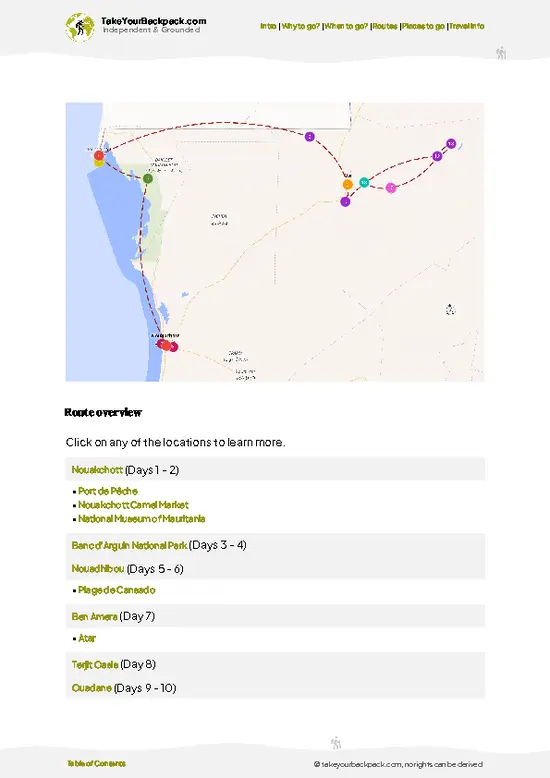
Loading the map 🌍

🛏️ Where to stay?Your Route at a Glance

👉 Click on any of the locations to learn more.
 
Nouakchott(Days 1 - 2)
 
Banc d’Arguin National Park(Days 3 - 4)
 
Nouadhibou(Days 5 - 7)
 
Atar(Day 8)
 
Chinguetti(Days 9 - 10)
 
Ouadane(Days 11 - 12)
 
Terjit Oasis(Days 13 - 14)
 
Tidjikja(Day 15)
 
Rosso(Day 16)
 
Kaédi(Day 17)

⚠️ This itinerary is intended as inspiration, not a fixed travel plan. Suggested routes and travel times may not always be feasible due to transport availability, seasonal conditions or other local factors. Always verify all travel logistics before booking.

✈️ The backpacker research shortcutMauritania Travel Guide

An offline-friendly backpacking guide with optimized travel routes, ranked highlights, transport advice, and the best areas to stay.
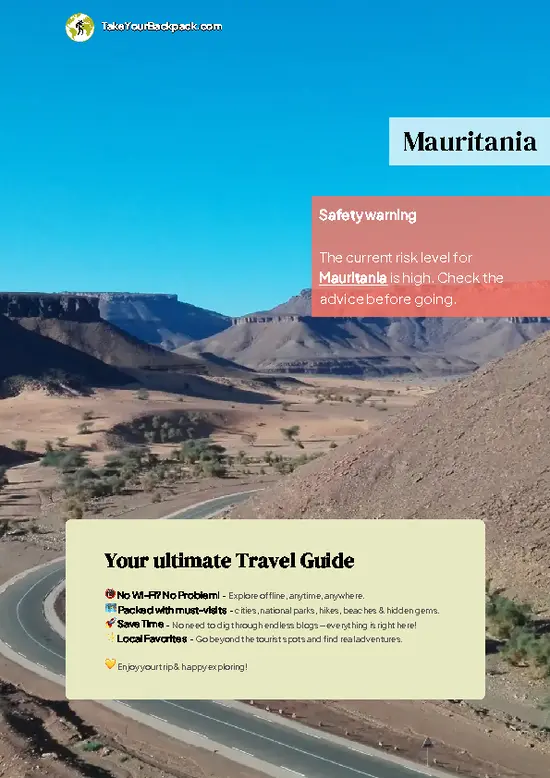
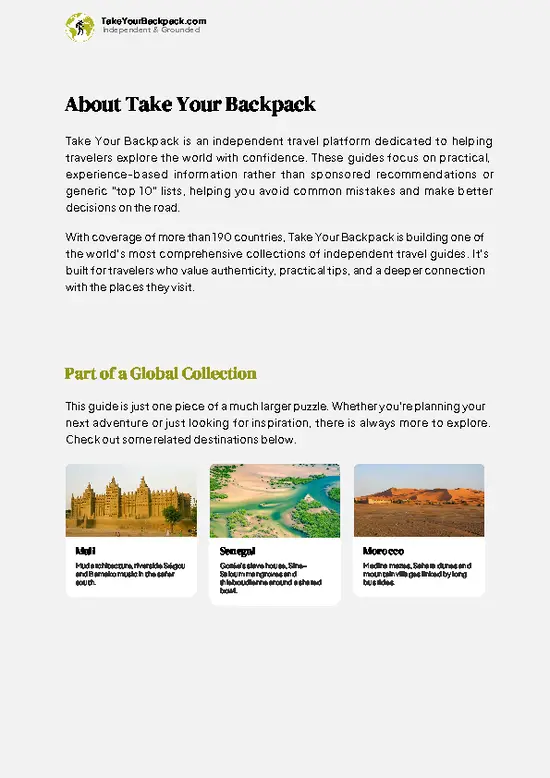
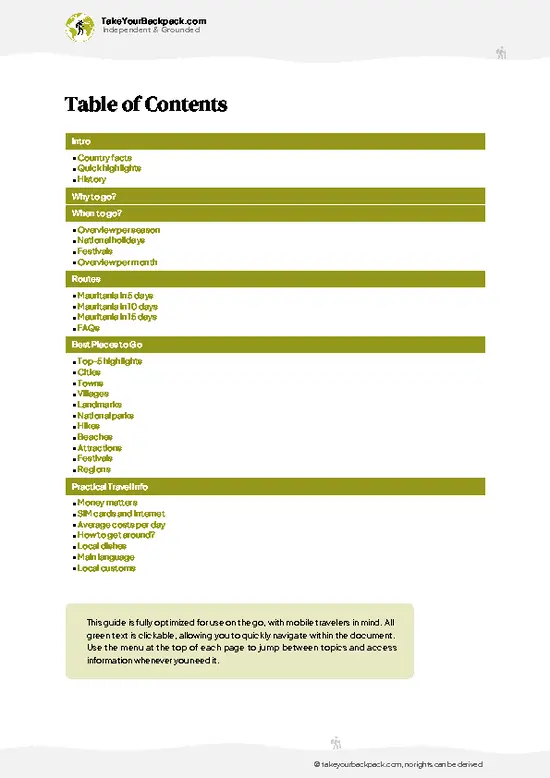
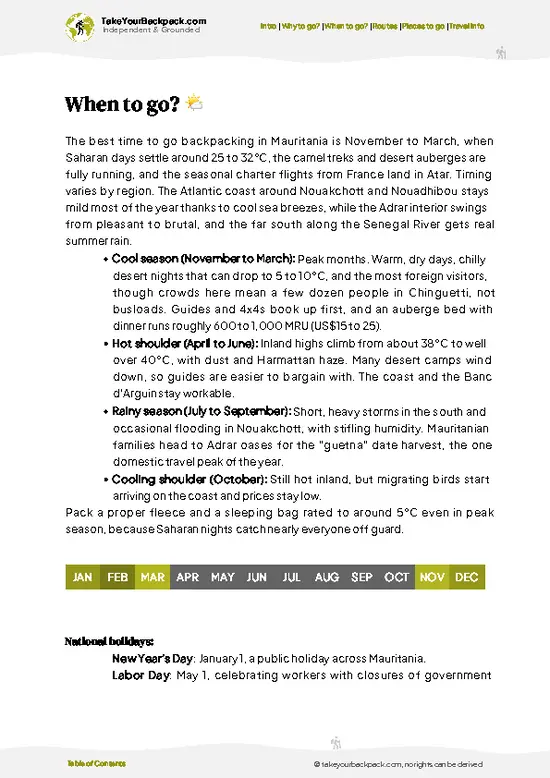
example page 0 from our offline Travel Guide for Mauritania
example page 1 from our offline Travel Guide for Mauritania
example page 2 from our offline Travel Guide for Mauritania
example page 3 from our offline Travel Guide for Mauritania
example page 4 from our offline Travel Guide for Mauritania
example page 5 from our offline Travel Guide for Mauritania
example page 6 from our offline Travel Guide for Mauritania
example page 7 from our offline Travel Guide for Mauritania
The digital guide (258 pages) contains:
59 highlights, ranked by travel appeal
Optimized 5, 10 & 15-day travel routes
Cities, national parks, landmarks, beaches
How to get around
Offline-friendly for travel without Wi-Fi
👉 Click to see all 30+ guide features

📅 Plan smarter in minutes, not weeks
Month by month travel advice
Festivals & national holidays
Budget expectations

🗺️ Go to the right places, skip the overrated ones
Honest pros & cons of destinations
Top hikes, parks & viewpoints
Lesser-known places most travelers miss
Clear “worth it vs skip it” guidance

🛏️ Travel smoothly without rookie mistakes
Best areas to stay
Transport systems explained simply
Common scams & safety advice
SIM cards, money & practical tips

🌍 Understand the country, not just visit it
Culture & traditions
52 Essential phrases & customs
Festivals worth planning around
Traveler-friendly historical context
Insights that make places more meaningful

📱 Built for real travel conditions
Fully downloadable PDF
Works completely offline
Optimized for phone use
Useful in remote areas & buses
Everything in one place
Save weeks of stressful planning
Get instant access to your full guide. 30‑day money-back guarantee.
+ Add another guide for just US$7.80

By proceeding you agree to our terms.
Sent to your inbox immediately after payment • 100% Secure Checkout
Best Backpacking Travel Advisor 2025 tourism awardBest Backpacking
Travel Advisor
2025
What others say about Take Your Backpack Guides:
⭐⭐⭐⭐⭐
Fantastic, amazing amount of information!
⭐⭐⭐⭐⭐
My goodness this is amazing, it's what I've been looking for hats off too you!
⭐⭐⭐⭐⭐
I think this is absolutely BRILLIANT
⭐⭐⭐⭐
Very complete and informative. It's still missing places, but I gotta to commend you
⭐⭐⭐⭐⭐
This is truly amazing, thank you, can't wait to explore it with my kids!
⭐⭐⭐⭐⭐
Awesome resource, thank you!
⭐⭐⭐⭐⭐
This is amazing! Can't wait to explore the ones I haven't seen
⭐⭐⭐⭐
I love this! Well done, great idea.
⭐⭐⭐⭐⭐
Thanks for taking the time to make this gem!
⭐⭐⭐⭐⭐
This might be the best website I've ever seen.
⭐⭐⭐⭐⭐
Congratulations, and thank you so much for your work; it's incredibly valuable.
⭐⭐⭐⭐
In all seriousness I think you did a great job pointing out the important spots
⭐⭐⭐⭐⭐
10/10 very good
⭐⭐⭐⭐⭐
As someone who's only just starting to visit regularly this is awesome, thank you.
⭐⭐⭐⭐
Thank you very much! I'm going to visit my dad, it's going to be very useful!
⭐⭐⭐⭐⭐
This is really cool! We'll be travelling for the first time and this definitely come in handy.
⭐⭐⭐⭐⭐
You are now our minister of culture, congratulations 👨‍💼
⭐⭐⭐⭐⭐
Just wanted to tell you that this is a pearl! Going to follow your recommendations.
⭐⭐⭐⭐⭐
This is so cool. I'll definitely be using the resource for my travels soon.
⭐⭐⭐⭐⭐
This is very impressive! Good work.
⭐⭐⭐⭐⭐
This is an amazing and informative site. Very well done!

🧭 RouteAlternative Routes

Travel Mauritania your way — from a quick highlights trip to a slow-paced adventure. Or build your custom route based on your own interests, time and travel style.
👉 Build your own Mauritania route

🙋 FAQBackpacking FAQ

Mauritania is possible to backpack independently, but it’s not “easy mode.” Outside Nouakchott and Nouadhibou, things are sparse, English is rare, and you need to be comfortable with long distances, basic French or Arabic, and plans changing. That said, for a budget traveler who’s patient, flexible, and okay with simple guesthouses and shared taxis, it’s very doable and feels like real adventure rather than a packaged route.

The main challenges are limited public transport schedules, occasional police checkpoints where you show your passport, and the need to carry enough cash because ATMs can be unreliable away from big towns. If you treat those as part of the trip rather than problems, solo backpacking here is tough in the right way, not dangerous for most travelers who use normal street sense.
If you want more than a rushed snapshot, aim for 10–14 days; that gives you time for Nouakchott, the desert around Chinguetti/Atar, and the iron ore train without feeling like you’re just sitting in buses. With a week, you can still have a strong trip, but you’ll need to pick either the Adrar region or the train and coast, not both in depth.

For slow, budget travel that leans on shared taxis and hitching, three weeks is the sweet spot, because distances are big and you’ll lose days to waiting, heat, and rest. Anything under five days is basically a teaser and not worth the visa cost unless you’re already nearby and just crossing a border.
You can absolutely get around Mauritania without your own car, but it takes patience. The backbone is shared taxis and minibuses that leave when full, not on a fixed timetable, so you trade money savings for time and comfort. For big hops like Nouakchott–Atar or Nouakchott–Nouadhibou, this system works fine; just start early in the morning and expect delays.

For more remote desert areas, you’ll often join a local 4x4 run or arrange a spot through a guesthouse or guide in Atar or Chinguetti, which is still cheaper than renting your own vehicle. Hitchhiking with trucks is common on main roads, but you should carry extra water, sun protection, and a screenshot map, because once you leave the asphalt, you’re in real Sahara, not a theme park.
For backpackers, the core trio is Atar, Chinguetti, and the iron ore train
On the coast, Nouadhibou is worth a short stop for ship graveyard views and a more relaxed feel than Nouakchott, while the capital itself is mainly useful for logistics, markets, and watching daily life rather than sightseeing. If you have extra time, the Adrar plateaus and canyons around Terjit oasis and Ouadane add that “I’m really in the Sahara” layer to the trip.
If you’re short on time, you can mostly skip deep exploration of Nouakchott; use it for money, SIM cards, and rest, then move on. The city has character, but for a budget traveler chasing unique experiences, extra days there rarely beat more time in the Adrar or on the train. One quick market wander and a beach sunset is usually enough before you head inland or north.

I’d also skip trying to cram in far southern border regions or chasing every oasis; the payoff drops fast compared to the time and transport hassle. Focus on one strong desert base (Atar/Chinguetti area) plus the iron ore train or the coast, rather than scattering yourself across the map and spending your whole trip in transit vans.
Yes, our itinerary-planner does exactly that. Set your trip length in days, give your interests and travel style, optionally give start- and end location and/or some mandatory stops you would like to include and the itinerary planner creates your personalized routes for Mauritania in seconds. Try it out!


Try the itinerary planner

🇲🇷 MauritaniaMore of Mauritania

Ready to build a truly unique trip? Predefined routes are perfect for first-time visitors, but there is so much more to discover. Whether you are chasing a city trip, pristine national parks, local food scenes, or quiet beaches, pick a category to design your own path.