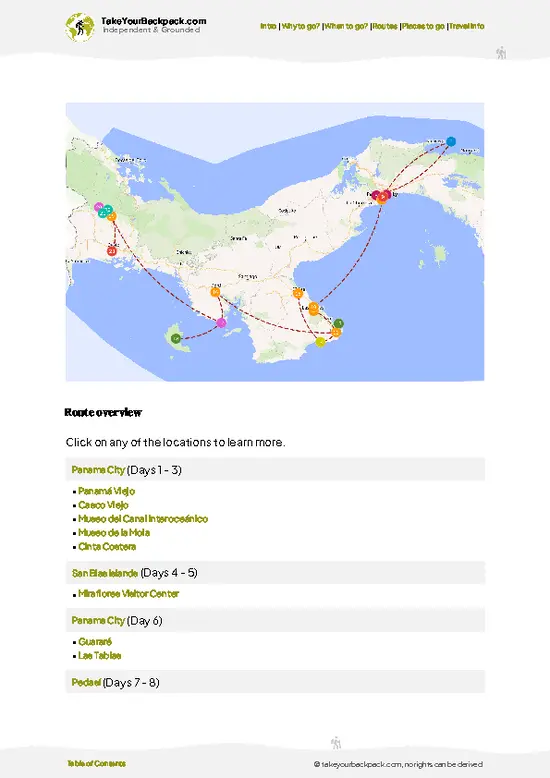
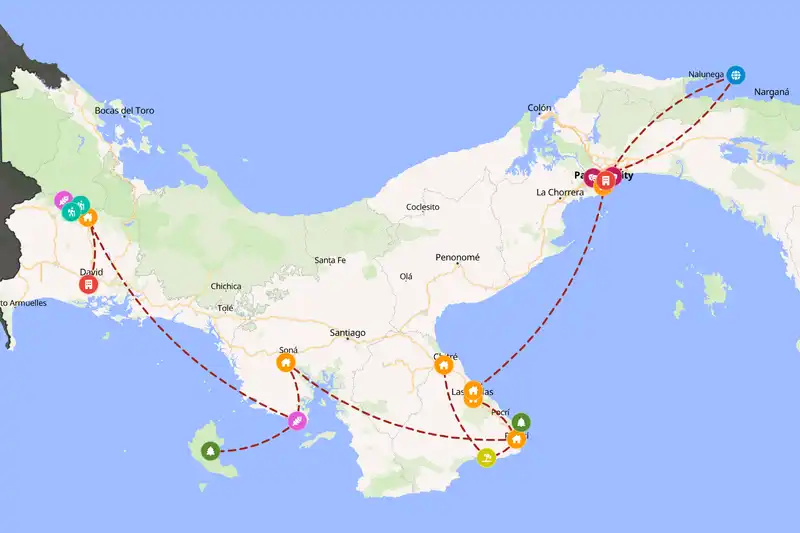
Panama is one of the easier Central American countries to backpack independently, especially if you’ve done at least a little travel before. The country is compact, buses are frequent on the main routes, and there’s a clear backpacker trail: Panama City → Santa Catalina or Pedasí → Boquete → Bocas del Toro, with optional side trips to the San Blas Islands (Guna Yala) and the Darién edge. Spanish helps a lot once you leave Panama City and Bocas, but you can get by with basic phrases plus offline translation. Hostels are common in all main stops, and most can be booked same-day outside of peak holidays (Carnaval, Christmas/New Year, Easter). Safety-wise, most backpackers stick to well-trodden areas and have no issues if they use normal city sense: avoid flashing valuables, be cautious late at night in Panama City’s rougher neighborhoods (especially around El Chorrillo and parts of Calidonia), and use registered taxis or ride-hailing apps in the capital. Trails around Boquete and Santa Fé are well-known, but weather can change fast in the highlands, so checking conditions locally and starting early is smart. For border crossings, the Costa Rica–Panama land borders (Sixaola/Guabito and Paso Canoas) are straightforward but can be slow; having proof of onward travel and a rough itinerary printed or on your phone avoids headaches. Overall, if you’ve backpacked anywhere in Latin America, Panama will feel very manageable; if it’s your first time, it’s a good starter country because infrastructure is decent but still feels adventurous once you leave the capital.
For a solid backpacking loop that doesn’t feel rushed, 2–3 weeks is the sweet spot. In about 14 days you can hit Panama City, one highland base (usually Boquete), one beach area on the Pacific (Santa Catalina or Pedasí/Playa Venao), and one Caribbean spot (Bocas del Toro or San Blas). With 10 days, you can still have a great trip if you focus: Panama City (2–3 days), Boquete or Santa Fé (3–4 days), and either Bocas del Toro or San Blas (3–4 days). With a full 3–4 weeks, you can slow down and add more offbeat stops like Santa Fé, the Azuero Peninsula villages, Coiba diving from Santa Catalina, or extra islands in Bocas. Travel days eat more time than they look like on the map: Panama City to Boquete is basically a full day by bus, and Panama City to Bocas via bus and boat is also a long haul, so building in buffer days keeps you from spending your whole trip in transit. If you’re combining Panama with Costa Rica or Colombia, 7–10 days in Panama works if you pick a tight route, like: Panama City + San Blas + Boquete, or Panama City + Bocas del Toro. Anything under a week means you should treat Panama more like a focused city-and-islands trip rather than trying to see the whole country.
You can absolutely get around Panama without a car, and most backpackers do. The backbone is the bus system: long-distance coaches and smaller buses run from Panama City’s Albrook terminal to almost everywhere that’s on the main grid. They’re cheap, reasonably comfortable, and frequent on popular routes like Panama City–David, David–Boquete, and Panama City–Santiago–Soná (for Santa Catalina). For short hops, you’ll use local buses or shared minibuses called ‘colectivos’; they leave when full and are very budget-friendly. To reach islands, you’ll combine buses with boat taxis: for Bocas del Toro, bus to Almirante then a 30-minute water taxi; for San Blas, most budget travelers book a package that includes 4x4 transport from Panama City plus boat transfers, since DIY is logistically messy and not much cheaper. Inside Panama City, the metro and city buses are cheap, but many travelers lean on ride-hailing apps or official taxis for speed and safety, especially at night or with luggage. The only times a rental car is genuinely useful are if you want to explore lots of small Pacific beaches on the Azuero Peninsula, chase surf breaks with odd schedules, or have very limited time and want maximum flexibility. For everyone else, buses plus the occasional shuttle or taxi are enough, and you’ll save a lot of money and stress by skipping the car.
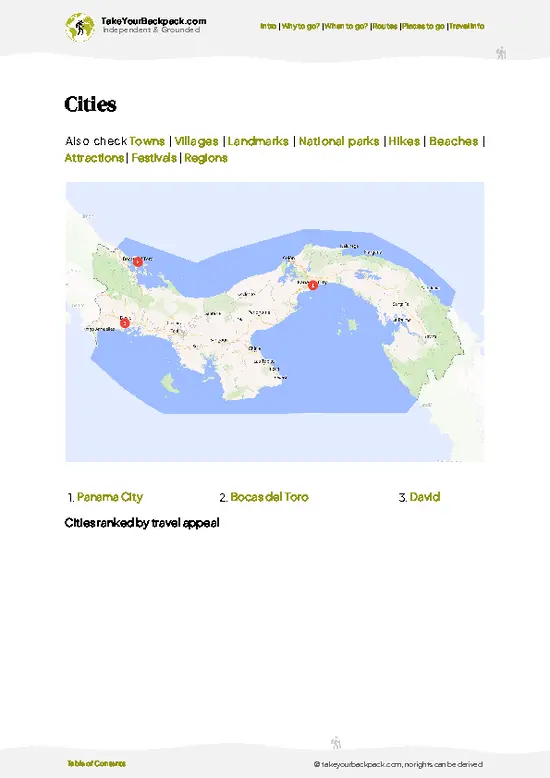
For a first-time backpacker in Panama on a budget, a few places consistently earn their spot on the itinerary. Panama City is worth at least a couple of days: wander Casco Viejo’s old streets, see the Panama Canal at Miraflores or Agua Clara locks, and eat your way through cheap fondas and markets. It’s one of the few capitals in the region that’s actually interesting enough to linger in, especially if you like history and big-city contrast. Boquete in the highlands is a classic backpacker base: cool air, coffee farms, cloud forest hikes, and the option to tackle Volcán Barú for sunrise views over both oceans if you’re up for a tough overnight or early-morning climb. It’s also a good place to catch your breath, do laundry, and reset. Bocas del Toro on the Caribbean side is the social hub: hostels on the water, cheap boat taxis to different islands and beaches, and a mix of party spots and quieter corners like Isla Bastimentos. It’s easy to meet other travelers here, and you can keep costs low by cooking and choosing simpler hostels. For a more raw, postcard-style island experience, the San Blas Islands (Guna Yala) are worth the splurge even for budget travelers: basic huts, clear water, and a strong sense you’re somewhere very different from the rest of the country. On the Pacific side, Santa Catalina is a solid call if you’re into surfing or diving; it’s the jump-off for Coiba National Park, which has some of the best underwater life in Central America. If you want something quieter and more low-key than Bocas, the Azuero Peninsula (Pedasí and Playa Venao) gives you surf, beaches, and a slower, more local feel without needing a huge budget.
If you’re short on time, skip anything that’s mostly about bragging rights or long transit for a short payoff. The full Volcán Barú overnight hike is one of those: it’s a tough slog, often cold and cloudy at the top, and it eats a night of sleep plus recovery time. If you’re not obsessed with summits, do shorter trails around Boquete or take a 4x4 sunrise tour instead. I’d also skip trying to do both Bocas del Toro and San Blas on a tight trip; they’re far apart and both are about islands and beaches. Pick one: Bocas for social hostels and easier logistics, San Blas for more rustic, off-grid island life. Many travelers also overcommit to the Azuero Peninsula, bouncing between multiple small beach towns; if you’re rushed, choose either Santa Catalina (for surf and Coiba access) or one Azuero base like Playa Venao, not both. In Panama City, you can skip the more generic malls and modern business districts unless you specifically need gear or banking; focus on Casco Viejo, the Canal, and maybe one nature escape like Parque Metropolitano or a day trip to the Canal Zone. If you’re extremely tight on time, avoid pushing toward the Darién region or remote Caribbean villages: they’re fascinating but logistically heavy and better saved for a longer, more focused trip. The guiding principle is to cut side trips that require a full day of buses for just one night somewhere; it’s usually better to deepen your time in 3–4 key spots than to collect a long list of rushed stops.