×
Panama🇵🇦 | 15 days itinerary

Your 15-Day Panama Itinerary

By Johan Kruseman 🇳🇱 | Updated May 7, 2026
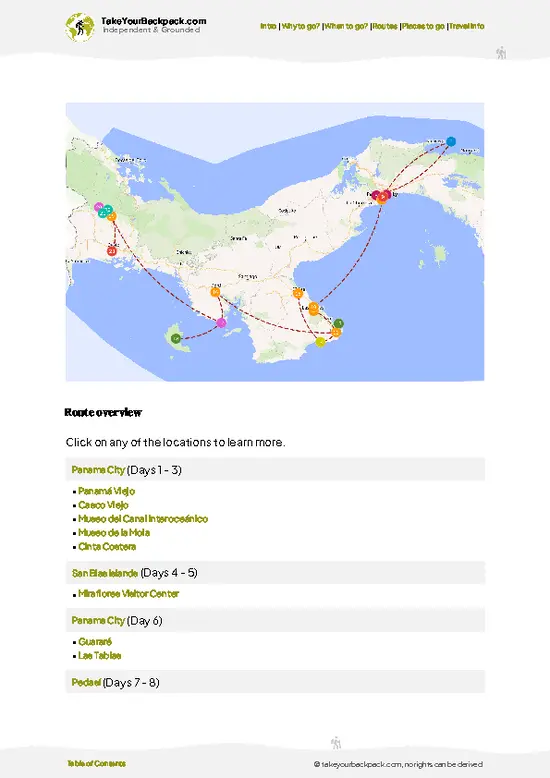
This 15-day route is for travelers who want the full Panama arc: capital city, Pacific surf towns, island-hopping, and cool mountain air, moving at a deliberate but adventurous pace using intercity buses, a couple of domestic flights or shuttles, taxis, and boat transfers. You’ll loop from Panama City down the Pacific coast through Pedasí and Santa Catalina, then up into the Chiriquí Highlands around Boquete and across to Bocas del Toro, layering beaches, national parks, and hikes instead of just ticking off cities.

Days 1-3: Panama City, Canal, and Coastal Contrast

Begin in Panama City with a day focused on the Panama Canal Miraflores Visitor Center and the Panama Canal itself, using taxis or Uber so you can time your visit around ship transits and linger on the viewing platforms. Spend your second day wandering the Casco Viejo Historic District, visiting the Metropolitan Cathedral of Panama and the Museo del Canal Interoceánico de Panamá, then walk the Cinta Costera at dusk to see the … read more 👉
This 15-day route is for travelers who want the full Panama arc: capital city, Pacific surf towns, island-hopping, and cool mountain air, moving at a deliberate but adventurous pace using intercity buses, a couple of domestic flights or shuttles, taxis, and boat transfers. You’ll loop from Panama City down the Pacific coast through Pedasí and Santa Catalina, then up into the Chiriquí Highlands around Boquete and across to Bocas del Toro, layering beaches, national parks, and hikes instead of just ticking off cities.

Days 1-3: Panama City, Canal, and Coastal Contrast

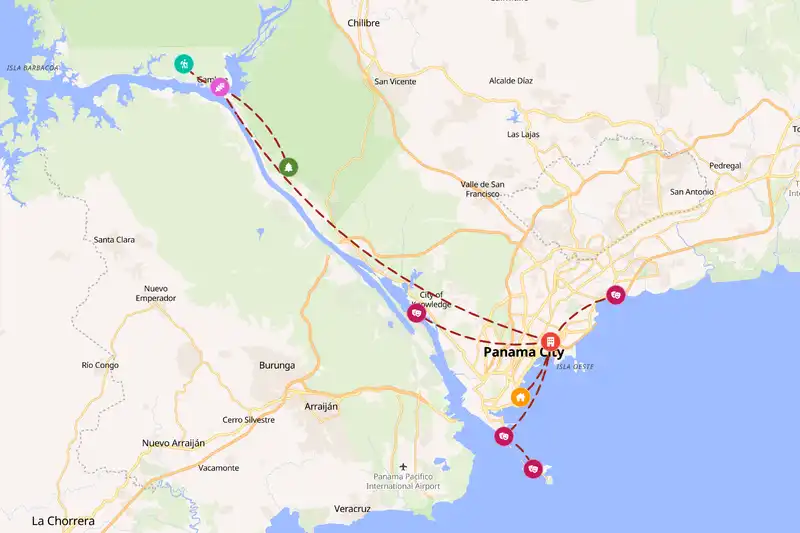
Begin in Panama City with a day focused on the Panama Canal Miraflores Visitor Center and the Panama Canal itself, using taxis or Uber so you can time your visit around ship transits and linger on the viewing platforms. Spend your second day wandering the Casco Viejo Historic District, visiting the Metropolitan Cathedral of Panama and the Museo del Canal Interoceánico de Panamá, then walk the Cinta Costera at dusk to see the skyline flip from hazy heat to neon. On day three, head to the Biomuseo and stroll the Amador Causeway, then finish at the Panama Viejo Archaeological Site and Museum to connect the ruined first city with the modern metropolis before you leave the capital behind.

Days 4-6: Pedasí, Playa Venao, and Pacific Chill

Ride a daytime bus from Panama City to Pedasí, a small town that makes a great base for exploring the Azuero Peninsula without resort-town chaos. Use taxis or local rides to reach Playa Venao for surf lessons, beach runs, and lazy café time, then swing back through Pedasí in the evenings for low-key dinners; this phase is about slowing your rhythm and getting your feet in the Pacific. With three nights, you can balance one full surf or beach day, one more relaxed day in town, and a buffer for weather or just doing nothing, which is half the point here.

Days 7-9: Santa Catalina & Coiba National Park

Continue by bus via Santiago de Veraguas to the village of Santa Catalina, accepting that this will be one of your longer travel days but also the gateway to some of Panama’s best marine life. Base yourself in Santa Catalina and dedicate at least one full day to a boat trip into Coiba National Park, where you can snorkel or dive with big schools of fish, turtles, and healthy coral, then use your extra day for surfing, kayaking, or simply watching the sunset from the rocky shoreline; the slower pace here lets the remoteness sink in instead of treating Coiba as a rushed checkbox.

Days 10-12: Boquete, Volcán Barú National Park & Sendero Los Quetzales

From Santa Catalina, travel by bus back through Santiago de Veraguas and on to Boquete in the Chiriquí Highlands, trading humid sea air for cool mountain evenings in a single day. Over the next two full days, explore Volcán Barú National Park with either a summit attempt on Baru Volcano or a 4x4-assisted sunrise visit, and hike the Sendero Los Quetzales for cloud forest, waterfalls, and serious birdwatching; spacing the hikes across two days keeps your legs functional and gives you time to enjoy Boquete’s cafés and hot showers between adventures.

Days 13-15: Bocas del Toro & Isla Bastimentos National Marine Park

Travel by bus from Boquete to the Caribbean coast and hop a water taxi into Bocas del Toro, where the vibe flips back to flip-flops and board shorts. Use boat tours to reach Isla Bastimentos National Marine Park and Starfish Beach, mixing snorkeling, mangrove channels, and sandy coves with slow evenings in town; this is your decompression chamber after the hikes. On your final day, fly or bus back from Bocas del Toro to Panama City, giving yourself a last night in the capital if possible so you’re not racing straight from a boat to your flight home.

On this long loop, the moment that hooked me was watching the sun set over the Pacific in Santa Catalina knowing that in a few days I’d be standing in cool mist on Sendero Los Quetzales, realizing how wildly diverse Panama feels in just two weeks.
Loading the map 🌍
film
0
0
0a
Panama City
Juan Carlos Figueroa
film
1
1
1a
Panama Canal Miraflores Visitor Center
film
2
2
2a
Panama Canal
iStockphoto
film
3
3
3a
Casco Viejo Historic District
film
4
4
4a
Metropolitan Cathedral of Panama
film
5
5
5a
Museo del Canal Interoceánico de Panamá
film
6
6
6a
Cinta Costera
film
7
7
7a
Biomuseo
film
8
8
8a
Panama Viejo Archaeological Site and Museum
film
9
9
9a
Playa Venao
film
10
10
10a
Santa Catalina
film
11
11
11a
Coiba
Gabi M
film
12
12
12a
Volcán Barú
film
13
13
13a
Baru Volcano
Miguel Gonzalez
film
14
14
14a
Sendero Los Quetzales
Felix Herzog
film
15
15
15a
Isla Bastimentos National Marine Park
film
16
16
16a
Starfish Beach
Laura Alexandra

✈️ The backpacker research shortcutPanama Travel Guide

An offline-friendly backpacking guide with optimized travel routes, ranked highlights, transport advice, and the best areas to stay.
example page 0 from our offline Travel Guide for Panamaexample page 1 from our offline Travel Guide for Panamaexample page 2 from our offline Travel Guide for Panamaexample page 3 from our offline Travel Guide for Panamaexample page 4 from our offline Travel Guide for Panamaexample page 5 from our offline Travel Guide for Panama
The digital guide (313 pages) contains:
96 highlights, ranked by travel appeal
Optimized 5, 10 & 15-day travel routes
Best neighborhoods to stay
How to get around
Offline-friendly for travel without Wi-Fi
👉 See all 30+ guide features

📅 Plan smarter in minutes, not weeks
Month by month travel advice
Festivals & national holidays
Budget expectations

🗺️ Go to the right places, skip the overrated ones
Honest pros & cons of destinations
Top hikes, parks & viewpoints
Lesser-known places most travelers miss
Clear “worth it vs skip it” guidance

🛏️ Travel smoothly without rookie mistakes
Best areas to stay
Transport systems explained simply
Common scams & safety advice
SIM cards, money & practical tips

🌍 Understand the country, not just visit it
Culture & traditions
52 Essential phrases & customs
Festivals worth planning around
Traveler-friendly historical context
Insights that make places more meaningful

📱 Built for real travel conditions
Fully downloadable PDF
Works completely offline
Optimized for phone use
Useful in remote areas & buses
Everything in one place
Save weeks of stressful planning
Get instant access to the full guide directly. 30-day money-back guarantee.


Sent to your inbox immediately after payment • 100% Secure Checkout
Best Backpacking Travel Advisor 2025 tourism awardBest Backpacking
Travel Advisor
2025
What others say about Take Your Backpack Guides:
⭐⭐⭐⭐⭐
Fantastic, amazing amount of information!
⭐⭐⭐⭐⭐
My goodness this is amazing, it's what I've been looking for hats off too you!
⭐⭐⭐⭐⭐
I think this is absolutely BRILLIANT
⭐⭐⭐⭐
Very complete and informative. It's still missing places, but I gotta to commend you
⭐⭐⭐⭐⭐
This is truly amazing, thank you, can't wait to explore it with my kids!
⭐⭐⭐⭐⭐
Awesome resource, thank you!
⭐⭐⭐⭐⭐
This is amazing! Can't wait to explore the ones I haven't seen
⭐⭐⭐⭐
I love this! Well done, great idea.
⭐⭐⭐⭐⭐
Thanks for taking the time to make this gem!
⭐⭐⭐⭐⭐
This might be the best website I've ever seen.
⭐⭐⭐⭐⭐
Congratulations, and thank you so much for your work; it's incredibly valuable.
⭐⭐⭐⭐
In all seriousness I think you did a great job pointing out the important spots
⭐⭐⭐⭐⭐
10/10 very good
⭐⭐⭐⭐⭐
As someone who's only just starting to visit regularly this is awesome, thank you.
⭐⭐⭐⭐
Thank you very much! I'm going to visit my dad, it's going to be very useful!
⭐⭐⭐⭐⭐
This is really cool! We'll be travelling for the first time and this definitely come in handy.
⭐⭐⭐⭐⭐
You are now our minister of culture, congratulations 👨‍💼
⭐⭐⭐⭐⭐
Just wanted to tell you that this is a pearl! Going to follow your recommendations.
⭐⭐⭐⭐⭐
This is so cool. I'll definitely be using the resource for my travels soon.
⭐⭐⭐⭐⭐
This is very impressive! Good work.
⭐⭐⭐⭐⭐
This is an amazing and informative site. Very well done!

🧭 RouteGot More or Less Time?

Travel Panama your way — from a quick highlights trip to a slow-paced adventure.

🙋 FAQCommon Questions

Panama is one of the easier Central American countries to backpack independently, especially if you’ve done at least a little travel before. The country is compact, buses are frequent on the main routes, and there’s a clear backpacker trail: Panama City → Santa Catalina or Pedasí → Boquete → Bocas del Toro, with optional side trips to the San Blas Islands (Guna Yala) and the Darién edge. Spanish helps a lot once you leave Panama City and Bocas, but you can get by with basic phrases plus offline translation. Hostels are common in all main stops, and most can be booked same-day outside of peak holidays (Carnaval, Christmas/New Year, Easter). Safety-wise, most backpackers stick to well-trodden areas and have no issues if they use normal city sense: avoid flashing valuables, be cautious late at night in Panama City’s rougher neighborhoods (especially around El Chorrillo and parts of Calidonia), and use registered taxis or ride-hailing apps in the capital. Trails around Boquete and Santa Fé are well-known, but weather can change fast in the highlands, so checking conditions locally and starting early is smart. For border crossings, the Costa Rica–Panama land borders (Sixaola/Guabito and Paso Canoas) are straightforward but can be slow; having proof of onward travel and a rough itinerary printed or on your phone avoids headaches. Overall, if you’ve backpacked anywhere in Latin America, Panama will feel very manageable; if it’s your first time, it’s a good starter country because infrastructure is decent but still feels adventurous once you leave the capital.
For a solid backpacking loop that doesn’t feel rushed, 2–3 weeks is the sweet spot. In about 14 days you can hit Panama City, one highland base (usually Boquete), one beach area on the Pacific (Santa Catalina or Pedasí/Playa Venao), and one Caribbean spot (Bocas del Toro or San Blas). With 10 days, you can still have a great trip if you focus: Panama City (2–3 days), Boquete or Santa Fé (3–4 days), and either Bocas del Toro or San Blas (3–4 days). With a full 3–4 weeks, you can slow down and add more offbeat stops like Santa Fé, the Azuero Peninsula villages, Coiba diving from Santa Catalina, or extra islands in Bocas. Travel days eat more time than they look like on the map: Panama City to Boquete is basically a full day by bus, and Panama City to Bocas via bus and boat is also a long haul, so building in buffer days keeps you from spending your whole trip in transit. If you’re combining Panama with Costa Rica or Colombia, 7–10 days in Panama works if you pick a tight route, like: Panama City + San Blas + Boquete, or Panama City + Bocas del Toro. Anything under a week means you should treat Panama more like a focused city-and-islands trip rather than trying to see the whole country.
You can absolutely get around Panama without a car, and most backpackers do. The backbone is the bus system: long-distance coaches and smaller buses run from Panama City’s Albrook terminal to almost everywhere that’s on the main grid. They’re cheap, reasonably comfortable, and frequent on popular routes like Panama City–David, David–Boquete, and Panama City–Santiago–Soná (for Santa Catalina). For short hops, you’ll use local buses or shared minibuses called ‘colectivos’; they leave when full and are very budget-friendly. To reach islands, you’ll combine buses with boat taxis: for Bocas del Toro, bus to Almirante then a 30-minute water taxi; for San Blas, most budget travelers book a package that includes 4x4 transport from Panama City plus boat transfers, since DIY is logistically messy and not much cheaper. Inside Panama City, the metro and city buses are cheap, but many travelers lean on ride-hailing apps or official taxis for speed and safety, especially at night or with luggage. The only times a rental car is genuinely useful are if you want to explore lots of small Pacific beaches on the Azuero Peninsula, chase surf breaks with odd schedules, or have very limited time and want maximum flexibility. For everyone else, buses plus the occasional shuttle or taxi are enough, and you’ll save a lot of money and stress by skipping the car.
For a first-time backpacker in Panama on a budget, a few places consistently earn their spot on the itinerary. Panama City is worth at least a couple of days: wander Casco Viejo’s old streets, see the Panama Canal at Miraflores or Agua Clara locks, and eat your way through cheap fondas and markets. It’s one of the few capitals in the region that’s actually interesting enough to linger in, especially if you like history and big-city contrast. Boquete in the highlands is a classic backpacker base: cool air, coffee farms, cloud forest hikes, and the option to tackle Volcán Barú for sunrise views over both oceans if you’re up for a tough overnight or early-morning climb. It’s also a good place to catch your breath, do laundry, and reset. Bocas del Toro on the Caribbean side is the social hub: hostels on the water, cheap boat taxis to different islands and beaches, and a mix of party spots and quieter corners like Isla Bastimentos. It’s easy to meet other travelers here, and you can keep costs low by cooking and choosing simpler hostels. For a more raw, postcard-style island experience, the San Blas Islands (Guna Yala) are worth the splurge even for budget travelers: basic huts, clear water, and a strong sense you’re somewhere very different from the rest of the country. On the Pacific side, Santa Catalina is a solid call if you’re into surfing or diving; it’s the jump-off for Coiba National Park, which has some of the best underwater life in Central America. If you want something quieter and more low-key than Bocas, the Azuero Peninsula (Pedasí and Playa Venao) gives you surf, beaches, and a slower, more local feel without needing a huge budget.
If you’re short on time, skip anything that’s mostly about bragging rights or long transit for a short payoff. The full Volcán Barú overnight hike is one of those: it’s a tough slog, often cold and cloudy at the top, and it eats a night of sleep plus recovery time. If you’re not obsessed with summits, do shorter trails around Boquete or take a 4x4 sunrise tour instead. I’d also skip trying to do both Bocas del Toro and San Blas on a tight trip; they’re far apart and both are about islands and beaches. Pick one: Bocas for social hostels and easier logistics, San Blas for more rustic, off-grid island life. Many travelers also overcommit to the Azuero Peninsula, bouncing between multiple small beach towns; if you’re rushed, choose either Santa Catalina (for surf and Coiba access) or one Azuero base like Playa Venao, not both. In Panama City, you can skip the more generic malls and modern business districts unless you specifically need gear or banking; focus on Casco Viejo, the Canal, and maybe one nature escape like Parque Metropolitano or a day trip to the Canal Zone. If you’re extremely tight on time, avoid pushing toward the Darién region or remote Caribbean villages: they’re fascinating but logistically heavy and better saved for a longer, more focused trip. The guiding principle is to cut side trips that require a full day of buses for just one night somewhere; it’s usually better to deepen your time in 3–4 key spots than to collect a long list of rushed stops.

🇵🇦 PanamaWhere to Go Next

Ready to build a truly unique trip? Predefined routes are perfect for first-time visitors, but there is so much more to discover. Whether you are chasing a city trip, pristine national parks, local food scenes, or quiet beaches, pick a category to design your own path.