×
Poland🇵🇱 | 5 days itinerary

Your 5-Day Poland Itinerary

By Johan Kruseman 🇳🇱 | Updated May 6, 2026
This 5-day route is for first-timers who want a deep, emotionally rich taste of southern Poland without racing across the country, moving mostly by train and short local buses. The pace is relaxed but purposeful: you’ll split time between historic Krakow, a day trip to Auschwitz-Birkenau State Museum, and a finale in the Tatra foothills around Zakopane and Tatra National Park.

Days 1-2: Krakow - Old Stones, Young Energy

Base yourself in Krakow to get your bearings in Poland with a city that’s compact, walkable, and loaded with atmosphere. Spend your first afternoon wandering the Old Town and Main Square, then climb up to Wawel Royal Castle to see how Polish history, Catholic tradition, and royal pomp all stack on one limestone hill. On day two, dive underground at the Wieliczka Salt Mine, where chapels carved from salt and echoing tunnels give you a surreal counterpoint to the sunny streets above; it’s a half-day trip that still leaves time for a slow evening back in Krakow’s cafes.

Day 3:

read more 👉
This 5-day route is for first-timers who want a deep, emotionally rich taste of southern Poland without racing across the country, moving mostly by train and short local buses. The pace is relaxed but purposeful: you’ll split time between historic Krakow, a day trip to Auschwitz-Birkenau State Museum, and a finale in the Tatra foothills around Zakopane and Tatra National Park.

Days 1-2: Krakow - Old Stones, Young Energy

Base yourself in Krakow to get your bearings in Poland with a city that’s compact, walkable, and loaded with atmosphere. Spend your first afternoon wandering the Old Town and Main Square, then climb up to Wawel Royal Castle to see how Polish history, Catholic tradition, and royal pomp all stack on one limestone hill. On day two, dive underground at the Wieliczka Salt Mine, where chapels carved from salt and echoing tunnels give you a surreal counterpoint to the sunny streets above; it’s a half-day trip that still leaves time for a slow evening back in Krakow’s cafes.

Day 3: Auschwitz-Birkenau - Confronting the 20th Century

Use Krakow as your launchpad for a full-day visit to the Auschwitz-Birkenau State Museum, traveling by organized bus or public transport so you can arrive early and not rush the experience. This is not a casual sightseeing stop: give yourself space to walk both Auschwitz I and Birkenau, listen carefully to the guides, and then return to Krakow in the evening for a quiet dinner and time to process what you’ve seen instead of cramming in more attractions.

Days 4-5: Zakopane and Tatra National Park - Mountain Reset

On day four, ride the bus or train-bus combo south to Zakopane, trading city spires for wooden chalets and mountain silhouettes. Use the afternoon to stroll Krupówki Street, sample oscypek cheese, and gear up for hiking, then dedicate your final full day to Tatra National Park, choosing between the classic walk to Morskie Oko for big alpine views or an easier valley trail if you prefer a gentler outing. Spend your last evening in Zakopane’s inns or thermal baths, then head back toward Krakow or onward connections the next morning with a clear sense of how Poland’s history and landscapes fit together.

As a quiet bonus, consider a future detour to the tiny wooden churches of the Sącz region, where creaking floors and hand-painted icons tell stories far from the main tourist routes.

Loading the map 🌍
film
0
0
0a
Krakow
Pixabay
film
1
1
1a
Wawel Royal Castle
film
2
2
2a
Wieliczka Salt Mine
film
3
3
3a
Auschwitz-Birkenau State Museum
Pixabay
film
4
4
4a
Zakopane
film
5
5
5a
Tatra
Július Jančo
film
6
6
6a
Morskie Oko
Tomasz Czechowicz

🛏️ Where to stay?Where You'll Go

✈️ The backpacker research shortcutPoland Travel Guide

An offline-friendly backpacking guide with optimized travel routes, ranked highlights, transport advice, and the best areas to stay.
example page 0 from our offline Travel Guide for Polandexample page 1 from our offline Travel Guide for Polandexample page 2 from our offline Travel Guide for Polandexample page 3 from our offline Travel Guide for Polandexample page 4 from our offline Travel Guide for Polandexample page 5 from our offline Travel Guide for Poland
The digital guide (369 pages) contains:
116 highlights, ranked by travel appeal
Optimized 5, 10 & 15-day travel routes
Best neighborhoods to stay
How to get around
Offline-friendly for travel without Wi-Fi
👉 See all 30+ guide features

📅 Plan smarter in minutes, not weeks
Month by month travel advice
Festivals & national holidays
Budget expectations

🗺️ Go to the right places, skip the overrated ones
Honest pros & cons of destinations
Top hikes, parks & viewpoints
Lesser-known places most travelers miss
Clear “worth it vs skip it” guidance

🛏️ Travel smoothly without rookie mistakes
Best areas to stay
Transport systems explained simply
Common scams & safety advice
SIM cards, money & practical tips

🌍 Understand the country, not just visit it
Culture & traditions
52 Essential phrases & customs
Festivals worth planning around
Traveler-friendly historical context
Insights that make places more meaningful

📱 Built for real travel conditions
Fully downloadable PDF
Works completely offline
Optimized for phone use
Useful in remote areas & buses
Everything in one place
Save weeks of stressful planning
Get instant access to the full guide directly. 30-day money-back guarantee.


Sent to your inbox immediately after payment • 100% Secure Checkout
Best Backpacking Travel Advisor 2025 tourism awardBest Backpacking
Travel Advisor
2025
What others say about Take Your Backpack Guides:
⭐⭐⭐⭐⭐
Fantastic, amazing amount of information!
⭐⭐⭐⭐⭐
My goodness this is amazing, it's what I've been looking for hats off too you!
⭐⭐⭐⭐⭐
I think this is absolutely BRILLIANT
⭐⭐⭐⭐
Very complete and informative. It's still missing places, but I gotta to commend you
⭐⭐⭐⭐⭐
This is truly amazing, thank you, can't wait to explore it with my kids!
⭐⭐⭐⭐⭐
Awesome resource, thank you!
⭐⭐⭐⭐⭐
This is amazing! Can't wait to explore the ones I haven't seen
⭐⭐⭐⭐
I love this! Well done, great idea.
⭐⭐⭐⭐⭐
Thanks for taking the time to make this gem!
⭐⭐⭐⭐⭐
This might be the best website I've ever seen.
⭐⭐⭐⭐⭐
Congratulations, and thank you so much for your work; it's incredibly valuable.
⭐⭐⭐⭐
In all seriousness I think you did a great job pointing out the important spots
⭐⭐⭐⭐⭐
10/10 very good
⭐⭐⭐⭐⭐
As someone who's only just starting to visit regularly this is awesome, thank you.
⭐⭐⭐⭐
Thank you very much! I'm going to visit my dad, it's going to be very useful!
⭐⭐⭐⭐⭐
This is really cool! We'll be travelling for the first time and this definitely come in handy.
⭐⭐⭐⭐⭐
You are now our minister of culture, congratulations 👨‍💼
⭐⭐⭐⭐⭐
Just wanted to tell you that this is a pearl! Going to follow your recommendations.
⭐⭐⭐⭐⭐
This is so cool. I'll definitely be using the resource for my travels soon.
⭐⭐⭐⭐⭐
This is very impressive! Good work.
⭐⭐⭐⭐⭐
This is an amazing and informative site. Very well done!

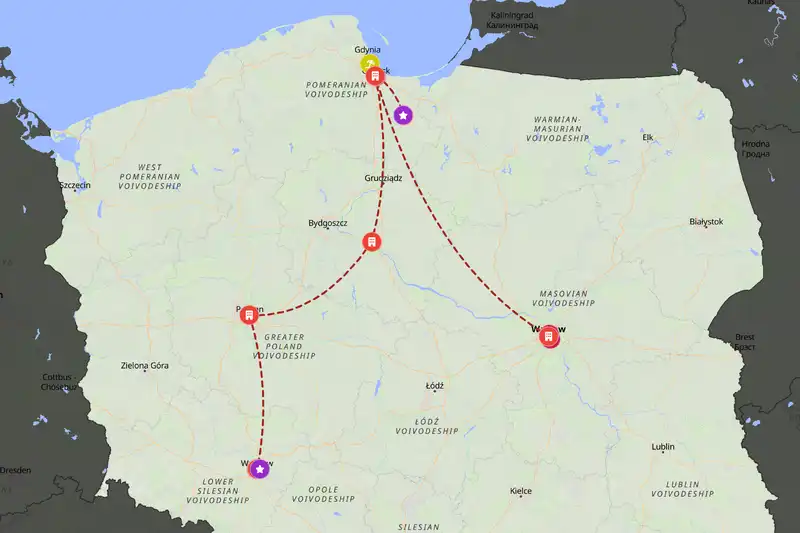
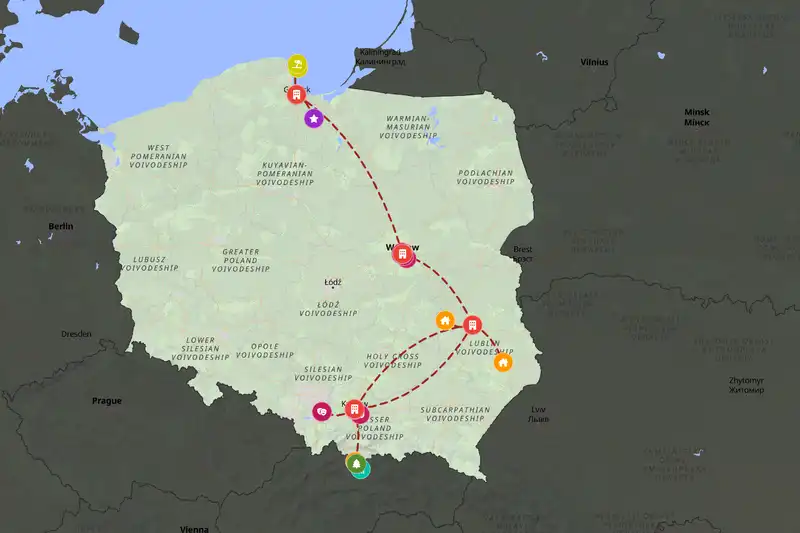
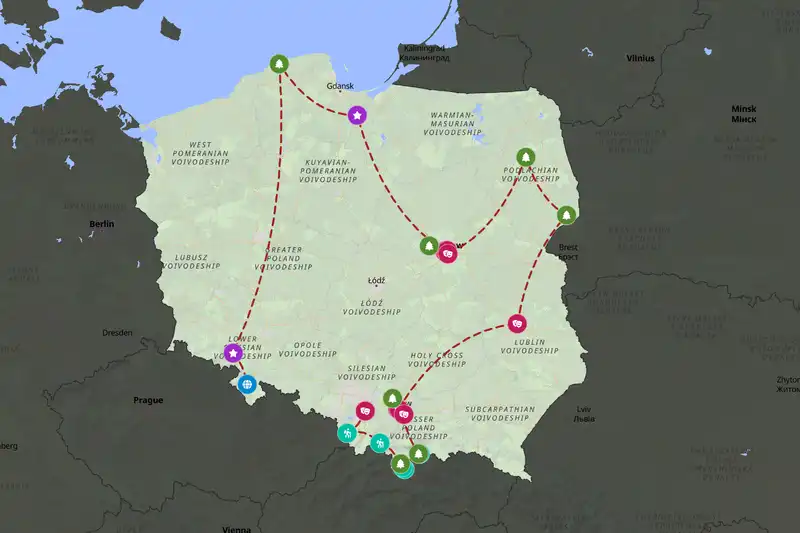
🧭 RouteAdjust Your Pace

Travel Poland your way — from a quick highlights trip to a slow-paced adventure.

🙋 FAQTraveler FAQ

Poland is one of the easiest countries in Europe to backpack independently, especially if you’re watching your budget. Hostels are common in all major cities and most mid-sized towns, and they’re usually clean, social, and cheaper than in Western Europe. English is widely spoken by younger people and in tourism-facing jobs, so you can usually sort out tickets, check-in, and basic questions without drama. Signs in train stations and on long-distance buses often include English, and ticket machines usually have an English option.

For solo travelers, Poland feels safe by European standards: violent crime against tourists is rare, and city centers are busy late into the evening. The main things to watch are the usual: pickpockets in crowds, overcharging taxis if you hail them on the street, and late-night drunkenness around clubs. Stick to licensed taxis or ride-hailing apps, and keep your bag zipped on trams and in stations.

Costs are a big win here. Food, local transport, and entry fees are noticeably cheaper than in Western Europe. You can eat well in milk bars (bar mleczny) for a few euros, and supermarket picnics are easy if you’re really stretching your budget. Long-distance buses and second-class trains are affordable, and walking is the best way to explore old towns.

If you’re new to backpacking, Poland is forgiving: infrastructure is solid, there’s Wi‑Fi almost everywhere, and you can book most things online or via apps. If you’re experienced, you’ll appreciate how far your money goes and how easy it is to mix cities, history, and nature without needing a tour or a car.
For a first-time backpacking trip, 7–10 days is the minimum that feels satisfying without turning into a blur. With a week, you can do a classic triangle: Warsaw, Kraków, and either Wrocław or Gdańsk. That gives you a taste of history, nightlife, and at least one different region.

If you have 2 weeks, Poland really opens up. You can add the Tatra Mountains (Zakopane) for hiking, the Mazury lake district for camping or kayaking, or smaller cities like Lublin, Toruń, or Poznań. Two weeks lets you slow down, use cheaper regional trains and buses, and avoid rushing paid day tours.

Three weeks or more is ideal if you like mixing cities with nature and want to keep costs low. You can spend a few nights in each city, take rest days, and slot in multi-day hikes in the Tatras or Bieszczady, or a longer lakes-and-forest loop in the northeast. Longer trips also mean you can chase off-peak days for museums and avoid weekend price spikes on accommodation.

If you’re really short on time—4–5 days—focus on one main base (Kraków or Warsaw) plus a quick side trip by train. Trying to cram the whole country into a long weekend just burns money and energy on transport instead of experiences.
You can absolutely get around Poland without a car, and for backpackers it’s usually the smarter move. The rail network connects all major cities and many smaller towns. Intercity (IC) and Express InterCity (EIC/EIP) trains are fast and comfortable, with reserved seats and online booking. They cost more than regional trains but still less than similar trains in Western Europe. For budget travelers, second class is perfectly fine.

Regional trains and buses fill in the gaps. Companies like FlixBus and Polish operators run frequent, cheap routes between cities and to some smaller towns. Buses are often the best option for cross-country routes that don’t follow the main rail lines, and for reaching places like Zakopane from Kraków.

Inside cities, public transport is strong: trams, buses, and sometimes metro (Warsaw) get you almost everywhere. Tickets are cheap and usually time-based, so you can transfer within a set period. You can often buy tickets from machines, kiosks, or via apps; just remember to validate them when you board if required. Walking is easy in old towns, and bike/scooter rentals are common if you’re comfortable with traffic.

The only time a car really helps is if you want to explore very rural areas, remote trailheads, or lots of tiny villages in one region. Even then, you can often reach a base town by train or bus and then use local buses, taxis, or occasional hitchhiking for the last stretch. For most backpackers, trains plus buses are cheaper, less stressful, and more flexible than renting a car.
For a first or second trip, a few places consistently deliver the best value for your time and money.

Kraków: This is the easiest win in Poland. The old town and Kazimierz (the former Jewish quarter) are walkable, packed with cheap bars and cafes, and full of history. It’s a great base for day trips to Auschwitz-Birkenau and the Wieliczka Salt Mine if those are on your list. Hostels here are some of the most social in the country.

Warsaw: More spread out and modern than Kraków, but underrated. The rebuilt Old Town, the Warsaw Uprising Museum, and the riverside hangout spots give you a strong sense of the country’s 20th-century story. It’s also a transport hub, so it fits easily into any route.

Wrocław: A beautiful city of bridges and islands with a relaxed student vibe and good nightlife. It’s cheaper and less crowded than Kraków, but just as enjoyable to wander. Great for people who like cafes, street life, and photography.

Gdańsk + Baltic Coast: Gdańsk’s old port and shipyard history (Solidarity movement) make it one of the most interesting cities in northern Europe. Combine it with nearby Sopot and Gdynia for beaches and sea air. In summer, this is a strong alternative to yet another city break.

Tatra Mountains (Zakopane): If you like hiking, the Tatras are the best bang-for-buck mountains in Poland. Trails range from easy lakeside walks to serious ridge hikes, and mountain huts let you keep costs down. Zakopane itself is touristy but has cheap rooms and frequent buses from Kraków.

If you have more time, places like Lublin, Toruń, Poznań, and the Mazury lakes are excellent additions, but for a tight backpacking itinerary, the cities above plus the Tatras give you a strong, varied snapshot of the country.
If you’re short on time, skip anything that eats hours of transit without adding something clearly different from what you’ve already seen.

You can usually skip:

1) Too many similar old towns: Once you’ve done Kraków and either Wrocław or Gdańsk, you don’t need to chase every pretty square in the country. Cities like Toruń or Poznań are lovely but not essential on a first, rushed trip.

2) Overlong Baltic beach time: If you’re not visiting in warm weather or you’re not a beach person, don’t burn days on the coast. A quick look at Gdańsk and maybe a half-day in Sopot is enough; long, chilly walks on flat beaches are easy to find elsewhere in Europe.

3) Deep countryside without a plan: Random small villages and remote areas are great if you have time and maybe a car, but they’re not efficient for a short backpacking trip. You’ll spend more time on slow buses than actually exploring. Focus on one nature area like the Tatras instead of trying to see every national park.

4) Big shopping malls and generic nightlife districts: Poland’s malls and club strips look and feel like those in many other countries. If your time is limited, prioritize local bars, milk bars, and old-town streets over giant shopping centers or expensive cocktail clubs.

5) Too many heavy day trips from one base: From Kraków, for example, doing both Auschwitz and the Salt Mine plus multiple long bus trips to the mountains in just a few days will leave you exhausted and rushed. If time is tight, pick one major day trip from each base city and skip the rest.

In short, keep your core route tight: 2–3 cities plus one nature area is usually better than zigzagging across the whole country. That saves money on transport and gives you more real time in the places you do choose.

🇵🇱 PolandSee More of Poland

Ready to build a truly unique trip? Predefined routes are perfect for first-time visitors, but there is so much more to discover. Whether you are chasing a city trip, pristine national parks, local food scenes, or quiet beaches, pick a category to design your own path.