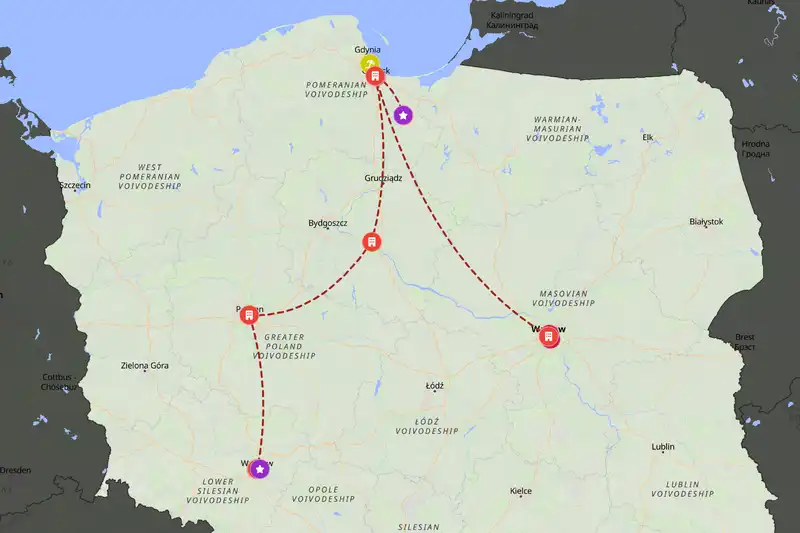
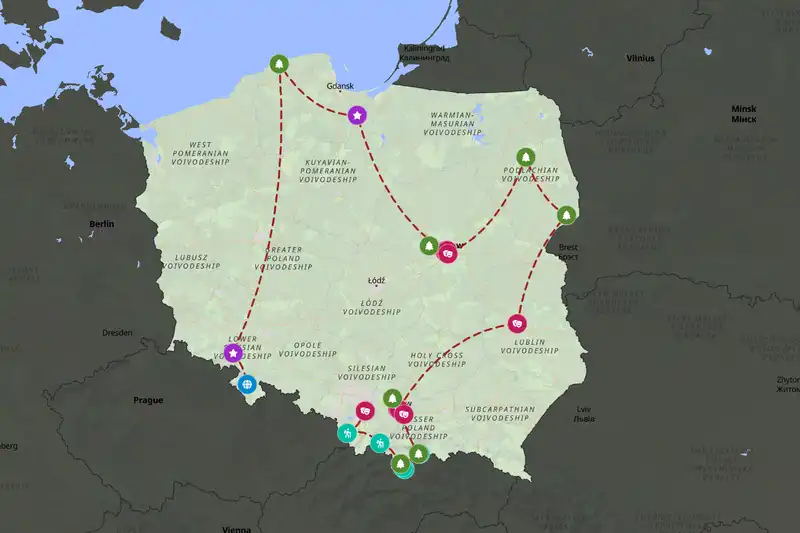
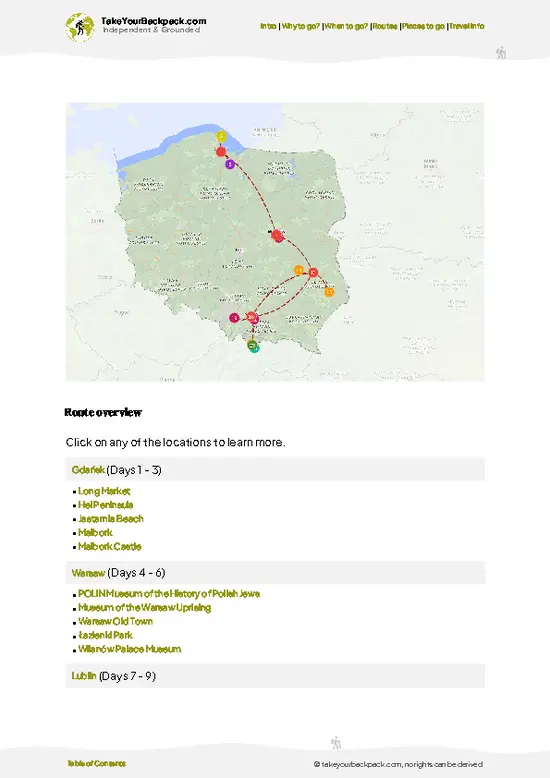
Fifteen days lets you cross Poland from the Baltic to the Tatras without rushing. This route is for travelers who want depth: the big cities, the Renaissance towns of the east that most visitors never reach, a long beach day and a serious hike at the end. The pace is relaxed, with three-night stays and day trips instead of daily packing. You will use PKP Intercity trains for the long legs, regional trains on the coast, and buses for Kazimierz Dolny, Zamość and the mountains.
Days 1-3: Gdansk and the Hel Peninsula
Spend your first three nights in
Gdansk and see the
Gdańsk Main Town and Long Market early, before the cruise groups arrive. Mariacka Street is the one to linger on, with its stone terraces, gargoyle rainspouts and amber workshops, then walk the Motława embankment as the light drops on the granaries across the water.
Day 2 goes to the
Hel Peninsula Beaches. Regional trains from Gdynia run up the 35 km sandbar in about 2 hours, and in summer water trams sail from Gdańsk and Gdynia. …
read more 👉Fifteen days lets you cross Poland from the Baltic to the Tatras without rushing. This route is for travelers who want depth: the big cities, the Renaissance towns of the east that most visitors never reach, a long beach day and a serious hike at the end. The pace is relaxed, with three-night stays and day trips instead of daily packing. You will use PKP Intercity trains for the long legs, regional trains on the coast, and buses for Kazimierz Dolny, Zamość and the mountains.
Days 1-3: Gdansk and the Hel Peninsula
Spend your first three nights in Gdansk and see the Gdańsk Main Town and Long Market early, before the cruise groups arrive. Mariacka Street is the one to linger on, with its stone terraces, gargoyle rainspouts and amber workshops, then walk the Motława embankment as the light drops on the granaries across the water.
Day 2 goes to the Hel Peninsula Beaches. Regional trains from Gdynia run up the 35 km sandbar in about 2 hours, and in summer water trams sail from Gdańsk and Gdynia. The peninsula is only a few hundred meters wide in places, so you choose between the open Baltic on one side and the shallow bay on the other. Jastarnia Beach on the bay side is where the kitesurf schools set up; ride on to Hel town at the tip for the seal center. Keep Day 3 loose for the Old Town you skipped and a long dinner.Day 4: Malbork on the Way South
Malbork sits right on the Gdańsk to Warsaw line, so you break the journey there instead of making a separate trip. The hop takes 30 to 50 minutes, and the Castle of the Teutonic Order in Malbork needs three to four hours to walk its three castle sections, chapter house and ramparts. Afterward it is about 2.5 hours on to Warsaw.Days 4-6: Warsaw
Three nights in Warsaw give you time for the city’s two heaviest museums on separate days. The POLIN Museum of the History of Polish Jews stands on the site of the former ghetto, facing the Ghetto Heroes Monument, and its core exhibition covers a thousand years of Jewish life in Poland; allow at least 3 hours. The next morning, the Museum of the Warsaw Uprising fills a former tram power station with the story of the 63-day revolt of 1944, including a replica sewer passage you crawl through. Finish that evening in the Warsaw Old Town and Royal Castle, best once the day-trippers leave.
Day 6 is the gentler one. Stroll Łazienki Królewskie in the morning, then take a city bus 30 to 40 minutes south to the Wilanów Palace Museum, the baroque residence of King Jan III Sobieski, which came through the war with much of its interior intact.Days 7-9: Lublin, Kazimierz Dolny and Zamość
The train to Lublin takes about 2 hours, and the city costs noticeably less than Warsaw for beds and food. Its Old Town is lived-in and scuffed in the best way, and the castle hides the Holy Trinity Chapel, covered in Byzantine-Ruthenian frescoes painted in 1418 for King Władysław Jagiełło.
Day 8 is a bus trip of about an hour to Kazimierz Dolny, a small Renaissance merchant town on the Vistula with carved facades on its market square, castle ruins on the hill and deep loess gorges you can walk through in the woods behind town. Day 9 heads the other way, 1.5 to 2 hours by bus to Zamość, a planned town founded in 1580 by Jan Zamoyski and laid out by Italian architect Bernardo Morando. The arcaded square with its pastel Armenian houses is UNESCO-listed and rarely crowded.Days 10-12: Krakow
Direct trains reach Krakow in about 4 hours, so leave early. Use the afternoon for the Old Town Market Square and Royal Route and the Jagiellonian University Museum - Collegium Maius, the oldest university building in Poland, where Copernicus studied and where a courtyard clock parades carved figures several times a day. Eat a zapiekanka from the hatches on Plac Nowy in the Kazimierz quarter after dark.
Day 11 is the Auschwitz-Birkenau State Museum. Book a slot with a museum educator; the guides give the scale of Birkenau a context that wandering alone cannot. Day 12 starts at Wawel Royal Castle (climb the cathedral tower to the Sigismund Bell, then exit through the Dragon’s Den), and after lunch the train runs 20 minutes to the Wieliczka Salt Mine, which stays at around 17°C year-round, so carry a layer.Days 13-15: Zakopane, Tatra National Park and Morskie Oko
Buses cover Kraków to Zakopane in about 2 hours. Settle in with an easy afternoon walk in Tatra National Park; the entry ticket costs around PLN 10 (US$2.50) at the trailhead booths. On Day 14 take the full-day version of Morskie Oko instead of the road: start at Palenica Białczańska, climb Dolina Roztoki to the Valley of Five Polish Ponds, eat at the mountain hut there, then cross the Świstówka pass and drop to the lake. Expect 18 to 20 km and 7 to 8 hours, so start by 7 a.m. Day 15 is the bus back to Kraków for your flight.
On your Zakopane days, ride 40 minutes east to Dębno Podhalańskie, where a late-15th-century larch church holds one of the oldest painted interiors in the region.


 Best Backpacking