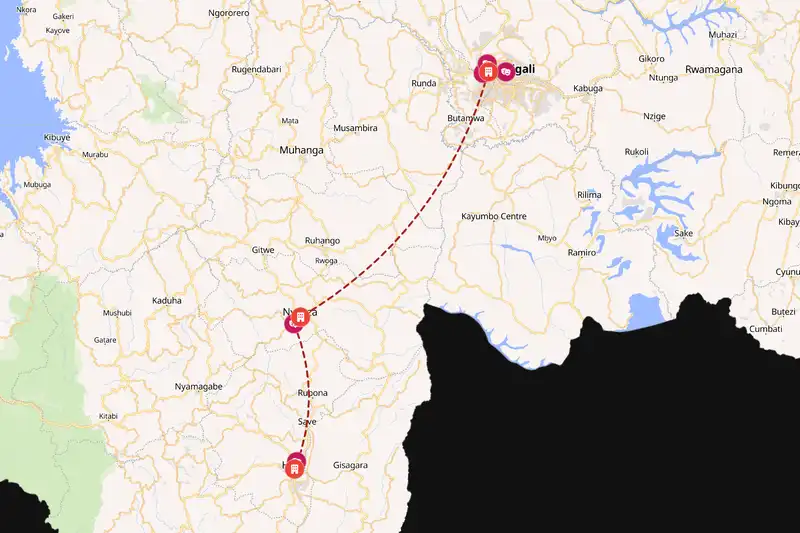
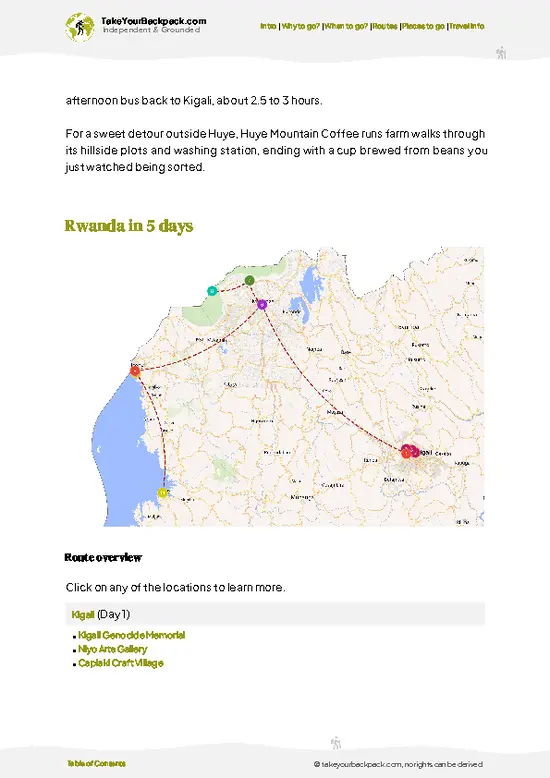
This five-day loop suits travelers who want Rwanda’s three big moods in one trip: the capital’s history and craft scene, a volcano climb, and a lazy finish on a lake. The pace is moderate, with no more than one bus ride per travel day and two nights in the north so you never pack up the morning of a hike. Everything runs on scheduled express buses out of Kigali’s Nyabugogo terminal, plus moto-taxis or a shared car for the short hops to trailheads.
Day 1: Kigali, Memory and Makers
Start where every serious visit to
Kigali should start: the
Kigali Genocide Memorial on the Gisozi hillside, where more than 250,000 victims of the 1994 genocide are buried. Entry is free, the audio guide is worth renting, and you need a solid two to three hours plus some quiet time afterward. In the afternoon, swing the mood toward the people rebuilding the city’s creative life.
Niyo Arts Gallery shows contemporary Rwandan painting, and artists often work right there in the studio space. Finish at
Caplaki Craft …
read more 👉This five-day loop suits travelers who want Rwanda’s three big moods in one trip: the capital’s history and craft scene, a volcano climb, and a lazy finish on a lake. The pace is moderate, with no more than one bus ride per travel day and two nights in the north so you never pack up the morning of a hike. Everything runs on scheduled express buses out of Kigali’s Nyabugogo terminal, plus moto-taxis or a shared car for the short hops to trailheads.
Day 1: Kigali, Memory and Makers
Start where every serious visit to Kigali should start: the Kigali Genocide Memorial on the Gisozi hillside, where more than 250,000 victims of the 1994 genocide are buried. Entry is free, the audio guide is worth renting, and you need a solid two to three hours plus some quiet time afterward. In the afternoon, swing the mood toward the people rebuilding the city’s creative life. Niyo Arts Gallery shows contemporary Rwandan painting, and artists often work right there in the studio space. Finish at Caplaki Craft Village in Kiyovu, a cluster of small stalls selling sisal baskets, banana-leaf cards, wood carvings and the zigzag imigongo panels traditionally made with cow dung. Prices start high, so bargain with a smile. Sleep in Kigali.Days 2-3: Ruhengeri and Volcanoes National Park
Catch a mid-morning bus north for the 2 to 2.5 hour climb into the hills to Ruhengeri, now usually signposted as Musanze. The town sits on a plateau with the Virunga cones lined up on the horizon, and the air turns noticeably cooler. Spend the afternoon underground at the Musanze Caves, a lava tube roughly 2 kilometers long with collapsed skylights that drop shafts of light onto the cave floor and a resident colony of bats. Day three is the big one in Volcanoes National Park. Register at the Kinigi headquarters by 7 a.m. for Bisoke Volcano, a 3,711-meter peak with a crater lake at the top and a muddy, steep, 6 to 7 hour round trip through bamboo and hagenia forest. Permits run around US$75, porters cost about US$10 to 20 and are worth hiring. If your budget stretches to the roughly US$1,500 gorilla permit, swap Bisoke for a trek that day, but book months ahead. Two nights in Ruhengeri means you come back filthy and simply collapse.Days 4-5: Gisenyi and Lake Kivu
The road west to Gisenyi takes about 1.5 hours and drops you from mountain chill to lakeside warmth. Spend the afternoon on Rubavu Beach, a strip of sand and palm-shaded lawns along Lake Kivu, one of the few big East African lakes widely considered safe for swimming. Around dusk, stay by the water: the fishing crews row their three-hull boats out for the night, chanting in rhythm as they go. On the final morning, walk the lakeshore road past old colonial villas or take a short boat ride before an early-afternoon bus back to Kigali, a 3.5 to 4 hour ride that lands you in time for an evening flight or a last dinner in town.
If you can spare an extra day, Gishwati-Mukura National Park, a regenerating forest south of Gisenyi with a small group of habituated chimpanzees, sees only a handful of visitors a week.
 Best Backpacking