Yes, Senegal is one of the easier West African countries to backpack on your own: shared transport covers every main route, guesthouses are easy to find, and you only need a guide inside the national parks.
French is the official language and Wolof is what you hear on the street, so a few phrases of each help a lot. A sept-place from
Dakar to
Saint-Louis takes 4 to 5 hours and costs about XOF 6,000 to 7,500 (US$10 to 13). A double room in a simple guesthouse runs XOF 12,000 to 25,000 (US$20 to 42). Most backpackers spend €25 to €45 (16,500 to 29,500 CFA) a day. Expect persistent touts at Dakar’s bus stations and on Gorée. A firm, friendly “non merci” usually works.
Ten days to two weeks covers Senegal’s main regions comfortably, while five days only works if you stay around Dakar.
With
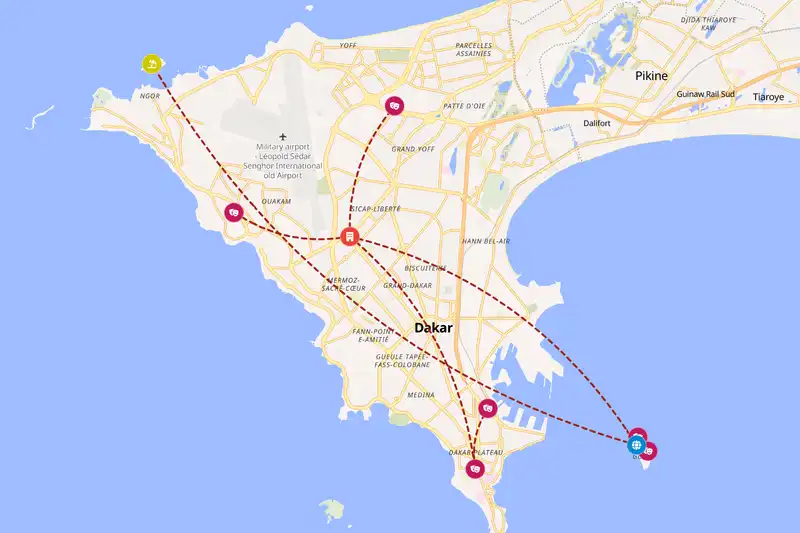
5 days, stick to Dakar, Gorée and Ngor Island. With
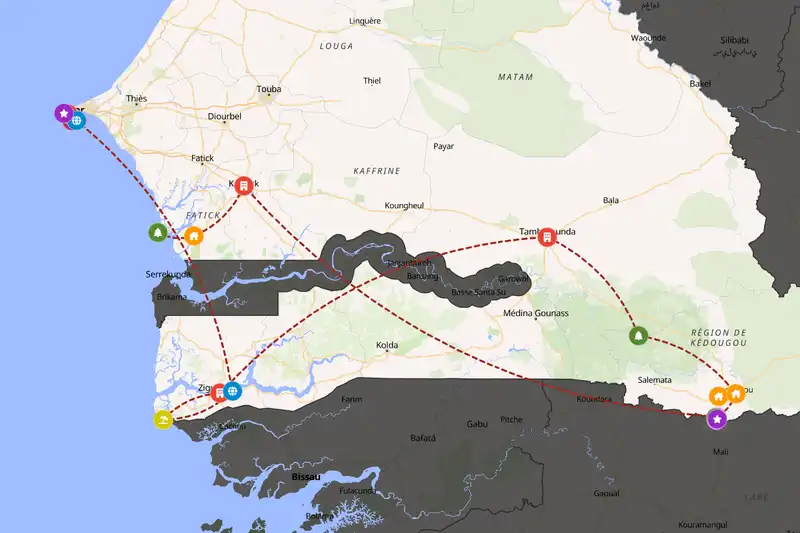
10 days, add Saint-Louis and Djoudj in the north (4 to 5 hours from Dakar), a night in the Lompoul dunes and the Saloum Delta. With
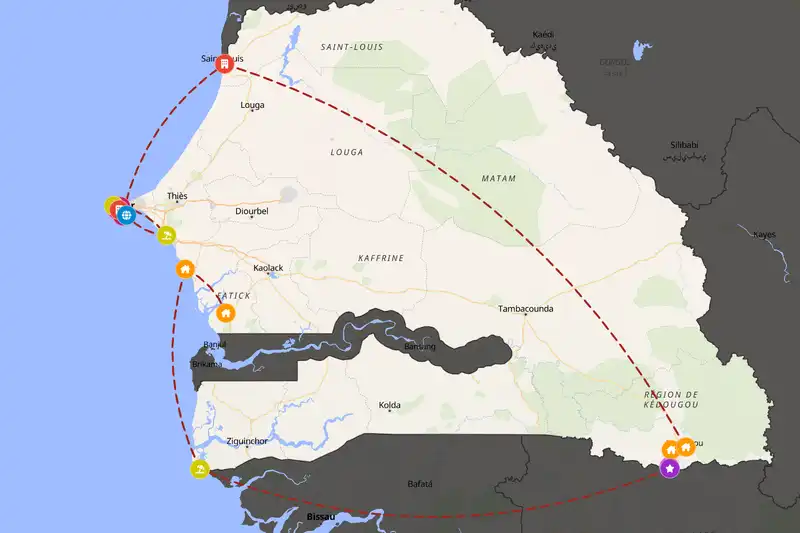
15 days, you can also reach Casamance. Ziguinchor is 7 to 9 hours overland from the Saloum, or about 15 hours by overnight ferry from Dakar. The southeast around Kédougou and Dindefelo needs another 4 to 5 days, since it lies 10 to 12 hours by road from the capital.
Yes, you can cover all of Senegal without a car, using shared sept-place taxis, minibuses, ferries and pirogues.
Sept-places are old station wagons with seven seats. They leave each town’s gare routière once full and are the fastest option: Dakar to Saint-Louis takes 4 to 5 hours, and Dakar to Mbour 1.5 to 2 hours. The
Dakar–Ziguinchor ferry sails twice a week in each direction, takes about 15 hours and costs from roughly XOF 15,000 (US$25) for a seat. In Dakar, taxis have no meters, so agree on the fare first (XOF 1,500 to 3,000 for most rides). For Djoudj or Fathala, hiring a car with a driver for the day (XOF 30,000 to 45,000) is easier than driving yourself.
The top places in Senegal are Île de Gorée, Saint-Louis and the Saloum Delta, followed by Casamance and Dindefelo if your trip runs past ten days.
Île de Gorée is a 20-minute ferry from Dakar, and its Maison des Esclaves is the country’s most visited historic site.
Saint-Louis, 4 to 5 hours north, deserves 2 to 3 nights, with a day trip to Djoudj for pelicans between November and April. Plan 2 nights in the
Saloum Delta around Toubacouta or Foundiougne for pirogue trips through the mangroves. In the south,
Cap Skirring has the best beaches. Out east, the
Dindefelo Waterfall near Kédougou drops about 100 meters into a cold pool, but it takes 10 to 12 hours to reach from Dakar.
If time is short in Senegal, skip the inland towns such as Kaolack, Diourbel and Thiès as destinations, and save the far southeast for another trip.
Kaolack is a transport junction, so change vehicles there and keep going.
Bandia Wildlife Reserve, about 65 km from Dakar, is fenced and stocked with introduced animals, so you can drop it if you plan to visit Fathala in the Saloum. The Saly resort strip works for a last night near the airport but needs no more than that.
Popenguine or
Joal-Fadiouth, 1.5 to 2.5 hours from Dakar, have far more character.
Niokolo-Koba National Park lies 8 to 10 hours from Dakar and big-animal sightings are rare, so it only makes sense with 3 or more spare days.
Yes, our itinerary-planner does exactly that. Set your trip length in days, give your interests and travel style, optionally give start- and end location and/or some mandatory stops you would like to include and the itinerary planner creates your personalized routes for Senegal in seconds. Try it out!
Try the itinerary planner
 Best Backpacking