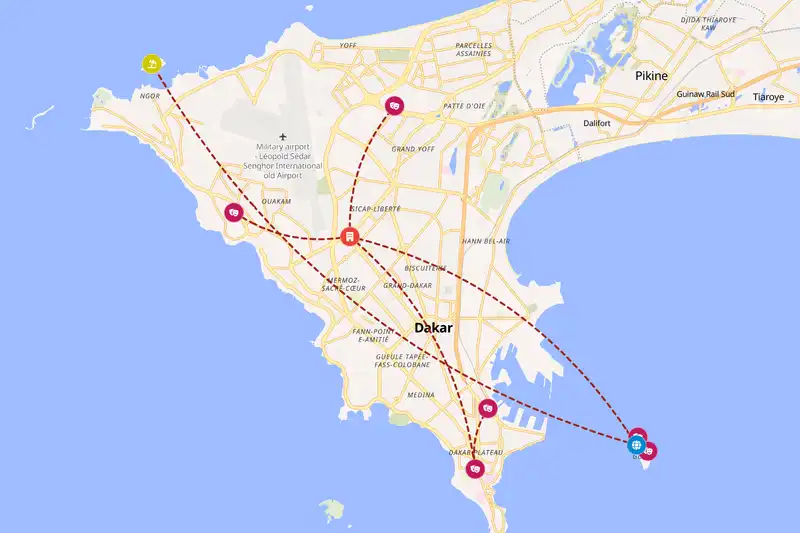
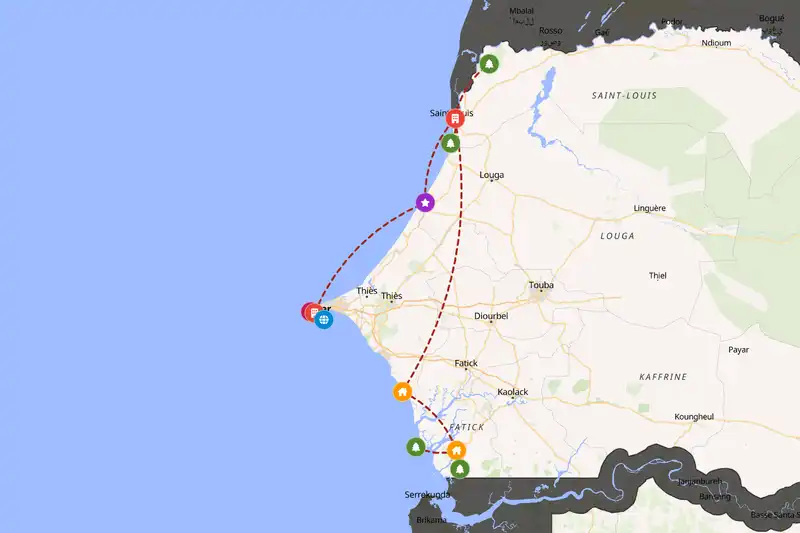
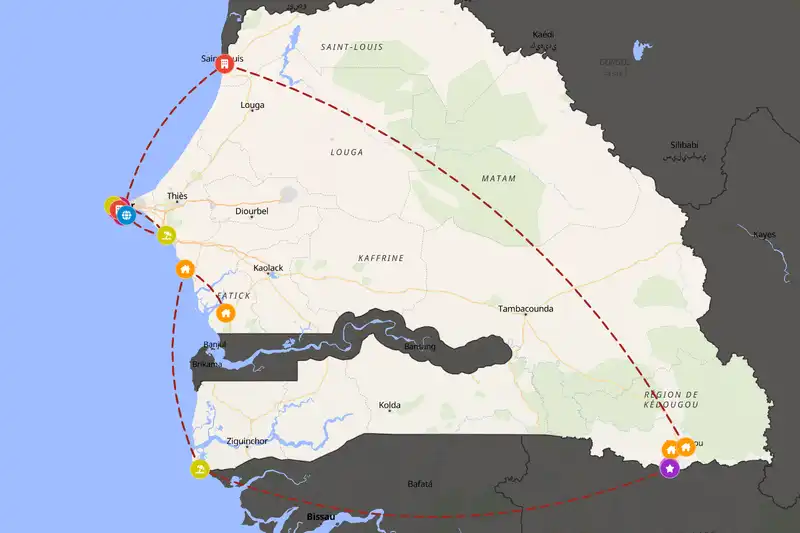
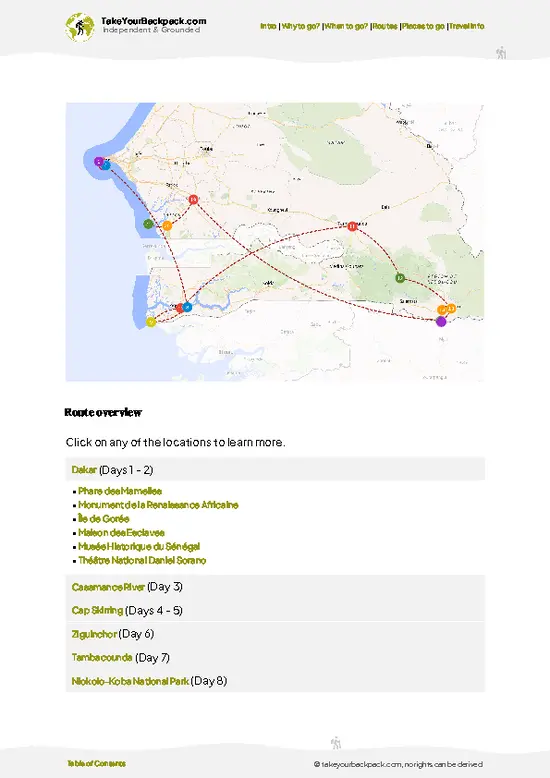
This 15-day loop through Senegal is for travelers who want the country’s south in full: Atlantic beaches, river towns, savanna parks and the hill villages of the far southeast. It suits travelers with some patience for road time. The pace is moderate, with two genuinely long road days balanced by multi-night stays. You will use an overnight coastal ferry, sept-place shared taxis, minibuses, pirogues on the Casamance and the Saloum, and a hired 4x4 with a guide for Niokolo-Koba.
Days 1-3: Dakar and Gorée
Give
Dakar two nights and most of a third day, because the ferry south leaves in the evening. Start high: the walk up to the
Les Mamelles Lighthouse Trail takes about 20 minutes and gives you the whole Cap-Vert peninsula, with the bronze
Monument de la Renaissance Africaine on the neighboring hill. Pair them on one morning. Spend another day on
Île de Gorée, 20 minutes by ferry from the port. Skip the hustle at the
Maison des Esclaves by arriving on the first boat, then climb to the round …
read more 👉This 15-day loop through Senegal is for travelers who want the country’s south in full: Atlantic beaches, river towns, savanna parks and the hill villages of the far southeast. It suits travelers with some patience for road time. The pace is moderate, with two genuinely long road days balanced by multi-night stays. You will use an overnight coastal ferry, sept-place shared taxis, minibuses, pirogues on the Casamance and the Saloum, and a hired 4x4 with a guide for Niokolo-Koba.
Days 1-3: Dakar and Gorée
Give Dakar two nights and most of a third day, because the ferry south leaves in the evening. Start high: the walk up to the Les Mamelles Lighthouse Trail takes about 20 minutes and gives you the whole Cap-Vert peninsula, with the bronze Monument de la Renaissance Africaine on the neighboring hill. Pair them on one morning. Spend another day on Île de Gorée, 20 minutes by ferry from the port. Skip the hustle at the Maison des Esclaves by arriving on the first boat, then climb to the round Fort d’Estrées, which holds the Musée Historique du Sénégal and puts the island’s history into a wider West African frame. If a show is on at the Théâtre National Daniel Sorano, book it for your second evening; a night of kora and Sabar drumming there costs far less than the tourist dinner shows.Days 3-4: The Casamance River ferry
The overnight boat from Dakar to Ziguinchor runs a couple of times a week, so build your start date around it. Book a four-berth or two-berth cabin. You wake up as the ship slides into the wide, mangrove-lined mouth of the Casamance River, and the last hours upstream are the best river cruise in the country, included in the fare. Head straight on to the coast after docking.Days 4-6: Cap Skirring and Ziguinchor
Cap Skirring gets two nights of wide, empty sand, grilled barracuda and Diola villages under huge kapok trees. Rent a bicycle and ride north along the beach at low tide. On day six, drive the 70 kilometers back to Ziguinchor and give it a night. Walk the riverfront, have a drink on a terrace facing the water, and browse the Saint-Maur market. It is a slow, green, easygoing town, and you want rest before the push east.Days 7-8: Tambacounda and Niokolo-Koba
Day seven is the first long haul, 7 to 9 hours by sept-place via Kolda and Velingara to Tambacounda, the hot crossroads of the east. Sleep there and arrange your Niokolo-Koba transport and guide that evening. The next morning, drive into Niokolo-Koba National Park and spend the night at Simenti on the Gambia River. Hippos, crocodiles, warthogs, baboons and several antelope species are realistic sightings; lions and elephants are rare, so treat any sighting as luck. The park tracks only work in the dry season, roughly November to May.Days 9-10: Kédougou and Bandafassi
Finish your last game drive and continue south to Kédougou for two nights. The town sits among red laterite hills and mango trees, and it feels completely different from the coast. Use the full day for Bandafassi and the Bedik hill villages above it, where stone-and-thatch houses cling to the slopes. A local guide is worth hiring for both the route and the etiquette. If you have energy left, a guided walk on the Niokolo-Koba Buffer Zone Trail gives you dry forest and baobabs on foot, with no 4x4 between you and the bush.Days 11-12: Dindéfélo
Spend a night in Dindefelo village, 35 kilometers from Kédougou near the Guinean border. The Dindefelo Waterfall is a 30-minute walk upstream through the Réserve Naturelle Communautaire de Dindéfélo, dropping about 100 meters into a cold pool you can swim in. The entrance fee goes to the community. Next morning, climb the steep path to Dande, a Fulani village on the plateau above the falls, before you leave. Then comes the second long day, roughly 9 to 10 hours of road back through Tambacounda to Kaolack.Days 13-15: Kaolack and the Saloum Delta
Wake up in Kaolack and see the Médina Baye mosque and the sprawling central market before the heat builds, then make the short run to Toubacouta for two nights. This is the payoff for all that road: pirogue trips through the Saloum Delta National Park, shell islands, oyster-covered mangrove roots, and herons lifting off ahead of the boat. Walk the Saloum Delta Mangrove Trail at dusk when the light goes gold. On day 15, the airport is about three hours away.
If you have one spare day in Ziguinchor, take a pirogue to Île de Carabane, a car-free island at the mouth of the Casamance with a crumbling colonial church and almost no visitors.v2.webp)

 Best Backpacking