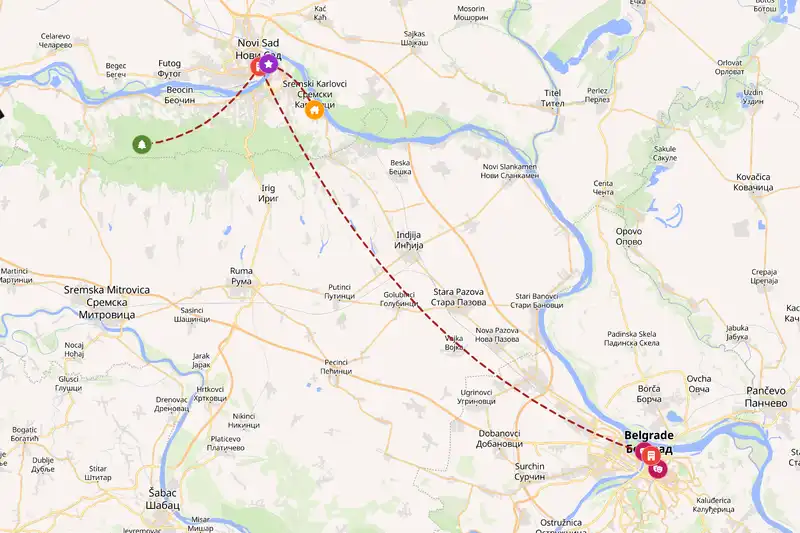
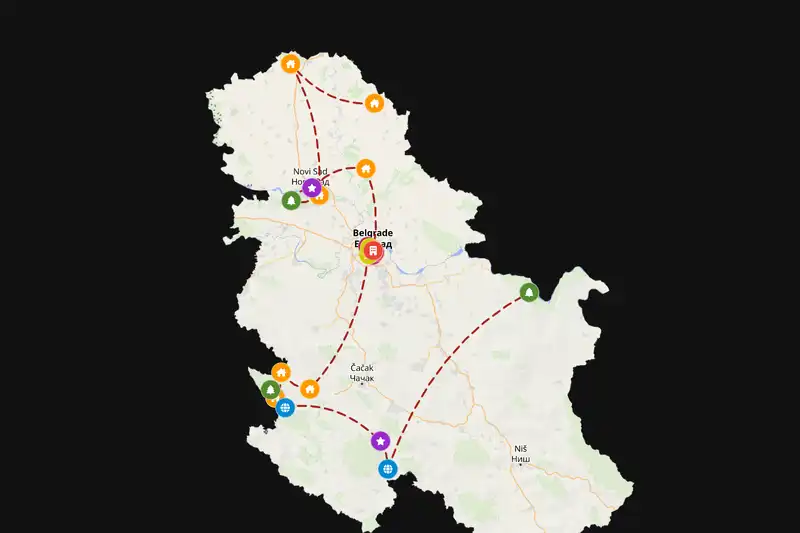
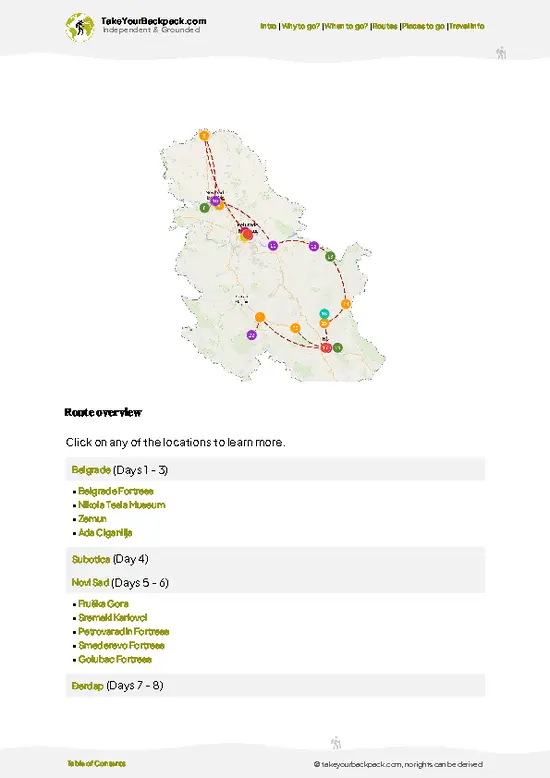
This fifteen-day loop suits travelers who want the whole country, from Habsburg-era towns on the Pannonian plain to Ottoman relics and mountain monasteries in the south. The pace is steady but unhurried, with two nights in most places and no back-to-back long travel days. Everything runs on intercity buses, with trains for the Belgrade, Novi Sad and Subotica stretch and the occasional local bus or taxi to reach trailheads and monasteries.
Days 1-3: Belgrade
Three nights in
Belgrade lets you treat the capital as a place to live in for a while. Spend the first afternoon in
Belgrade Fortress, timing the walk along the ramparts for sunset over the meeting of the Sava and Danube, then eat in the cobbled lanes of Skadarlija, where the murals on side walls are more interesting than the tourist menus. Day two pairs the
Nikola Tesla Museum (book the English guided tour, which includes the coil demonstration and the gold sphere holding his ashes) with a riverside walk north to
Zemun Old Town & Gardos …
read more 👉This fifteen-day loop suits travelers who want the whole country, from Habsburg-era towns on the Pannonian plain to Ottoman relics and mountain monasteries in the south. The pace is steady but unhurried, with two nights in most places and no back-to-back long travel days. Everything runs on intercity buses, with trains for the Belgrade, Novi Sad and Subotica stretch and the occasional local bus or taxi to reach trailheads and monasteries.
Days 1-3: Belgrade
Three nights in Belgrade lets you treat the capital as a place to live in for a while. Spend the first afternoon in Belgrade Fortress, timing the walk along the ramparts for sunset over the meeting of the Sava and Danube, then eat in the cobbled lanes of Skadarlija, where the murals on side walls are more interesting than the tourist menus. Day two pairs the Nikola Tesla Museum (book the English guided tour, which includes the coil demonstration and the gold sphere holding his ashes) with a riverside walk north to Zemun Old Town & Gardos Tower, an Austro-Hungarian quarter with fish restaurants along the Danube quay. Keep day three loose: in summer, take a bus to Ada Ciganlija, a 7 km gravel shore on a dammed Sava lake where half the city swims and plays beach volleyball after work.Days 4-6: Subotica and Novi Sad
Head north to Subotica, near the Hungarian border, for one night. The Art Nouveau City Hall, with its glazed Zsolnay roof tiles, and the restored 1902 synagogue are reason enough, and a local bus reaches Palić lake in about 15 minutes for an evening walk. Next morning, drop back south to Novi Sad (around 1.5 hours) for two nights. This time skip the obvious café strip and give a full day to Fruška Gora, the low forested ridge holding sixteen surviving Orthodox monasteries; a taxi or tour linking Krušedol and Novo Hopovo is easier than local buses. Finish in Sremski Karlovci for a glass of bermet, the spiced dessert wine, and save the evening for the ramparts of Novi Sad’s Petrovaradin Fortress, whose clock tower has its hour and minute hands reversed so boatmen could read it from the river.Days 7-8: Đerdap and the Danube
This is the longest travel day: back through Belgrade and east by bus along the Danube, roughly 5 hours in total. Break it at Smederevo Fortress, a 15th-century triangle of 25 towers on the riverbank, then continue to Golubac Fortress, where the river widens into a lake and ten towers climb the cliff behind the road. Spend two nights inside Đerdap National Park, staying in a riverside guesthouse. The Iron Gates gorge runs for around 100 km, and at the Kazan narrows the Danube squeezes to about 150 meters between limestone walls; a boat trip from the Serbian bank is the best way to grasp the scale.Days 9-10: Soko Banja and Rtanj
Leave the river for the hills, changing buses in Zaječar (4 to 5 hours in total), and settle into Soko Banja, a low-key spa town with thermal pools and the ruined Sokograd fortress above a gorge. The town works as a base for Rtanj mountain, whose near-perfect pyramid peak, Šiljak, rises to 1,565 meters. The climb takes 5 to 7 hours round trip on steep, loose ground, and the summit chapel looks out over half of eastern Serbia. Buy a bag of Rtanj tea (wild mountain savory) in town afterward.Days 11-12: Niš
A short 1.5-hour bus ride brings you to Niš, the south’s main city and the birthplace of Constantine the Great. The Skull Tower is the sight that stays with people: the Ottomans built it from the heads of Serbian rebels after the 1809 Battle of Čegar, and about 58 of the original 952 skulls remain set in the mortar, now under a protective chapel. Spend the second day in Sićevo Gorge, where the Nišava river cuts a 17 km canyon east of the city; local buses toward Pirot drop you near viewpoints and climbing crags. Evenings belong to Kazandžijsko Sokače, the old coppersmiths’ lane, and a plate of grilled meat, which Niš does better and cheaper than Belgrade.Days 13-15: Kraljevo and Studenica
Travel northwest via Kruševac, stopping for an hour at Lazarica, the 14th-century church of Prince Lazar with its red-and-cream banded stonework. Base yourself in Kraljevo for two nights and use the full middle day for Studenica Monastery, around 1.5 hours away by bus or taxi up the Ibar valley. Founded by Stefan Nemanja in the late 12th century, its Church of the Virgin is faced in white marble, and the frescoes inside are some of the oldest and finest in the Serbian Orthodox world. On day fifteen, a 3-hour bus returns you to Belgrade for your flight.
If you have a spare morning in the east, hike into Lazar’s Canyon near Bor, a narrow limestone gorge with cave entrances and almost no other visitors.
 Best Backpacking