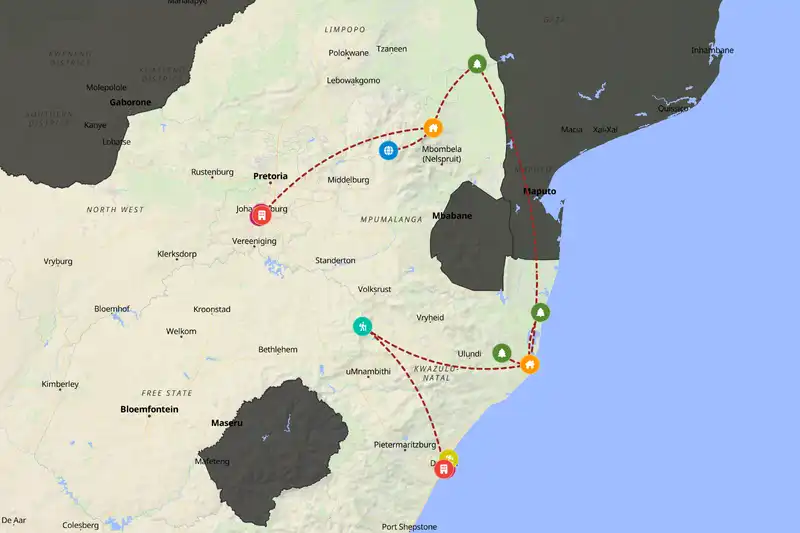
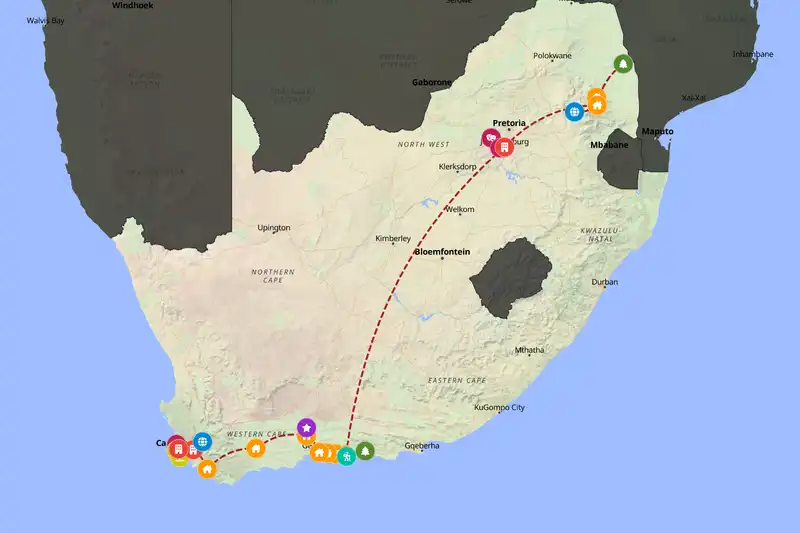
Short version: yes, South Africa is very doable to backpack independently, as long as you respect distances and stay sharp about safety.
For budget travelers, the big win is the network of hostels (often called backpackers) along the coast and in most major towns. Many of them are social, used to solo travelers, and can help you book tours, shuttles, and activities on arrival. You don’t need a tour company to string a trip together.
The main challenges are:
- Distances are long, especially between major cities.
- Some areas are not walkable at night or feel empty after dark.
- Public transport is not always intuitive for a first-timer.
If you:
- Stick to well-trodden routes (Cape Town, Garden Route, Drakensberg, Wild Coast, Kruger/other parks),
- Use hostels as your logistics base,
- Avoid walking around with valuables or at night in quiet areas,
- Use rideshares or registered taxis in cities,
then independent backpacking is straightforward and rewarding.
It’s not Southeast Asia-easy, but it’s absolutely manageable for a first big trip if you’re reasonably street-smart and plan your transport between stops in advance.
If you want a quick rule of thumb:
- 1 week: One region only (e.g., just Cape Town and nearby areas, or just Kruger and a bit of Johannesburg).
- 2 weeks: A classic first-timer route (Cape Town + Garden Route, or Johannesburg + Kruger + one extra stop).
- 3–4 weeks: A satisfying backpacking loop with both coast and safari, plus some hiking.
For backpackers, 3 weeks is the sweet spot:
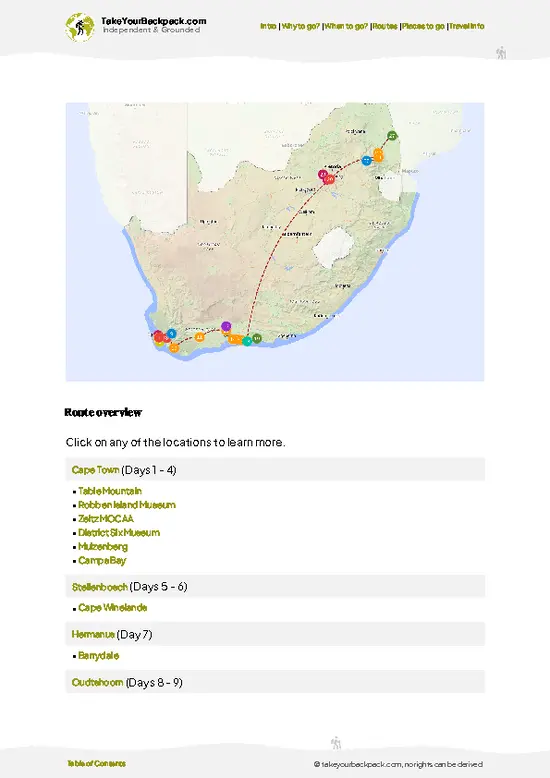
- 4–5 days: Cape Town (city, Table Mountain, Cape Peninsula, wine region as a day trip if you drink).
- 4–6 days: Garden Route (Wilderness, Knysna, Plettenberg Bay, Tsitsikamma) or Wild Coast.
- 3–5 days: Safari (Kruger or another park) including travel days.
- 2–4 days: Drakensberg or another hiking area.
- 1–3 days: Johannesburg or Pretoria for history and context.
If you only have 10–12 days, focus on either:
- Cape Town + Garden Route, or
- Johannesburg + Kruger + one extra stop (like Blyde River Canyon).
Trying to do Cape Town, Garden Route, Drakensberg, and Kruger in under 2 weeks turns your trip into a bus marathon. Fewer regions, more depth, is better for your budget and your sanity.
You can get around South Africa without a car, but you need to be deliberate.
What works well without a car:
- Long-distance buses: Companies like Intercape and others connect major cities and towns (Cape Town, Port Elizabeth/Gqeberha, Durban, Johannesburg, etc.). They’re good value and safer than hitchhiking.
- Backpacker shuttles: Some hostels and private operators run shuttles along popular routes (especially the Garden Route and Wild Coast). These are designed for travelers and can drop you at hostels.
- Domestic flights: Often cheap if booked early and save huge chunks of time on long routes like Cape Town–Johannesburg or Johannesburg–Durban.
- City transport: In Cape Town and Johannesburg, use rideshare apps or registered taxis for door-to-door trips, especially at night.
What’s harder without a car:
- Remote hikes and viewpoints (Drakensberg trailheads, some Wild Coast villages, off-the-main-road beaches).
- Self-drive safaris (Kruger is famous for this, but you can join guided game drives instead).
If you’re car-free, plan like this:
- Base yourself in towns with multiple activities and tours (Cape Town, Durban, Port Elizabeth/Gqeberha, Nelspruit/Mbombela for Kruger).
- Use hostels that offer daily shuttles or tours to nearby sights.
- Accept that you’ll skip some remote corners or pay a bit more for transfers.
You won’t see every backroad, but you can still have a rich, varied trip without ever renting a car.
For a first-time backpacker on a budget, these are the places that punch way above their cost and logistics hassle:
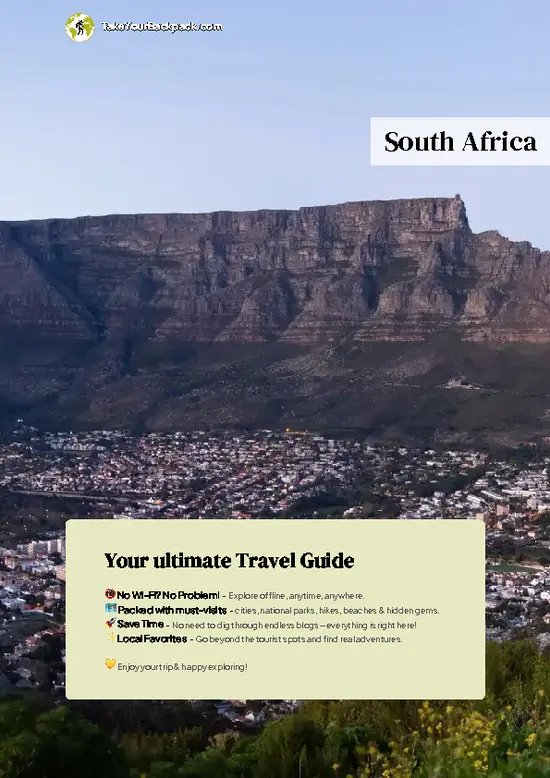
Cape Town & surrounds- Why: Mountains, ocean, history, food, and hostel culture in one place.
- Highlights: Table Mountain or Lion’s Head hike, Cape Peninsula (Cape Point, penguins at Boulders Beach), Bo-Kaap, cheap local food, sunset beaches.
- Value tip: Use a mix of self-guided hikes and one or two targeted tours (like the peninsula) instead of booking a tour for everything.
Garden Route- Why: Easy overland route with beaches, forests, and adventure sports.
- Key stops: Wilderness (lakes and chill), Knysna (lagoon), Plettenberg Bay (beaches, hikes), Tsitsikamma (suspension bridges, coastal trails).
- Value tip: Stay longer in one or two towns instead of hopping every night; you’ll save on transport and get hostel discounts.
Kruger National Park (or a comparable safari area)- Why: This is one of the best-value big-animal safari experiences on earth.
- How: Either a budget group tour from Johannesburg/Nelspruit or a mix of public transport + hostel that offers game drives.
- Value tip: Two full days of game drives is usually enough; more days give diminishing returns for tight budgets.
Drakensberg Mountains- Why: World-class hiking, dramatic cliffs, and starry nights.
- Where: Northern or central Drakensberg (Amphitheatre area, Cathedral Peak, etc.).
- Value tip: Base at a hiker-friendly hostel or lodge that organizes guided hikes and shuttles to trailheads.
Wild Coast (if you have time)- Why: Rugged coastline, Xhosa villages, and slower, more local travel.
- Where: Coffee Bay, Port St Johns, or a similar base.
- Value tip: This is where your money stretches far on accommodation and food, but transport is slower, so give it at least 3–4 days.
If you’re short on time or cash, skip anything that eats days in transit without adding a new type of experience.
Trying to do both Garden Route and Wild Coast on a short tripThey’re both coastal, both beautiful, and both require time. Pick one: Garden Route for easier logistics and activities, Wild Coast for slower, more local vibes. Doing both in under 3 weeks usually means you’re just sitting on buses.
Too many safari daysSafari is incredible, but after 2–3 full days of game drives, most backpackers start repeating sightings. If you’re counting days, do a focused 2–3 day Kruger (or similar) trip instead of a 5–7 day blowout.
Secondary cities just to tick boxesIf you’re rushed, don’t force in places like Bloemfontein or Port Elizabeth/Gqeberha unless they’re logical transit hubs for your route. They’re fine, but they’re not essential for a first-timer.
Over-scheduled wine tourismWine regions like Stellenbosch and Franschhoek are lovely, but you don’t need multiple days of wine tours on a backpacker budget. One day trip from Cape Town or one overnight is plenty; use the saved time for hikes or coast.
Long detours just for one photo spotPlaces that require a full day of travel each way for a single viewpoint or Instagram-famous stop are rarely worth it if you only have 1–2 weeks. Focus on hubs where you can do several activities from one base instead of chasing isolated attractions.
If you’re really squeezed, the core that gives you the most variety per day is: Cape Town area + 1 coastal stretch (Garden Route or Wild Coast) + 2–3 days of safari. Everything else is optional seasoning.