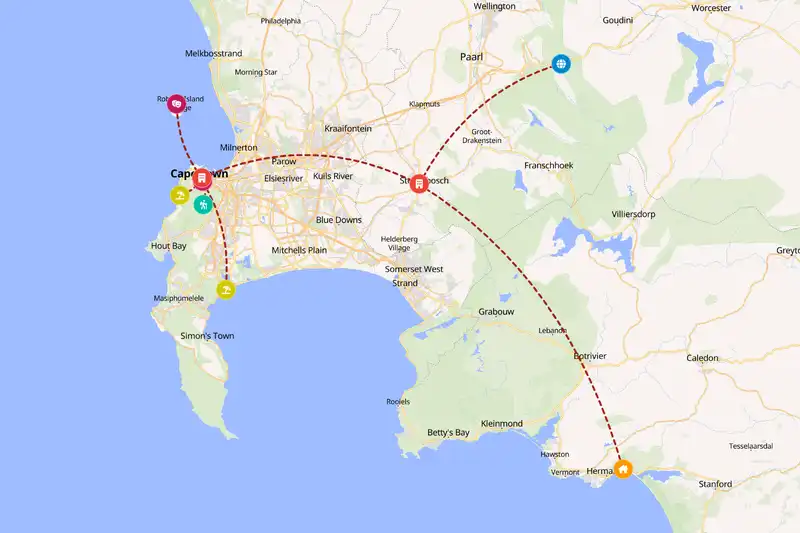
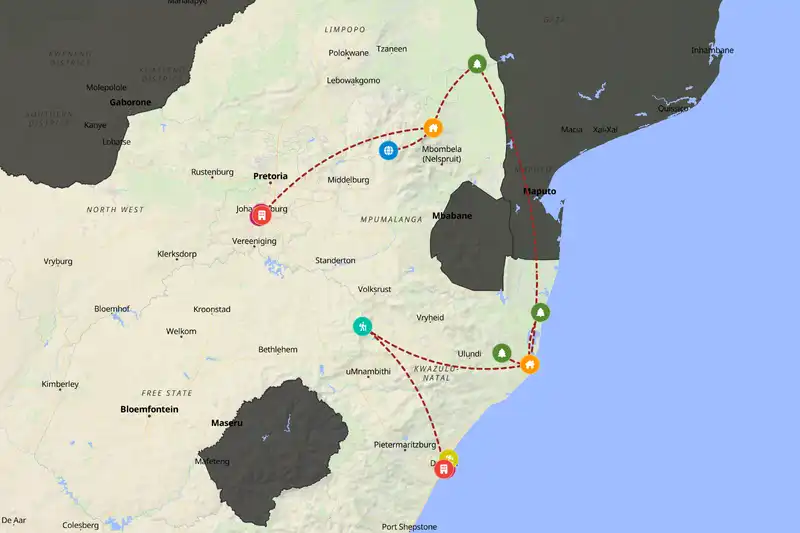
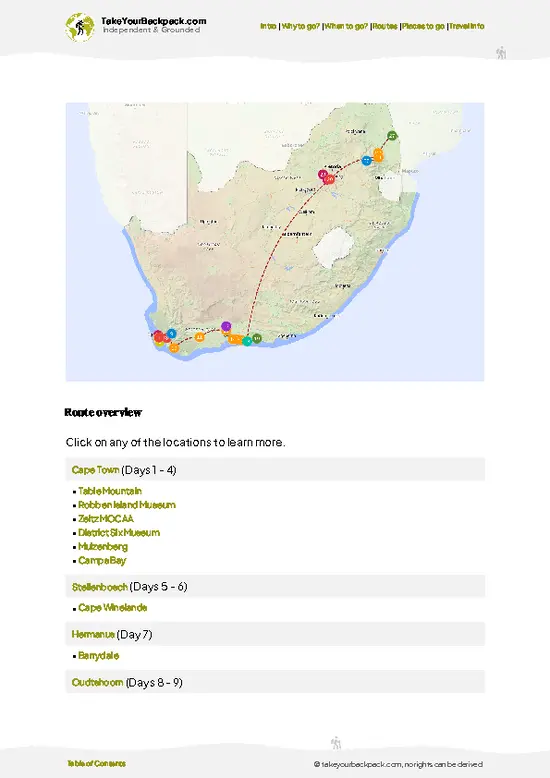
Three weeks gives you both ends of South Africa: the Cape coast with its mountain, vineyards and Route 62, then the Highveld and the bush around Kruger. It suits travelers who want the big names plus a few small towns where nobody is selling a tour. The pace is moderate, with two nights in most places and four in Cape Town. In Cape Town you’ll use MyCiTi buses and Uber. From Stellenbosch to George you’ll want a one-way hire car, because Route 62 has no useful bus service. Intercape coaches along the N2 work as a fallback for the coastal stretch. A domestic flight takes you from George to Johannesburg in about 1 hour 45 minutes, and a second hire car covers Mpumalanga and Kruger.
Days 1-4: Cape Town
Four nights let you work around the weather. The southeasterly wind can shut the Table Mountain cableway for days, so keep your first clear morning free for
Table Mountain. Skeleton Gorge from the Kirstenbosch side is a shady, ladder-assisted climb of 2.5 to 3.5 hours, and the cable car down saves …
read more 👉Three weeks gives you both ends of South Africa: the Cape coast with its mountain, vineyards and Route 62, then the Highveld and the bush around Kruger. It suits travelers who want the big names plus a few small towns where nobody is selling a tour. The pace is moderate, with two nights in most places and four in Cape Town. In Cape Town you’ll use MyCiTi buses and Uber. From Stellenbosch to George you’ll want a one-way hire car, because Route 62 has no useful bus service. Intercape coaches along the N2 work as a fallback for the coastal stretch. A domestic flight takes you from George to Johannesburg in about 1 hour 45 minutes, and a second hire car covers Mpumalanga and Kruger.
Days 1-4: Cape Town
Four nights let you work around the weather. The southeasterly wind can shut the Table Mountain cableway for days, so keep your first clear morning free for Table Mountain. Skeleton Gorge from the Kirstenbosch side is a shady, ladder-assisted climb of 2.5 to 3.5 hours, and the cable car down saves your knees.
Book the Robben Island Museum ferry from the V&A Waterfront several days ahead. The trip takes about 3.5 hours and costs around R600 (US$33). Afterward, walk over to Zeitz MOCAA, a contemporary African art museum carved out of a 1920s grain silo. The next morning, the District Six Museum fills in the other half of the city’s story: a mixed inner-city neighborhood, bulldozed under apartheid, retold through street signs and former residents’ handwritten memories.
Give the last day to Table Mountain National Park on the peninsula. Start with a surf lesson at Muizenberg, where the water is warmer and the waves gentler than on the Atlantic side. Then continue to Cape Point, and come back via Chapman’s Peak for sunset over Camps Bay.Days 5-6: Stellenbosch and the Cape Winelands
Pick up your hire car and drive 45 minutes to Stellenbosch. It’s a university town, so dorm beds and student-priced burgers sit a short walk from 300-year-old Cape Dutch buildings. Spend one day cycling or taking a hop-on shuttle between estates in the Cape Winelands. Tastings usually run R100 to R250. Use the second morning for a hike in Jonkershoek, right on the edge of town, before the afternoon heat sets in.Day 7: Hermanus
The 1.5-hour drive to Hermanus is worth taking via Clarence Drive along the cliffs of False Bay. From June to November, southern right whales calve close enough to the cliff path to hear them blow. Even out of season, the 11-kilometer path is a good evening walk. One night is enough here, because the next leg is long.Days 8-9: Route 62 to Oudtshoorn
This is the only long driving day on the Cape side, about 5 hours including stops. Head inland to Barrydale, a one-street Karoo town with good coffee and art studios, and stop there for lunch. Then follow Route 62 through semi-desert to Oudtshoorn. Ostrich farms line the roads, and you can skip them without missing much. Spend your full day at the Cango Caves. The Heritage Tour suits everyone. The Adventure Tour has you squeezing on your belly through gaps like the Devil’s Chimney, so leave the big backpack in the car.Days 10-11: Wilderness
Cross the Outeniqua Mountains to Wilderness, about 1 hour 15 minutes, and the scenery switches from dry scrub to green lakes and forest. Rent a kayak on the Touw River, paddle upstream, then walk to a waterfall. On a Saturday, drive 20 minutes to Sedgefield for the Wild Oats farmers market. Continue to Knysna for lunch with a view of the Heads, the sandstone gateway where the lagoon meets the sea.Days 12-13: Plettenberg Bay
From a base in Plettenberg Bay, walk the full loop of Robberg Nature Reserve. It’s about 9 kilometers, past a Cape fur seal colony, and the rock-hopping sections are slow going. The next day, drive about an hour east to Storms River Mouth in Tsitsikamma. The suspension bridge there hangs over the spot where the river meets the Indian Ocean. The 216-meter Bloukrans bungee is on the same road, for anyone who wants it.Days 14-15: Johannesburg
Drop the car at George airport (about 1.5 hours from Plett) and fly to Johannesburg. Spend one day in Soweto. Visit the Hector Pieterson Memorial and Museum, which tells the story of the 1976 student uprising, then walk Vilakazi Street. After that, give the Apartheid Museum 3 hours. Your entry ticket randomly assigns you a racial classification, and that sets the tone. Spend the second day at the Cradle of Humankind Visitor Centre, about an hour northwest of the city, and pair it with the Sterkfontein Caves, where some of the oldest hominin fossils were found.Days 16-17: Sabie and the Panorama Route
Pick up a second car and drive about 4 hours east to Sabie. It’s a forestry town with half a dozen waterfalls within a 15-minute drive, and it costs less to stay in than the Panorama Route hotspots. Drive the Panorama Route early, before the mist or the tour buses arrive. Stop at the Three Rondavels viewpoint above Blyde River Canyon, then finish at Pilgrim’s Rest. It’s a gold-rush village from the 1870s with corrugated-iron houses and an old-fashioned main street.Days 18-21: Kruger National Park
Enter Kruger National Park about an hour from Sabie and keep to the south, where game density is highest. Split your three nights between SANParks rest camps such as Skukuza and Lower Sabie. That way you’re already inside the fence when the gates open at dawn. Book at least one guided night drive, because the park is closed to self-drivers after dark. Budget roughly R500 a day in conservation fees for international visitors. On Day 21, exit to Kruger Mpumalanga International Airport near Nelspruit, about an hour away, or drive 5 hours back to Johannesburg.
If a friend were driving from Oudtshoorn to Wilderness, I’d tell them to skip the main Outeniqua Pass and take the old gravel Montagu Pass alongside it, which is fine in a normal car in dry weather and has hardly any traffic.v2.webp)
 Best Backpacking