×
South Sudan🇸🇸 | 5 days itinerary

South Sudan in 5 Days

By Johan Kruseman 🇳🇱 | Updated May 4, 2026
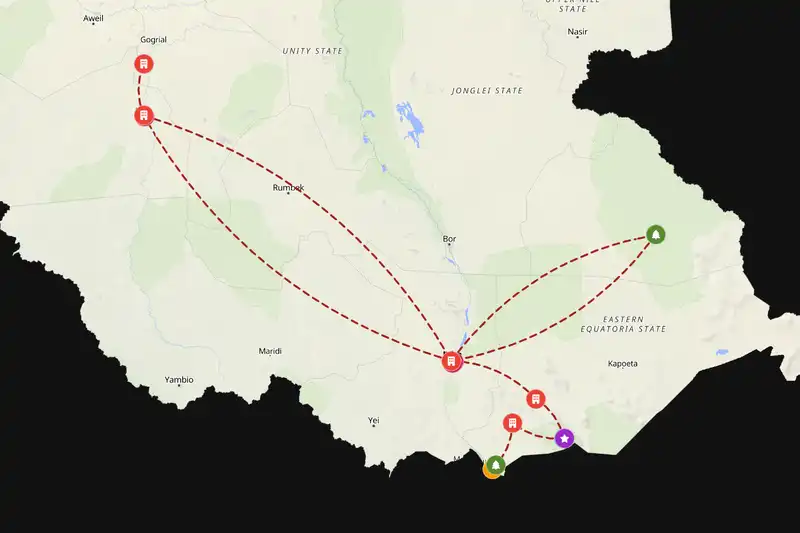
This 5-day route is for curious, reasonably adventurous travelers who want a compact taste of South Sudan built around Juba and the Nile, with a relaxed pace and time to actually talk to people instead of just ticking sights. You’ll move mostly by private car or arranged taxi within Juba, plus one overland transfer to Nimule using local buses or shared cars, keeping logistics simple but still feeling like a real journey.

Days 1-2: Juba orientation and recent history

Base yourself in Juba and give yourself time to land: walk the dusty streets, get used to the heat, and learn how the city ticks. Start with the John Garang Mausoleum, where you get a crash course in the country’s modern story and a sense of how much sacrifice sits behind the flag you see everywhere. Swing by the South Sudan National Museum for context on the many ethnic groups and the long arc of conflict and resilience, then balance the heavy history with an evening at Nyakuron Cultural Centre, where you might catch music, … read more 👉
This 5-day route is for curious, reasonably adventurous travelers who want a compact taste of South Sudan built around Juba and the Nile, with a relaxed pace and time to actually talk to people instead of just ticking sights. You’ll move mostly by private car or arranged taxi within Juba, plus one overland transfer to Nimule using local buses or shared cars, keeping logistics simple but still feeling like a real journey.

Days 1-2: Juba orientation and recent history

Base yourself in Juba and give yourself time to land: walk the dusty streets, get used to the heat, and learn how the city ticks. Start with the John Garang Mausoleum, where you get a crash course in the country’s modern story and a sense of how much sacrifice sits behind the flag you see everywhere. Swing by the South Sudan National Museum for context on the many ethnic groups and the long arc of conflict and resilience, then balance the heavy history with an evening at Nyakuron Cultural Centre, where you might catch music, dance, or just a lively courtyard scene that shows off the city’s creative side.

Day 3: Faith and everyday life in Juba

Stay in Juba and slow the pace so this doesn’t feel like a checklist trip. Visit All Saints Cathedral and St. Theresa Cathedral, not just for architecture but to see how faith shapes daily life; if you time it around a service, the singing alone is worth the detour. In the afternoon, wander markets or head to the riverside, and if you’re up for something low-key and local, drop by Juba Stadium if there’s a match or training session—football here is pure, noisy joy and a fast way to meet people.

Days 4-5: Nile-side reset in Nimule and Nimule National Park

Travel overland from Juba to the border town of Nimule, trading city bustle for a greener, river-focused setting. Use Nimule as your base to explore Nimule National Park, where you can arrange a boat trip on the White Nile, look for hippos and birdlife, and feel how wild the river still is this close to the border. With two days you can do one big park day and still have time for slow walks in town and sunset views over the water before heading back toward Juba or onward.
As a final bonus idea, consider a future side trip to the remote cattle camps of the Eastern Lakes region, where seasonal migrations turn the landscape into a smoky, otherworldly world of horns and song.
Loading the map 🌍

🛏️ Where to stay?Itinerary Summary

✈️ The backpacker research shortcutSouth Sudan Travel Guide

An offline-friendly backpacking guide with optimized travel routes, ranked highlights, transport advice, and the best areas to stay.
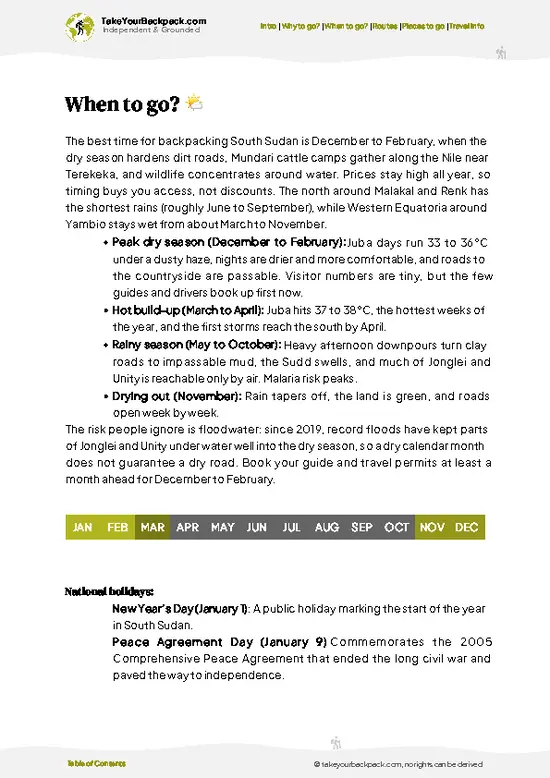
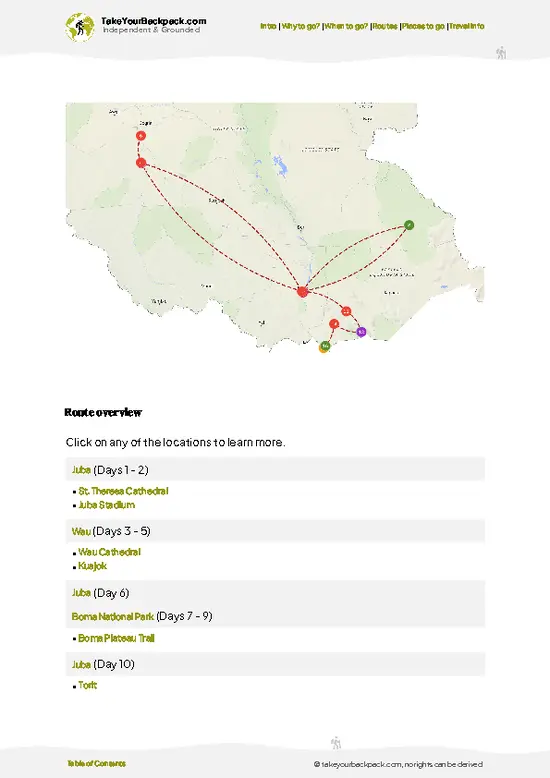
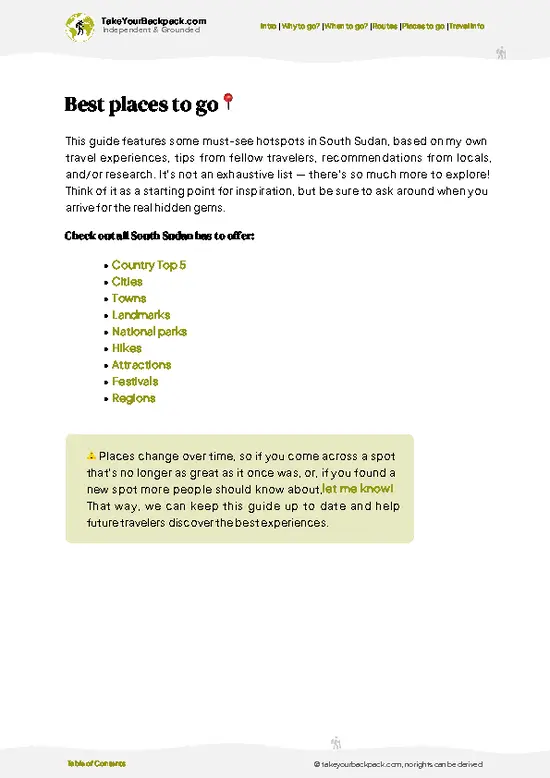
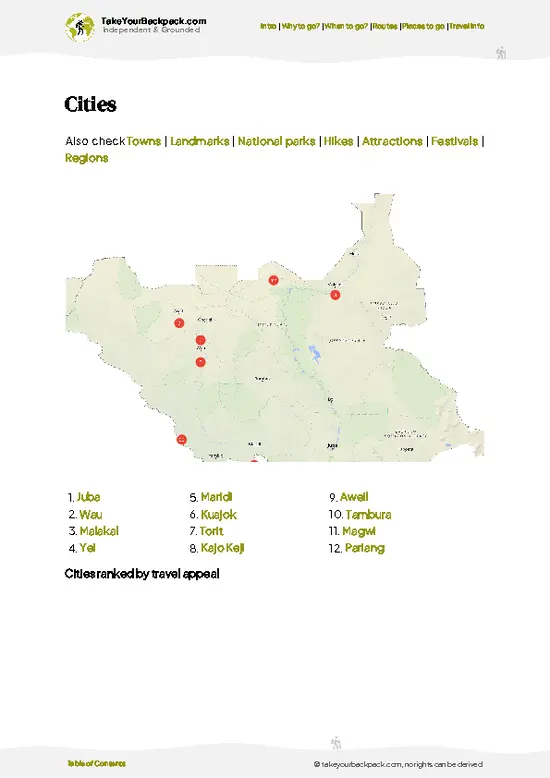
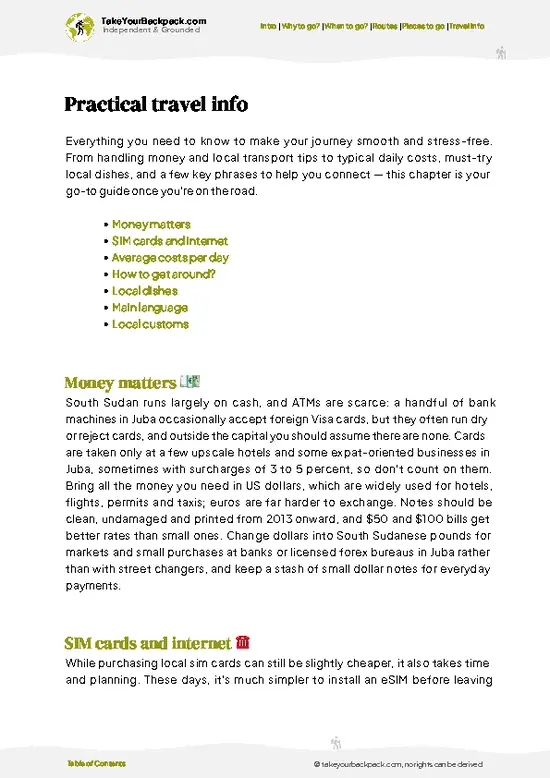
example page 0 from our offline Travel Guide for South Sudanexample page 1 from our offline Travel Guide for South Sudanexample page 2 from our offline Travel Guide for South Sudanexample page 3 from our offline Travel Guide for South Sudanexample page 4 from our offline Travel Guide for South Sudanexample page 5 from our offline Travel Guide for South Sudan
The digital guide (234 pages) contains:
69 highlights, ranked by travel appeal
Optimized 5, 10 & 15-day travel routes
Best neighborhoods to stay
How to get around
Offline-friendly for travel without Wi-Fi
👉 See all 30+ guide features

📅 Plan smarter in minutes, not weeks
Month by month travel advice
Festivals & national holidays
Budget expectations

🗺️ Go to the right places, skip the overrated ones
Honest pros & cons of destinations
Top hikes, parks & viewpoints
Lesser-known places most travelers miss
Clear “worth it vs skip it” guidance

🛏️ Travel smoothly without rookie mistakes
Best areas to stay
Transport systems explained simply
Common scams & safety advice
SIM cards, money & practical tips

🌍 Understand the country, not just visit it
Culture & traditions
52 Essential phrases & customs
Festivals worth planning around
Traveler-friendly historical context
Insights that make places more meaningful

📱 Built for real travel conditions
Fully downloadable PDF
Works completely offline
Optimized for phone use
Useful in remote areas & buses
Everything in one place
Save weeks of stressful planning
Get instant access to the full guide directly. 30-day money-back guarantee.


Sent to your inbox immediately after payment • 100% Secure Checkout
Best Backpacking Travel Advisor 2025 tourism awardBest Backpacking
Travel Advisor
2025
What others say about Take Your Backpack Guides:
⭐⭐⭐⭐⭐
Fantastic, amazing amount of information!
⭐⭐⭐⭐⭐
My goodness this is amazing, it's what I've been looking for hats off too you!
⭐⭐⭐⭐⭐
I think this is absolutely BRILLIANT
⭐⭐⭐⭐
Very complete and informative. It's still missing places, but I gotta to commend you
⭐⭐⭐⭐⭐
This is truly amazing, thank you, can't wait to explore it with my kids!
⭐⭐⭐⭐⭐
Awesome resource, thank you!
⭐⭐⭐⭐⭐
This is amazing! Can't wait to explore the ones I haven't seen
⭐⭐⭐⭐
I love this! Well done, great idea.
⭐⭐⭐⭐⭐
Thanks for taking the time to make this gem!
⭐⭐⭐⭐⭐
This might be the best website I've ever seen.
⭐⭐⭐⭐⭐
Congratulations, and thank you so much for your work; it's incredibly valuable.
⭐⭐⭐⭐
In all seriousness I think you did a great job pointing out the important spots
⭐⭐⭐⭐⭐
10/10 very good
⭐⭐⭐⭐⭐
As someone who's only just starting to visit regularly this is awesome, thank you.
⭐⭐⭐⭐
Thank you very much! I'm going to visit my dad, it's going to be very useful!
⭐⭐⭐⭐⭐
This is really cool! We'll be travelling for the first time and this definitely come in handy.
⭐⭐⭐⭐⭐
You are now our minister of culture, congratulations 👨‍💼
⭐⭐⭐⭐⭐
Just wanted to tell you that this is a pearl! Going to follow your recommendations.
⭐⭐⭐⭐⭐
This is so cool. I'll definitely be using the resource for my travels soon.
⭐⭐⭐⭐⭐
This is very impressive! Good work.
⭐⭐⭐⭐⭐
This is an amazing and informative site. Very well done!

🧭 RouteChoose Your Itinerary

Travel South Sudan your way — from a quick highlights trip to a slow-paced adventure.

🙋 FAQFrequently Asked Questions

Short answer: no, South Sudan is not an easy independent backpacking destination, even for experienced travelers. It’s possible, but it feels more like an expedition than a casual trip. The main challenges are security, bureaucracy, and infrastructure. Security can shift quickly between regions, so you need up‑to‑date local intel from NGOs, guesthouses, or trusted fixers, not just a guidebook. Bureaucracy is heavy: visas, permits, and registration rules change often, and photography can be sensitive, especially around bridges, government buildings, and checkpoints. Infrastructure is thin: outside Juba, expect rough roads, limited public transport, patchy phone signal, and very basic medical facilities.
If you’re on a budget, the biggest shock is that South Sudan is expensive for what you get. Juba accommodation, food, and transport are priced for NGO and oil workers, not backpackers. You save money by staying longer in fewer places, using local guesthouses instead of expat hotels, and sharing costs with other travelers or volunteers when possible.
Independent backpacking here usually means: arranging a fixer or local guide for at least some legs; being flexible with routes and dates; and accepting that you’ll spend more time waiting for transport, permits, or safe windows to move. If you’re new to Africa or to unstable regions, South Sudan is not the place to start. If you already have experience in places like eastern DRC, CAR, or remote Sahel regions, you’ll recognize the rhythm: slow, relationship‑based, and very dependent on local advice.
For a first‑time, budget‑conscious backpacker, 7–10 days is the realistic minimum that feels worth the visa cost and effort. Less than a week and you’ll barely see more than Juba and maybe one side trip.
A tight but solid 7–10 day plan could look like:
- 2–3 days in Juba: sort permits, adjust to the pace, walk the markets, visit the Nile, and line up contacts for the rest of the trip.
- 3–4 days in one region outside Juba (for example, Torit or Yei if security allows): stay in a local guesthouse, walk or moto around nearby villages, and get a feel for daily life.
- 1–2 buffer days: for transport delays, weather, or security‑related changes.
If you have 2 weeks, you can add a second region or a more ambitious overland leg, but only if current conditions are stable. With 3+ weeks, you can slow down, build relationships, and maybe reach more remote communities or wildlife areas with a guide, but that usually stops being “budget” and becomes “slow, expensive expedition travel.”
Because transport is slow and plans change often, it’s smarter to pick one or two areas and go deeper rather than trying to “see the whole country.” Your time buffer is not optional; it’s your safety net when roads wash out, vehicles break, or checkpoints hold you up for hours.
You can move around South Sudan without your own car, but it’s not like hopping minibuses in East Africa’s backpacker circuits. Think: a patchwork of shared cars, motorbikes, NGO lifts, and occasional domestic flights, all running on their own logic and schedules.
Within Juba, you can get around by boda (motorbike taxi) or shared cars if you’re comfortable negotiating and riding with a helmet (bring your own if you’re picky about safety). Walking is possible in some central areas during daylight, but you need to stay alert and follow local advice on where not to go.
Between towns, options are:
- Shared cars and pickups: cheap by local standards but slow, crowded, and not always safe. They leave when full, not on a timetable.
- Motorbike taxis for longer distances: useful for short hops between nearby towns or villages, but tiring and risky on bad roads.
- Domestic flights: expensive but sometimes the only practical way to reach certain regions, especially in rainy season or when roads are unsafe.
- Hitched rides with NGOs or church groups: occasionally possible if you have contacts, but never rely on this as your main plan.
If you’re on a tight budget and don’t want to hire a private 4x4, you can still travel, but you must be flexible, ready for long waits, and willing to turn back if security or road conditions deteriorate. In some areas, local authorities or your guesthouse may strongly recommend moving only with a trusted driver or guide; that’s one of those times where saving money is not worth the risk.
For backpackers, the “must‑visits” in South Sudan are less about specific sights and more about experiences that show you how the country actually lives. A realistic, high‑value hit list:
1. Juba (as a base, not a destination):
You’ll pass through anyway, so use it well. Walk the markets, eat at simple local restaurants, and spend time along the Nile in the late afternoon. It’s where you sort permits, meet fixers, and feel the mix of NGO world and local hustle.
2. Rural town + surrounding villages (for example, Torit or Yei, if safe):
This is where South Sudan opens up. Stay in a basic guesthouse, use motorbikes or your feet to explore nearby villages, and accept invitations for tea or local food when they come. The value here is human: conversations, church music, kids playing football on dusty pitches, and the slow rhythm of evenings without much electricity.
3. Cultural encounters with local communities:
If you can arrange it ethically and safely, spending time with communities such as Dinka, Nuer, or others in their home areas can be powerful. This usually requires a trusted local intermediary, clear expectations, and sensitivity around photography and payment. Done right, it’s one of the most meaningful reasons to come.
4. The Nile around Juba:
Not a classic “sight,” but the river is the spine of the country. Sitting by the water at sunset, watching boats and daily life, gives you a sense of scale and history that no museum can.
5. A church service or community gathering:
If you’re comfortable, attending a Sunday service or local event is a window into music, language, and resilience. It costs nothing, but you walk away with a much deeper sense of place than from any monument.
For a budget traveler, these experiences give you the most insight per dollar: they’re people‑focused, low on formal fees, and high on context.
If you’re short on time or money, skip anything that requires heavy logistics, expensive permits, or long, risky overland detours just to tick a box. In South Sudan, that usually means:
1. Deep‑remote wildlife trips without a clear, trusted operator:
National parks and remote reserves sound incredible on paper, but many are hard to access, under‑resourced, and require serious 4x4 logistics and security planning. For most backpackers, the cost and risk outweigh the actual wildlife experience you’ll get.
2. Trying to “cover the whole country”:
Rushing to hit multiple far‑flung regions in 7–10 days is a recipe for frustration and safety compromises. Pick one or two areas and skip the rest for another trip.
3. High‑end expat bars and restaurants in Juba:
They’re fine if you need a break, but they burn through your budget fast and don’t add much cultural depth. One visit is enough; after that, eat where local staff and teachers eat.
4. Photography missions around official sites or checkpoints:
If your time is limited, don’t waste it negotiating with authorities or risking your gear for shots of bridges, government buildings, or military areas. Focus on markets, daily life, and landscapes where photography is clearly allowed.
5. Overcomplicated border crossings just for bragging rights:
If you’re only in the region briefly, skip risky or bureaucratic land borders that add stress without adding real experience. Fly in and out of Juba or use the simplest, safest route available.
In South Sudan, the best use of limited time is depth over distance: more conversations, fewer checkpoints; more evenings in one community, fewer days bouncing between towns just to say you’ve been there.

🇸🇸 South SudanExplore South Sudan

Ready to build a truly unique trip? Predefined routes are perfect for first-time visitors, but there is so much more to discover. Whether you are chasing a city trip, pristine national parks, local food scenes, or quiet beaches, pick a category to design your own path.