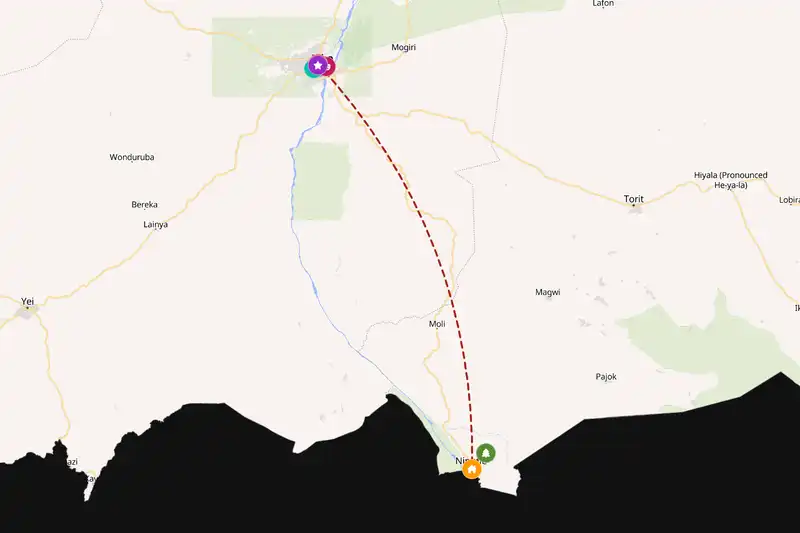
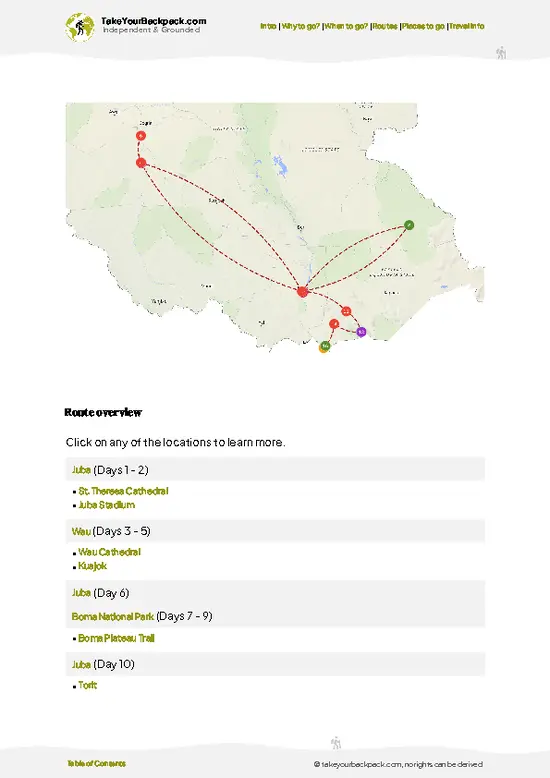
This fifteen-day route is for travelers who want the widest possible view of South Sudan in one trip: the capital, the red-brick mission city of Wau in the northwest, the wildlife plains of Boma near the Ethiopian border, the cloud forest of the Imatong range and the Nile crossing at Nimule. The pace is moderate, with rest days placed after every long transfer. You need a scheduled domestic flight for Wau, a chartered light aircraft for Boma, and a hired 4x4 with driver for the southern road loop. Arrange the photography permit and the travel permits for leaving Juba in your first two days, because nothing past the city limits runs smoothly without them.
Days 1-2: Juba
Give
Juba two slow days to recover from the flight and get the paperwork sorted. Your sightseeing this time runs through the older Catholic side of town:
St. Theresa Cathedral in Kator is the seat of the Archdiocese of Juba, and a Sunday morning Mass there, with choirs singing in Bari and Arabic, tells you more about how the …
read more 👉This fifteen-day route is for travelers who want the widest possible view of South Sudan in one trip: the capital, the red-brick mission city of Wau in the northwest, the wildlife plains of Boma near the Ethiopian border, the cloud forest of the Imatong range and the Nile crossing at Nimule. The pace is moderate, with rest days placed after every long transfer. You need a scheduled domestic flight for Wau, a chartered light aircraft for Boma, and a hired 4x4 with driver for the southern road loop. Arrange the photography permit and the travel permits for leaving Juba in your first two days, because nothing past the city limits runs smoothly without them.
Days 1-2: Juba
Give Juba two slow days to recover from the flight and get the paperwork sorted. Your sightseeing this time runs through the older Catholic side of town: St. Theresa Cathedral in Kator is the seat of the Archdiocese of Juba, and a Sunday morning Mass there, with choirs singing in Bari and Arabic, tells you more about how the city holds together than any monument. On a match day, a local league game at Juba Stadium is the cheapest night out in the capital and a loud, friendly crowd to sit among.Days 3-5: Wau
Fly northwest to Wau, a flight of roughly an hour and a half, and the country suddenly looks different: flatter, greener in the rains, and built around the slow brown Jur River. The Wau Cathedral, a large red-brick Catholic church, anchors the town center, and the Wau Cultural Centre hosts dance and music groups from the surrounding Dinka, Luo and Fertit communities. Use the middle day for a road trip to Kuajok, the capital of Warrap State, roughly 1.5 to 2 hours north, where cattle herds and Catholic mission history sit side by side. Three nights here means you see Wau at its own unhurried rhythm instead of rushing back to the airstrip.Day 6: Juba
Fly back to Juba and keep the afternoon empty. A riverside dinner along the Nile and an early night set you up for the charter flight in the morning.Days 7-9: Boma National Park
The charter to Boma National Park is the most expensive single piece of this trip and the one most travelers talk about afterward. The park protects one of the largest land mammal migrations in Africa, with white-eared kob, tiang and Mongalla gazelle moving across the plains in huge numbers, best timed for the dry season. Spend one of the three days on the Boma Plateau Trail, climbing above the grasslands toward the Ethiopian border with a ranger and a local Murle guide. Splitting the charter with a small group brings the cost down considerably.Day 10: Juba
Return to Juba by charter. Restock water, cash and fuel for the southern loop, and confirm your driver for the dawn start.Days 11-12: Imatong Mountains
Drive east to Torit, about 3 to 4 hours on a largely paved road, and continue south into the Imatong Mountains around Katire, where the air turns cool and the forest closes in. Day 12 is for hiking: the trails give views up to Mount Kinyeti, at 3,187 meters the highest point in the country, and the walking is a welcome contrast to the heat of the plains. Sleeping two nights here keeps the long drive in from colliding with the long drive out.Days 13-14: Nimule
Head southwest through Magwi, a quiet farming town on the back road toward the Ugandan border, to reach Nimule. Day 14 belongs to Nimule National Park, where the White Nile squeezes through the Fula Rapids and you can look for elephants, hippos and Uganda kob along the riverbanks with a ranger. On Day 15, drive the paved highway north to Juba, about 3 to 4 hours, in time for an afternoon flight out.
If your schedule can stretch, the swamp junction at Lake No, where the Bahr el Ghazal River pours into the White Nile, sees almost no outside visitors and is one of the strangest landscapes in the country.v2.webp)
 Best Backpacking