×

Sudan🇸🇩 | best townsYour Guide to the 6 Best towns in Sudan

Towns in Sudan are river settlements, desert trading posts and Red Sea ports, and the differences between them decide your trip. The Nile corridor in the north is dry, quiet and low-cost, with mud-brick lanes, date groves and few other foreigners. The Red Sea coast is hotter, more humid and pricier, with an Afro-Arab port culture. Kassala and the east mix Beja and Rashaida markets at the Eritrean border. Darfur, Kordofan and Khartoum are not worth planning around while the conflict that began in 2023 continues. For independent travel, pick one region, expect permits, thin transport and basic guesthouses, and skip anywhere that needs a convoy.

By Johan Kruseman 🇳🇱 | Updated October 19, 2026
Explore the best landmarks in Sudan

Why go?Why Travelers Love These Spots

Sudan suits towns because life here follows water. For most of its length the Nile is a thin green ribbon through desert, so settlements cluster on its banks and along a few old trade routes. That gives compact, walkable towns with big markets, tea sellers under tarps, and hospitality that is real rather than staged. Foreign visitors have always been few, so nothing is packaged for you.

The limits are just as clear. Infrastructure is thin: long road stretches, irregular buses, frequent power cuts, and cash-based economies where foreign cards do not work. Few towns offer more than a day or two of sights, so a long stay in any single one is wasted time. Inflation is severe, which makes prices shift month to month.

Before choosing Sudan, understand the security situation. The war between the … read more 👉
Sudan suits towns because life here follows water. For most of its length the Nile is a thin green ribbon through desert, so settlements cluster on its banks and along a few old trade routes. That gives compact, walkable towns with big markets, tea sellers under tarps, and hospitality that is real rather than staged. Foreign visitors have always been few, so nothing is packaged for you.

The limits are just as clear. Infrastructure is thin: long road stretches, irregular buses, frequent power cuts, and cash-based economies where foreign cards do not work. Few towns offer more than a day or two of sights, so a long stay in any single one is wasted time. Inflation is severe, which makes prices shift month to month.

Before choosing Sudan, understand the security situation. The war between the army and the Rapid Support Forces since 2023 has made large parts of the country unsafe, and many governments advise against all travel. Conditions differ sharply between the northern and eastern regions and the west and center, and they can change fast. Visas, travel permits and photo permits are required, and rules vary by state. Sudan is a country for experienced, flexible travelers who can accept limited comfort and uncertain access, not for those wanting a smooth, predictable town-hopping trip.
Why These Made the Cut
The list of best towns in Sudan is created based on charm, local culture, atmosphere, hidden gems, and visitor appeal. If you feel a town is missing in this list, please let us know.

When to go?Timing Your Visit for the Best Experience

Best months: The best months for towns in Sudan are November to February, when daytime highs in the north sit around 24 to 32°C and nights drop to 8 to 16°C, so walking markets and sleeping without struggling against heat is realistic. Outside this window the north is miserable by midday.

Shoulder seasons: March, April and October work but run hotter, with highs of 35 to 40°C. Plan outdoor wandering for early morning and after 4 pm. The Red Sea coast is best from November to March, when highs stay around 28 to 32°C. Rain there is light and falls mostly October to January, usually under 100 mm a year in total, but humidity stays heavy.

Seasons to skip: May to September is not worth the time in the north. Highs of 42 to 47°C are normal, and haboob dust storms can shut down visibility for hours. … read more 👉
Best months: The best months for towns in Sudan are November to February, when daytime highs in the north sit around 24 to 32°C and nights drop to 8 to 16°C, so walking markets and sleeping without struggling against heat is realistic. Outside this window the north is miserable by midday.

Shoulder seasons: March, April and October work but run hotter, with highs of 35 to 40°C. Plan outdoor wandering for early morning and after 4 pm. The Red Sea coast is best from November to March, when highs stay around 28 to 32°C. Rain there is light and falls mostly October to January, usually under 100 mm a year in total, but humidity stays heavy.

Seasons to skip: May to September is not worth the time in the north. Highs of 42 to 47°C are normal, and haboob dust storms can shut down visibility for hours. The coast is similar, with sticky heat of 38 to 45°C. In central and southern regions the rainy season runs roughly June to October, with 400 to 800 mm in places, turning dirt roads to mud and cutting off many routes.

Crowds and prices: Sudan has no real tourist peak, so crowds do not matter. Cooler months bring slightly more foreigners and occasionally higher guesthouse rates, but the difference is small compared with inflation-driven changes. Many businesses close around midday in summer, and Ramadan shifts opening hours and makes daytime eating difficult.

town hoppingPlanning Your Route Efficiently

Trip length: A trip linking several towns in Sudan needs 10 to 14 days, because distances are large and public transport leaves on its own schedule. Fewer than 8 days turns the trip into a series of bus rides.

Which regions group together: Choose one cluster. The northern Nile corridor works well as a single chain, with Dongola and Karima as natural bases. The east links the Red Sea port of Port Sudan with Kassala. Combining the north and east is rarely sensible, since linking them means long desert crossings via Atbara or Khartoum, which adds a full day or more each way. Travel north to south along the Nile, or coast to inland, so the longest overland leg comes first while energy is high.

Time per stop: Allow 1 to 2 nights per town. Most places need a day for the market and permits, and … read more 👉
Trip length: A trip linking several towns in Sudan needs 10 to 14 days, because distances are large and public transport leaves on its own schedule. Fewer than 8 days turns the trip into a series of bus rides.

Which regions group together: Choose one cluster. The northern Nile corridor works well as a single chain, with Dongola and Karima as natural bases. The east links the Red Sea port of Port Sudan with Kassala. Combining the north and east is rarely sensible, since linking them means long desert crossings via Atbara or Khartoum, which adds a full day or more each way. Travel north to south along the Nile, or coast to inland, so the longest overland leg comes first while energy is high.

Time per stop: Allow 1 to 2 nights per town. Most places need a day for the market and permits, and a second only if there is an excursion. Travel between regional hubs takes 4 to 6 hours on the Nile road and 8 to 12 hours on the long runs, such as Port Sudan to Kassala. Buses and shared minibuses often leave only when full, usually early morning.

Planning mistakes: The first is cramming in too many stops, which wastes days on buses. Cut stops, not rest days. The second is arriving without travel and photo permits, which stalls everything at checkpoints, so register early. The third is assuming afternoon departures. Plan to leave before 8 am. The fourth is relying on cards or ATMs. Carry enough cash for each leg.

The ListThe Best towns of Sudan

1 Karima

Jebel Barkal, ancient temples, desert oasis

Climb a sacred mountain and explore nearby ruins, with the desert and river meeting at a site of historical significance.

2 Wadi Halfa

Lake Nubia port, Egyptian border, ferry terminal

Arrive at Sudan’s northern gateway, where lake crossings and border formalities mark the transition between two countries and landscapes.

3 Tokar

Red Sea foothills, cotton fields, Eritrean border

Visit a lowland agricultural center near the border, where cotton farming and cross-cultural influences shape the town’s daily rhythm.

4 Abu Jubaiha

Kordofan woodlands, seasonal streams, rural markets

Explore a small town surrounded by acacia forests, where local markets and changing seasons offer insight into rural Kordofan life.

5 Zalingei

Jebel Marra foothills, local crafts, regional center

Find a base for exploring volcanic highlands, with a modest town atmosphere and access to unique handmade goods from the surrounding area.

6 Talodi

Nuba Mountains, mining legacy, remote villages

Reach a mountain town with a mining past, offering access to rugged terrain and a glimpse of Nuba cultural diversity.

Loading the map 🌍

Expert viewTips and Advice from Travelers

How many towns: Visit two to four towns on one trip, all within a single region. Each needs a day or two, but every move costs a half to full day of travel, and permits and checkpoints add friction. More than four means time on buses with little to show for it. The war also makes a narrow plan safer, since fewer legs mean fewer exposure points.

Choosing the kind of town: River towns on the Nile suit slow, culture-focused travelers who want old markets, quiet lanes and long conversations over tea. They are the cheapest and the easiest on logistics. Red Sea ports suit people who want a different texture, with Beja traders, dock life and warmer evenings, but costs run higher and humidity wears you down. Border-region market towns suit travelers who enjoy people-watching and tolerate rough accommodation. … read more 👉
How many towns: Visit two to four towns on one trip, all within a single region. Each needs a day or two, but every move costs a half to full day of travel, and permits and checkpoints add friction. More than four means time on buses with little to show for it. The war also makes a narrow plan safer, since fewer legs mean fewer exposure points.

Choosing the kind of town: River towns on the Nile suit slow, culture-focused travelers who want old markets, quiet lanes and long conversations over tea. They are the cheapest and the easiest on logistics. Red Sea ports suit people who want a different texture, with Beja traders, dock life and warmer evenings, but costs run higher and humidity wears you down. Border-region market towns suit travelers who enjoy people-watching and tolerate rough accommodation. Skip any town that needs a military escort or sits near active fighting. A single extra sight is never worth it.

Budget: Plan on roughly US$25 to 45 a day, paid in Sudanese pounds at the market rate. That covers a basic guesthouse room at US$8 to 20, meals at US$3 to 8, and local transport. Intercity buses and shared vehicles typically cost US$5 to 20 per leg depending on distance. Private cars with a driver are US$80 to 150 a day. Guides for archaeological and desert excursions run US$20 to 50 a day. Budget a further US$10 to 25 per town for entry fees and permits. Bring cash in clean, recent US dollar notes, because cards do not work and exchange rates shift quickly. Changing small amounts at a time avoids losing value.

Costs and delays that catch travelers out: Permit delays are the biggest time sink. Register on arrival and keep several photocopies of your passport and visa, as checkpoints ask for them repeatedly. Photography without a permit can lead to confiscated gear or detention, and photographing bridges, military sites, airports and officials is a firm no. Fuel shortages disrupt transport, so add a spare day to any plan with a fixed flight home. Power and mobile networks drop out, so download offline maps and carry a power bank.

Safety and culture: Check your government’s current advice and local conditions before each leg, because security can change within days. Avoid Khartoum, Darfur and Kordofan entirely. Sudan is conservative: dress modestly, with shoulders and knees covered, and women should carry a headscarf. Alcohol is banned and not worth seeking. Ask before photographing people, and accept tea when it is offered. Refusing repeatedly is rude.

✈️ The backpacker research shortcutSudan Travel Guide

An offline-friendly backpacking guide with optimized travel routes, ranked highlights, transport advice, and the best areas to stay.
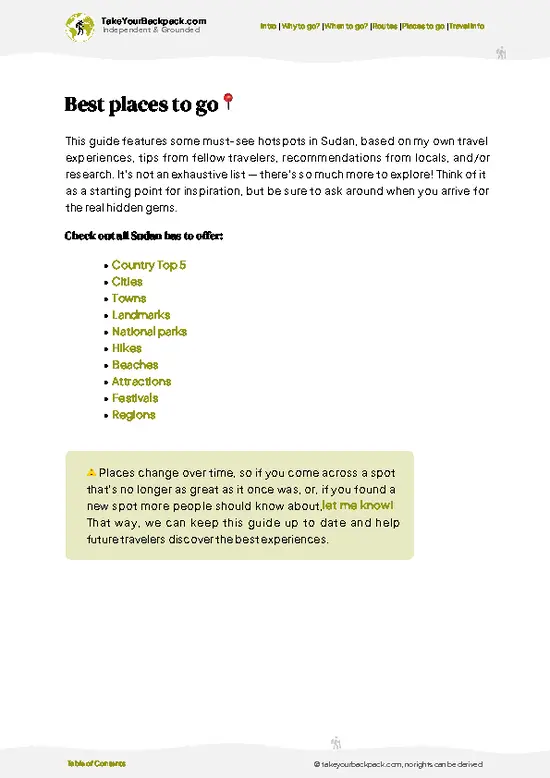
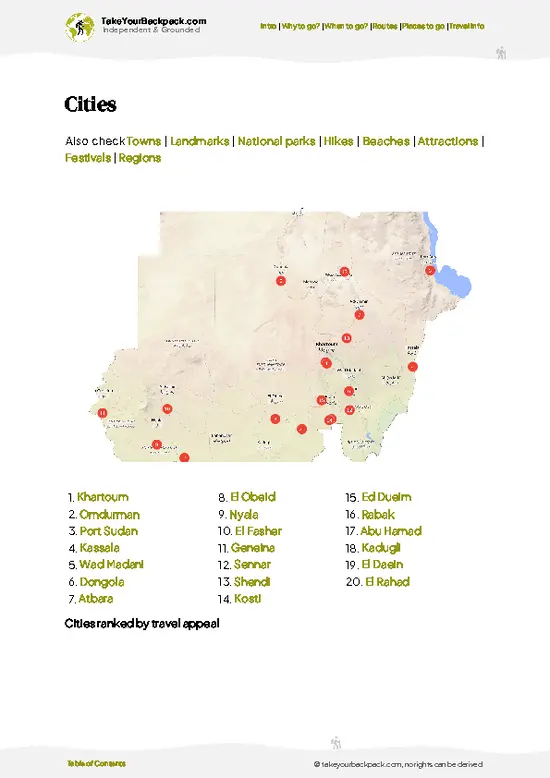
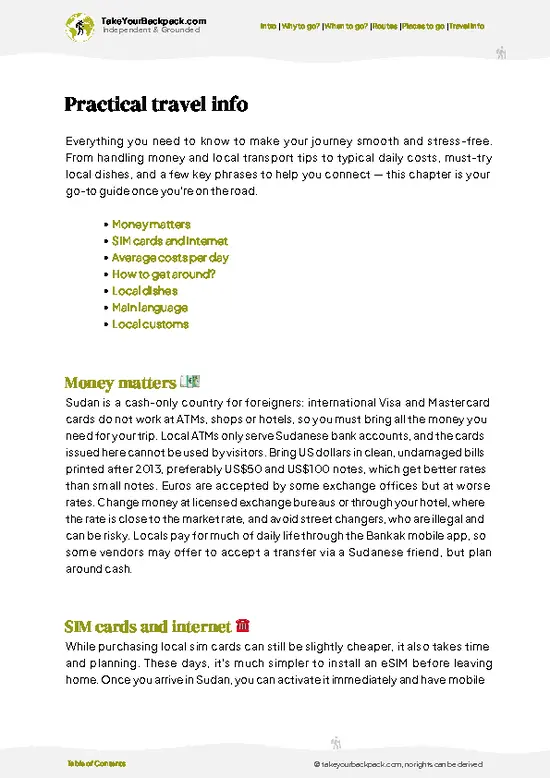
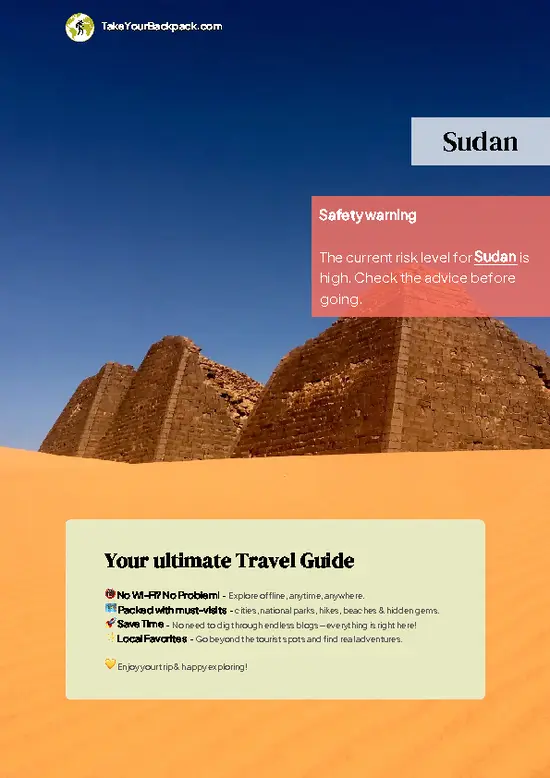
example page 0 from our offline Travel Guide for Sudan
example page 1 from our offline Travel Guide for Sudan
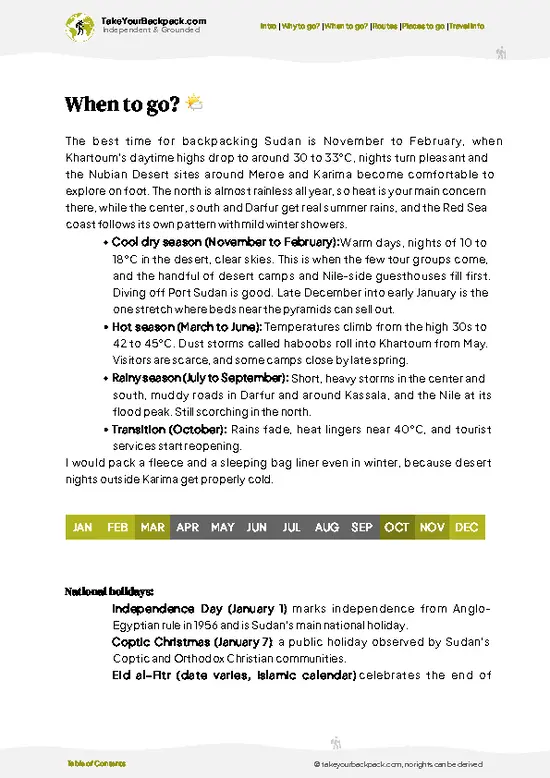
example page 2 from our offline Travel Guide for Sudan
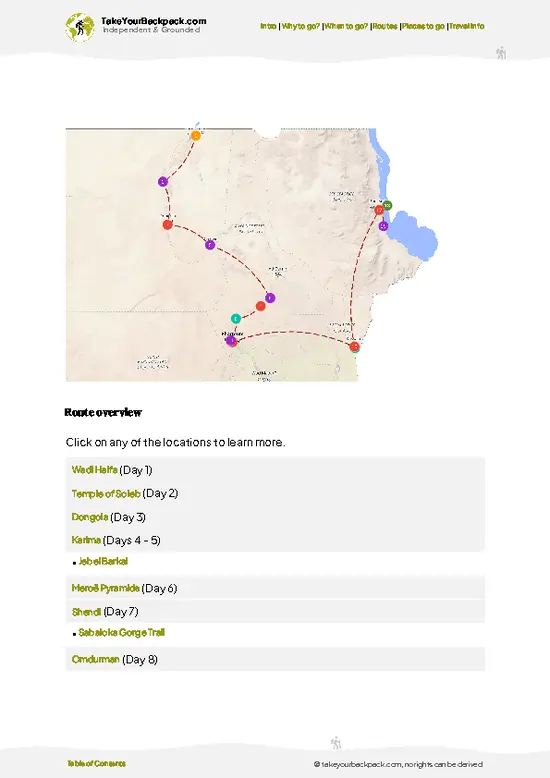
example page 3 from our offline Travel Guide for Sudan
example page 4 from our offline Travel Guide for Sudan
example page 5 from our offline Travel Guide for Sudan
example page 6 from our offline Travel Guide for Sudan
example page 7 from our offline Travel Guide for Sudan
The digital guide (268 pages) contains:
✅ 62 highlights, ranked by travel appeal
✅ Optimized 5, 10 & 15-day travel routes
✅ Cities, national parks, landmarks, beaches
✅ How to get around
✅ Offline-friendly for travel without Wi-Fi
👉 Click to see all 30+ guide features

📅 Plan smarter in minutes, not weeks
✅ Month by month travel advice
✅ Festivals & national holidays
✅ Budget expectations

🗺️ Go to the right places, skip the overrated ones
✅ Honest pros & cons of destinations
✅ Top hikes, parks & viewpoints
✅ Lesser-known places most travelers miss
✅ Clear “worth it vs skip it” guidance

🛏️ Travel smoothly without rookie mistakes
✅ Best areas to stay
✅ Transport systems explained simply
✅ Common scams & safety advice
✅ SIM cards, money & practical tips

🌍 Understand the country, not just visit it
✅ Culture & traditions
✅ 52 Essential phrases & customs
✅ Festivals worth planning around
✅ Traveler-friendly historical context
✅ Insights that make places more meaningful

📱 Built for real travel conditions
✅ Fully downloadable PDF
✅ Works completely offline
✅ Optimized for phone use
✅ Useful in remote areas & buses
✅ Everything in one place
Stop searching, start planning
Get instant access to your full guide. 30‑day money-back guarantee.
+ Add another guide for just

By proceeding you agree to our terms.
Sent to your inbox immediately after payment • 100% Secure Checkout
Best Backpacking Travel Advisor 2025 tourism awardBest Backpacking
Travel Advisor
2025
What others say about Take Your Backpack Guides:
⭐⭐⭐⭐⭐
Fantastic, amazing amount of information!
⭐⭐⭐⭐⭐
My goodness this is amazing, it's what I've been looking for hats off too you!
⭐⭐⭐⭐⭐
I think this is absolutely BRILLIANT
⭐⭐⭐⭐
Very complete and informative. It's still missing places, but I gotta to commend you
⭐⭐⭐⭐⭐
This is truly amazing, thank you, can't wait to explore it with my kids!
⭐⭐⭐⭐⭐
Awesome resource, thank you!
⭐⭐⭐⭐⭐
This is amazing! Can't wait to explore the ones I haven't seen
⭐⭐⭐⭐
I love this! Well done, great idea.
⭐⭐⭐⭐⭐
Thanks for taking the time to make this gem!
⭐⭐⭐⭐⭐
This might be the best website I've ever seen.
⭐⭐⭐⭐⭐
Congratulations, and thank you so much for your work; it's incredibly valuable.
⭐⭐⭐⭐
In all seriousness I think you did a great job pointing out the important spots
⭐⭐⭐⭐⭐
10/10 very good
⭐⭐⭐⭐⭐
As someone who's only just starting to visit regularly this is awesome, thank you.
⭐⭐⭐⭐
Thank you very much! I'm going to visit my dad, it's going to be very useful!
⭐⭐⭐⭐⭐
This is really cool! We'll be travelling for the first time and this definitely come in handy.
⭐⭐⭐⭐⭐
You are now our minister of culture, congratulations 👨‍💼
⭐⭐⭐⭐⭐
Just wanted to tell you that this is a pearl! Going to follow your recommendations.
⭐⭐⭐⭐⭐
This is so cool. I'll definitely be using the resource for my travels soon.
⭐⭐⭐⭐⭐
This is very impressive! Good work.
⭐⭐⭐⭐⭐
This is an amazing and informative site. Very well done!

🛏️ Where to stay?Best Stay Options in Sudan

There are no real backpacker hostels in Sudan, so budget travel here runs on simple hotels and lokandas (basic guesthouses with shared rooms and shared bathrooms), usually around US$10 to 30 a night, paid in Sudanese pounds. Port Sudan has the widest choice, with most cheap rooms around the central market and harbor area, close to bus offices and the Red Sea waterfront, though high demand keeps prices up and good rooms fill fast. In Khartoum, the area around Souq Al Arabi downtown has the cheapest beds near the minibus hubs but is noisy and dusty, while Amarat costs more and is quieter, sits closer to the airport and has better-kept streets; neither has any nightlife, since alcohol is banned … read more 👉
There are no real backpacker hostels in Sudan, so budget travel here runs on simple hotels and lokandas (basic guesthouses with shared rooms and shared bathrooms), usually around US$10 to 30 a night, paid in Sudanese pounds. Port Sudan has the widest choice, with most cheap rooms around the central market and harbor area, close to bus offices and the Red Sea waterfront, though high demand keeps prices up and good rooms fill fast. In Khartoum, the area around Souq Al Arabi downtown has the cheapest beds near the minibus hubs but is noisy and dusty, while Amarat costs more and is quieter, sits closer to the airport and has better-kept streets; neither has any nightlife, since alcohol is banned nationwide.

If you enjoy meeting fellow travelers, consider choosing hostels with high ratings for atmosphere. On the other hand, if you prefer having your own space, a hotel might be a better option.

SudanWhere to Go Next

👋 Meet the founderWho’s Behind Take Your Backpack?

Johan, backpacker and founder of TakeYourBackpackHi, I’m Johan (Netherlands 🇳🇱), the creator of TakeYourBackpack. Over the past 3 decades, I’ve backpacked through 90+ countries across six continents, gaining extensive experience with independent travel, long-term trips, and overland routes.

This site is built on a combination of firsthand travel experience and carefully curated insights from other backpackers. Many guides are based on places I’ve personally visited, while others bring together tips, observations, and practical advice shared by trusted travelers I’ve met along the way.

The goal is to provide realistic, experience-driven guidance — not generic itineraries — so you can explore destinations with better context, clearer expectations, and more confidence.