×

Sudan🇸🇩 | best landmarksYour Guide to the 5 Best landmarks in Sudan

Landmarks in Sudan are mostly ancient Nubian and Kushite sites along the Nile, plus a few Islamic-era and colonial-era places in the Khartoum area. Expect empty sand, no ticket queues and almost no facilities. The northern Nile valley is the real draw: sites sit hours apart on desert roads, entry fees are low, and you will often be the only visitor. The Khartoum region offers city sights, but they are less rewarding and harder to reach in the current security climate. The east and south have little of interest for landmark hunters. Independent travel works here only with patience, permits and a tolerance for rough logistics.

By Johan Kruseman 🇳🇱 | Updated October 19, 2026
Explore the best national parks in Sudan

Why go?Why Travelers Love These Spots

Sudan holds more pyramids than Egypt, built by the Kushite kings who ruled the Nile corridor for roughly a thousand years. That is the country's unique angle: a Nubian civilization with its own architecture, temples and royal burial grounds, found in the open desert and not behind barriers.

The dry climate in the north preserved stone and sandstone remarkably well, but wind and sand have buried or eroded some structures. Many sites have no roofs, no signage and no shade. Do not expect museum-grade interpretation. The National Museum held much of the context, and its condition has been affected by the conflict.

The infrastructure is thin. Distances between sites are long, public transport runs on fill-and-go minibuses, and tourist services barely exist outside a handful of towns. This is … read more 👉
Sudan holds more pyramids than Egypt, built by the Kushite kings who ruled the Nile corridor for roughly a thousand years. That is the country's unique angle: a Nubian civilization with its own architecture, temples and royal burial grounds, found in the open desert and not behind barriers.

The dry climate in the north preserved stone and sandstone remarkably well, but wind and sand have buried or eroded some structures. Many sites have no roofs, no signage and no shade. Do not expect museum-grade interpretation. The National Museum held much of the context, and its condition has been affected by the conflict.

The infrastructure is thin. Distances between sites are long, public transport runs on fill-and-go minibuses, and tourist services barely exist outside a handful of towns. This is what keeps crowds near zero, but it also means self-reliance is required.

Before choosing Sudan, know that the conflict that began in 2023 has closed or disrupted much of the country, and many governments advise against all travel. Check current advisories, entry rules and which regions are accessible before spending anything. Do not come for sites in the war-affected center. Come, when conditions allow, for the northern Nile valley.
How the List Was Created
The list of best unique sites in Sudan is created based on history or culture, wow factor, atmosphere, quirks, and memorability. If you feel a unique site is missing in this list, please let us know.

When to go?Timing Your Visit for the Best Experience

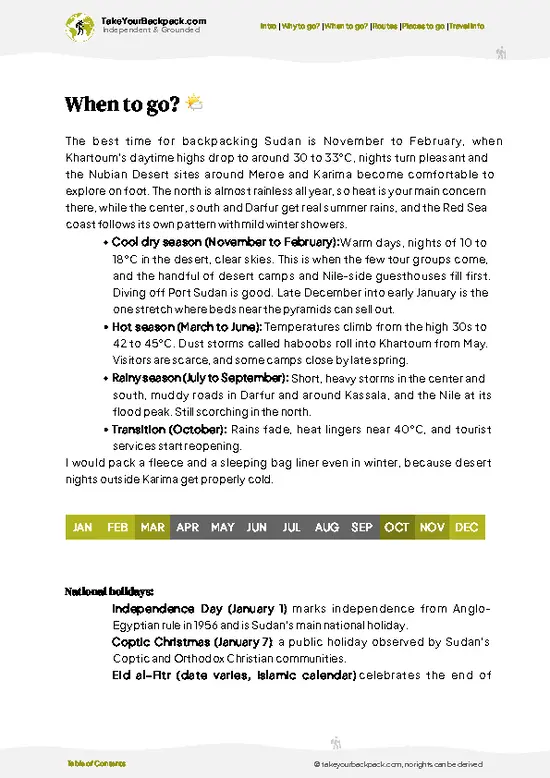
Best months: The best months for landmarks in Sudan are November to February, when northern daytime highs sit around 25 to 33°C and nights drop to 8 to 15°C, so exposed desert sites are walkable all day. Rainfall in the north is close to zero, which means roads and tracks stay open.

Shoulder seasons: March and October are workable but warm, with highs of 35 to 40°C. Visit early in the morning and again late in the afternoon. Skip midday outdoors, since there is almost no shade at most ruins. Dust storms (haboobs) are common from April to June and can cut visibility to a few meters for an hour or more.

Months to skip: From May to September, temperatures along the Nile regularly hit 42 to 47°C. That is not a trip, it is an endurance test, and tours rarely operate. The rainy season runs roughly … read more 👉
Best months: The best months for landmarks in Sudan are November to February, when northern daytime highs sit around 25 to 33°C and nights drop to 8 to 15°C, so exposed desert sites are walkable all day. Rainfall in the north is close to zero, which means roads and tracks stay open.

Shoulder seasons: March and October are workable but warm, with highs of 35 to 40°C. Visit early in the morning and again late in the afternoon. Skip midday outdoors, since there is almost no shade at most ruins. Dust storms (haboobs) are common from April to June and can cut visibility to a few meters for an hour or more.

Months to skip: From May to September, temperatures along the Nile regularly hit 42 to 47°C. That is not a trip, it is an endurance test, and tours rarely operate. The rainy season runs roughly July to September in Khartoum (around 100 to 160 mm a year) and is heavier in the south, where flooded tracks isolate areas for days.

Crowds hardly change between seasons, but prices for drivers and cars rise in winter when a few groups travel, by perhaps 10 to 20 percent. Book transport ahead for December and January.

unique site hoppingPlanning Your Route Efficiently

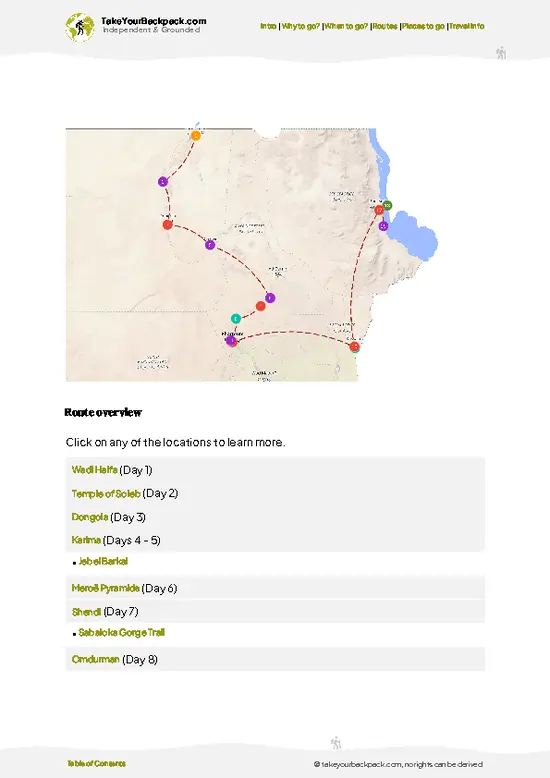
How long to allow: A trip combining several landmarks in Sudan needs 7 to 12 days, and the distances are the reason, not the number of sights. Most sites lie along one corridor, the Nile north of the capital.

Direction and grouping: Travel south to north, then loop back or exit by the same road. Group the sites near the Nile bends together: the area northeast of Khartoum, the Karima district, and the far north around Dongola and Kerma. These clusters are separated by long, hot driving. Khartoum to the Karima area is roughly 5 to 7 hours by road, and onward to Dongola another 5 to 7. Plan one base per cluster.

Time per stop: Allow half a day for a single ruin field and 2 to 3 days for a cluster with several sites. Add one buffer day for permits, police registration and delays.

Planning mistakes: … read more 👉
How long to allow: A trip combining several landmarks in Sudan needs 7 to 12 days, and the distances are the reason, not the number of sights. Most sites lie along one corridor, the Nile north of the capital.

Direction and grouping: Travel south to north, then loop back or exit by the same road. Group the sites near the Nile bends together: the area northeast of Khartoum, the Karima district, and the far north around Dongola and Kerma. These clusters are separated by long, hot driving. Khartoum to the Karima area is roughly 5 to 7 hours by road, and onward to Dongola another 5 to 7. Plan one base per cluster.

Time per stop: Allow half a day for a single ruin field and 2 to 3 days for a cluster with several sites. Add one buffer day for permits, police registration and delays.

Planning mistakes: The first is trying to fit every site in a week. It leaves you in a vehicle for 8 hours a day with little time at the ruins. Pick two clusters and stay longer. The second is ignoring permits. Travel permits and photography permits must be sorted in advance, ideally through a local agent, or you will lose a full day at a checkpoint. The third is relying on public minibuses for remote stops. They run to fill, not to schedule, so hire a private car with a driver for any site off the main road.

The ListThe Best landmarks of Sudan

1 Meroë Pyramids

steep-sided pyramids, Nubian burial grounds, desert isolation, hieroglyphic carvings

Stand alone among dozens of slender pyramids, their sharp outlines rising from the sand, each marking a royal tomb of a lost dynasty.

2 Jebel Barkal

sandstone mountain, pharaonic temples, cliffside views, sacred site

Climb the sacred mountain for sweeping views, then descend to explore temples carved with hieroglyphs and ancient Nubian symbols.

3 Suakin

coral stone ruins, Red Sea port, Ottoman architecture, crumbling facades

Stroll through silent streets lined with coral stone buildings, imagining centuries of trade and migration along the Red Sea coast.

4 Temple of Soleb

sandstone pillars, Nile riverside, pharaoh reliefs, remote setting

Walk beneath towering pillars etched with pharaohs’ images, surrounded by the quiet of the Nile’s edge and distant desert hills.

5 Great Mosque of Omdurman

minaret silhouette, Friday market, prayer courtyard, Sufi gatherings

Experience the pulse of local life as worshippers gather, markets bustle, and Sufi chants echo through the mosque’s open courtyards.

Loading the map 🌍

Expert viewTips and Advice from Travelers

How many landmarks to visit: Plan on 4 to 6 landmarks in total, spread across two clusters. Sudan's sites are far apart, roads are slow, and each stop deserves at least half a day. A seventh or eighth adds a night of driving but rarely adds anything new, as the architectural and funerary styles repeat. Fewer stops also leave margin for the delays that catch most travelers out.

Which kind to prioritize: For first-timers and history buffs, the Kushite pyramid fields and temple complexes are the priority. They are what Sudan is known for and what you cannot see elsewhere. Travelers with an interest in living culture should add Islamic-era sites, such as the Sufi ceremonies and tombs near the capital, if access is open. Skip anything described as a city monument or colonial building unless you … read more 👉
How many landmarks to visit: Plan on 4 to 6 landmarks in total, spread across two clusters. Sudan's sites are far apart, roads are slow, and each stop deserves at least half a day. A seventh or eighth adds a night of driving but rarely adds anything new, as the architectural and funerary styles repeat. Fewer stops also leave margin for the delays that catch most travelers out.

Which kind to prioritize: For first-timers and history buffs, the Kushite pyramid fields and temple complexes are the priority. They are what Sudan is known for and what you cannot see elsewhere. Travelers with an interest in living culture should add Islamic-era sites, such as the Sufi ceremonies and tombs near the capital, if access is open. Skip anything described as a city monument or colonial building unless you are already passing through. They are cheaper and easier to reach but offer little beyond a photograph.

What it costs: Budget US$35 to 60 a day including a private driver. Entry fees at most archaeological sites are low, roughly US$3 to 10 per visit for foreigners. A photography permit adds around US$5 to 10 and is often checked. Guides at the main sites cost about US$10 to 25 a day. A hired car with a driver for a day trip runs about US$60 to 120 depending on distance and fuel. Public minibuses cost US$3 to 10 per leg but run irregularly. Budget accommodation in the north runs US$10 to 25 a night.

Costs and delays that catch people out: The Sudanese pound has lost most of its value, and exchange rates vary widely. Bring clean US dollar bills in small denominations, because cards do not work and ATMs are unreliable. Official and informal rates differ, so agree prices in dollars before you set off and confirm what is included. Foreigners must register with the authorities in each new region, and permits can take a day or more. Skipping this means turned-back checkpoints and wasted fuel money.

Safety and cultural considerations: The ongoing conflict is the main decision factor. Many governments advise against all travel, and insurance may be void in affected areas. Check advisories and local conditions before you commit money, and keep a flexible plan. Photography of military, police, bridges and government buildings is prohibited and can lead to detention, so ask your guide before raising a camera. Carry copies of your permits at all times.

Sudan is a conservative Muslim country. Cover shoulders and knees, and women should carry a light scarf. Ask before photographing people. At desert sites, carry at least 3 liters of water per person, as there is rarely anywhere to buy it near the ruins. Do not climb on pyramids or walls, and do not remove stones or pottery. It is illegal and damages sites that have few protections.

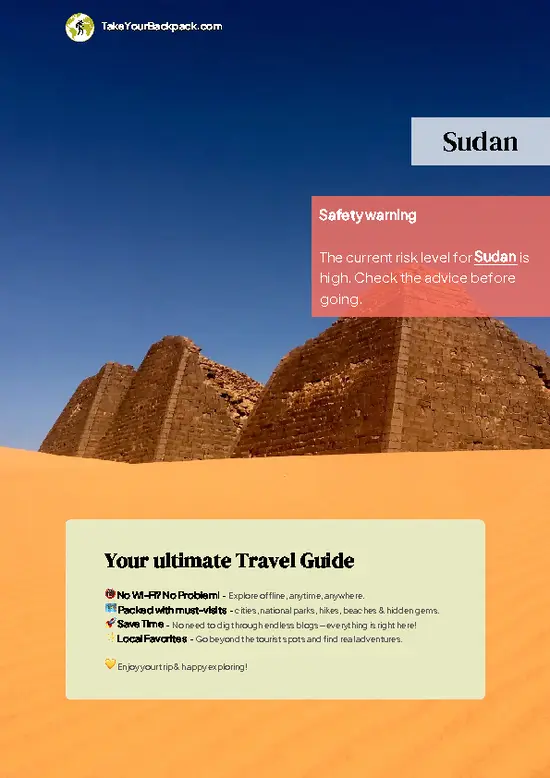
✈️ The backpacker research shortcutSudan Travel Guide

An offline-friendly backpacking guide with optimized travel routes, ranked highlights, transport advice, and the best areas to stay.
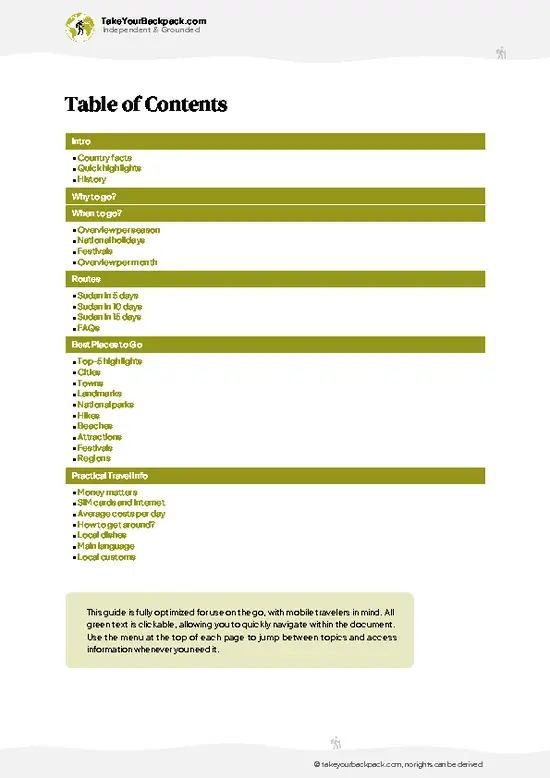
example page 0 from our offline Travel Guide for Sudan
example page 1 from our offline Travel Guide for Sudan
example page 2 from our offline Travel Guide for Sudan
example page 3 from our offline Travel Guide for Sudan
example page 4 from our offline Travel Guide for Sudan
example page 5 from our offline Travel Guide for Sudan
example page 6 from our offline Travel Guide for Sudan
example page 7 from our offline Travel Guide for Sudan
The digital guide (268 pages) contains:
✅ 62 highlights, ranked by travel appeal
✅ Optimized 5, 10 & 15-day travel routes
✅ Cities, national parks, landmarks, beaches
✅ How to get around
✅ Offline-friendly for travel without Wi-Fi
👉 Click to see all 30+ guide features

📅 Plan smarter in minutes, not weeks
✅ Month by month travel advice
✅ Festivals & national holidays
✅ Budget expectations

🗺️ Go to the right places, skip the overrated ones
✅ Honest pros & cons of destinations
✅ Top hikes, parks & viewpoints
✅ Lesser-known places most travelers miss
✅ Clear “worth it vs skip it” guidance

🛏️ Travel smoothly without rookie mistakes
✅ Best areas to stay
✅ Transport systems explained simply
✅ Common scams & safety advice
✅ SIM cards, money & practical tips

🌍 Understand the country, not just visit it
✅ Culture & traditions
✅ 52 Essential phrases & customs
✅ Festivals worth planning around
✅ Traveler-friendly historical context
✅ Insights that make places more meaningful

📱 Built for real travel conditions
✅ Fully downloadable PDF
✅ Works completely offline
✅ Optimized for phone use
✅ Useful in remote areas & buses
✅ Everything in one place
Stop searching, start planning
Get instant access to your full guide. 30‑day money-back guarantee.
+ Add another guide for just

By proceeding you agree to our terms.
Sent to your inbox immediately after payment • 100% Secure Checkout
Best Backpacking Travel Advisor 2025 tourism awardBest Backpacking
Travel Advisor
2025
What others say about Take Your Backpack Guides:
⭐⭐⭐⭐⭐
Fantastic, amazing amount of information!
⭐⭐⭐⭐⭐
My goodness this is amazing, it's what I've been looking for hats off too you!
⭐⭐⭐⭐⭐
I think this is absolutely BRILLIANT
⭐⭐⭐⭐
Very complete and informative. It's still missing places, but I gotta to commend you
⭐⭐⭐⭐⭐
This is truly amazing, thank you, can't wait to explore it with my kids!
⭐⭐⭐⭐⭐
Awesome resource, thank you!
⭐⭐⭐⭐⭐
This is amazing! Can't wait to explore the ones I haven't seen
⭐⭐⭐⭐
I love this! Well done, great idea.
⭐⭐⭐⭐⭐
Thanks for taking the time to make this gem!
⭐⭐⭐⭐⭐
This might be the best website I've ever seen.
⭐⭐⭐⭐⭐
Congratulations, and thank you so much for your work; it's incredibly valuable.
⭐⭐⭐⭐
In all seriousness I think you did a great job pointing out the important spots
⭐⭐⭐⭐⭐
10/10 very good
⭐⭐⭐⭐⭐
As someone who's only just starting to visit regularly this is awesome, thank you.
⭐⭐⭐⭐
Thank you very much! I'm going to visit my dad, it's going to be very useful!
⭐⭐⭐⭐⭐
This is really cool! We'll be travelling for the first time and this definitely come in handy.
⭐⭐⭐⭐⭐
You are now our minister of culture, congratulations 👨‍💼
⭐⭐⭐⭐⭐
Just wanted to tell you that this is a pearl! Going to follow your recommendations.
⭐⭐⭐⭐⭐
This is so cool. I'll definitely be using the resource for my travels soon.
⭐⭐⭐⭐⭐
This is very impressive! Good work.
⭐⭐⭐⭐⭐
This is an amazing and informative site. Very well done!

🛏️ Where to stay?Where to Stay in Sudan

There are no real backpacker hostels in Sudan, so budget travel here runs on simple hotels and lokandas (basic guesthouses with shared rooms and shared bathrooms), usually around US$10 to 30 a night, paid in Sudanese pounds. Port Sudan has the widest choice, with most cheap rooms around the central market and harbor area, close to bus offices and the Red Sea waterfront, though high demand keeps prices up and good rooms fill fast. In Khartoum, the area around Souq Al Arabi downtown has the cheapest beds near the minibus hubs but is noisy and dusty, while Amarat costs more and is quieter, sits closer to the airport and has better-kept streets; neither has any nightlife, since alcohol is banned … read more 👉
There are no real backpacker hostels in Sudan, so budget travel here runs on simple hotels and lokandas (basic guesthouses with shared rooms and shared bathrooms), usually around US$10 to 30 a night, paid in Sudanese pounds. Port Sudan has the widest choice, with most cheap rooms around the central market and harbor area, close to bus offices and the Red Sea waterfront, though high demand keeps prices up and good rooms fill fast. In Khartoum, the area around Souq Al Arabi downtown has the cheapest beds near the minibus hubs but is noisy and dusty, while Amarat costs more and is quieter, sits closer to the airport and has better-kept streets; neither has any nightlife, since alcohol is banned nationwide.

If you enjoy meeting fellow travelers, consider choosing hostels with high ratings for atmosphere. On the other hand, if you prefer having your own space, a hotel might be a better option.

SudanMore of Sudan

👋 Meet the founderWho’s Behind Take Your Backpack?

Johan, backpacker and founder of TakeYourBackpackHi, I’m Johan (Netherlands 🇳🇱), the creator of TakeYourBackpack. Over the past 3 decades, I’ve backpacked through 90+ countries across six continents, gaining extensive experience with independent travel, long-term trips, and overland routes.

This site is built on a combination of firsthand travel experience and carefully curated insights from other backpackers. Many guides are based on places I’ve personally visited, while others bring together tips, observations, and practical advice shared by trusted travelers I’ve met along the way.

The goal is to provide realistic, experience-driven guidance — not generic itineraries — so you can explore destinations with better context, clearer expectations, and more confidence.