Yes. Switzerland is one of the easiest countries in Europe to backpack on your own, because trains reach almost every village on a fixed clock-face timetable and English is widely spoken in tourist areas.
The challenge is cost, not logistics. Hostel dorms run about CHF 40 to 70 (US$45 to 80) a night, from Swiss Youth Hostels to independents like Balmers in
Interlaken. A lean daily budget lands around CHF 100 to 150 (US$120 to 185) if you cook and picnic from Coop and Migros. The SBB app shows live connections and platforms. Yellow hiking signposts list walking times in hours, so you can plan days like a
Lauterbrunnen to
Mürren walk without a guide.
Ten days is enough for a well-rounded first trip to Switzerland, covering the lakes, two Alpine areas and the Lake Geneva shore at a relaxed pace.
With 5 days, stay in one region such as the Jungfrau area and sleep in
Lauterbrunnen or
Grindelwald for summits and hikes. With 10 days, add
Lucerne,
Zermatt and the
Lavaux vineyards. Two weeks lets you add the
Glacier Express (about 8 hours from Zermatt to St. Moritz), the Engadin and Ticino. Distances are short: Zurich to Geneva takes 2 hours 45 minutes by train and Zurich to Lucerne 45 minutes. Mountain weather and budget limit you more than travel time does.
Yes. In Switzerland, a car is often a handicap, since Zermatt, Mürren, Wengen and Saas-Fee are closed to private cars and trains reach nearly every valley.
Most budget travelers buy either a Swiss Travel Pass or a Half Fare Card. The pass costs roughly CHF 245 for 3 days to CHF 470 for 15 days in second class (about US$280 to 540). The Half Fare Card costs about CHF 150 (US$175) for a month and halves most train, bus and boat fares. Typical times:
Zurich to
Interlaken about 2 hours,
Bern to
Zermatt about 2 hours 10 minutes, and
Lugano to
Lucerne about 2 hours through the Gotthard Base Tunnel. Panorama trains need a paid seat reservation on top of any pass.
The must-visits in Switzerland are the Jungfrau region, Zermatt with the Matterhorn, Lucerne and the Lake Geneva shore, which together cover the country’s best mountains and lake towns.
Give the
Lauterbrunnen Valley,
Mürren and the
Jungfraujoch at least 2 to 3 days. The Jungfraujoch railway climbs to 3,454 meters.
Zermatt needs 2 days for the Gornergrat railway and the Matterhorn Glacier Paradise cable cars, and
Lucerne 1 to 2 days including a trip up Rigi.
Chillon Castle and the
Lavaux terraces on Lake Geneva fit into one day from Vevey or Lausanne. With more time, the Glacier Express from Zermatt to St. Moritz makes the best single rail day.
If you are short on time in Switzerland, skip Basel, Interlaken town and the full 8-hour Glacier Express ride, and spend those hours in the mountains instead.
Interlaken works best as a transfer point. Sleep in
Lauterbrunnen,
Mürren or
Grindelwald instead, 20 to 45 minutes away.
Geneva deserves one evening by the lake rather than two days.
St. Moritz charges premium prices for views you also get from cheaper Engadin villages like Pontresina. Pick either
Zermatt or
Saas Fee, since they sit in neighboring valleys with similar glacier scenery. Instead of the Glacier Express, ride the regular regional trains on the same tracks, which need no reservation and cost nothing extra with a pass.
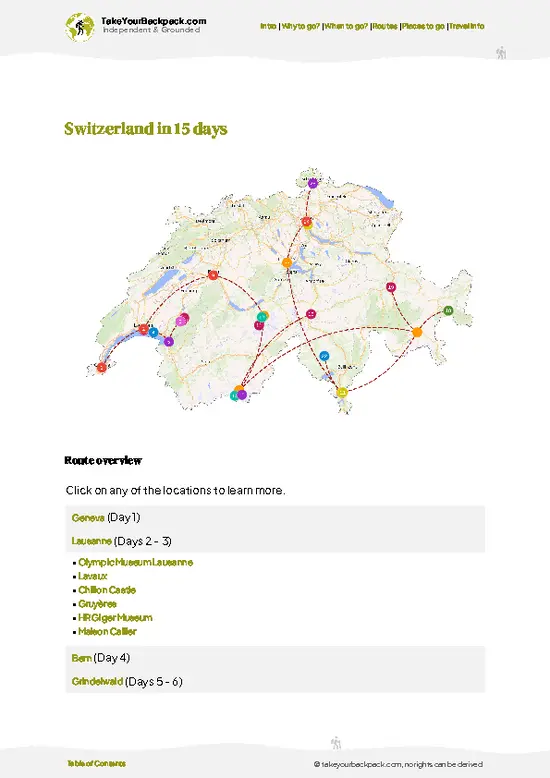
Yes, our itinerary-planner does exactly that. Set your trip length in days, give your interests and travel style, optionally give start- and end location and/or some mandatory stops you would like to include and the itinerary planner creates your personalized routes for Switzerland in seconds. Try it out!
Try the itinerary planner
 Best Backpacking


