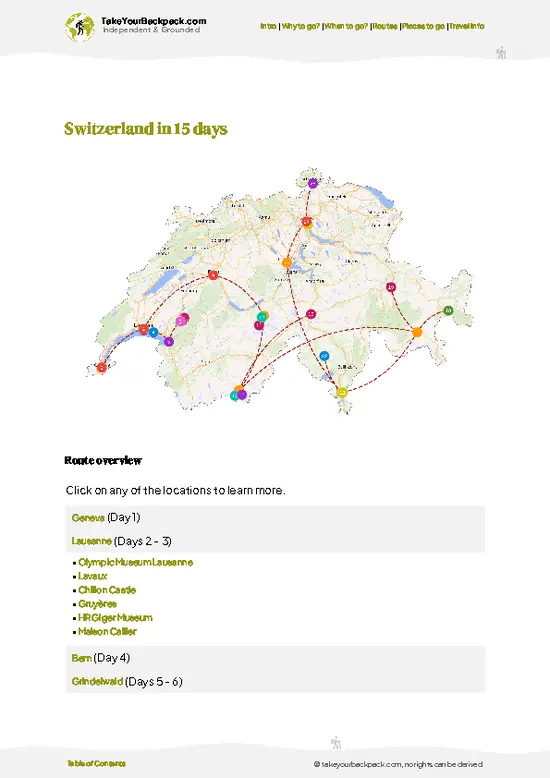
This fifteen-day journey suits travelers who want to see how much Switzerland changes within a few hundred kilometers: French-speaking lake towns, arcaded Bern, the big glaciers, the Romansh-speaking Engadin and Italian-speaking Ticino. It runs west to east and then north, with two-night stops in most places. The pace stays relaxed, and the two long scenic rail days are kept apart. You’ll ride SBB trains, the Glacier Express and Bernina Express panorama services (seat reservations required), cogwheel railways, cable cars, PostBuses and one cross-border coach from Tirano to Lugano. A 15-day Swiss Travel Pass covers nearly all of it.
Day 1: Geneva and the lake
Treat
Geneva as a soft landing. Walk out along the Pâquis pier to the Bains des Pâquis, the city’s favorite stretch of
Lake Geneva Beach. Entry costs about CHF 2 (US$2.30), and locals swim off concrete jetties with Mont Blanc on the horizon on clear days. The cheapest dinners in town are in the immigrant-run eateries on the Pâquis streets …
read more 👉This fifteen-day journey suits travelers who want to see how much Switzerland changes within a few hundred kilometers: French-speaking lake towns, arcaded Bern, the big glaciers, the Romansh-speaking Engadin and Italian-speaking Ticino. It runs west to east and then north, with two-night stops in most places. The pace stays relaxed, and the two long scenic rail days are kept apart. You’ll ride SBB trains, the Glacier Express and Bernina Express panorama services (seat reservations required), cogwheel railways, cable cars, PostBuses and one cross-border coach from Tirano to Lugano. A 15-day Swiss Travel Pass covers nearly all of it.
Day 1: Geneva and the lake
Treat Geneva as a soft landing. Walk out along the Pâquis pier to the Bains des Pâquis, the city’s favorite stretch of Lake Geneva Beach. Entry costs about CHF 2 (US$2.30), and locals swim off concrete jetties with Mont Blanc on the horizon on clear days. The cheapest dinners in town are in the immigrant-run eateries on the Pâquis streets just behind it, a sharp contrast to the hotel terraces on the quay.Days 2-4: Lausanne, Lavaux, Chillon and Gruyères
Lausanne is 40 minutes away and climbs so steeply from the lake that its m2 metro works like a funicular. Hotel and hostel guests get a free transport card, which makes two nights here good value. Spend the first afternoon at the Olympic Museum Lausanne in Ouchy (around CHF 20), set in a lakeside park with sculptures and a running track.
On day 3, take a regional train to Lutry and walk up through the Lavaux, Vineyard Terraces to Epesses, about 2 hours on stone-walled paths with the lake below. Then ride on to Veytaux-Chillon for Chillon Castle. Its frescoed halls are fine, but the medieval latrines dropping straight into the water are what you’ll talk about later.
Check out on day 4 and head inland by train via Bulle to Gruyères, a walled hilltop village with one cobbled main street and a castle at the top. Order the local double cream with meringues. The HR Giger Museum, in a château on the same street, shows the biomechanical art of the Swiss designer behind the Alien creature, and the bar opposite has ribbed, skeletal vaults. One stop down the line in Broc, Maison Cailler Chocolate Factory ends its tour (around CHF 20) with a tasting room you’re free to graze. From there, Bern is about 1.5 hours away. Arrive for an evening walk under 6 kilometers of sandstone arcades to the Zytglogge clock tower. In summer, do what locals do and float down the Aare to the Marzili baths.Days 5-6: Grindelwald and the Eiger
Bern to Grindelwald takes about 1.5 hours, so you arrive by lunch with time for a gentle valley walk. On day 6, take the Eiger Express gondola to Eigergletscher and the train through the rock to Jungfraujoch - Top of Europe. The gondola shortcut puts you on the glacier saddle faster than the old route via Kleine Scheidegg. Come back down to Eigergletscher and walk the Eiger Trail to Alpiglen. It takes about 2.5 hours on a path that hugs the base of the North Face, close enough to hear meltwater and the odd stone fall.Days 7-8: Zermatt
Grindelwald to Zermatt is about 3 hours via Interlaken, Spiez and Visp, which leaves an evening to wander the old larch-wood barns of the Hinterdorf. On day 8, ride the cable car to Trockener Steg and hike the Matterhorn Glacier Trail to Schwarzsee. It covers about 6.5 kilometers in 2 hours across bare, glacier-polished rock, and boards along the way show how far the ice has retreated. In the late afternoon, take the cogwheel railway up to Zermatt’s Gornergrat for the low-angle light on the Matterhorn and the Monte Rosa massif. Pass holders get 50 percent off both lifts.Days 9-10: Glacier Express and St. Moritz
Day 9 is a deliberate long travel day. The Glacier Express takes about 8 hours to reach St. Moritz, crossing the Oberalp Pass at 2,033 meters and the Landwasser Viaduct. Pack your own lunch, because the onboard meals are steep. St. Moritz is the polished, pricey end of the Engadin, but the youth hostel by the forest keeps costs sane. Day 10 makes up for the long ride: the train to Zernez takes about 1 hour and drops you at the visitor center of the Swiss National Park. It is the country’s only national park, with strict rules, so you stay on marked trails and leave nothing behind. Val Trupchun, reached from S-chanf, is the classic valley for spotting ibex and chamois.Days 11-12: Bernina Express to Lugano and the Verzasca
The Bernina Express climbs over the Bernina Pass at 2,253 meters, passes the Palü glacier at Alp Grüm and corkscrews down the Brusio spiral viaduct to Tirano in Italy in about 2.5 hours. The connecting Bernina Express coach then reaches Lugano in about 3 hours, running in the warmer months only. In Lugano, the lakefront palms and the Lido di Lugano pools and lakeside lawn show a Switzerland that eats risotto and stays up later. On day 12, take the train to Locarno (about 1 hour) and the PostBus into the Verzasca valley to Lavertezzo. There, the double-arched Ponte dei Salti spans water so clear and green you can count the stones on the bottom. That water stays painfully cold in August, and the current is stronger than it looks.Day 13: Lucerne
The train back north runs through the 57-kilometer Gotthard Base Tunnel and reaches Lucerne in about 2 hours. Use the evening to walk the Musegg city wall, whose towers you can climb for free in summer, then cross the Chapel Bridge once the day-trippers have left.Days 14-15: Zurich and the Rhine Falls
Zurich is 45 minutes away. On a warm afternoon, the Strandbad Zürich at Mythenquai, with its lawns and swimming platforms (around CHF 8), beats any museum. On your final morning, take the train to Schloss Laufen and walk down to the Rhine Falls, about 150 meters wide and the most powerful waterfall in Europe by volume. Direct trains from Schaffhausen reach Zurich airport in about 40 minutes, so the falls fit before an afternoon flight.
On your free day in the Engadin, I would send a friend to Soglio: take the PostBus over the Maloja Pass, change in Promontogno, and bring proper shoes for the chestnut-forest path down to Castasegna.v2.webp)
 Best Backpacking

