×
Switzerland🇨🇭 | 10 days itinerary

10 Days in Switzerland

By Johan Kruseman 🇳🇱 | Updated May 3, 2026
This 10-day itinerary is for travelers who want a classic “first big Switzerland” loop: a mix of lakeside towns, high mountains, scenic trains, and a bit of culture at a steady, not frantic, pace. You’ll rely entirely on trains, boats, and mountain railways, with one or two big travel days spaced out by slower, immersive stops.

Days 1-3: Lucerne, Mount Rigi & Lake Time

Start in Lucerne, an easy-to-love base with its covered bridge, lakeside promenades, and quick access to the mountains, giving you a soft landing before you head deeper into the Alps. Use a full day to ride up for the Rigi Panoramic Trail, pairing a classic cogwheel railway with a ridge walk that gives you sweeping lake-and-peak views without extreme effort, then spend your third day lingering in town or taking a short lake cruise so you’re not burning out early in the trip.

Days 4-6: Interlaken, Jungfrau Region & Lauterbrunnen

Ride the train to Interlaken and treat it as your gateway hub rather than the main attraction, quickly … read more 👉
This 10-day itinerary is for travelers who want a classic “first big Switzerland” loop: a mix of lakeside towns, high mountains, scenic trains, and a bit of culture at a steady, not frantic, pace. You’ll rely entirely on trains, boats, and mountain railways, with one or two big travel days spaced out by slower, immersive stops.

Days 1-3: Lucerne, Mount Rigi & Lake Time

Start in Lucerne, an easy-to-love base with its covered bridge, lakeside promenades, and quick access to the mountains, giving you a soft landing before you head deeper into the Alps. Use a full day to ride up for the Rigi Panoramic Trail, pairing a classic cogwheel railway with a ridge walk that gives you sweeping lake-and-peak views without extreme effort, then spend your third day lingering in town or taking a short lake cruise so you’re not burning out early in the trip.

Days 4-6: Interlaken, Jungfrau Region & Lauterbrunnen

Ride the train to Interlaken and treat it as your gateway hub rather than the main attraction, quickly continuing into the Lauterbrunnen Valley where the cliffs and waterfalls feel like a natural amphitheater. Over the next two days, mix a big alpine railway day up to Jungfraujoch - Top of Europe with time in the car-free village of Mürren and a selection of Jungfrau Region Hikes, choosing routes that match your fitness so you can actually enjoy the altitude instead of just surviving it.

Days 7-8: Zermatt, Matterhorn & Glacier Trails

Take a scenic train ride down the valley and across to Zermatt, where the streets are car-free and everything quietly orients around the pyramid of the Matterhorn. Give yourself two full days here: one to ride up to Zermatt’s Gornergrat for a front-row seat to glaciers and 4000-meter peaks, and another to walk the Five Lakes Walk or the Matterhorn Glacier Trail, both of which let you watch the mountain shift shape from different angles as you move through the landscape.

Days 9-10: GlacierExpress to St. Moritz & Engadin Valley

Board the GlacierExpress for a full-day, slow-motion panorama ride to St. Moritz, trading speed for huge windows, viaducts, and deep valleys that stitch together everything you’ve been seeing on foot. Spend your final day using St. Moritz as a jumping-off point into the Engadin Valley, where you can take easy lakeside walks or short hikes in the surrounding hills before a last evening in town, feeling like you’ve sampled the greatest hits of the Alps without ever needing a rental car.

The moment that always sticks with me on this route is rolling into Zermatt at dusk, catching my first clear view of the Matterhorn glowing pink above the rooftops.
Loading the map 🌍
film
0
0
0a
Lucerne
Benny Davidian
film
1
1
1a
Rigi Panoramic Trail
film
2
2
2a
Interlaken
Natalka
film
3
3
3a
Lauterbrunnen Valley
Silvia Cote
film
4
4
4a
Mürren
Juan-ting Lin
film
5
5
5a
Jungfrau Region Hikes
Pixabay
film
6
6
6a
Zermatt
Reane Delseth
film
7
7
7a
Matterhorn
Pixabay
film
8
8
8a
Five Lakes Walk
Devshack
film
9
9
9a
Matterhorn Glacier Trail
Kristin Christ
film
10
10
10a
St. Moritz
Marcello Domenighini
film
11
11
11a
Engadin Valley
Salvatore Patacca

🛏️ Where to stay?10 Days of Adventure

✈️ The backpacker research shortcutSwitzerland Travel Guide

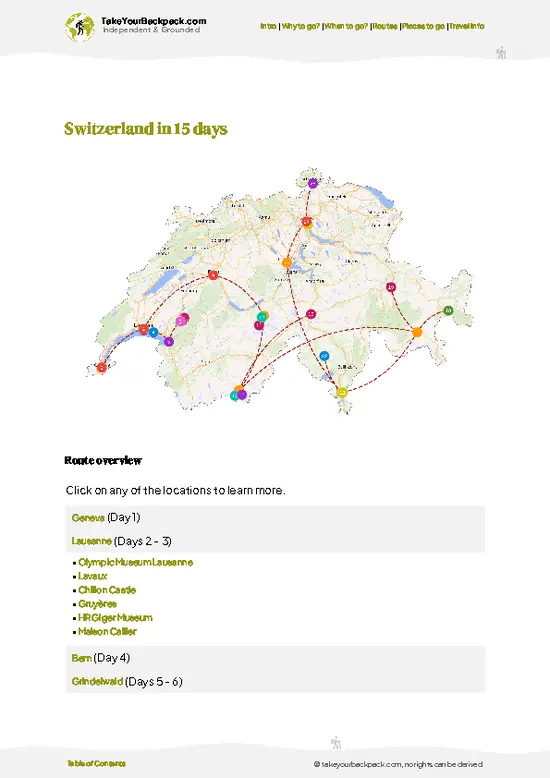
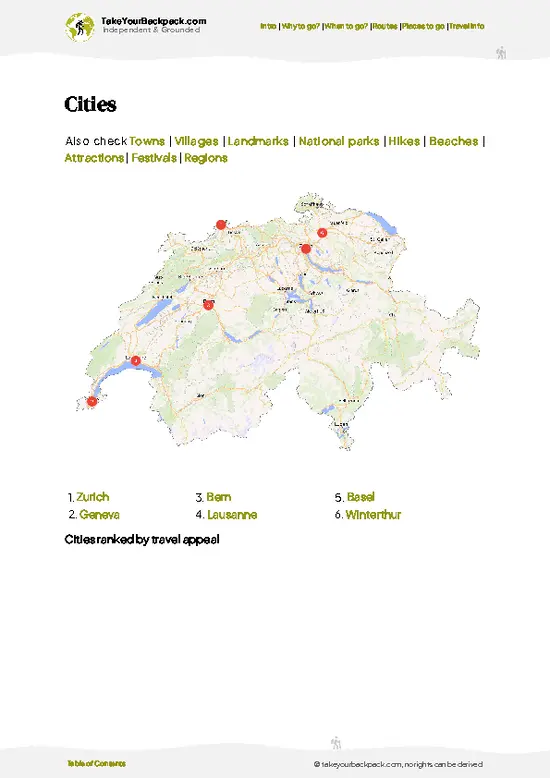
An offline-friendly backpacking guide with optimized travel routes, ranked highlights, transport advice, and the best areas to stay.
example page 0 from our offline Travel Guide for Switzerlandexample page 1 from our offline Travel Guide for Switzerlandexample page 2 from our offline Travel Guide for Switzerlandexample page 3 from our offline Travel Guide for Switzerlandexample page 4 from our offline Travel Guide for Switzerlandexample page 5 from our offline Travel Guide for Switzerland
The digital guide (383 pages) contains:
121 highlights, ranked by travel appeal
Optimized 5, 10 & 15-day travel routes
Best neighborhoods to stay
How to get around
Offline-friendly for travel without Wi-Fi
👉 See all 30+ guide features

📅 Plan smarter in minutes, not weeks
Month by month travel advice
Festivals & national holidays
Budget expectations

🗺️ Go to the right places, skip the overrated ones
Honest pros & cons of destinations
Top hikes, parks & viewpoints
Lesser-known places most travelers miss
Clear “worth it vs skip it” guidance

🛏️ Travel smoothly without rookie mistakes
Best areas to stay
Transport systems explained simply
Common scams & safety advice
SIM cards, money & practical tips

🌍 Understand the country, not just visit it
Culture & traditions
52 Essential phrases & customs
Festivals worth planning around
Traveler-friendly historical context
Insights that make places more meaningful

📱 Built for real travel conditions
Fully downloadable PDF
Works completely offline
Optimized for phone use
Useful in remote areas & buses
Everything in one place
Save weeks of stressful planning
Get instant access to the full guide directly. 30-day money-back guarantee.


Sent to your inbox immediately after payment • 100% Secure Checkout
Best Backpacking Travel Advisor 2025 tourism awardBest Backpacking
Travel Advisor
2025
What others say about Take Your Backpack Guides:
⭐⭐⭐⭐⭐
Fantastic, amazing amount of information!
⭐⭐⭐⭐⭐
My goodness this is amazing, it's what I've been looking for hats off too you!
⭐⭐⭐⭐⭐
I think this is absolutely BRILLIANT
⭐⭐⭐⭐
Very complete and informative. It's still missing places, but I gotta to commend you
⭐⭐⭐⭐⭐
This is truly amazing, thank you, can't wait to explore it with my kids!
⭐⭐⭐⭐⭐
Awesome resource, thank you!
⭐⭐⭐⭐⭐
This is amazing! Can't wait to explore the ones I haven't seen
⭐⭐⭐⭐
I love this! Well done, great idea.
⭐⭐⭐⭐⭐
Thanks for taking the time to make this gem!
⭐⭐⭐⭐⭐
This might be the best website I've ever seen.
⭐⭐⭐⭐⭐
Congratulations, and thank you so much for your work; it's incredibly valuable.
⭐⭐⭐⭐
In all seriousness I think you did a great job pointing out the important spots
⭐⭐⭐⭐⭐
10/10 very good
⭐⭐⭐⭐⭐
As someone who's only just starting to visit regularly this is awesome, thank you.
⭐⭐⭐⭐
Thank you very much! I'm going to visit my dad, it's going to be very useful!
⭐⭐⭐⭐⭐
This is really cool! We'll be travelling for the first time and this definitely come in handy.
⭐⭐⭐⭐⭐
You are now our minister of culture, congratulations 👨‍💼
⭐⭐⭐⭐⭐
Just wanted to tell you that this is a pearl! Going to follow your recommendations.
⭐⭐⭐⭐⭐
This is so cool. I'll definitely be using the resource for my travels soon.
⭐⭐⭐⭐⭐
This is very impressive! Good work.
⭐⭐⭐⭐⭐
This is an amazing and informative site. Very well done!

🧭 RouteMore Ways to Explore

Travel Switzerland your way — from a quick highlights trip to a slow-paced adventure.

🙋 FAQGood to Know

Short answer: yes, Switzerland is one of the easiest countries on earth to backpack independently, even for a first-timer. The country runs on punctuality and clear signage, which is exactly what you want when you’re hauling a pack and chasing cheap connections.

For navigation, almost every trail junction is signed with yellow hiking posts showing time estimates, not distances, which makes planning your day very straightforward. In towns and cities, train and tram stops are clearly marked, and ticket machines usually have English as a language option.

Hostels are common in major hubs (Zurich, Geneva, Bern, Basel, Interlaken, Lucerne, Zermatt, Lausanne, Lugano) and in many mountain areas. They’re not dirt-cheap, but they’re clean, safe, and social. To keep costs down, you can self-cater using hostel kitchens and big supermarkets like Coop and Migros, which often have discounted ready-to-eat food in the evenings.

Safety-wise, Switzerland is very low risk for violent crime. The main things to watch are pickpockets in busy stations and basic mountain safety: check weather, know your route, and don’t underestimate how quickly conditions can change at altitude.

Language is rarely a barrier. German, French, Italian, and Romansh are the official languages, but English is widely understood in transport, tourism, and most hostels. You can show a screenshot of a route or a train time and people will usually help.

The main challenge is cost, not logistics. You control that by: cooking your own meals, drinking tap water instead of buying bottles, using supermarket bakeries for cheap lunches, hiking instead of paying for every cable car, and choosing a few big-ticket mountain viewpoints instead of doing them all.

If you’re comfortable reading a timetable, following trail signs, and carrying your own gear, Switzerland is almost plug-and-play for independent backpacking.
For a budget traveler, the sweet spot is usually 7–10 days. That’s enough to see a couple of cities, hit the mountains properly, and not feel like you’re just bouncing between train platforms.

Rough guide:

3–4 days (ultra-short trip)
You’ll have to choose either cities or mountains.
- City-focused: Base in Zurich or Geneva with a day trip to Lucerne or Bern.
- Mountain-focused: Base in Interlaken or Lucerne and do 2–3 day hikes plus one big viewpoint (like Schilthorn or Pilatus).
This is more of a teaser than a full trip.

7 days (solid first trip)
- 2 days: Zurich or Geneva + Bern or Lucerne for old towns, lakes, and museums.
- 3–4 days: Interlaken area (Lauterbrunnen, Mürren, Grindelwald) or Lucerne + Engelberg for hiking and alpine scenery.
You’ll get a good mix of culture and mountains without racing.

10–14 days (ideal backpacking loop)
- 2–3 days: Cities and lakes (Zurich, Bern, Lucerne, or Lausanne/Montreux).
- 4–6 days: Alps (Interlaken region, Zermatt, or a hut-to-hut trek like part of the Via Alpina).
- 1–2 days: Italian-speaking Ticino (Lugano or Locarno) for a different vibe and warmer climate.
This length lets you slow down, pick cheaper accommodation by staying longer in each base, and take advantage of supermarket cooking.

3+ weeks (deep dive, if you can afford it)
You can add multi-day treks, more remote valleys (Valais, Engadine), and rest days to protect your knees and your budget.

For most backpackers watching costs, 7–10 days is the best balance between seeing a lot and not spending a fortune on constant transport.
You can absolutely get around Switzerland without a car, and for most backpackers it’s actually better not to drive.

Trains
The rail network is dense, fast, and famously on time. Major cities and many small towns are linked by frequent trains, and connections are usually designed to line up with each other. You can cross the country in a few hours without touching a steering wheel.

Buses and PostBuses
Where trains stop, yellow PostBuses take over, especially in mountain valleys and rural areas. They’re timed to meet trains, and they reach trailheads, passes, and small villages that would be a headache with a rental car and limited parking.

Mountain transport
Cable cars, funiculars, and cogwheel trains get you up to high viewpoints and trail starts. They’re expensive, so budget travelers should pick a few key rides and hike the rest. Often you can hike up and ride down, or vice versa, to save money.

Tickets and passes
Point-to-point tickets are simple but add up fast. To save money:
- Use regional passes (like passes for the Bernese Oberland or Tell-Pass regions) if you’re staying in one area and riding a lot.
- Consider half-fare style discounts if you’re in the country long enough and moving around daily.
- Use city transport cards that some hostels and hotels provide, which cover local buses and trams.

Why skipping a car helps budget travelers
- No fuel, parking, or motorway vignette costs.
- No stress about mountain roads, snow, or tight village streets.
- You can nap, read, or plan your next hike on the train instead of focusing on driving.

For a backpacker, the best strategy is to build your itinerary around train lines and bus routes, choose bases that are well-connected, and use your feet for the last mile. You won’t miss having a car.
For budget travelers, the must-visits are the places where you can get big scenery or strong character without paying for every single viewpoint. Think good trail access, free walks, and lakes you can enjoy without a tour.

1. Interlaken region (Lauterbrunnen, Mürren, Grindelwald)
This is classic postcard Switzerland: cliffs, waterfalls, glaciers, and cowbells. Lauterbrunnen Valley has easy, mostly flat walks with huge views, while Mürren and Wengen give you car-free mountain villages. You can do full days of hiking with zero or minimal lift costs if you’re willing to climb.

2. Lucerne and Lake Lucerne
Lucerne’s old town, covered bridges, and lakeside promenades are great for low-cost wandering. From here you can reach mountains like Pilatus and Rigi. Rigi in particular can be cheaper if you use regional passes or hike partway.

3. Bern
Bern is underrated for backpackers. The old town is compact and walkable, the Aare River is perfect for a summer float if you’re confident in water, and you get a strong sense of Swiss daily life without paying resort prices. It’s a good base for day trips too.

4. Zermatt (if you can squeeze it in)
Zermatt is pricey, but seeing the Matterhorn in person is special. To keep it budget-friendly, stay only 1–2 nights, self-cater, and focus on one or two hikes like the 5-Seenweg (Five Lakes Walk) instead of riding every lift.

5. Ticino (Lugano or Locarno)
This is the Italian-speaking part of Switzerland: palm trees, lakes, and stone villages. It feels like a mini-vacation from the rest of the country. You can hike between villages, swim in rivers, and enjoy the change in food and language.

6. The Engadine (if you like quieter places)
The Engadine valley (around St. Moritz, Pontresina, Scuol) has big landscapes and well-marked trails, with a slightly wilder feel than the central tourist magnets. It’s great if you prefer long hikes and fewer crowds, though still not cheap.

If you have limited time and money, prioritize one city (Bern or Lucerne) plus one major mountain base (Interlaken area or Zermatt) and, if possible, a quick taste of Ticino.
When you’re short on time and money, you want to avoid places that eat your budget without adding much beyond what you’ll see elsewhere.

1. Doing every scenic train
Named panoramic trains (like Glacier Express and Bernina Express) are beautiful but expensive and slow. Regular regional trains often run on the same or similar routes with the same views for less money and more flexibility. If you’re tight on time, skip the branded train experience and just ride normal trains through mountain passes.

2. Multiple expensive mountain viewpoints in one trip
You don’t need to ride every famous cable car. Jungfraujoch, Gornergrat, Schilthorn, Pilatus, Titlis, and others all cost serious money. Pick one or two that fit your route and weather, then rely on hiking and free viewpoints the rest of the time. The landscape is consistently dramatic; you won’t feel deprived.

3. Long museum crawls if you’re mainly here for mountains
Swiss museums are high quality, but entry fees add up. If your main goal is hiking and scenery, limit yourself to one or two museums that really interest you and spend the rest of your time outdoors, which is free once you’re there.

4. Extra big cities beyond your first choice
Zurich, Geneva, and Basel are all interesting, but they’re also expensive and somewhat similar in that they’re polished, international cities. If you’re short on time, pick one as your arrival/departure hub and focus the rest of your days on smaller cities (Bern, Lucerne, Lausanne) and mountain areas.

5. Over-scheduling tiny day trips
Hopping between lots of nearby towns in a single day sounds efficient, but every train ride costs money and mental energy. Instead of ticking off every lakeside village, choose one or two strong bases and explore on foot or with short, targeted rides.

6. Shopping districts and luxury resorts
High-end shopping streets and ultra-luxury resorts are fun to glance at, but they don’t add much to a budget trip. Window-shop as you pass through if you like, but don’t plan whole days around them.

If you’re short on time, build your trip around one city base and one mountain base, skip the extra scenic trains and duplicate viewpoints, and let hiking, lakes, and simple picnics do the heavy lifting for your experience.

🇨🇭 SwitzerlandDiscover the Country

Ready to build a truly unique trip? Predefined routes are perfect for first-time visitors, but there is so much more to discover. Whether you are chasing a city trip, pristine national parks, local food scenes, or quiet beaches, pick a category to design your own path.