×
Austria🇦🇹 | 15 days itinerary

A Complete 15-Day Plan for Austria

By Johan Kruseman 🇳🇱 | Updated May 8, 2026
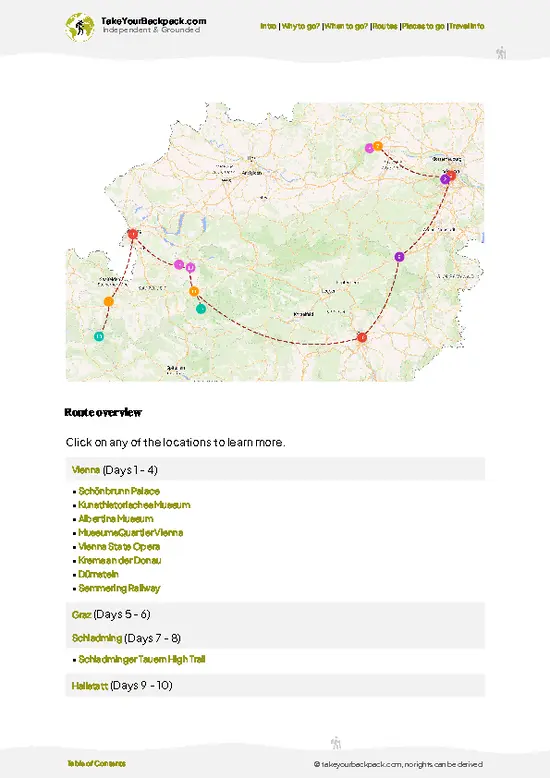
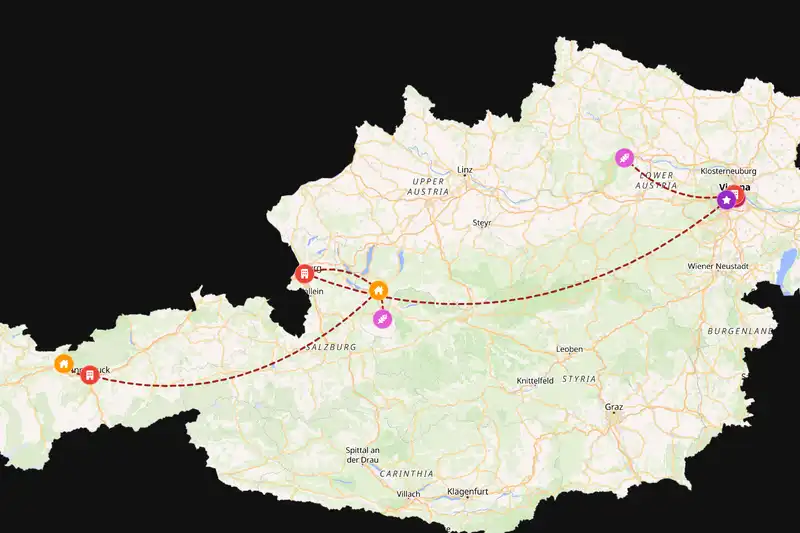
This 15-day route is for travelers who want to go deep on Austria: big cities, classic lakes, serious hiking, and a few quieter corners that most visitors never reach, all at a steady, not frantic, pace. You’ll rely on trains and regional buses, with the occasional cable car, linking Vienna, the Wachau, the Salzkammergut, the high Alps around Schladming and Zell am See, and a finale in the Tyrolean mountains around Seefeld in Tirol and the Eagle Walk.

Days 1-3: Vienna’s palaces, museums, and music

Spend three nights in Vienna to let the city’s layers stack up instead of blurring together. Dedicate one full day to Schönbrunn Palace and the Palace and Gardens of Schönbrunn, wandering the gardens, side paths, and hilltop viewpoints until you’ve actually earned your slice of cake. Another day is for the museum cluster: the Kunsthistorisches Museum, Albertina Museum, and Leopold Museum, which together give you everything from Habsburg grandeur to raw Austrian expressionism. Use an evening for … read more 👉
This 15-day route is for travelers who want to go deep on Austria: big cities, classic lakes, serious hiking, and a few quieter corners that most visitors never reach, all at a steady, not frantic, pace. You’ll rely on trains and regional buses, with the occasional cable car, linking Vienna, the Wachau, the Salzkammergut, the high Alps around Schladming and Zell am See, and a finale in the Tyrolean mountains around Seefeld in Tirol and the Eagle Walk.

Days 1-3: Vienna’s palaces, museums, and music

Spend three nights in Vienna to let the city’s layers stack up instead of blurring together. Dedicate one full day to Schönbrunn Palace and the Palace and Gardens of Schönbrunn, wandering the gardens, side paths, and hilltop viewpoints until you’ve actually earned your slice of cake. Another day is for the museum cluster: the Kunsthistorisches Museum, Albertina Museum, and Leopold Museum, which together give you everything from Habsburg grandeur to raw Austrian expressionism. Use an evening for the Vienna State Opera or a visit to the Spanish Riding School, and keep one pocket of time for a niche stop like the Haus der Musik if you’re curious about sound and composition.

Days 4-5: Wachau Valley and Krems an der Donau

Head west along the Danube for two nights in or around Krems an der Donau, your base for the Wachau Valley. This stretch is all about slower travel: regional trains and boats, vineyard walks, and small-town streets. Spend one day exploring Dürnstein with 0 nights there, climbing up to the castle ruins and wandering the narrow lanes before returning to Krems in the evening. The second day can be a mix of riverside cycling or walking sections of the Wachau World Heritage Trail, giving you a feel for rural Austria that’s very different from the Alps but just as addictive.

Days 6-8: Salzkammergut lakes - St. Wolfgang, Bad Ischl, Hallstatt

Travel by train and bus into the Salzkammergut and settle in St. Wolfgang for one night to break the journey and get your first lake fix. Ride the boat on Wolfgangsee or head up the local mountain for a short hike before the evening quiet sets in. The next day, move via Bad Ischl (0 nights) for a café stop and a quick look at the old spa town atmosphere, then continue to Hallstatt for two nights. Use your full day here to explore the Dachstein Salzkammergut area, riding up to the high plateau for walks and viewpoints, then returning to Hallstatt for a slow evening by the water once the crowds thin out.

Days 9-11: Schladming and the Dachstein Salzkammergut mountains

Shift your base to Schladming for three nights, trading lakeside calm for a proper mountain town with easy access to trails. From here you can dive into the Dachstein Salzkammergut high country again from a different angle, using lifts to reach ridge walks and alpine huts without needing a car. With multiple days, you can mix one bigger hike day with a lighter one, maybe sampling a section of the Schladminger Tauern High Trail as a day outing while still having time to enjoy the town’s cafés and riverside paths. This phase is where the trip shifts from “seeing Austria” to actually hiking in it, at a pace that lets your legs adapt instead of burning out.

Days 12-13: Zell am See and Hohe Tauern

Continue by train to Zell am See for two nights, using the town as your launchpad into Hohe Tauern National Park. One day is for the lake and nearby viewpoints, giving you a softer day after Schladming’s trails. The other is for a full excursion into Hohe Tauern, where you can choose between valley walks, glacier viewpoints, or a more demanding hike depending on how ambitious you’re feeling. This combo of a lively lake town and a huge national park gives you a broad snapshot of Austria’s alpine side without needing to rent a car or rush between valleys.

Days 14-15: Seefeld in Tirol and the Eagle Walk

Finish with two nights in Seefeld in Tirol, a high plateau town that’s easy to reach by train and perfect for mellow but scenic walking. Use your full day to sample a stage or partial stage of the Eagle Walk, choosing a section that matches your fitness while still delivering big Tyrolean views. Ending here keeps the pace relaxed: you can do a half-day hike, linger over a long lunch, and still have time to pack without stress before your onward train.

The part of this route I still think about is a late-afternoon walk above Seefeld, watching the light slide across the ridges while cowbells echoed from somewhere I couldn’t quite see.
Loading the map 🌍
film
0
0
0a
Vienna
Pixabay
film
1
1
1a
Schönbrunn Palace
film
2
2
2a
Palace and Gardens of Schönbrunn
Tanja Paunovic
film
3
3
3a
Kunsthistorisches Museum
Pixabay
film
4
4
4a
Albertina Museum
film
5
5
5a
Vienna State Opera
Pixabay
film
6
6
6a
Spanish Riding School
film
7
7
7a
Wachau Valley
Ház Precíz
film
8
8
8a
Dürnstein
Christian M
film
9
9
9a
Wachau World Heritage Trail
Rudolf Sedlaczek
film
10
10
10a
St. Wolfgang
Sebastiaan Terlouw
film
11
11
11a
Bad Ischl
film
12
12
12a
Hallstatt
Gal1leo
film
13
13
13a
Dachstein, Salzkammergut
賀禎禎
film
14
14
14a
Schladminger Tauern High Trail
film
15
15
15a
Zell am See
Hb Hb
film
16
16
16a
Hohe Tauern
Pixabay
film
17
17
17a
Eagle Walk

✈️ The backpacker research shortcutAustria Travel Guide

An offline-friendly backpacking guide with optimized travel routes, ranked highlights, transport advice, and the best areas to stay.
example page 0 from our offline Travel Guide for Austriaexample page 1 from our offline Travel Guide for Austriaexample page 2 from our offline Travel Guide for Austriaexample page 3 from our offline Travel Guide for Austriaexample page 4 from our offline Travel Guide for Austriaexample page 5 from our offline Travel Guide for Austria
The digital guide (323 pages) contains:
94 highlights, ranked by travel appeal
Optimized 5, 10 & 15-day travel routes
Best neighborhoods to stay
How to get around
Offline-friendly for travel without Wi-Fi
👉 See all 30+ guide features

📅 Plan smarter in minutes, not weeks
Month by month travel advice
Festivals & national holidays
Budget expectations

🗺️ Go to the right places, skip the overrated ones
Honest pros & cons of destinations
Top hikes, parks & viewpoints
Lesser-known places most travelers miss
Clear “worth it vs skip it” guidance

🛏️ Travel smoothly without rookie mistakes
Best areas to stay
Transport systems explained simply
Common scams & safety advice
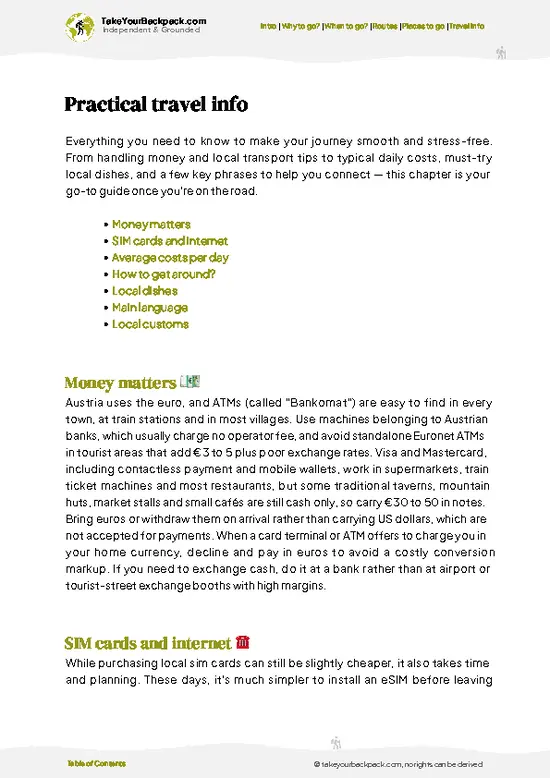
SIM cards, money & practical tips

🌍 Understand the country, not just visit it
Culture & traditions
52 Essential phrases & customs
Festivals worth planning around
Traveler-friendly historical context
Insights that make places more meaningful

📱 Built for real travel conditions
Fully downloadable PDF
Works completely offline
Optimized for phone use
Useful in remote areas & buses
Everything in one place
Save weeks of stressful planning
Get instant access to the full guide directly. 30-day money-back guarantee.


Sent to your inbox immediately after payment • 100% Secure Checkout
Best Backpacking Travel Advisor 2025 tourism awardBest Backpacking
Travel Advisor
2025
What others say about Take Your Backpack Guides:
⭐⭐⭐⭐⭐
Fantastic, amazing amount of information!
⭐⭐⭐⭐⭐
My goodness this is amazing, it's what I've been looking for hats off too you!
⭐⭐⭐⭐⭐
I think this is absolutely BRILLIANT
⭐⭐⭐⭐
Very complete and informative. It's still missing places, but I gotta to commend you
⭐⭐⭐⭐⭐
This is truly amazing, thank you, can't wait to explore it with my kids!
⭐⭐⭐⭐⭐
Awesome resource, thank you!
⭐⭐⭐⭐⭐
This is amazing! Can't wait to explore the ones I haven't seen
⭐⭐⭐⭐
I love this! Well done, great idea.
⭐⭐⭐⭐⭐
Thanks for taking the time to make this gem!
⭐⭐⭐⭐⭐
This might be the best website I've ever seen.
⭐⭐⭐⭐⭐
Congratulations, and thank you so much for your work; it's incredibly valuable.
⭐⭐⭐⭐
In all seriousness I think you did a great job pointing out the important spots
⭐⭐⭐⭐⭐
10/10 very good
⭐⭐⭐⭐⭐
As someone who's only just starting to visit regularly this is awesome, thank you.
⭐⭐⭐⭐
Thank you very much! I'm going to visit my dad, it's going to be very useful!
⭐⭐⭐⭐⭐
This is really cool! We'll be travelling for the first time and this definitely come in handy.
⭐⭐⭐⭐⭐
You are now our minister of culture, congratulations 👨‍💼
⭐⭐⭐⭐⭐
Just wanted to tell you that this is a pearl! Going to follow your recommendations.
⭐⭐⭐⭐⭐
This is so cool. I'll definitely be using the resource for my travels soon.
⭐⭐⭐⭐⭐
This is very impressive! Good work.
⭐⭐⭐⭐⭐
This is an amazing and informative site. Very well done!

🧭 RouteMore Ways to Explore

Travel Austria your way — from a quick highlights trip to a slow-paced adventure.

🙋 FAQGood to Know

Austria is very easy to backpack independently, even for a first big trip. The country is compact, safe, and extremely organized, which means fewer logistics headaches and more time actually enjoying the place. English is widely spoken in cities and tourist areas, and even in smaller towns you can usually get by with basic phrases and a smile. Booking dorm beds, trains, and buses is straightforward, and most things run on time to an almost comical degree.

For budget travelers, the main challenge is cost, not complexity. Austria is not ultra-cheap, but you can keep it reasonable by staying in hostels, shopping at supermarkets (Billa, Spar, Hofer), and using lunch specials or student menus instead of sit-down dinners every night. Tap water is drinkable almost everywhere, so you avoid buying bottled water. Wild camping is restricted or banned in many regions, so rely on hostels, official campgrounds, or mountain huts instead of stealth camping.

Safety-wise, Austria is one of the easier countries to relax in. Pickpocketing exists in busy tourist zones and on crowded transit, but violent crime is rare. Night trains, late trams, and walking home from bars are generally fine if you use normal common sense. Solo travelers, including solo women, usually report feeling comfortable.

If you are used to chaotic countries where you improvise everything, Austria will feel almost too smooth. You can show up in shoulder season and often find a bed the same day, but in July–August and around Christmas markets you should pre-book hostels in Vienna, Salzburg, and Hallstatt. Hiking regions like the Salzkammergut and Tyrol also fill up in peak season, especially weekends.

In short: Austria is a very beginner-friendly backpacking country with the infrastructure of Western Europe and the scale of a smaller, more manageable destination. Plan a loose route, book key nights in advance during high season, and leave space for spontaneous day hikes and lake days.
For a budget backpacker, 7–10 days is a solid first trip, 2 weeks is ideal, and 3 weeks lets you slow down and add more hiking without rushing.

Rough breakdowns that actually work on the ground:

5–7 days (fast but doable):
- Vienna: 2–3 days for the big sights, free walking tours, cheap museum combo tickets, and café culture.
- Salzburg: 1–2 days for the old town, fortress views, and a half-day hike like Mönchsberg or Kapuzinerberg.
- Day trip or overnight to a lake area (Salzkammergut / Hallstatt region) if you move quickly.

10 days (sweet spot for most backpackers):
- Vienna: 3 days.
- Salzburg: 2 days.
- Salzkammergut (lakes around Hallstatt, Bad Ischl, or St. Wolfgang): 2–3 days for swimming, easy hikes, and cheap picnic dinners by the water.
- Innsbruck or another Tyrolean base: 2–3 days for mountain views and cable car or hiking days.

14 days (ideal if you like nature):
- Vienna: 3 days.
- Salzburg: 2 days.
- Salzkammergut: 3 days.
- Innsbruck or Tyrol: 3–4 days.
- Graz or Linz: 1–2 days as a cheaper, more local-feeling city stop.

3 weeks (slow and scenic):
- Everything above, plus extra hiking days in the Alps (Zillertal, Ötztal, or Hohe Tauern), maybe a multi-day hut-to-hut trek if your budget allows.

If you are on a tight budget, it is better to spend more days in fewer places. Austria rewards slow travel: you save money by staying longer in one hostel, cooking more, and taking local hikes instead of stacking paid attractions and long-distance trains every day.
You can absolutely get around Austria without a car, and for backpackers it is usually the smarter move. The public transport network is dense, punctual, and easy to navigate, especially between cities and major towns.

Trains: Fast, frequent, and comfortable. The main cities (Vienna, Salzburg, Linz, Graz, Innsbruck) are all linked by regular trains. For budget travel, look for advance-purchase tickets and regional passes that cover unlimited travel in a state or region for a day or several days. Night trains also connect Austria with neighboring countries, which can save you a hostel night.

Buses: Buses fill in the gaps where trains do not go, especially in rural areas and around lakes and valleys. They are usually integrated with the train system, so one ticket can cover both in many regions. Timetables can thin out on Sundays and in the off-season, so check schedules and avoid assuming there will be a late bus back from a hike.

City transport: Vienna, Salzburg, Graz, and Innsbruck all have excellent local networks of trams, buses, and metros (in Vienna). Day passes are often cheaper than multiple single tickets if you are moving around a lot. Walking is safe and often the best way to see the old towns.

Hitchhiking and rideshares: Hitchhiking is possible and relatively safe but slower and less predictable than in some other countries. Organized rideshare platforms can be a cheaper alternative to trains on popular routes, but you trade flexibility for savings.

Bikes: Austria is bike-friendly, especially along rivers like the Danube. Renting a bike for a day or two can be a fun, low-cost way to explore wine regions or lakes, but you do not need a bike for general transport.

The only time a car really helps is if you want to reach very remote trailheads, do a lot of spontaneous side valleys in the Alps, or travel in a group with camping gear. For most backpackers, trains and buses are more than enough and keep your trip simpler and cheaper.
For a first-time backpacker in Austria on a budget, a few places are worth prioritizing because they give you the best mix of culture, scenery, and value.

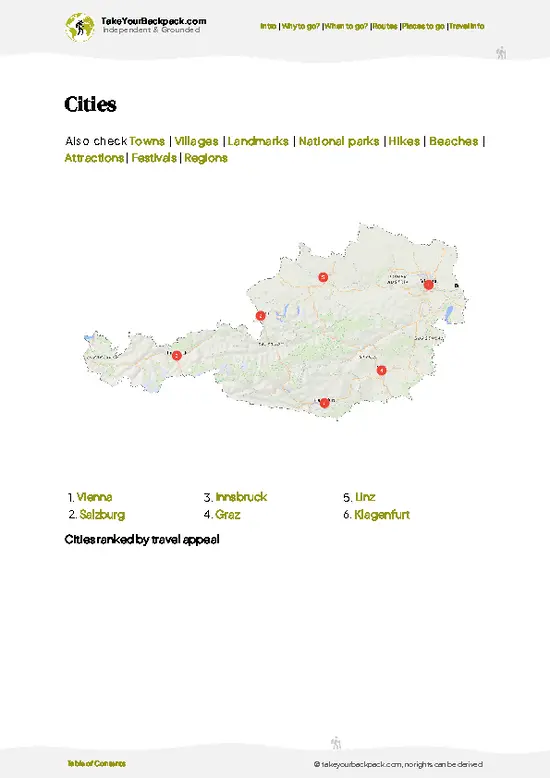
Vienna: The capital is non-negotiable. You get grand architecture, classical music history, and café culture, but you do not have to blow your budget. Use free walking tours, cheap standing tickets at the opera, and student or combo tickets for museums. Wander the Ringstrasse, the Prater park, and the Danube Canal street art instead of paying for every palace interior.

Salzburg: Compact, walkable, and very pretty, with mountains framing the old town. It is touristy but still worth it. Hike up to the fortress viewpoints, walk Mönchsberg or Kapuzinerberg for free panoramas, and enjoy the riverfront. One or two days is enough if you keep moving.

Salzkammergut (lake district around Hallstatt, Bad Ischl, St. Wolfgang, etc.): This region is where Austria really feels like a postcard: clear lakes, steep hills, and small towns. Hallstatt itself is crowded and pricey, but staying in a cheaper nearby town and visiting as a day trip works well. Swim in the lakes, pack supermarket picnics, and do low-cost hikes instead of paying for every viewpoint platform.

Tyrol / Innsbruck and surroundings: Innsbruck is a great base for budget-friendly mountain time. The old town is small, and you can reach serious alpine scenery with short bus rides or cable cars. Cable cars are expensive, so mix one or two big splurges with free or cheap valley hikes and viewpoints you can reach on foot.

Graz: Often skipped, but for backpackers it is a good value city stop. It has a big student population, cheaper food and nightlife than Vienna, and a relaxed old town with a hilltop fortress and riverside walks. It is a nice way to see everyday Austrian life without only being in tourist zones.

If you have extra time, consider a day or two in the Wachau Valley (between Krems and Melk) for Danube-side cycling and wine villages, or a national park like Hohe Tauern for serious hiking if your budget can handle mountain huts or extra transport.
If you are short on time or money, you do not need to chase every famous name. Some places are better as quick stops or can be swapped for cheaper, less crowded alternatives.

Hallstatt as an overnight: The village is beautiful, but it is also expensive and packed with day-trippers. If you are tight on time or cash, stay in a cheaper town in the Salzkammergut (like Bad Goisern or Bad Ischl) and visit Hallstatt for a few hours instead of sleeping there.

Too many palaces and paid interiors in Vienna: Schönbrunn, Hofburg, Belvedere, and multiple museums can eat your budget fast. Pick one or two that genuinely interest you and enjoy the rest from the outside or via free gardens and viewpoints. You do not need to tour every room to appreciate the city.

Sound of Music tours in Salzburg: If you are not a hardcore fan, the tours are pricey for what you get. You can see many filming locations or similar scenery by walking around town or taking cheap local buses to nearby lakes and hills.

High-end ski resorts in peak season: If you are not coming specifically to ski and you are on a backpacker budget, big-name resorts in Tyrol or Vorarlberg in winter can drain your wallet. For general mountain views and hiking, visit in late spring to autumn instead, when accommodation is cheaper and hiking is free.

Extra big cities just for the checklist: Linz and some smaller cities are pleasant but not essential if you are rushing. If you only have a week, focus on Vienna, Salzburg, one lake area, and maybe Innsbruck rather than trying to tick every city.

Over-structured day trips: Organized bus tours to places you can reach by train or local bus (like Wachau, some lakes, or nearby towns) are usually not worth the markup for a budget traveler. Plan your own day trips with public transport and spend the savings on one or two experiences that really matter to you, like a cable car ride or a concert.

🇦🇹 AustriaDiscover the Country

Ready to build a truly unique trip? Predefined routes are perfect for first-time visitors, but there is so much more to discover. Whether you are chasing a city trip, pristine national parks, local food scenes, or quiet beaches, pick a category to design your own path.