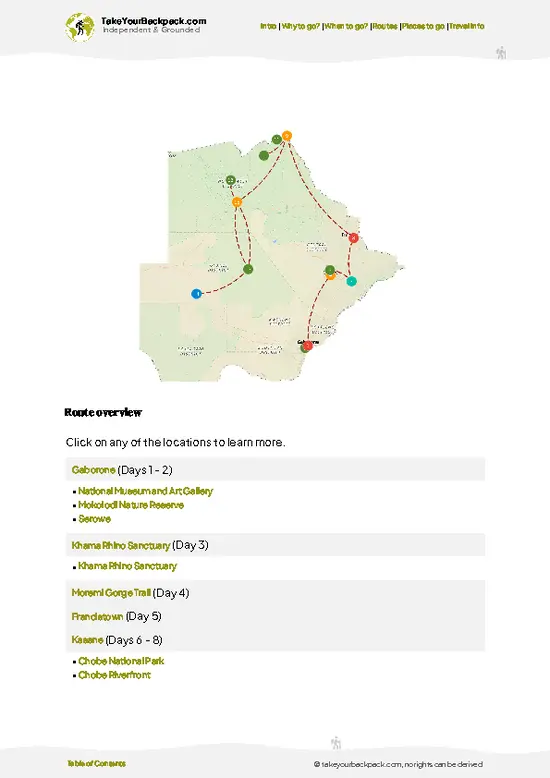
This fifteen-day route is for travelers with time who want to see how Botswana works away from the safari circuit: a small, orderly capital, community-run rhino and gorge projects in the east, the river and elephants of the north, then desert and Delta to finish. It suits budget-minded backpackers comfortable with intercity buses and the odd shared taxi. The pace is steady rather than rushed, and no two long bus days fall back to back. You will use long-distance buses on the A1 and A33, combis and shared taxis for short hops, a private taxi for the last kilometers to the rhino sanctuary and the gorge, and operator 4x4s plus a mokoro for the Central Kalahari and the Delta.
Days 1-3: Gaborone
Two nights in
Gaborone give you the country before the wilderness. The capital is low-rise and spread out, a city of shopping malls, ministries and white combis that cost around P7 a ride. The
National Museum and Art Gallery is free and small enough for a morning, with ethnographic displays and work by …
read more 👉This fifteen-day route is for travelers with time who want to see how Botswana works away from the safari circuit: a small, orderly capital, community-run rhino and gorge projects in the east, the river and elephants of the north, then desert and Delta to finish. It suits budget-minded backpackers comfortable with intercity buses and the odd shared taxi. The pace is steady rather than rushed, and no two long bus days fall back to back. You will use long-distance buses on the A1 and A33, combis and shared taxis for short hops, a private taxi for the last kilometers to the rhino sanctuary and the gorge, and operator 4x4s plus a mokoro for the Central Kalahari and the Delta.
Days 1-3: Gaborone
Two nights in Gaborone give you the country before the wilderness. The capital is low-rise and spread out, a city of shopping malls, ministries and white combis that cost around P7 a ride. The National Museum and Art Gallery is free and small enough for a morning, with ethnographic displays and work by Batswana artists. Nearby, the Three Dikgosi Monument honors the three chiefs who sailed to London in 1895 to keep their land out of Cecil Rhodes’s hands, a story that explains a lot about the country’s independent streak. On day 2, take a taxi about 15 kilometers south to Mokolodi Nature Reserve for a game drive or guided walk among giraffe, zebra and white rhino. Treat it as a gentle warm-up: the animals are relaxed and the drives short.Days 3-4: Serowe and Khama Rhino Sanctuary
The bus north to Palapye takes about four hours, and a combi covers the 50 kilometers to Serowe. This sprawling traditional village is the seat of the Bamangwato and the birthplace of Seretse Khama, the first president, whose family graves sit on Thathaganyana Hill above the kgotla. From there a taxi runs about 25 kilometers north to the Khama Rhino Sanctuary, a community trust that protects both white and black rhino on Kalahari sandveld. Do the late-afternoon game drive, sleep at the campsite under the camelthorns, and spend the next morning on the Khama Rhino Sanctuary Walking Trails with a guide, tracking rhino on foot.Days 4-6: Moremi Gorge and Francistown
On day 4, hire a taxi back through Serowe and Palapye to Moremi village in the Tswapong Hills and stay at the community campsite below the gorge. The Moremi Gorge Trail is a guided half-day hike up a sacred valley of fig trees, rock pools and seasonal waterfalls, with Cape vultures nesting on the cliffs. Guides are compulsory, and they explain which pools are off limits for spiritual reasons. On day 5, head back to Palapye and ride the bus roughly two hours to Francistown, which grew around one of the earliest gold rushes in southern Africa. The Supa Ngwao Museum covers that history, and the city’s supermarkets are the place to stock up before the north.Days 6-9: Kasane and Chobe
Day 6 is a long one: 6 to 7 hours by bus through Nata to Kasane. Three nights here let you treat Chobe as a place to slow down. Book two dawn game drives into Chobe National Park, when lions are still on the floodplain and sable occasionally come down from the wooded ridge. Spend one afternoon on a Chobe River Sunset Boat Cruise; I’d choose a small open boat over the double-decker barges, since you sit closer to the waterline and can hold position beside bathing elephants. Keep day 8 open for laundry, a swim and planning the west.Days 9-12: Maun and the Central Kalahari
The Kasane to Maun run, 8 to 10 hours with a change at Nata, is the longest ride of the trip, so the days either side stay easy. After one night in Maun, join a two-night operator trip into the Central Kalahari Game Reserve, a 4 to 5 hour drive to Deception Valley. The reserve covers more ground than Denmark and is the ancestral land of the San. This is the Kalahari Desert at full scale: fossil river valleys, gemsbok on the skyline, brown hyena at dusk, black-maned lions, and, after the rains from about December to March, springbok herds spread across green grass. Nights are silent and the stars reach the horizon. You return to Maun on day 12 for a shower and a bed.Days 12-15: Okavango Delta
Finishing in the Okavango Delta after the desert sharpens the contrast: two nights of clear water, papyrus and frog calls after three days of red sand. A morning transfer takes you to the poling station, and an Okavango Delta Mokoro Excursion carries you through the channels to an island camp, with bush walks at dawn and dusk. Bring your own food if your package is self-catering, a headlamp and some pula to tip your poler. You are back in Maun by midday on day 15 for the flight out.
Before leaving Gaborone, catch a combi about 45 kilometers south to Otse for Mannyelanong Hill, a protected cliff where Cape vultures breed above a quiet village.
 Best Backpacking


