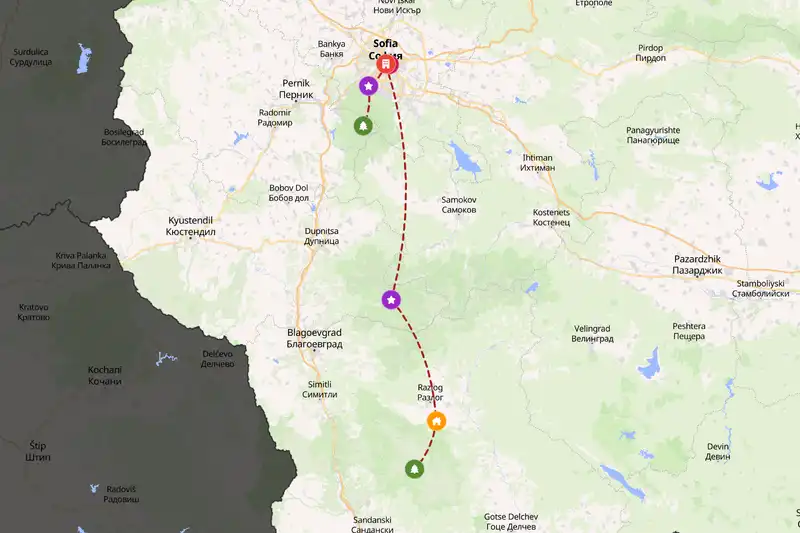
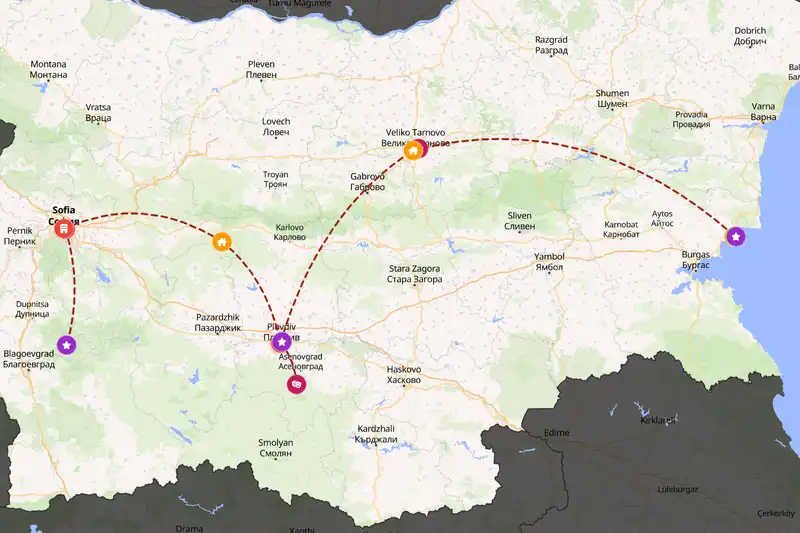
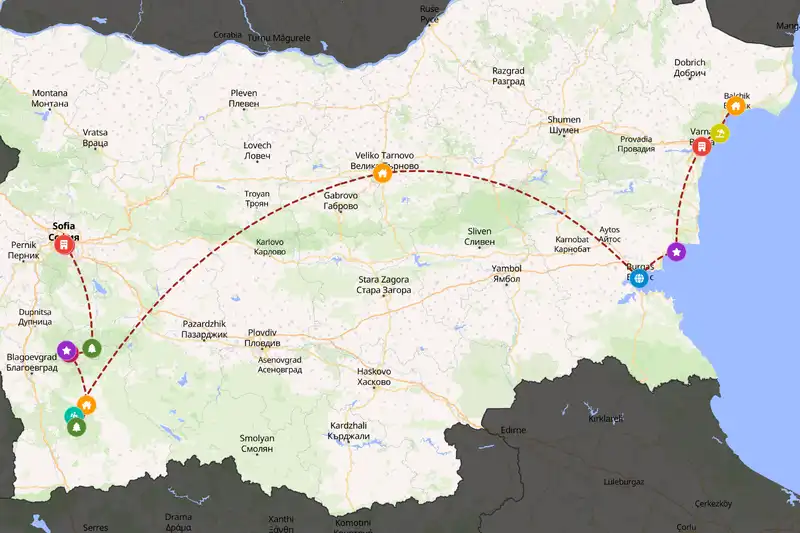
Two weeks in Bulgaria lets you see the whole country in one loop, from the capital to the Black Sea and back through the mountains, without a single rushed day. This route suits travelers who want both the headline sights and the smaller places in between: a woodcarvers’ town, a salt lake, an abandoned communist monument, a mountain railway. The pace is relaxed, with two nights in most places and only one properly long travel day. You will use intercity trains and buses, local buses for day trips, the narrow-gauge railway through the western Rhodopes, and one taxi for Buzludzha.
Days 1-2: Sofia
Spend the first two days in
Sofia on the country’s backstory rather than its postcard views. The
National Historical Museum sits in a former government residence at the foot of Vitosha and holds the best collection of Thracian gold and medieval church art you will find anywhere in Bulgaria. Plan half a day there, because it is a bus ride out of the center. Back in town, the
National Gallery Kvadrat …
read more 👉Two weeks in Bulgaria lets you see the whole country in one loop, from the capital to the Black Sea and back through the mountains, without a single rushed day. This route suits travelers who want both the headline sights and the smaller places in between: a woodcarvers’ town, a salt lake, an abandoned communist monument, a mountain railway. The pace is relaxed, with two nights in most places and only one properly long travel day. You will use intercity trains and buses, local buses for day trips, the narrow-gauge railway through the western Rhodopes, and one taxi for Buzludzha.
Days 1-2: Sofia
Spend the first two days in Sofia on the country’s backstory rather than its postcard views. The National Historical Museum sits in a former government residence at the foot of Vitosha and holds the best collection of Thracian gold and medieval church art you will find anywhere in Bulgaria. Plan half a day there, because it is a bus ride out of the center. Back in town, the National Gallery Kvadrat 500 covers Bulgarian painting from icons to the 20th century, plus a surprising amount of European art. In the evenings, the free walking tours that leave daily from the Palace of Justice are a quick way to learn the layout before you leave.Days 3-4: Veliko Tarnovo
Head east by bus or train, 3 to 4 hours, to Veliko Tarnovo, a town of stacked houses on the bends of the Yantra River. The walls of Tsarevets Fortress wrap a whole hilltop that served as the capital of the Second Bulgarian Empire, and the climb to the patriarchal church at the top is best done early before the tour groups arrive. On day 4, take the train about an hour to Tryavna, the quiet town of National Revival woodcarvers. Its cobbled main street, clock tower and carved ceilings in the Daskalov House make an easy half day, and you are back in Tarnovo for dinner overlooking the river.Days 5-6: Varna and Balchik
A 3.5 hour bus ride takes you to Varna, the country’s seaside capital. The Archaeological Museum shows gold from the Varna Necropolis, dated to around 4,500 BC and counted among the oldest worked gold ever found. Afterward, walk the long Sea Garden down to Varna Beach for a swim. Day 6 is for Balchik, roughly an hour north by bus, where Queen Marie of Romania built a small palace and a terraced botanical garden above the sea in the 1920s and 1930s. It is the most relaxed corner of the northern coast.Days 7-8: Nessebar, Pomorie and the Burgas Lakes
Ride south about 2 hours to the Ancient City of Nessebar and sleep inside the old town, which matters: once the day-trippers go back to the resorts, the peninsula’s medieval churches, with their striped brick and stone walls, are yours. On day 8, take local buses south to Pomorie, a salt-making town with a mud-bath lagoon, and on to Burgas. The Burgas Lakes ring the city; at Atanasovsko Lake the salt pans turn pink in summer and birdwatchers come for pelicans and other migrating waterbirds.Day 9: Kazanlak and Buzludzha
Leave the coast with a 3 hour bus to Kazanlak in the Valley of the Roses. The town’s Thracian tomb is visited through a faithful replica next to the sealed original, and the Rose Museum explains the rose-oil trade that still drives the region. In the afternoon, arrange a taxi up to the Buzludzha Monument Trail, where the saucer-shaped former Communist Party hall sits on a ridge of the Balkan Mountains. The interior is closed, but the walk around the outside and the view over the range are the point.Days 10-11: Plovdiv and Bachkovo
A 2 hour bus brings you to Plovdiv. In Plovdiv Old Town, go past the obvious stops: look down at the Roman stadium half buried under the main pedestrian street, then spend an evening in the Kapana quarter, a grid of small lanes full of bars and galleries. On day 11, take the bus to Asenovgrad, the hillside town of churches and a ruined fortress, and continue a few kilometers to Bachkovo Monastery, founded in 1083 and known for its fresco-covered refectory.Days 12-13: The narrow-gauge railway to Bansko
Day 12 is the long travel day, and it is the most scenic one of the trip. Take a regular train to Septemvri, then board the narrow-gauge line that climbs through the western Rhodopes. Break the journey in Velingrad for a few hours in its hot mineral pools, then continue on the slow, winding stretch to Bansko. Use day 13 for Pirin National Park: a summer shuttle or taxi reaches Vihren hut, the trailhead for the Banderitsa lakes and, for experienced hikers with a head for heights, the exposed Koncheto ridge.Days 14-15: Rila Monastery and back to Sofia
Travel by bus through Blagoevgrad to Rila Monastery and spend your last night there. Late afternoon and early morning are the times to see the striped arcades and painted church without crowds. On day 15, the afternoon bus brings you back to Sofia in about 3 hours, in time for a last dinner before your flight.
If you have a spare day near Bansko, the stone village of Kovachevitsa in the western Rhodopes, with its slate roofs and almost no traffic, is worth the detour.
 Best Backpacking