×

Bulgaria🇧🇬 | best townsYour Guide to the 10 Best towns in Bulgaria

Towns in Bulgaria come in flavors that have little to do with each other. The Black Sea coast runs from sleepy fishing harbors to resort strips where a beer costs more than it should in August. Inland, the Balkan Mountains hold hillside towns of stone and timber that look pleasant and cost little. The south carries Ottoman and Roman layers, and the cafés keep strong coffee flowing. Trains are slow and buses are quicker, which suits independent travel fine. Prices run low, crowds stay thin outside the coast, and a Cyrillic street sign is a puzzle you solve once and then enjoy.

By Johan Kruseman 🇳🇱 | Updated October 18, 2026
Explore the best villages in Bulgaria

Why go?Understanding Their Importance

Bulgaria packs an unusual amount of history into a country about the size of Tennessee. Thracian tombs, Roman roads, medieval capitals, Ottoman quarters and Communist-era blocks all sit within a few hours of each other, so towns here tend to show several centuries at once, sometimes on the same street. Geography does the rest. Mountains split the country into distinct zones, and each zone developed its own building style, food and pace, which means a short trip can feel like crossing several countries.

The Revival-era houses with their overhanging upper floors are a signature of the central hills, and the fortress ruins on the ridges above them are a reminder that this was a frontier for a very long time. Costs stay among the lowest in the European Union, even though the country uses the … read more 👉
Bulgaria packs an unusual amount of history into a country about the size of Tennessee. Thracian tombs, Roman roads, medieval capitals, Ottoman quarters and Communist-era blocks all sit within a few hours of each other, so towns here tend to show several centuries at once, sometimes on the same street. Geography does the rest. Mountains split the country into distinct zones, and each zone developed its own building style, food and pace, which means a short trip can feel like crossing several countries.

The Revival-era houses with their overhanging upper floors are a signature of the central hills, and the fortress ruins on the ridges above them are a reminder that this was a frontier for a very long time. Costs stay among the lowest in the European Union, even though the country uses the lev and not the euro, so a full meal and a drink rarely strain a budget.

There are things to know before choosing Bulgaria for its towns. Public transport is workable but unhurried, and many smaller places have only a few departures a day. English is common among younger people and thinner elsewhere, so learning to read Cyrillic pays off quickly. Museums often keep short hours and quiet days, and nobody will apologize for it.
Evaluating the Top Choices
The list of best towns in Bulgaria is created based on charm, local culture, atmosphere, hidden gems, and visitor appeal. If you feel a town is missing in this list, please let us know.

When to go?When to Plan Your Trip

Best months and why: May, June, September and early October are the best months for towns in Bulgaria, because daytime highs sit around 18 to 27°C, the hill towns are green or golden, and the coast has not yet become a crowd or an invoice. Walking cobbled lanes in that range is pleasant. Doing it in July is a character-building exercise.

Summer and winter: July and August push the interior to 28 to 35°C, with the Danube plain and the Thracian lowlands running hottest. The Black Sea coast is busiest then, and accommodation there can cost 40 to 100 percent more than in June or September. Inland hill towns stay cooler and calmer, so they are the sensible summer choice. Afternoon thunderstorms are common in the mountains, usually short.

Winter, from December to February, brings average temperatures … read more 👉
Best months and why: May, June, September and early October are the best months for towns in Bulgaria, because daytime highs sit around 18 to 27°C, the hill towns are green or golden, and the coast has not yet become a crowd or an invoice. Walking cobbled lanes in that range is pleasant. Doing it in July is a character-building exercise.

Summer and winter: July and August push the interior to 28 to 35°C, with the Danube plain and the Thracian lowlands running hottest. The Black Sea coast is busiest then, and accommodation there can cost 40 to 100 percent more than in June or September. Inland hill towns stay cooler and calmer, so they are the sensible summer choice. Afternoon thunderstorms are common in the mountains, usually short.

Winter, from December to February, brings average temperatures near or below freezing, with frequent snow in the Balkan and Rila ranges. Mountain resort towns turn expensive around New Year and in February school holidays. Coastal places often close many hotels and restaurants from late October to April, so most seaside towns feel suspended then.

Shoulder seasons: April and November are cheaper but less reliable, with spring rain and chilly, gray days. Spring has the most rainfall, around 50 to 70 mm a month in many regions, so pack a shell. Sofia and the interior stay open year-round, while seasonal coastal places do not.

town hoppingTips for Visiting Multiple Destinations

How long you need: A trip linking several towns in Bulgaria works best in 7 to 14 days, since distances are modest but buses are slow. The country is roughly 500 km across, yet a 150 km hop can eat three hours once you add a station wait and a road that winds through a pass.

Which regions pair well: Group by region and move in one loop. A sensible direction runs from Sofia through the Rila and Pirin foothills, east across the Thracian plain via Plovdiv, up into the central Balkans, then to the Black Sea, or the reverse if you fly into Varna or Burgas. Typical transfers between regions take 2 to 4 hours by bus or minibus, and Sofia to the coast takes 6 to 7 hours. Trains are cheaper but slower, and they suit only a few routes.

Allow 1 to 2 nights in a smaller town and 2 to 3 where there is … read more 👉
How long you need: A trip linking several towns in Bulgaria works best in 7 to 14 days, since distances are modest but buses are slow. The country is roughly 500 km across, yet a 150 km hop can eat three hours once you add a station wait and a road that winds through a pass.

Which regions pair well: Group by region and move in one loop. A sensible direction runs from Sofia through the Rila and Pirin foothills, east across the Thracian plain via Plovdiv, up into the central Balkans, then to the Black Sea, or the reverse if you fly into Varna or Burgas. Typical transfers between regions take 2 to 4 hours by bus or minibus, and Sofia to the coast takes 6 to 7 hours. Trains are cheaper but slower, and they suit only a few routes.

Allow 1 to 2 nights in a smaller town and 2 to 3 where there is a lot to see or a hiking base nearby. Fewer, longer stays always beat a daily shuffle with a backpack.

Planning mistakes: The classic error is drawing a straight line on the map and assuming a straight journey. Mountains break that plan, so check actual bus times first. Another is leaving the coast for a winter trip when many places have shut. Weekend and holiday departures also fill up, so buy tickets a day ahead. Finally, avoid a transfer on the last evening before a flight, since the last bus may leave earlier than expected.

The ListMust-Visit towns in Bulgaria

1 Veliko Tarnovo

Hilltop fortress, terraced houses, student quarter

Climb steep streets to panoramic views, explore fortress ruins, and find energy in the university district’s cafes and bookshops.

bulgaria-city-veliko-tarnovo
© Google | Vladan Damnjanovic

2 Bansko

Pirin foothills, ski base, stone houses

Start days with mountain air, wander cobbled lanes lined with stone homes, and use the town as a launchpad for alpine trails or winter slopes.

3 Koprivshtitsa

painted houses, cobbled lanes, folk museums

Trace Bulgaria’s revolutionary past through colorfully preserved homes and quiet squares, where local traditions shape daily life.

bulgaria-city-koprivshtitsa
© Google | Marjan Petrovski

4 Balchik

Seaside cliffs, botanical gardens, royal villa

Stroll along chalky bluffs, visit a former queen’s retreat, and enjoy quiet beaches away from Bulgaria’s main resort crowds.

5 Belogradchik

Red rock formations, hilltop fortress, panoramic trails

Hike through surreal sandstone towers, climb fortress walls, and take in sweeping views over the northwest’s rugged landscape.

6 Velingrad

Hot springs, pine forests, sanatoriums

Relax in steaming pools, breathe in mountain air, and explore a town known for its therapeutic waters and forested surroundings.

7 Sandanski

Mild climate, spa resorts, park-lined avenues

Take advantage of year-round warmth, stroll through landscaped parks, and use Sandanski as a gateway to the Pirin foothills.

8 Hisarya

Roman walls, mineral baths, leafy promenades

Soak in ancient spa traditions, walk beside crumbling fortifications, and enjoy a relaxed pace in a town built for wellness.

bulgaria-city-hisarya
© Google |

9 Kazanlak

Rose fields, Thracian tombs, valley festivals

Time your visit for blooming fields, explore ancient burial mounds, and join local celebrations that center on the region’s unique harvest.

10 Pomorie

Salt pans, lakeside spa, old town peninsula

Float in mineral-rich lakes, explore a compact peninsula, and learn about salt harvesting traditions unique to this coastal spot.

11 Tryavna

Woodcarving workshops, clock tower, leafy squares

Browse artisan studios, linger in shaded courtyards, and admire preserved architecture that reveals the town’s craft traditions.

12 Devin

Thermal springs, forested gorges, spa hotels

Unwind in mineral pools, hike through pine-scented canyons, and use Devin as a restful stop between mountain adventures.

bulgaria-city-devin
© Google |

13 Gabrovo

Satire museum, riverside mills, Balkan foothills

Trace the town’s industrial roots along the river, visit quirky museums, and use Gabrovo as a base for Balkan hiking routes.

14 Troyan

Monastery, pottery workshops, mountain pass

Visit a working monastery, browse local ceramics, and plan excursions over the Stara Planina via the nearby mountain road.

15 Karlovo

Rose distilleries, Ottoman houses, Balkan foothills

Tour working rose distilleries, wander among 19th-century homes, and plan treks into the nearby Central Balkan National Park.

16 Asenovgrad

Wine cellars, cliffside church, Rhodope gateway

Sample local vintages, visit a medieval chapel perched above the valley, and use Asenovgrad as a starting point for Rhodope hikes.

17 Razlog

Mountain views, mehanas, parkland

Wake to vistas of three mountain ranges, dine in rustic taverns, and enjoy open spaces that frame the town’s relaxed rhythm.

18 Kardzhali

Reservoir views, Thracian sites, multicultural markets

Experience a crossroads town where lakeside walks, ancient sanctuaries, and diverse food stalls reflect the region’s layered past.

19 Etropole

Monastery, waterfall, forest trails

Combine monastery visits with short hikes to waterfalls, and use Etropole as a quiet base for exploring the western Balkan slopes.

20 Kalofer

Monastery, waterfall hikes, folk festivals

Join local celebrations, hike to a high waterfall, and visit a monastery that anchors the town’s cultural and spiritual life.

21 Vidin

Danube fortress, Ottoman relics, riverside parks

Walk along the Danube to discover medieval ramparts, faded mansions, and quiet green spaces shaped by centuries of borderland history.

22 Tsarevo

Black Sea coves, fishing port, summer markets

Swim in sheltered bays, watch boats unload the day’s catch, and browse seasonal markets along the southern Black Sea coast.

23 Kotel

weaving workshops, Balkan foothills, music schools

Listen for the sound of bagpipes and watch artisans at work, then wander wooded hills dotted with reminders of Bulgaria’s cultural roots.

bulgaria-city-kotel
© Google | Ersinskii

24 Svilengrad

Border crossing, casino hotels, river bridge

Pause in a transit hub defined by its international border, lively gaming halls, and a centuries-old bridge spanning the Maritsa.

Think you know Bulgaria?

Prove you’re a true local — uncover 14 lesser-known towns in Bulgaria that locals tend to keep to themselves.
Loading the map 🌍

Expert viewInsights from Locals and Experts

How many towns to visit: Four to six towns is the number I advise for a trip of one to two weeks, because that leaves roughly two nights each and a day to spare. Each extra stop costs half a day in bus stations and checkout hours, and the towns here are small enough that a second night shows you more than a second town does. Trying for eight or ten means you mostly meet the inside of minibuses.

Which kind suits which traveler: Hill and Revival-era towns give a backpacker the most for the money. Lodging is cheap, walks start from the door, and evenings are quiet and cost little. Southern towns with Roman and Ottoman layers reward culture-minded travelers and keep prices low even in busy months. Coastal towns suit those wanting a beach, but they are the priciest and most seasonal, so go in … read more 👉
How many towns to visit: Four to six towns is the number I advise for a trip of one to two weeks, because that leaves roughly two nights each and a day to spare. Each extra stop costs half a day in bus stations and checkout hours, and the towns here are small enough that a second night shows you more than a second town does. Trying for eight or ten means you mostly meet the inside of minibuses.

Which kind suits which traveler: Hill and Revival-era towns give a backpacker the most for the money. Lodging is cheap, walks start from the door, and evenings are quiet and cost little. Southern towns with Roman and Ottoman layers reward culture-minded travelers and keep prices low even in busy months. Coastal towns suit those wanting a beach, but they are the priciest and most seasonal, so go in June or September if you choose them. Mountain resort towns are best for hikers and skiers, though costs rise sharply in winter peak weeks.

What it costs: Expect about US$30 to 50 a day (roughly 55 to 90 lev) for a budget traveler: a hostel bed or simple guesthouse room at US$12 to 25, meals at US$8 to 15, and local transport at US$3 to 8. Mid-range comfort runs US$60 to 90. Museum and fortress entry is usually 5 to 15 lev (US$3 to 8). Guided walks, where offered, cost about US$10 to 25, and a private guide for a day is US$60 to 120. Intercity buses typically cost 10 to 30 lev (US$6 to 17) a leg. Cash is still handy in small places, and ATMs are common in every town of any size.

Safety and cultural considerations: Towns here are generally safe, with petty theft in busy stations and on the coast being the usual issue. Keep bags close on crowded buses, and use metered, marked taxis because unmarked ones sometimes overcharge, especially near stations. Stray dogs are common but mostly indifferent. Mountain weather turns quickly, so tell your lodging where you are hiking.

One head gesture is worth learning: a nod usually means no and a side-to-side shake means yes. It turns a simple order into a small comedy, so confirm with words. Greet shopkeepers on entering, dress modestly in churches and monasteries, and ask before photographing inside. Tipping around 10 percent is appreciated in restaurants, and rounding up is fine in cafés. Expect smoking indoors in some older bars, and bring a reusable bottle, since tap water is drinkable in most towns.

✈️ The backpacker research shortcutBulgaria Travel Guide

An offline-friendly backpacking guide with optimized travel routes, ranked highlights, transport advice, and the best areas to stay.
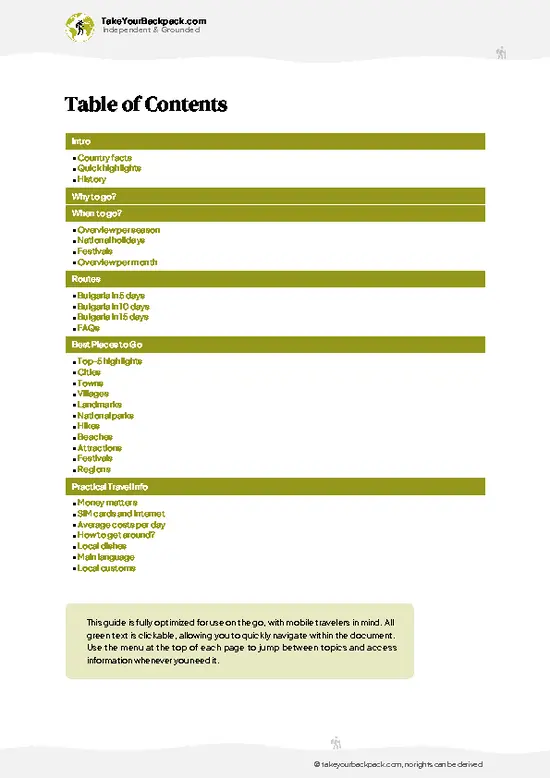
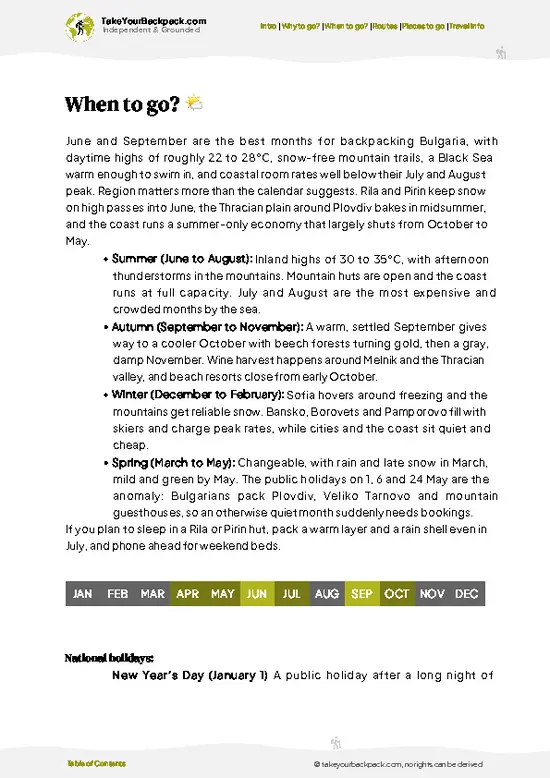
example page 0 from our offline Travel Guide for Bulgaria
example page 1 from our offline Travel Guide for Bulgaria
example page 2 from our offline Travel Guide for Bulgaria
example page 3 from our offline Travel Guide for Bulgaria
example page 4 from our offline Travel Guide for Bulgaria
example page 5 from our offline Travel Guide for Bulgaria
example page 6 from our offline Travel Guide for Bulgaria
example page 7 from our offline Travel Guide for Bulgaria
The digital guide (349 pages) contains:
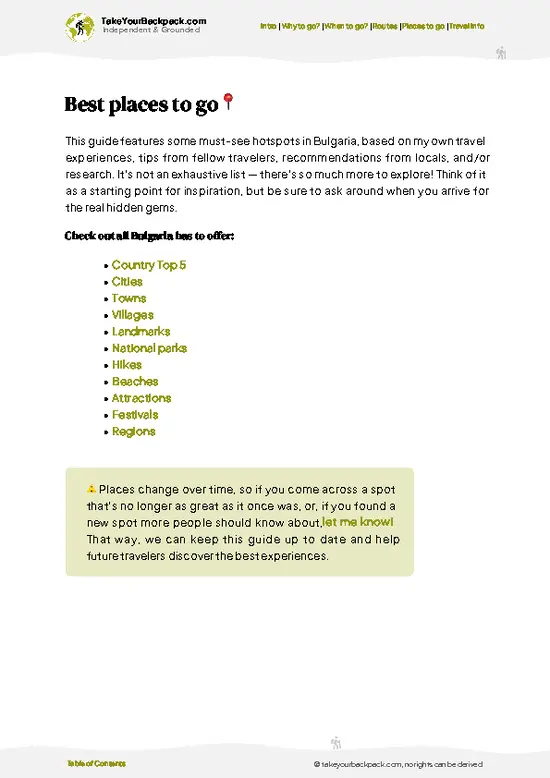
✅ 92 highlights, ranked by travel appeal
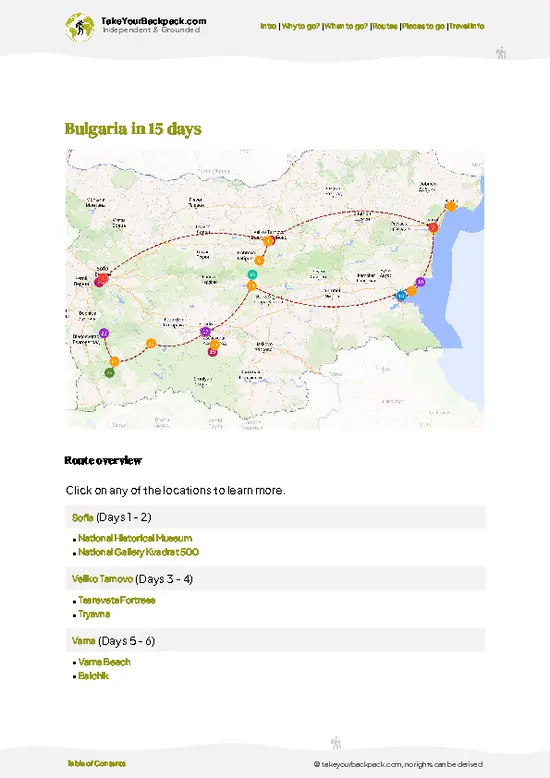
✅ Optimized 5, 10 & 15-day travel routes
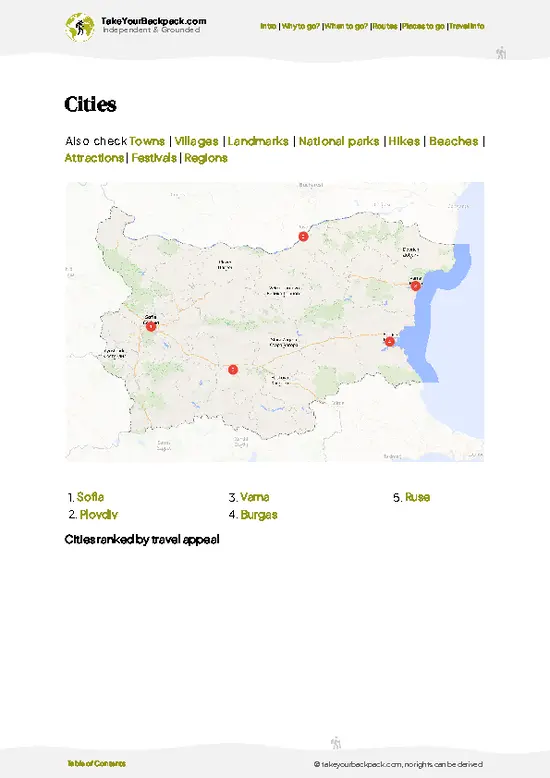
✅ Cities, national parks, landmarks, beaches
✅ How to get around
✅ Offline-friendly for travel without Wi-Fi
👉 Click to see all 30+ guide features

📅 Plan smarter in minutes, not weeks
✅ Month by month travel advice
✅ Festivals & national holidays
✅ Budget expectations

🗺️ Go to the right places, skip the overrated ones
✅ Honest pros & cons of destinations
✅ Top hikes, parks & viewpoints
✅ Lesser-known places most travelers miss
✅ Clear “worth it vs skip it” guidance

🛏️ Travel smoothly without rookie mistakes
✅ Best areas to stay
✅ Transport systems explained simply
✅ Common scams & safety advice
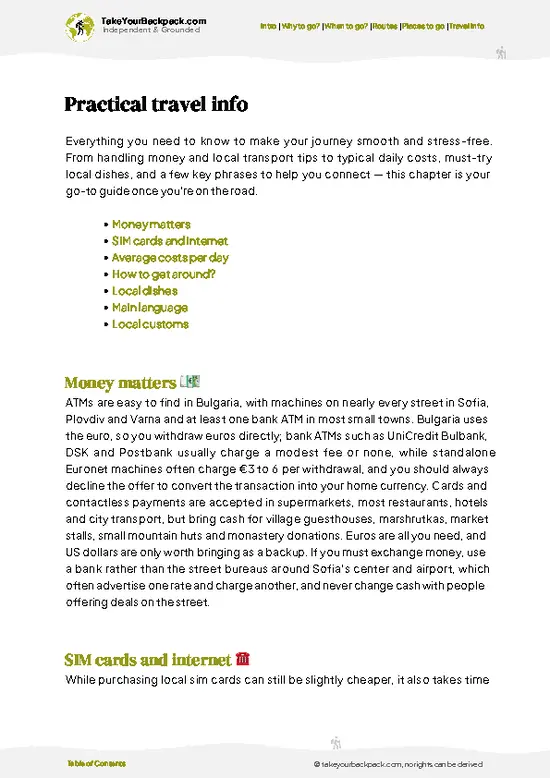
✅ SIM cards, money & practical tips

🌍 Understand the country, not just visit it
✅ Culture & traditions
✅ 52 Essential phrases & customs
✅ Festivals worth planning around
✅ Traveler-friendly historical context
✅ Insights that make places more meaningful

📱 Built for real travel conditions
✅ Fully downloadable PDF
✅ Works completely offline
✅ Optimized for phone use
✅ Useful in remote areas & buses
✅ Everything in one place
Stop searching, start planning
Get instant access to your full guide. 30‑day money-back guarantee.
+ Add another guide for just

By proceeding you agree to our terms.
Sent to your inbox immediately after payment • 100% Secure Checkout
Best Backpacking Travel Advisor 2025 tourism awardBest Backpacking
Travel Advisor
2025
What others say about Take Your Backpack Guides:
⭐⭐⭐⭐⭐
Fantastic, amazing amount of information!
⭐⭐⭐⭐⭐
My goodness this is amazing, it's what I've been looking for hats off too you!
⭐⭐⭐⭐⭐
I think this is absolutely BRILLIANT
⭐⭐⭐⭐
Very complete and informative. It's still missing places, but I gotta to commend you
⭐⭐⭐⭐⭐
This is truly amazing, thank you, can't wait to explore it with my kids!
⭐⭐⭐⭐⭐
Awesome resource, thank you!
⭐⭐⭐⭐⭐
This is amazing! Can't wait to explore the ones I haven't seen
⭐⭐⭐⭐
I love this! Well done, great idea.
⭐⭐⭐⭐⭐
Thanks for taking the time to make this gem!
⭐⭐⭐⭐⭐
This might be the best website I've ever seen.
⭐⭐⭐⭐⭐
Congratulations, and thank you so much for your work; it's incredibly valuable.
⭐⭐⭐⭐
In all seriousness I think you did a great job pointing out the important spots
⭐⭐⭐⭐⭐
10/10 very good
⭐⭐⭐⭐⭐
As someone who's only just starting to visit regularly this is awesome, thank you.
⭐⭐⭐⭐
Thank you very much! I'm going to visit my dad, it's going to be very useful!
⭐⭐⭐⭐⭐
This is really cool! We'll be travelling for the first time and this definitely come in handy.
⭐⭐⭐⭐⭐
You are now our minister of culture, congratulations 👨‍💼
⭐⭐⭐⭐⭐
Just wanted to tell you that this is a pearl! Going to follow your recommendations.
⭐⭐⭐⭐⭐
This is so cool. I'll definitely be using the resource for my travels soon.
⭐⭐⭐⭐⭐
This is very impressive! Good work.
⭐⭐⭐⭐⭐
This is an amazing and informative site. Very well done!

🛏️ Where to stay?Top Areas to Stay

Bulgaria has plenty of hostels and budget guesthouses, with dorm beds typically running €10 to 20 a night and private doubles from about €30 to 50. In Sofia, the streets around Vitosha Boulevard and Serdika put you within walking distance of the main sights, metro lines and bars, though weekend nights get loud, while Plovdiv splits between the cobbled Old Town (quiet, atmospheric, hilly) and the Kapana district (craft beer, late cafés, more noise). In Veliko Tarnovo, the Old Town along Gurko and Samovodska streets gives you cliffside views and a calm, safe base, and in Varna the center near the Sea Garden keeps you close to the beach and summer nightlife, at peak-season prices.

If you enjoy meeting … read more 👉
Bulgaria has plenty of hostels and budget guesthouses, with dorm beds typically running €10 to 20 a night and private doubles from about €30 to 50. In Sofia, the streets around Vitosha Boulevard and Serdika put you within walking distance of the main sights, metro lines and bars, though weekend nights get loud, while Plovdiv splits between the cobbled Old Town (quiet, atmospheric, hilly) and the Kapana district (craft beer, late cafés, more noise). In Veliko Tarnovo, the Old Town along Gurko and Samovodska streets gives you cliffside views and a calm, safe base, and in Varna the center near the Sea Garden keeps you close to the beach and summer nightlife, at peak-season prices.

If you enjoy meeting fellow travelers, consider choosing hostels with high ratings for atmosphere. On the other hand, if you prefer having your own space, a hotel might be a better option.

BulgariaDiscover the Country

👋 Meet the founderWho’s Behind Take Your Backpack?

Johan, backpacker and founder of TakeYourBackpackHi, I’m Johan (Netherlands 🇳🇱), the creator of TakeYourBackpack. Over the past 3 decades, I’ve backpacked through 90+ countries across six continents, gaining extensive experience with independent travel, long-term trips, and overland routes.

This site is built on a combination of firsthand travel experience and carefully curated insights from other backpackers. Many guides are based on places I’ve personally visited, while others bring together tips, observations, and practical advice shared by trusted travelers I’ve met along the way.

The goal is to provide realistic, experience-driven guidance — not generic itineraries — so you can explore destinations with better context, clearer expectations, and more confidence.