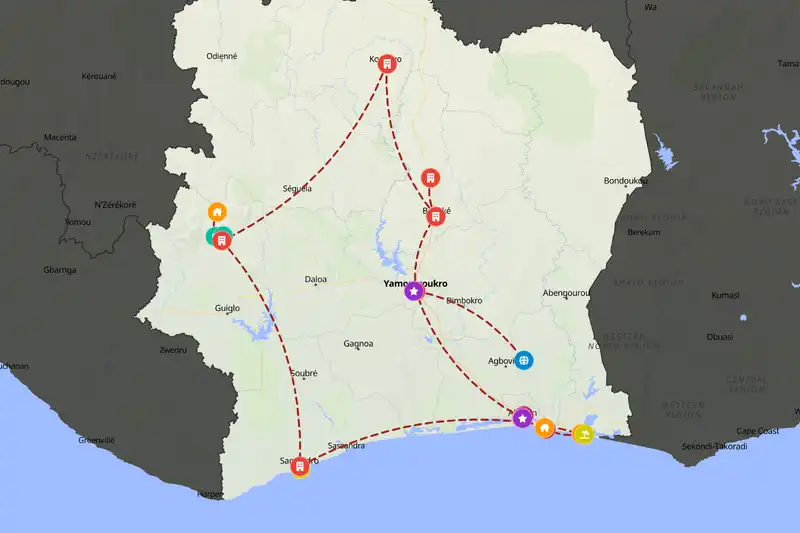
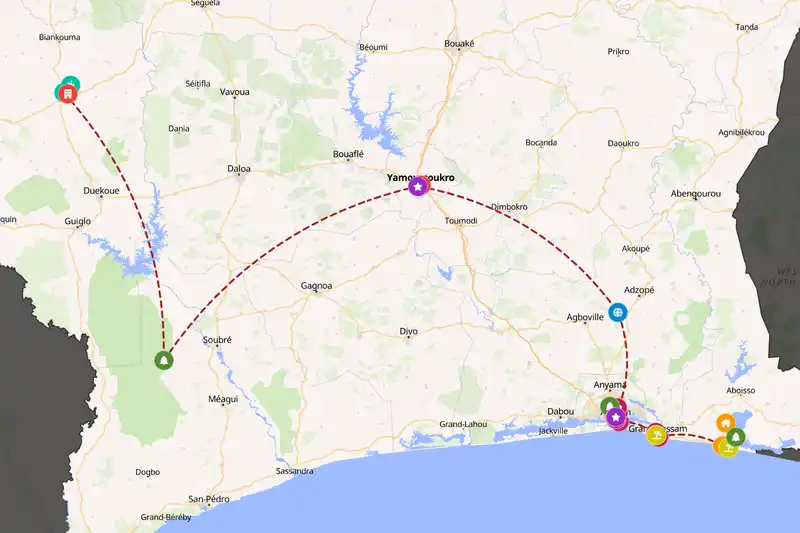
Yes, Côte d’Ivoire is very doable on your own if you speak some French and accept that there is almost no hostel scene. The main road corridors are well served by intercity coaches.
Expect budget hotel rooms at 10,000 to 25,000 CFA (US$17 to 42) outside
Abidjan, with the city itself costing more. A daily budget of roughly 16,500 to 29,500 CFA (US$30 to 50) covers a room, maquis meals and buses. Most nationalities need an e-visa, applied for online before arrival and stamped at Abidjan airport. English is rarely spoken beyond upscale hotels, so learning basic French numbers and greetings will save you money at every taxi rank.
Ten days is the right length for a first trip to Côte d’Ivoire. That covers
Abidjan, the coast,
Yamoussoukro and the mountains around
Man without rushing.
With five days, stay in the south-east: two nights in Abidjan, one in
Grand-Bassam and one or two in
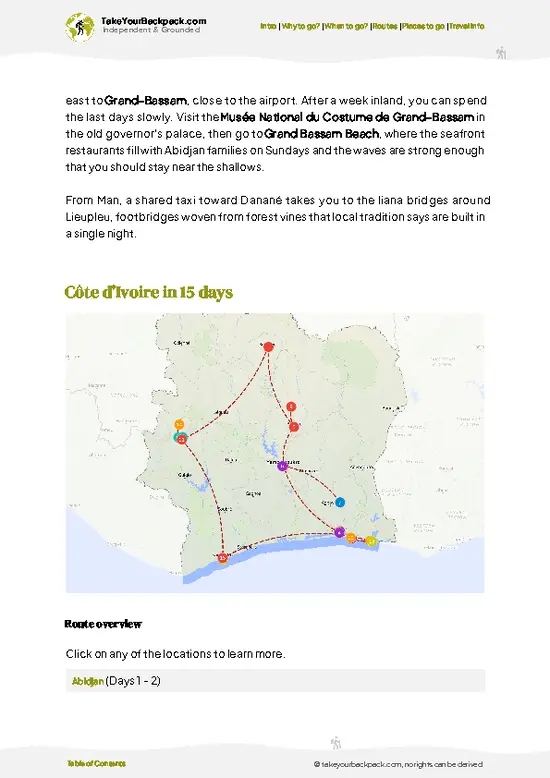
Assinie, with no ride longer than about two hours. Fifteen days lets you add
Korhogo in the north and
San Pedro in the west. Plan around the travel times: Abidjan to Yamoussoukro takes about 3 hours, Abidjan to Man 8 to 10 hours, and Korhogo to Man 7 to 9 hours. Each of those long days needs a rest day after it.
Yes, you can cover Côte d’Ivoire without a car. Intercity coaches link every major city, and shared taxis and minibuses fill the gaps.
Typical runs:
Abidjan to
Yamoussoukro takes about 3 hours for 4,000 to 6,000 CFA (US$7 to 10). Abidjan to
Man takes 8 to 10 hours for 10,000 to 12,000 CFA (US$17 to 20). Abidjan to
Grand-Bassam takes under an hour for about 1,000 CFA (under US$2). Book coach seats a day ahead on busy routes and arrive early, because departures often leave when full. A car becomes worthwhile only for
Taï or
Comoé national parks, which require organized transport and a guide.
The essential stops in Côte d’Ivoire are the
Basilica of Our Lady of Peace in Yamoussoukro, the old colonial quarter of
Grand-Bassam, and the mountains around
Man.
Give Yamoussoukro one or two nights; it is about 3 hours from Abidjan. Grand-Bassam is an easy day or overnight under an hour from the airport, and its costume museum is the best small museum in the country. In Man, plan two or three nights to climb
La Dent de Man, a 2 to 3 hour ascent with a guide. Add
Assinie for beach time and
Korhogo for Senufo weaving villages if your trip is longer than ten days.
If time is tight in Côte d’Ivoire, skip
Bouaké, the big national parks and Abidjan’s amusement attractions. Each takes time that most short trips can’t spare.
Bouaké is mainly a huge market and a transit hub, and you can pass through it on the way north.
Taï and
Comoé national parks each need three or more days plus organized transport, so they suit a dedicated second trip. In
Abidjan, the zoo and the Parc d’Attractions are fine for families but forgettable otherwise.
San Pedro is a 5 to 7 hour ride from Abidjan, so with under ten days, do your beach time at Assinie or Grand-Bassam instead.
Yes, our itinerary-planner does exactly that. Set your trip length in days, give your interests and travel style, optionally give start- and end location and/or some mandatory stops you would like to include and the itinerary planner creates your personalized routes for Côte d’Ivoire in seconds. Try it out!
Try the itinerary plannerv2.webp)


 Best Backpacking