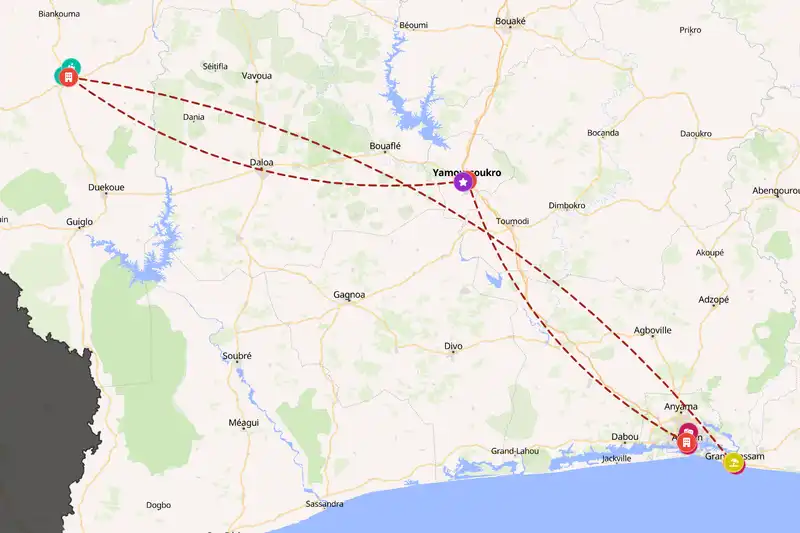
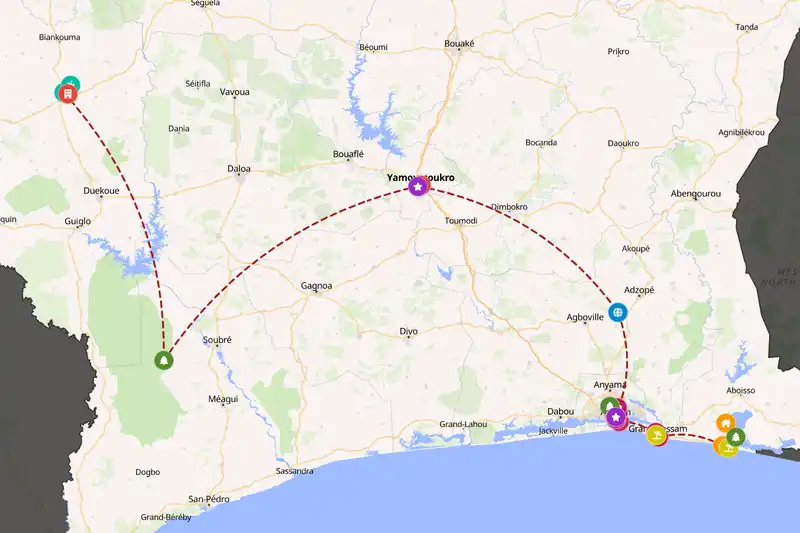
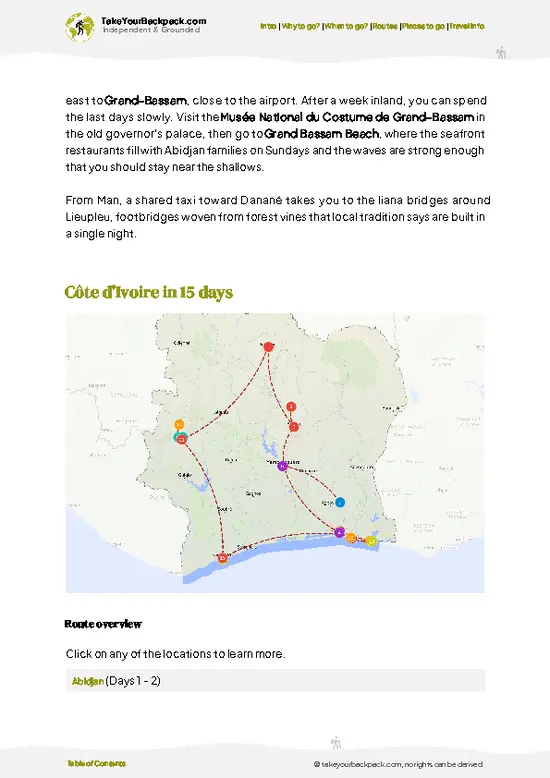
This fifteen-day circuit is for travelers who want the whole country in one trip: the Abidjan art scene, the Yamoussoukro basilica, Senufo weaving villages in the north, the forested mountains around Man, and two very different coastlines. The pace is steady rather than rushed, with two- and three-night stops between the three long road days, and none of those long days fall back to back. You can do all of it on public transport in Côte d’Ivoire: intercity coaches on the main corridors, shared taxis and minibuses for village side trips, and the lagoon boats in Abidjan.
Days 1-2: Abidjan Through Its Museums and Galleries
Start in
Abidjan, and spend these two days on the city’s creative side. The
Musée des Civilisations de Côte d’Ivoire in Plateau gives you the background for everything that follows: Dan masks from the Man region, Senufo carvings from around Korhogo, and Akan gold weights. Seeing them first means you will recognize the styles later in the villages where they are still made. …
read more 👉This fifteen-day circuit is for travelers who want the whole country in one trip: the Abidjan art scene, the Yamoussoukro basilica, Senufo weaving villages in the north, the forested mountains around Man, and two very different coastlines. The pace is steady rather than rushed, with two- and three-night stops between the three long road days, and none of those long days fall back to back. You can do all of it on public transport in Côte d’Ivoire: intercity coaches on the main corridors, shared taxis and minibuses for village side trips, and the lagoon boats in Abidjan.
Days 1-2: Abidjan Through Its Museums and Galleries
Start in Abidjan, and spend these two days on the city’s creative side. The Musée des Civilisations de Côte d’Ivoire in Plateau gives you the background for everything that follows: Dan masks from the Man region, Senufo carvings from around Korhogo, and Akan gold weights. Seeing them first means you will recognize the styles later in the villages where they are still made. Then cross to Cocody for the Fondation Donwahi pour l’Art Contemporain, where current Ivorian and African artists show work in a quiet villa-and-garden setting.
Give yourself at least one ride across the Abidjan Lagoon on the public boats. The crossing costs under 500 CFA and shows you the Plateau skyline from the water. It is also the fastest way to understand how the city splits into separate districts around the Ébrié Lagoon.Days 3-4: Yamoussoukro and the Bélier Region
The autoroute north gets you to Yamoussoukro in about three hours. Two nights here let you see the Basilica of Our Lady of Peace in the soft morning light, when the stained glass glows and the plaza is nearly empty. The building was modeled on St Peter’s in Rome, and its dome rises higher than the original. A guided visit takes you up into the structure for a view over a city of oversized boulevards with very little traffic.
Use the second day to explore the wider Bélier Region. The lake around the former presidential palace is home to the crocodiles linked to Houphouët-Boigny’s legend, and keepers feed them in the late afternoon. Spend the rest of the day on the countryside around the capital, which is Baoulé farming land of yams, cocoa and small roadside markets.Days 5-7: Bouaké, Katiola and Korhogo
It is only about 1.5 hours from Yamoussoukro to Bouaké, so you arrive with the afternoon free for the grand marché. It is one of the largest markets in West Africa and runs for blocks: cloth, hardware, mounds of dried fish, and stalls of secondhand clothes. One night is enough.
Next morning, head north and stop in Katiola. Women potters there still shape large clay pots by hand and fire them in the open, and watching them work takes an hour or two. Continue to Korhogo for two nights. This is Senufo country, with drier air, red laterite roads and mango trees. From town, shared taxis reach the weaving village of Waraniéné, where narrow strips of cotton are woven on looms, and the painters who make the black-on-cream Korhogo cloth.Days 8-10: Man and the Western Mountains
Day 8 is a full travel day, roughly 7 to 9 hours south-west to Man. That is why the next three nights are all spent there. On the first full day, climb La Dent de Man Trail from the village of Zoguale. The steep pull up the tooth-shaped peak takes 2 to 3 hours with a local guide, and the view from the top looks over green ridges toward the Guinean border.
The second day goes to Mount Tonkoui Trail. At about 1,190 meters it is one of the highest points in the country, and the summit is cool enough in the morning that you will want a fleece. On the way back, detour to Biankouma for Dan villages with round thatched houses and a mask culture that is still a living part of village life.Days 11-12: San Pedro on the Western Coast
The second long road day runs from the mountains down through the cocoa belt to San Pedro, taking 7 to 9 hours. Two nights give you a whole day to recover on San Pedro Beach, a long, wide stretch of sand that sees far fewer weekend crowds than the beaches east of Abidjan. The port town has a working, sweaty feel to it, and grilled fish at the beach shacks costs a fraction of what you would pay in Assinie.Days 13-15: Assinie-Mafia and a Last Morning in Grand-Bassam
Day 13 is the final long ride: east along the coast, past Abidjan, and on to Assinie-Mafia. It takes most of the day, so plan to arrive tired and do nothing that evening. Day 14 belongs to Assinie Beach. The town sits on a thin sandbar, and the lagoon side is the calm one for swimming. On the ocean side, respect the heavy surf and the undertow.
On Day 15, head back toward the airport through Grand-Bassam, which lies right on the way. Give the morning to the Musée National du Costume de Grand-Bassam, housed in the old colonial governor’s palace, then catch your flight from Port-Bouët, which is only about 30 minutes further.
With a spare day in the north, ride out from Korhogo toward Kong, an old Dyula trading town whose Sudanese-style mud mosque bristles with wooden beams and sees only a handful of foreign visitors a year.
 Best Backpacking