×
Dominican Republic🇩🇴 | 5 days itinerary

How to Spend 5 Days in Dominican Republic

By Johan Kruseman 🇳🇱 | Updated April 25, 2026
This 5-day route is for travelers who want a concentrated hit of culture, food, and nightlife without burning out, using Santo Domingo as a single, easy base and moving mostly on foot or by short taxi rides. The pace is relaxed but full: you’ll walk the colonial streets by day, dive into museums when the sun is harsh, and lean into long dinners and music-filled evenings instead of long bus rides.

Days 1-2: Santo Domingo’s Colonial Core

Base yourself in Santo Domingo and spend your first two days orbiting the compact Colonial Zone, where nearly everything you want is within a 10-15 minute walk. Start with the Catedral Primada de América, not just because it’s the oldest cathedral in the Americas, but because standing inside its cool stone nave instantly resets your sense of time and place. From there, wander over to the Alcázar de Colón Museum, where the thick walls, creaking floors, and river views give you a feel for how absurdly powerful this port once was. Round out the historical triangle … read more 👉
This 5-day route is for travelers who want a concentrated hit of culture, food, and nightlife without burning out, using Santo Domingo as a single, easy base and moving mostly on foot or by short taxi rides. The pace is relaxed but full: you’ll walk the colonial streets by day, dive into museums when the sun is harsh, and lean into long dinners and music-filled evenings instead of long bus rides.

Days 1-2: Santo Domingo’s Colonial Core

Base yourself in Santo Domingo and spend your first two days orbiting the compact Colonial Zone, where nearly everything you want is within a 10-15 minute walk. Start with the Catedral Primada de América, not just because it’s the oldest cathedral in the Americas, but because standing inside its cool stone nave instantly resets your sense of time and place. From there, wander over to the Alcázar de Colón Museum, where the thick walls, creaking floors, and river views give you a feel for how absurdly powerful this port once was. Round out the historical triangle at the Museo de las Casas Reales, which ties together the colonial bureaucracy, trade routes, and everyday life; it’s the museum that makes the streets outside feel like a living extension of the exhibits.

Day 3: Deep-Dive Museums and Modern Culture

Keep your base in Santo Domingo and use day three to go beyond the postcard version of the city. Head to the Museo del Hombre Dominicano to get a grounded sense of Taíno heritage, African roots, and how those threads show up in music, religion, and daily life; it’s the context that makes every merengue track and street altar you see later click into place. Then swing by the Museo de Arte Moderno, where the building and the collections both show you how Dominican artists have been wrestling with identity, politics, and Caribbean light in the last century. If you still have energy, finish at the Amber World Museum, where you can see amber pieces that look like they were frozen mid-breath, and learn enough to avoid overpaying for a fake in a souvenir shop.

Day 4: Coastal Contrast and Monumental Scale

Stay one more night in Santo Domingo but change the scenery by heading out toward the seafront and eastern edge of the city. Start at Parque Nacional Submarino La Caleta, where you can get a feel for the underwater world that frames so much of Dominican life, whether you’re snorkeling, diving, or just watching the coastline and local weekend scene. In the afternoon, visit the Faro a Colón, a massive, controversial monument that feels part mausoleum, part spaceship; it’s less about beauty and more about understanding how the country has chosen to frame Columbus and its own history in concrete and light beams. Returning to the Colonial Zone in the evening, you’ll appreciate how human-scale and lively it feels after a day of big structures and open sea.

Day 5: Stones, Stories, and a Last Slow Walk

Use your final day in Santo Domingo to loop back to any favorite corners of the Colonial Zone and to pick up anything you missed. Drop into the Museo Larimar to learn why that blue stone shows up in so much local jewelry and how to tell the good pieces from the tourist-trap ones, then circle back through plazas and side streets that now feel familiar. With flights and onward buses leaving from the same city you’ve been exploring all week, you avoid any last-day transit stress and can spend your final hours exactly how you want: one more coffee in a shady courtyard, one more slow walk past centuries-old stone.

As a tiny bonus detour for future trips, keep a mental pin in the quiet riverside community of La Ciénaga de Manabao, where mountain air and backyard coffee farms give you a completely different Dominican rhythm.
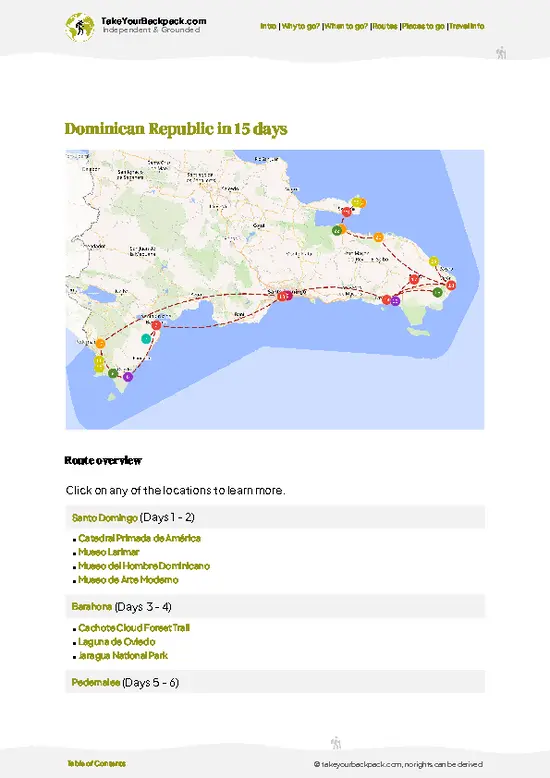
Loading the map 🌍
film
0
0
0a
Santo Domingo
Ana Cecilia Matías (anicemati)
film
1
1
1a
Catedral Primada de América
film
2
2
2a
Alcázar de Colón Museum
film
3
3
3a
Museo de las Casas Reales
film
4
4
4a
Museo del Hombre Dominicano
film
5
5
5a
Museo de Arte Moderno
film
6
6
6a
Faro a Colón
film
7
7
7a
Museo Larimar

🛏️ Where to stay?Where You'll Go

✈️ The backpacker research shortcutDominican Republic Travel Guide

An offline-friendly backpacking guide with optimized travel routes, ranked highlights, transport advice, and the best areas to stay.
example page 0 from our offline Travel Guide for Dominican Republicexample page 1 from our offline Travel Guide for Dominican Republicexample page 2 from our offline Travel Guide for Dominican Republicexample page 3 from our offline Travel Guide for Dominican Republicexample page 4 from our offline Travel Guide for Dominican Republicexample page 5 from our offline Travel Guide for Dominican Republic
The digital guide (372 pages) contains:
119 highlights, ranked by travel appeal
Optimized 5, 10 & 15-day travel routes
Best neighborhoods to stay
How to get around
Offline-friendly for travel without Wi-Fi
👉 See all 30+ guide features

📅 Plan smarter in minutes, not weeks
Month by month travel advice
Festivals & national holidays
Budget expectations

🗺️ Go to the right places, skip the overrated ones
Honest pros & cons of destinations
Top hikes, parks & viewpoints
Lesser-known places most travelers miss
Clear “worth it vs skip it” guidance

🛏️ Travel smoothly without rookie mistakes
Best areas to stay
Transport systems explained simply
Common scams & safety advice
SIM cards, money & practical tips

🌍 Understand the country, not just visit it
Culture & traditions
52 Essential phrases & customs
Festivals worth planning around
Traveler-friendly historical context
Insights that make places more meaningful

📱 Built for real travel conditions
Fully downloadable PDF
Works completely offline
Optimized for phone use
Useful in remote areas & buses
Everything in one place
Save weeks of stressful planning
Get instant access to the full guide directly. 30-day money-back guarantee.


Sent to your inbox immediately after payment • 100% Secure Checkout
Best Backpacking Travel Advisor 2025 tourism awardBest Backpacking
Travel Advisor
2025
What others say about Take Your Backpack Guides:
⭐⭐⭐⭐⭐
Fantastic, amazing amount of information!
⭐⭐⭐⭐⭐
My goodness this is amazing, it's what I've been looking for hats off too you!
⭐⭐⭐⭐⭐
I think this is absolutely BRILLIANT
⭐⭐⭐⭐
Very complete and informative. It's still missing places, but I gotta to commend you
⭐⭐⭐⭐⭐
This is truly amazing, thank you, can't wait to explore it with my kids!
⭐⭐⭐⭐⭐
Awesome resource, thank you!
⭐⭐⭐⭐⭐
This is amazing! Can't wait to explore the ones I haven't seen
⭐⭐⭐⭐
I love this! Well done, great idea.
⭐⭐⭐⭐⭐
Thanks for taking the time to make this gem!
⭐⭐⭐⭐⭐
This might be the best website I've ever seen.
⭐⭐⭐⭐⭐
Congratulations, and thank you so much for your work; it's incredibly valuable.
⭐⭐⭐⭐
In all seriousness I think you did a great job pointing out the important spots
⭐⭐⭐⭐⭐
10/10 very good
⭐⭐⭐⭐⭐
As someone who's only just starting to visit regularly this is awesome, thank you.
⭐⭐⭐⭐
Thank you very much! I'm going to visit my dad, it's going to be very useful!
⭐⭐⭐⭐⭐
This is really cool! We'll be travelling for the first time and this definitely come in handy.
⭐⭐⭐⭐⭐
You are now our minister of culture, congratulations 👨‍💼
⭐⭐⭐⭐⭐
Just wanted to tell you that this is a pearl! Going to follow your recommendations.
⭐⭐⭐⭐⭐
This is so cool. I'll definitely be using the resource for my travels soon.
⭐⭐⭐⭐⭐
This is very impressive! Good work.
⭐⭐⭐⭐⭐
This is an amazing and informative site. Very well done!

🧭 RouteAdjust Your Pace

Travel Dominican Republic your way — from a quick highlights trip to a slow-paced adventure.

🙋 FAQTraveler FAQ

Short version: yes, Dominican Republic is very doable to backpack independently if you’re a bit flexible and patient.

Why it’s backpacker‑friendly:
- Accommodation: Plenty of cheap guesthouses, hostels, and family-run hotels in most towns and beach areas. You can usually walk around and compare a few places before committing.
- Food: Street food and comedores (local eateries) are cheap and filling—think rice, beans, chicken, plantains, empanadas. You can eat well on a tight budget if you stick to local spots.
- People: Dominicans are social and usually happy to help with directions or transport questions, especially if you try a little Spanish.

What makes it slightly tricky:
- Language: Outside tourist zones, English drops off fast. Basic Spanish (numbers, directions, days of the week, simple questions) makes your life much easier.
- Transport chaos: Guaguas (minibuses) and carros públicos (shared taxis) don’t always have clear signs or schedules. You often ask around and confirm the destination before hopping in.
- Night travel: Roads can be rough, lighting is poor, and driving standards are…creative. For safety and sanity, avoid long-distance road travel after dark.

If you’ve backpacked anywhere in Latin America or Southeast Asia, DR will feel familiar: a bit chaotic, very human, and absolutely manageable if you keep your plans loose and your expectations realistic.
If you’re flying all the way to Dominican Republic, aim for at least 10–14 days. You can do less, but you’ll be cutting corners.

Rough timing guide for budget travelers:
- 5–7 days: Pick one region and do it properly.
- Example: Santo Domingo + Bayahibe/La Romana, or Santo Domingo + Samaná, or just the north coast (Puerto Plata/Cabarete/Sosúa).
- 10–14 days: Solid first trip.
- Combo of culture, beaches, and a bit of nature: Santo Domingo (2–3 days), Samaná or north coast beaches (4–6 days), plus 2–3 days in the mountains around Jarabacoa/Constanza or a second beach area.
- 3+ weeks: Great backpacking window.
- You can loop: Santo Domingo → Samaná → north coast (Cabarete/Puerto Plata) → central mountains (Jarabacoa/Constanza) → south coast (Barahona/Pedernales) → back to Santo Domingo.

If you’re very short on time (under a week), don’t try to “see the whole island.” Pick one base and do day trips. Travel days eat more time than they look like on the map, especially with public transport.
You can absolutely get around Dominican Republic without renting a car, especially on a backpacker budget.

Main options:
- Guaguas (minibuses): Cheapest way to move between towns and within regions. They leave when full, not on strict schedules, but they’re frequent on popular routes. Expect tight seating and lots of stops.
- Intercity buses: Companies like Caribe Tours and Metro run comfortable, air‑conditioned buses between major cities (Santo Domingo, Santiago, Puerto Plata, etc.). They’re cheap, reliable, and the easiest way to cover longer distances.
- Carros públicos (shared taxis): Fixed routes within and between nearby towns. You share with others, pay a set price, and hop out along the route. They’re crowded but efficient.
- Motoconchos (motorbike taxis): Common for short hops in towns and villages. Always agree on the price first and wear a helmet if one is available.
- Private shuttles/taxis: More expensive but useful for awkward routes (like some beach towns or late arrivals). Good to budget for a couple of these if you’re short on time.

When going car‑free, the main constraints are:
- Time: Public transport is cheap but slower and less direct. Build in buffer time for transfers and waiting.
- Night travel: Try to move during daylight. Buses are fine, but I’d avoid long guagua or motoconcho rides after dark.

If you’re comfortable with a bit of improvisation and asking locals which bus to take, you don’t need a car.
For a budget traveler, “must‑visit” means places with character, good value, and easy-ish logistics. These are the heavy hitters:

1. Santo Domingo (Zona Colonial)
- Why go: History, street life, and real Dominican city energy. Cobblestone streets, old forts, plazas full of domino games and music.
- Budget angle: Cheap guesthouses, local food, and walkable sights. Great intro to the country before you hit the beaches.

2. Samaná Peninsula (Las Terrenas, Las Galeras, Samaná town)
- Why go: Wild-feeling beaches, palm forests, and a more laid‑back vibe than the big resort zones.
- Highlights: Playa Rincón, Playa Frontón (boat or hike), waterfalls like El Limón, whale watching in season (roughly Jan–Mar).
- Budget angle: Guesthouses and simple apartments are common; you can cook or eat at local comedores instead of resort restaurants.

3. North Coast (Cabarete, Puerto Plata, Sosúa)
- Why go: Surf, kitesurf, backpacker scene, and a mix of local life with tourism.
- Highlights: Cabarete for water sports and social hostels, Puerto Plata for cable car views and a more local city feel, Sosúa for beaches and easy access.
- Budget angle: Lots of competition keeps prices reasonable; you can walk or use cheap local transport between towns.

4. Central Mountains (Jarabacoa and/or Constanza)
- Why go: Cooler temperatures, rivers, waterfalls, and hiking. A nice break from the heat and beach.
- Highlights: Waterfalls like Salto de Jimenoa, river rafting near Jarabacoa, hiking and viewpoints around Constanza.
- Budget angle: Simple cabins, guesthouses, and cheap local food. Great value if you like nature more than nightlife.

5. Southwest Coast (Barahona, Bahía de las Águilas/Pedernales) – if you have time
- Why go: Dramatic coastline, fewer tourists, and a more rugged, road‑trip feel.
- Highlights: Bahía de las Águilas (one of the most impressive beaches in the country), Lago Enriquillo area, coastal viewpoints.
- Budget angle: Transport is slower and a bit more complex, but once there, costs can be low if you stay in basic guesthouses and eat local.
If you’re short on time or cash, skip anything that eats days without adding much beyond what you can get elsewhere.

1. All‑inclusive resort bubbles (especially around Punta Cana)
- Why skip: They’re designed to keep you inside the complex. You’ll spend more, see less of the country, and be locked into resort prices.
- Better alternative: A simple guesthouse or hostel near a public beach in Samaná or the north coast gives you more freedom and local flavor.

2. Trying to circle the entire island in one trip
- Why skip: Distances plus slow transport mean you’ll spend half your trip on buses and guaguas. You’ll collect bus tickets instead of experiences.
- Better alternative: Pick 2–3 regions max (for example: Santo Domingo + Samaná + mountains, or Santo Domingo + north coast) and actually enjoy them.

3. Overpriced “shopping tours” and generic city tours
- Why skip: Many are commission-driven stops at souvenir shops and malls. You pay for a bus seat and pressure to buy things.
- Better alternative: Use local buses or walk, visit markets on your own, and spend that money on a local guide for one focused experience (like a hike or a historical walking tour).

4. Cruise‑port style beach days near big resorts
- Why skip: Crowded, more expensive, and often full of vendors targeting short‑term visitors.
- Better alternative: Public beaches a bit farther from the main resort strips or the beaches around Samaná and the north coast feel more relaxed and are easier on the wallet.

5. Long detours to very remote corners if you only have a week
- Why skip: Places like the far southwest (Pedernales/Bahía de las Águilas) are incredible but can eat 2–3 full days in transport alone.
- Better alternative: Save those for a longer trip. With limited time, stick to areas with good bus connections so you’re swimming, hiking, and eating, not just sitting on a bus.

🇩🇴 Dominican RepublicSee More of Dominican Republic

Ready to build a truly unique trip? Predefined routes are perfect for first-time visitors, but there is so much more to discover. Whether you are chasing a city trip, pristine national parks, local food scenes, or quiet beaches, pick a category to design your own path.