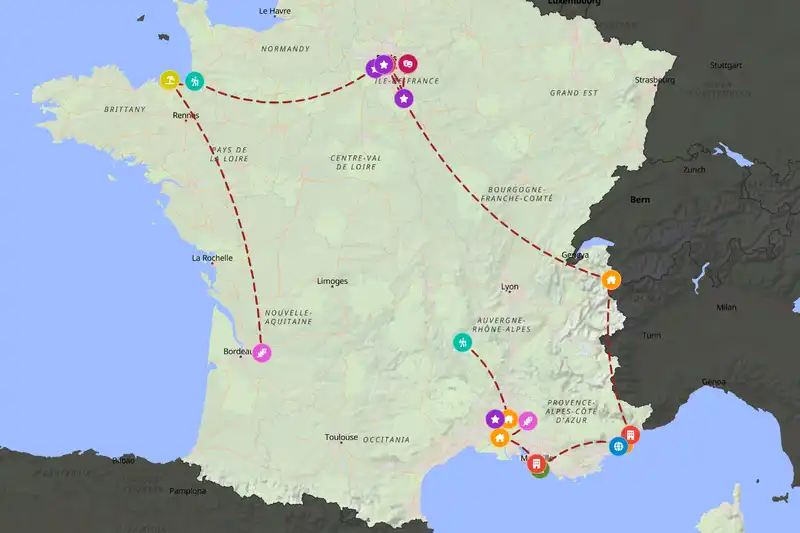
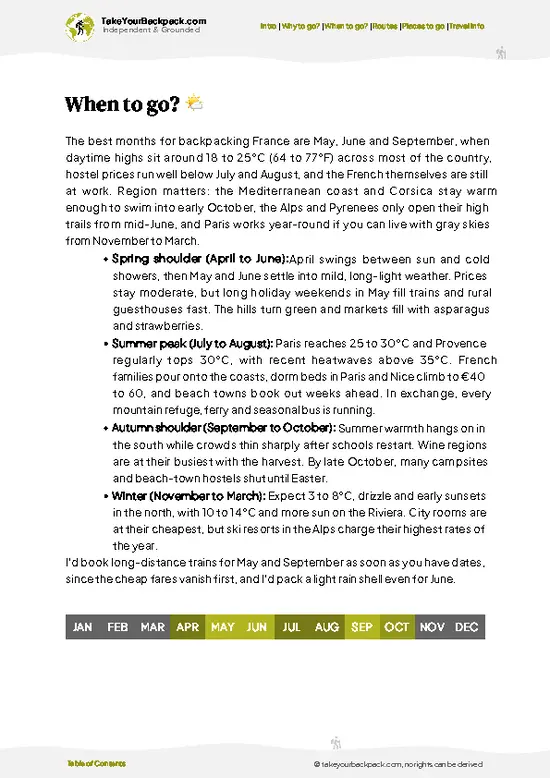
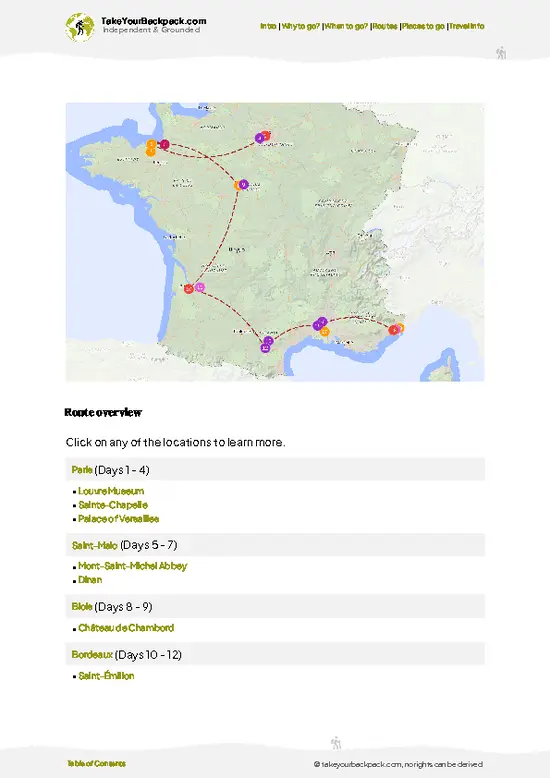
Two weeks gives you the classic north-to-south sweep of France by rail: a short Paris stay, a gastronomic stop in Lyon, then a slow descent through Provence to the Mediterranean. It suits travelers who want cities and coast in equal measure and like having a base for day trips. The pace is moderate, with two or three nights per stop. You will rely on TGV high-speed trains, regional TER trains, city buses in Marseille and Nice, and a regional bus to the Pont du Gard.
Days 1-3: Paris, Panthéon and Eiffel Tower
With three nights in
Paris, focus on neighborhoods over checklists. Base yourself on the Left Bank and climb the hill of the Latin Quarter to the
Panthéon, where Voltaire, Victor Hugo and Marie Curie are buried in the crypt and a Foucault pendulum swings beneath the dome; the colonnade terrace, open in the warmer months, looks straight across the rooftops. On another evening, pack a baguette and cheese for a picnic on the Champ de Mars facing the
Eiffel Tower, which is how many Parisians …
read more 👉Two weeks gives you the classic north-to-south sweep of France by rail: a short Paris stay, a gastronomic stop in Lyon, then a slow descent through Provence to the Mediterranean. It suits travelers who want cities and coast in equal measure and like having a base for day trips. The pace is moderate, with two or three nights per stop. You will rely on TGV high-speed trains, regional TER trains, city buses in Marseille and Nice, and a regional bus to the Pont du Gard.
Days 1-3: Paris, Panthéon and Eiffel Tower
With three nights in Paris, focus on neighborhoods over checklists. Base yourself on the Left Bank and climb the hill of the Latin Quarter to the Panthéon, where Voltaire, Victor Hugo and Marie Curie are buried in the crypt and a Foucault pendulum swings beneath the dome; the colonnade terrace, open in the warmer months, looks straight across the rooftops. On another evening, pack a baguette and cheese for a picnic on the Champ de Mars facing the Eiffel Tower, which is how many Parisians actually enjoy it.Days 4-5: Lyon
The TGV from Gare de Lyon covers the distance in about 2 hours. Lyon is the place to spend your food budget: book a bouchon for quenelles and saucisson brioché at €25 to 35 for a set menu, and browse Les Halles Paul Bocuse for cheese and charcuterie. Ride the funicular up to Fourvière for the basilica and the Roman theater, then walk down through Vieux Lyon, ducking into the traboules, covered passageways that cut through Renaissance courtyards. The Croix-Rousse hill, the old silk-weavers’ district, has the best cheap wine bars.Days 6-8: Avignon, Pont du Gard and Arles
A train south lands you in Avignon in roughly 1 to 1.5 hours. The Palais des Papes is the largest Gothic palace in Europe, and the half-bridge of Saint-Bénézet still stops dead in the middle of the Rhône. Use Avignon as a hub: a regional bus reaches the Pont du Gard (Roman Aqueduct) in about 45 minutes to 1 hour, where you can walk the riverbank and swim beneath three tiers of arches in summer. On another day, the train to Arles takes about 20 minutes. Its Roman arena, cryptoportico and the café terrace on Place du Forum that Van Gogh painted all fit into a slow walk.Days 9-10: Marseille and Les Calanques
The TGV from Avignon to Marseille takes around 35 minutes. Marseille is loud, sunny and real: fishermen sell the morning catch on the Vieux-Port, the lanes of Le Panier are covered in murals, and Notre-Dame de la Garde watches over everything from its hilltop. Day ten is for Les Calanques. A city bus runs to the Luminy campus, from where a rocky trail descends to the Sugiton cove in about an hour, with turquoise water at the bottom. In summer, access to some coves requires a free reservation and trails can close on high fire-risk days, so check the night before and bring at least two liters of water.Days 11-14: Nice, Eze and Antibes
Marseille to Nice is about 2 hours 40 minutes along the coast. Wander the old town, climb Castle Hill for the view over the Baie des Anges, and eat socca, a chickpea pancake, hot from the griddle. Take the bus to hilltop Eze in about 30 minutes, then walk the Nietzsche Path down to Èze-sur-Mer (1 to 1.5 hours, steep) and ride the train back. Give your last full day to Antibes, 20 to 25 minutes by train, for the Picasso Museum inside the Château Grimaldi, a ramparts walk and a swim at a small sandy beach below the walls.
For a bonus half-day from Avignon, cross the Rhône to Villeneuve-lès-Avignon, where the Fort Saint-André offers a quiet view back over the papal city.v2.webp)
 Best Backpacking