×
France🇫🇷 | 21 days itinerary

21 Days in France

By Johan Kruseman 🇳🇱 | Updated May 9, 2026
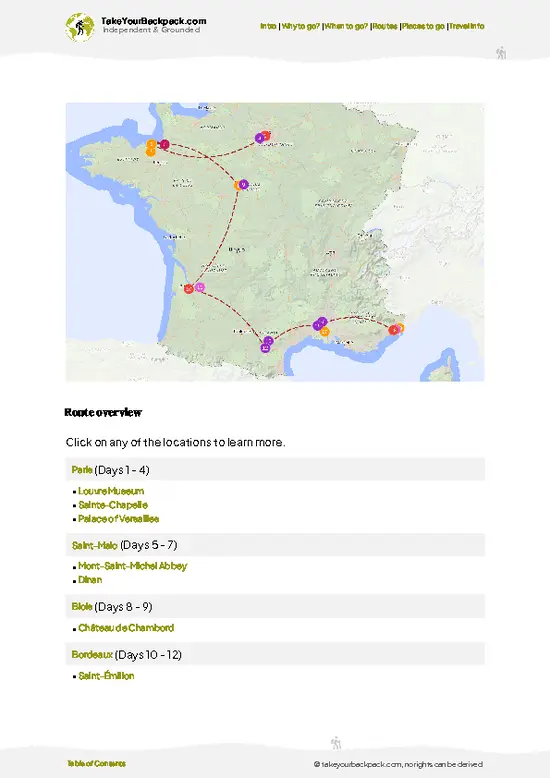
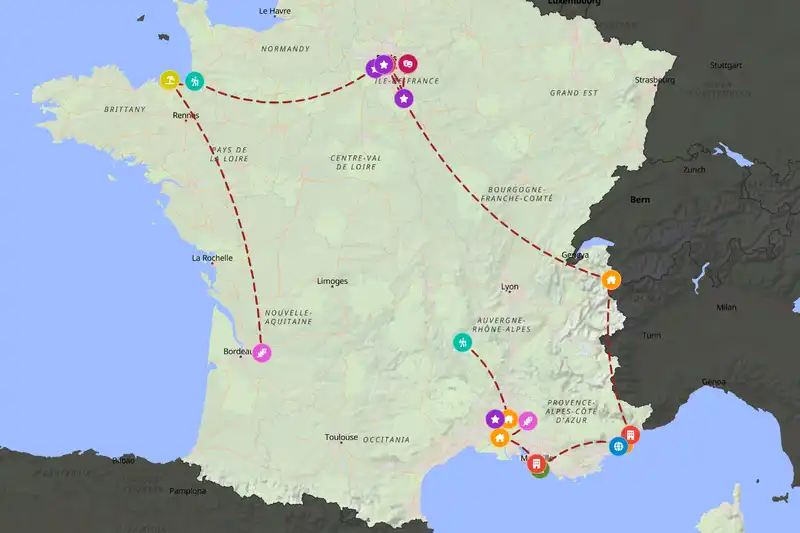
This 21-day route is for travelers who want to really live in France for a few weeks: big cities, mountain air, Mediterranean coves, medieval fortresses, and a mix of famous sights and quieter corners, all at a steady, immersive pace. You’ll lean on high-speed trains between major regions, regional trains and buses for the smaller hops, and the occasional boat or local shuttle to reach coastal and mountain areas without rushing.

Days 1-4: Paris - Deep Dive into the Capital

Start with four nights in Paris to give yourself time for both the icons and the side streets. Spread out your heavy hitters: one day for the Eiffel Tower and riverside wandering, another for the Louvre Museum, and another for the Musée d’Orsay paired with the calmer Musée de l’Orangerie so you’re not overwhelmed. Add in Sainte-Chapelle for its stained-glass glow and the Centre Pompidou if you want to see how France handles modern art and bold architecture. With the extra time, you can also slip in the Rodin Museum for … read more 👉
This 21-day route is for travelers who want to really live in France for a few weeks: big cities, mountain air, Mediterranean coves, medieval fortresses, and a mix of famous sights and quieter corners, all at a steady, immersive pace. You’ll lean on high-speed trains between major regions, regional trains and buses for the smaller hops, and the occasional boat or local shuttle to reach coastal and mountain areas without rushing.

Days 1-4: Paris - Deep Dive into the Capital

Start with four nights in Paris to give yourself time for both the icons and the side streets. Spread out your heavy hitters: one day for the Eiffel Tower and riverside wandering, another for the Louvre Museum, and another for the Musée d’Orsay paired with the calmer Musée de l’Orangerie so you’re not overwhelmed. Add in Sainte-Chapelle for its stained-glass glow and the Centre Pompidou if you want to see how France handles modern art and bold architecture. With the extra time, you can also slip in the Rodin Museum for sculpture in a garden setting and still have evenings free for neighborhood bistros and aimless walks, which is where Paris really gets under your skin.

Days 5-7: Loire Valley and Chartres - Castles and Cathedrals

On day 5, head toward the Loire Valley and base in Blois for two nights, using it as your launchpad for royal France. Spend a full day at Château de Chambord, taking time to climb the rooftop terraces and wander the surrounding park so it feels like an outing, not a quick photo stop. On day 7, travel via Chartres Cathedral, stopping to admire its soaring Gothic architecture and famous stained glass before continuing on; this breaks up the journey and adds one of France’s great cathedrals to your mental scrapbook. The combination of river-valley castles and a pilgrimage-era cathedral gives this phase a strong historical backbone without too much transit fatigue.

Days 8-11: Provence - Avignon, Gordes, and Roussillon

Continue by train to Avignon and settle in for three nights to explore Provence at a human pace. Use one day for Avignon’s own papal history and city walls, then another to reach the hilltop village of Gordes, where stone houses cling to the slope and the views stretch across the countryside. Add a day trip to Roussillon, whose ochre cliffs and warm-toned streets feel completely different from the gray stone of northern France; the color and light here are exactly why so many painters fell for Provence. With three nights, you can enjoy long lunches, evening strolls, and the sense that you’re actually staying in Provence rather than just passing through.

Days 12-15: Mediterranean Coast - Marseille, Les Calanques, and Cassis

Travel to Marseille for three nights and use the city as your base for the wild edge of the Mediterranean. Dedicate a full day to Les Calanques, where you can hike or boat into limestone inlets with turquoise water that feels a world away from urban life; this is where the trip shifts from cultural to more outdoorsy without requiring mountaineering skills. Spend another day in the smaller coastal town of Cassis, which gives you a softer, harbor-town version of the same coastline and a good place to recover with seafood and a swim. With the remaining time in Marseille, explore its neighborhoods and waterfront, enjoying the contrast between gritty port energy and the calm of the nearby coves.

Days 16-18: Carcassonne and Toulouse - Medieval Walls and Southern City Life

Head west by train to Toulouse for two nights, using the pink-brick city as a relaxed urban stop between coast and mountains. Wander its riverfront, squares, and cafés, soaking up a very different southern vibe from Marseille. Take a day trip to the Cité de Carcassonne and the Historic Fortified City of Carcassonne, where double walls and towers make you feel like you’ve walked into a storybook; going as a day trip keeps things simple while still giving you time to explore the ramparts. On day 18, return to Toulouse for one more evening, enjoying the student energy and easy-going nightlife before you head for the high country.

Days 19-21: Pyrenees and Saint-Malo - Mountains and the Atlantic Finale

Travel toward the southwest mountains and base yourself in Biarritz for two nights, giving you access to both surf culture and the nearby Pyrenees. Use a full day to reach Pyrenees National Park, where you can do a moderate hike or simply enjoy the alpine scenery and fresh air without committing to a full long-distance trek; it’s a satisfying way to add real mountain time to the route. On your final leg, make your way north to Saint-Malo for one last night on the Atlantic, walking the ramparts and watching the tide shift around the walled town. Ending here, with sea spray in the air and centuries of history under your feet, ties together the coastal, cultural, and adventurous threads of the whole journey.

My favorite stretch of this long route is hiking above the turquoise inlets of Les Calanques and then eating a slow dinner back in Marseille, feeling sun-tired and very smug about how much of France you’ve managed to fold into three weeks.
Loading the map 🌍
film
0
0
0a
Paris
Pixabay
film
1
1
1a
Eiffel Tower
Pixabay
film
2
2
2a
Louvre Museum
Pixabay
film
3
3
3a
Musée d’Orsay
Pixabay
film
4
4
4a
Musée de l’Orangerie
film
5
5
5a
Sainte-Chapelle
film
6
6
6a
Centre Pompidou
Pixabay
film
7
7
7a
Château de Chambord
Hossein Mohammadi
film
8
8
8a
Chartres Cathedral
René Rozo
film
9
9
9a
Avignon
Fabrice Di Giovanni
film
10
10
10a
Gordes
Luis Vidilla
film
11
11
11a
Roussillon
Poco Loco
film
12
12
12a
Marseille
Richard T. (စဝ်ခွန်ဆေ)
film
13
13
13a
Cassis
Yeisis Mendez
film
14
14
14a
Cité de Carcassonne
film
15
15
15a
Historic Fortified City of Carcassonne
Laurence Dréano
film
16
16
16a
Biarritz
film
17
17
17a
Pyrenees
Ara Ara I Ara

🛏️ Where to stay?21 Days of Adventure

✈️ The backpacker research shortcutFrance Travel Guide

An offline-friendly backpacking guide with optimized travel routes, ranked highlights, transport advice, and the best areas to stay.
example page 0 from our offline Travel Guide for Franceexample page 1 from our offline Travel Guide for Franceexample page 2 from our offline Travel Guide for Franceexample page 3 from our offline Travel Guide for Franceexample page 4 from our offline Travel Guide for Franceexample page 5 from our offline Travel Guide for France
The digital guide (402 pages) contains:
144 highlights, ranked by travel appeal
Optimized 7, 14 & 21-day travel routes
Best neighborhoods to stay
How to get around
Offline-friendly for travel without Wi-Fi
👉 See all 30+ guide features

📅 Plan smarter in minutes, not weeks
Month by month travel advice
Festivals & national holidays
Budget expectations

🗺️ Go to the right places, skip the overrated ones
Honest pros & cons of destinations
Top hikes, parks & viewpoints
Lesser-known places most travelers miss
Clear “worth it vs skip it” guidance

🛏️ Travel smoothly without rookie mistakes
Best areas to stay
Transport systems explained simply
Common scams & safety advice
SIM cards, money & practical tips

🌍 Understand the country, not just visit it
Culture & traditions
52 Essential phrases & customs
Festivals worth planning around
Traveler-friendly historical context
Insights that make places more meaningful

📱 Built for real travel conditions
Fully downloadable PDF
Works completely offline
Optimized for phone use
Useful in remote areas & buses
Everything in one place
Save weeks of stressful planning
Get instant access to the full guide directly. 30-day money-back guarantee.


Sent to your inbox immediately after payment • 100% Secure Checkout
Best Backpacking Travel Advisor 2025 tourism awardBest Backpacking
Travel Advisor
2025
What others say about Take Your Backpack Guides:
⭐⭐⭐⭐⭐
Fantastic, amazing amount of information!
⭐⭐⭐⭐⭐
My goodness this is amazing, it's what I've been looking for hats off too you!
⭐⭐⭐⭐⭐
I think this is absolutely BRILLIANT
⭐⭐⭐⭐
Very complete and informative. It's still missing places, but I gotta to commend you
⭐⭐⭐⭐⭐
This is truly amazing, thank you, can't wait to explore it with my kids!
⭐⭐⭐⭐⭐
Awesome resource, thank you!
⭐⭐⭐⭐⭐
This is amazing! Can't wait to explore the ones I haven't seen
⭐⭐⭐⭐
I love this! Well done, great idea.
⭐⭐⭐⭐⭐
Thanks for taking the time to make this gem!
⭐⭐⭐⭐⭐
This might be the best website I've ever seen.
⭐⭐⭐⭐⭐
Congratulations, and thank you so much for your work; it's incredibly valuable.
⭐⭐⭐⭐
In all seriousness I think you did a great job pointing out the important spots
⭐⭐⭐⭐⭐
10/10 very good
⭐⭐⭐⭐⭐
As someone who's only just starting to visit regularly this is awesome, thank you.
⭐⭐⭐⭐
Thank you very much! I'm going to visit my dad, it's going to be very useful!
⭐⭐⭐⭐⭐
This is really cool! We'll be travelling for the first time and this definitely come in handy.
⭐⭐⭐⭐⭐
You are now our minister of culture, congratulations 👨‍💼
⭐⭐⭐⭐⭐
Just wanted to tell you that this is a pearl! Going to follow your recommendations.
⭐⭐⭐⭐⭐
This is so cool. I'll definitely be using the resource for my travels soon.
⭐⭐⭐⭐⭐
This is very impressive! Good work.
⭐⭐⭐⭐⭐
This is an amazing and informative site. Very well done!

🧭 RouteMore Ways to Explore

Travel France your way — from a quick highlights trip to a slow-paced adventure.

🙋 FAQGood to Know

France is one of the easiest countries in Europe to backpack on your own if you’re even mildly organized. The rail network is dense, hostels are common in cities and tourist hubs, and you can usually fall back on basic English if your French is rusty. The key is understanding that France is not as cheap as Eastern Europe, so “independent” here means planning around value, not rock-bottom prices. Book long-distance trains in advance, travel off-peak when you can, and lean on supermarket picnics instead of restaurant meals. Safety-wise, solo travel is straightforward: watch your stuff in big-city train stations and on the Paris metro, but outside the main urban centers it’s mostly calm and predictable. Culturally, people appreciate a simple bonjour, s’il vous plaît, and merci; starting in French and then switching to English usually gets you much better help. If you’re comfortable reading timetables, using a map app offline, and booking beds a few days ahead, France is absolutely backpacker-friendly.
For a first backpacking trip to France, 10–14 days is the sweet spot if you want more than just Paris and a blur of train windows. With 3–5 days, focus on Paris only and maybe a single day trip (Versailles or a nearby town) so you’re not spending half your time in transit. With 7 days, do Paris (4 days) plus one region: Normandy, Alsace, the Loire, or the south (Provence or the Riviera). With 10–14 days, you can do a classic loop: Paris → Normandy or Brittany → Loire or Bordeaux → south of France → back to Paris. With 3 weeks or more, you can slow down and add mountains (Alps or Pyrenees), smaller cities (Lyon, Toulouse, Montpellier), and actual multi-day hikes. Budget travelers get more value by staying longer in fewer places: every time you move, you burn money on transport and lose half a day. If you’re tight on time, cut regions, not days in each place.
You can absolutely get around France without a car, and as a backpacker you probably should. High-speed trains (TGV) connect major cities quickly, and slower regional trains (TER) cover most towns that travelers care about. Book TGVs in advance for cheaper fares; TER tickets are usually fixed-price and more flexible. Buses fill in the gaps, especially for cross-country routes that avoid Paris and for budget options between big cities. In cities, metros and trams are cheap and efficient; in smaller towns, you’ll rely on buses or just walking. For rural areas, vineyards, and some hiking trailheads, public transport can be thin, so choose bases with good connections (e.g., Annecy for the Alps, Bayonne for the Basque coast) and then use local buses or occasional rideshares. BlaBlaCar (ridesharing) is huge in France and can be cheaper than trains on some routes, but you need a bit of French and flexibility with timing. If you plan your route around train lines and mid-sized cities instead of tiny villages, traveling without a car is totally workable.
For a budget backpacker, the must-visits are the places that mix character, walkability, and free or cheap experiences. Paris is non-negotiable: aim for at least 3 full days to wander neighborhoods (Montmartre, the Latin Quarter, Canal Saint-Martin), hit one or two big museums on discounted days, and picnic along the Seine instead of eating out every meal. Beyond Paris, pick 2–3 regions that match your style. For coast and history, Normandy (Bayeux, D-Day beaches, Honfleur) or Brittany (Saint-Malo, Dinan, coastal hikes) are excellent and less pricey than the Riviera. For wine and relaxed city life, Bordeaux or Lyon give you great food markets, riverfront walks, and easy day trips to vineyards or villages. For mountains and lakes, Annecy or Chamonix are ideal bases: you can do day hikes, swim in lakes, and ride cable cars selectively instead of every viewpoint. For a taste of the south, choose either Provence (Avignon, Arles, small hill towns) or the Mediterranean coast (Nice as a hub, with day trips to Villefranche-sur-Mer, Antibes, or Menton). Alsace (Strasbourg, Colmar) is also a strong pick if you like half-timbered villages and easy cycling between wine towns. The must-visit list is less about ticking every famous sight and more about choosing a few bases where you can walk, eat well on a budget, and do cheap or free day trips.
If you’re short on time or money, skip anything that eats a full day for a single photo or feels like a box-ticking exercise. You can skip climbing every paid viewpoint in Paris (Eiffel Tower summit, Arc de Triomphe rooftop, Montparnasse Tower); pick one or just enjoy free views from places like Sacré-Cœur’s steps or along the Seine. You can skip spending a night near Disneyland Paris unless theme parks are your top priority; it’s expensive and doesn’t add much to understanding France. The Côte d’Azur’s ultra-glitzy side (Monaco, Cannes) is easy to skip on a tight budget: you can get the same sea-and-sun fix in cheaper towns like Antibes or smaller Mediterranean villages. If you’re not obsessed with wine, you can skip doing multiple paid winery tours; visit one good vineyard or just enjoy local bottles from supermarkets and bars. Many smaller châteaux in the Loire or around Paris are skippable if you’ve already seen one or two major ones; they start to blur together and the entry fees add up. In general, skip rushing to far-flung villages that require awkward bus connections just because they’re famous on Instagram. Focus on a few well-connected bases, free city walks, markets, riversides, and one or two big-ticket sights that genuinely excite you instead of trying to see “all of France” in one go.

🇫🇷 FranceDiscover the Country

Ready to build a truly unique trip? Predefined routes are perfect for first-time visitors, but there is so much more to discover. Whether you are chasing a city trip, pristine national parks, local food scenes, or quiet beaches, pick a category to design your own path.