For most passports, Iran is easy to backpack independently: buses reach every city, hostels and courtyard guesthouses cover the main stops, and strangers regularly go out of their way to help.
The exception is citizens of the US, UK and Canada, who must travel with a licensed guide on a pre-approved itinerary; most other nationalities get an e-visa or a visa on arrival. Foreign bank cards don’t work in the country, so bring all your money as euros or US dollars in cash and change it at exchange offices. Dorm beds in
Isfahan,
Yazd and
Shiraz run about US$7 to 15, a VIP bus from
Tehran to Isfahan takes 5 to 7 hours for US$4 to 8, and a VPN should be installed before you land.
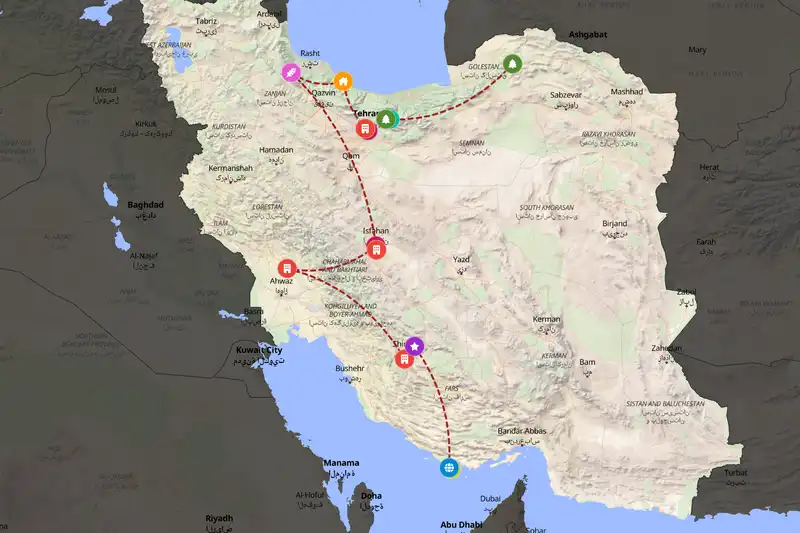
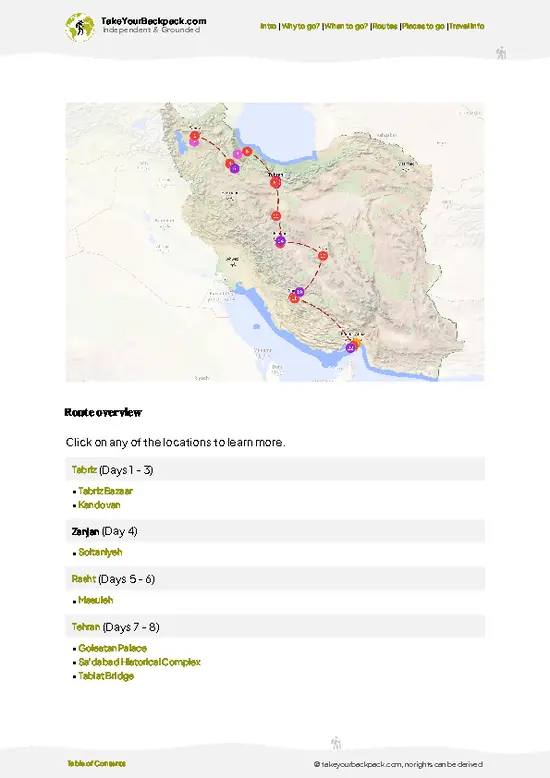
Two weeks is the right length for a first trip to Iran, enough for the classic cities and a night in the desert without a bus ride every day.
With 7 days, stick to
Tehran,
Kashan,
Isfahan and
Yazd, giving Isfahan 3 nights. With 14 days, add
Shiraz and
Persepolis, then
Kerman,
Bam Citadel and a night in the
Lut Desert. Three weeks lets you add
Tabriz and
Masuleh in the north-west and finish on
Qeshm and
Hormuz in the Gulf. Distances are real here: Isfahan to Shiraz and Shiraz to Yazd each take 6 to 7 hours by bus, so plan at least 2 nights per stop.
Yes, you can cover Iran comfortably without a car, using cheap intercity buses, overnight trains and domestic flights.
VIP buses with three wide seats per row link every city:
Isfahan to
Yazd takes 4 to 5 hours and Yazd to
Shiraz 6 to 7, usually for US$4 to 10. Overnight trains run from
Tehran to
Tabriz and to
Mashhad in about 12 hours, and domestic flights cost roughly US$25 to 60. Inside cities, the Snapp app works like Uber. The gaps are rural: plan on a shared taxi or hired driver for
Masuleh or
Persepolis (about US$20 to 35 for a half day) and a driver or tour for the
Lut Desert.
The places in Iran you shouldn’t miss are
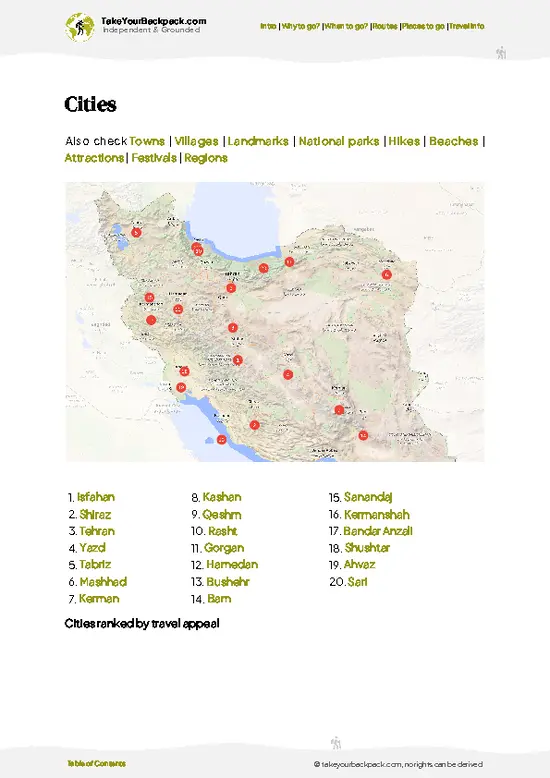
Isfahan,
Persepolis and
Yazd, with Kashan, Shiraz and Tabriz close behind.
Give Isfahan 3 nights for
Meidan Emam, the 17th-century square roughly 560 meters long, and the
Masjed-e Jāmé, whose oldest domes date from the 11th century. Persepolis lies about an hour from
Shiraz, so stay 2 to 3 nights there. Yazd’s adobe old town needs 2 nights, and
Kashan, 3 hours from
Tehran, makes a calm first stop for its courtyard merchant houses. With more time, the
Tabriz Historic Bazaar Complex, the stacked hillside village of
Masuleh and the red-soiled island of
Hormuz (best November to March) round out a trip.
If time is short in Iran, skip
Kish Island, keep
Tehran to one or two days, and save
Mashhad for another trip unless its shrine is your reason for coming.
Kish is a duty-free resort island of malls and hotels that costs more than the mainland and shows little of everyday Persian life;
Hormuz and
Qeshm give you the Gulf with far more character. In Tehran,
Golestan Palace and the
National Museum of Iran fill a full day, while
Milad Tower and
Azadi Tower are fine seen from a taxi window. Mashhad sits about 12 hours from Tehran by overnight train, a detour that eats around 3 days of a short trip.
Yes, our itinerary-planner does exactly that. Set your trip length in days, give your interests and travel style, optionally give start- and end location and/or some mandatory stops you would like to include and the itinerary planner creates your personalized routes for Iran in seconds. Try it out!
Try the itinerary plannerv2.webp)


 Best Backpacking