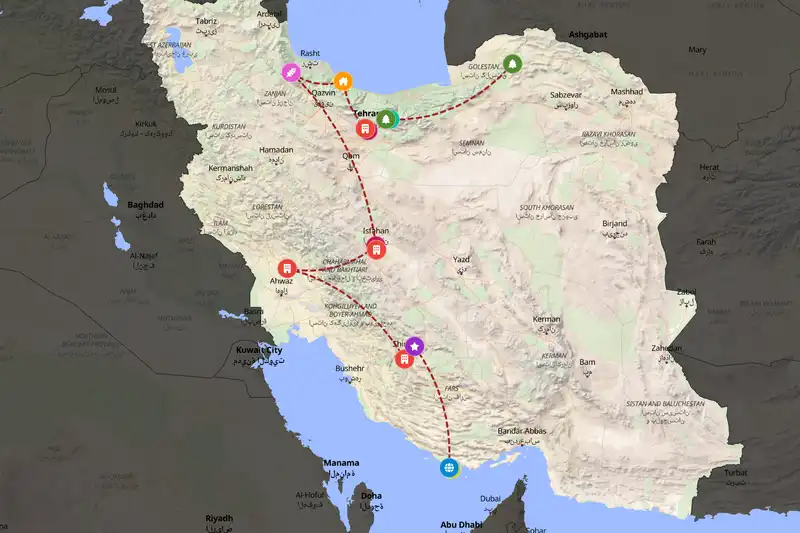
This three-week loop through Iran is for travelers who want the whole arc of the country, from Azeri bazaars in the northwest and rain-soaked rice terraces near the Caspian to the desert cities of the plateau and the red-earth islands of the Persian Gulf. Since the 2026 war with the US and Israel, Western governments advise against all travel to Iran and international flights have been heavily disrupted, so treat this as a plan to hold until that changes. The pace is steady and unhurried, with two or three nights in most places and only one overnight-length transfer. You’ll use intercity buses, trains, shared taxis for day trips, one domestic flight or overnight bus to the south coast, and boats between the Gulf islands.
Days 1-4: Tabriz, Kandovan and the Bazaar
Starting in
Tabriz lets you ease in through the northwest, where Azeri Turkish is the street language and the food leans toward kebabs, dried fruit and sweet, dense pastries. Give the
Tabriz Historic Bazaar Complex a full morning: …
read more 👉This three-week loop through Iran is for travelers who want the whole arc of the country, from Azeri bazaars in the northwest and rain-soaked rice terraces near the Caspian to the desert cities of the plateau and the red-earth islands of the Persian Gulf. Since the 2026 war with the US and Israel, Western governments advise against all travel to Iran and international flights have been heavily disrupted, so treat this as a plan to hold until that changes. The pace is steady and unhurried, with two or three nights in most places and only one overnight-length transfer. You’ll use intercity buses, trains, shared taxis for day trips, one domestic flight or overnight bus to the south coast, and boats between the Gulf islands.
Days 1-4: Tabriz, Kandovan and the Bazaar
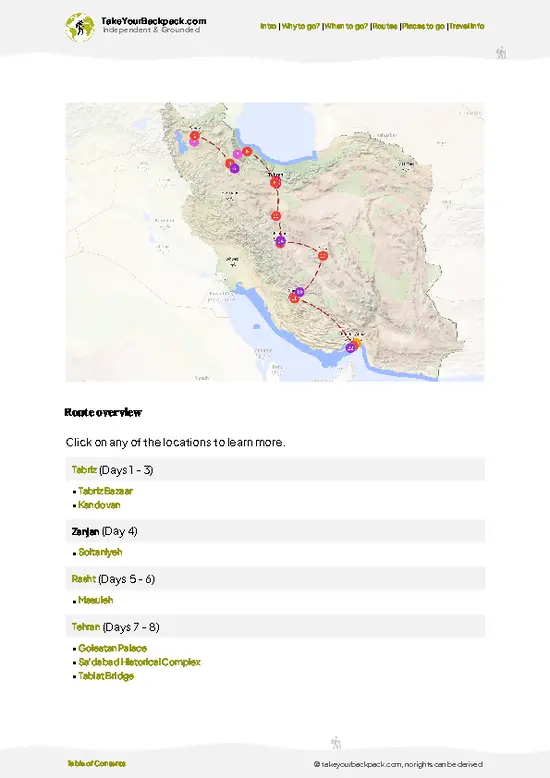
Starting in Tabriz lets you ease in through the northwest, where Azeri Turkish is the street language and the food leans toward kebabs, dried fruit and sweet, dense pastries. Give the Tabriz Historic Bazaar Complex a full morning: it’s one of the largest covered bazaars on earth, a brick-vaulted maze of carpet halls, spice lanes and caravanserais that still runs as a working market. On another day, take a shared taxi about 50 km south to Kandovan, where families still live in homes carved into volcanic cones. Go early, before the day-trip crowds, and climb above the village for the view over the honeycomb of doorways.Days 4-5: Zanjan and Soltaniyeh
The four-hour ride to Zanjan breaks up what would otherwise be a brutal run to the Caspian. Spend the afternoon at Soltaniyeh, about 40 km away, where the early 14th-century mausoleum of Oljaitu rises out of flat farmland. Its brick dome is one of the largest ever built, and standing under it with almost nobody else around is the kind of quiet moment that the big-name sites rarely allow. Back in Zanjan, the bazaar is known for handmade knives and leather slippers.Days 5-7: Rasht and Masuleh
Three to four hours north, the landscape flips from dry plateau to green, humid hills. Rasht is the food capital of Gilan, so plan meals around garlicky eggplant dishes, herb stews and smoked fish, and wander the main bazaar in the late afternoon when the produce stalls are at their fullest. Use your full day for Masuleh, roughly 60 km west, a stepped mountain village where the roof of one house is the courtyard or footpath of the next. Mist rolls in fast here, so bring a light jacket even in summer.Days 7-9: Tehran’s Palaces and Parks
Coming into Tehran from the north, you see the capital at its most livable. Spend one day downtown at Golestan Palace, where Qajar-era mirror halls and tiled courtyards sit a short walk from the old bazaar. The second day belongs to north Tehran: the tree-shaded villas of the Sa’dabad Historical Complex in the morning, then sunset on Tabiat Bridge, the curving pedestrian bridge linking two hillside parks, where Tehranis come out in numbers after dark to walk, eat and talk.Days 9-11: Kashan
Three hours south by bus or train, Kashan is where the desert begins. The town’s 19th-century merchant houses, with sunken courtyards and stucco work fine enough to look like lace, are best seen in the softer morning light. Kashan is compact and walkable, which makes it a good place to slow down before the intensity of Isfahan.Days 11-14: Isfahan
Three nights in Isfahan is the minimum I’d give it. Meidan Emam, Esfahan is the anchor: an enormous rectangular square framed by two mosques, a palace and the entrance to the bazaar, and it changes character completely between the empty early morning and the picnic-filled evenings. Visit Chehel Sotoun Palace for its frescoed reception hall and the pool that doubles its twenty columns into the forty of its name. For something smaller, the Music Museum of Isfahan displays traditional Persian instruments and often ends visits with a short live performance. Walk the old bridges over the river at dusk, when the arches fill with people singing.Days 14-16: Yazd
Four to five hours east, Yazd is a mudbrick city of windcatchers and narrow alleys that stay cool even in the afternoon. This is the place to learn about Iran’s Zoroastrian heritage and the underground qanat channels that made desert life possible. Climb onto a rooftop café at sunset, when the domes and wind towers turn gold.Days 16-19: Shiraz and Persepolis
The Yazd to Shiraz road is long, six to seven hours, so this is the right moment for three nights. Give one full day to Persepolis, about 60 km out, and arrive at opening time to have the carved staircases of tribute bearers before the heat and the tour groups. In the city, Eram Garden is a lovely place for an afternoon among cypresses and rose beds, and Shiraz in general is softer and more poetic than the cities further north, with locals reciting Hafez at his tomb in the evening.Days 19-21: Qeshm and Hormuz
Take a short domestic flight or an overnight bus to Bandar Abbas, then a ferry to Qeshm. The Qeshm Island Geopark covers eroded canyons, salt caves and the strange wind-sculpted formations around the Valley of Stars, and a hired driver for a day is the practical way to cover them. Finish with a boat to Hormuz, a small island of red, ochre and purple soils, where the beaches are streaked with iron oxide and the local cooks use the red earth as a spice. From Qeshm, domestic flights connect back to Tehran or Shiraz for your onward journey.
If you can squeeze in one extra day, take a boat from Qeshm to Hengam Island, where fishermen run small boats out to watch dolphins in the early morning.
 Best Backpacking